
The good vs the better by Oxana Poberejnaia

oxanaToday let’s talk about the relationship between the Ultimate and the relative. I do not have the answers to these tricky questions, I would just like to outline the problems. Why, on the Buddhist path, do I often tell myself and others not to rush to get Enlightened immediately? Why do I often keep silent about my friends’ attitudes that I find not so feminist?

There is an old platitude that the theme of the Soviet films about social problems was the “struggle of the good against the better.” This was the case because in the USSR there supposedly was no class struggle and no problems proceeding from the rule of the Communist Party. So in the scripts the conflict was set up between good Soviet people and even better Soviet people, the latter even more dedicated to the Communist ideals.

The fact that I am a feminist and follow a Buddhist path must mean that in principle I am all for “the better” and even, “the best” – that is, a social world where women and men enjoy equal rights and everyone is enlightened.

Continue reading “The good vs the better by Oxana Poberejnaia”
“Suchness” of inequality vs. the “story” of patriarchy by Oxana Poberejnaia

oxanaIn the TV film about American suffragists “Iron Jawed AngelsAlice Paul (played by Hilary Swank) says to a psychiatrist who came to prison to assess her mental state during her hunger strike:

You asked me to explain myself. I just wonder what needs to be explained. Let me be very clear. Look into your own heart. I swear to you, mine’s no different. You want a place in the trades and professions where you can earn your bread? So do I. You want some means of self expression? Some way of satisfying your own personal ambitions? So do I. You want a voice in the government in which you live? So do I. What is there to explain? Continue reading ““Suchness” of inequality vs. the “story” of patriarchy by Oxana Poberejnaia”

Feminism and Buddhism: constructive wave interference by Oxana Poberejnaia

oxanaAlthough it can be said that the Buddhist teaching can benefit all, including feminists, it can also be argued that Feminism has a lot to teach Buddhist practitioners. Rita M. Gross made this point brilliantly in her “Buddhism After Patriarchy: A Feminist History, Analysis, and Reconstruction of Buddhism.”

While Buddhism generally encourages investigation, it is still easy for a Buddhist practitioner to become complacent. This complacency can be caused by the feeling of safety that your particular school of Buddhism provides. How your mind works, how the world works are all explained, all is well, just keep practising in the assigned paradigm, there is no need for thinking outside the box.

However, Buddhists often forget that it is exactly outside the box where the Buddha has been pointing with his every teaching, ever since he got liberated. When a Buddhist practitioner is stuck, the vigour of Feminism can provide inspiration. Feminists simply never stopped, do not intend to stop now.

Continue reading “Feminism and Buddhism: constructive wave interference by Oxana Poberejnaia”

Body of Nature by Oxana Poberejnaia

oxanaIn the medieval European philosophy, woman’s body was seen as a vessel filled with sins, while man was regarded as a more spiritual being. This is one of the reasons why the concept of body is reassessed in feminist studies and why body is elevated in neo-paganism and Goddess spirituality. My fear is that nowadays body can be treated as an instrument for social advancement.

OLYMPUS DIGITAL CAMERA

We still live in a society that is deeply hostile to women’s bodies. Alla Demidova, an actress I respect for her talent and her critical mind, did a programme of Christmas-related poetry. I could not listen to more than five minutes of it.

The poems have been all written by men. I am not saying that men do not have the right to write about birth. I am saying that our prevalent image of Christmas should not be based on male view alone. In this sense I much better like the Carol from “The Vicar of Dibley” (one of my favourite British comedy series, about a female Vicar), which describes the movement of baby Jesus through Mary’s birth canal.

Continue reading “Body of Nature by Oxana Poberejnaia”

Drop the sense of entitlement towards life by Oxana Poberejnaia

oxanaAt the time of climate change and crises of capitalism we need to drop our sense of entitlement to comfortable life or even to life at all. Nature will not spare us just because we are humans. When the meltdown of economic and environmental systems occurs, we are all going down: humans and non-humans, women and men, spiritual or not. We have almost run out of time.

Victor Pelevin, my favourite contemporary Russian author, has a novel called “The Sacred Book of the Werewolf“. I love it in part because, like Kill Bill, it is a rare creation by a male author, which manages to capture the female warrior spirit.

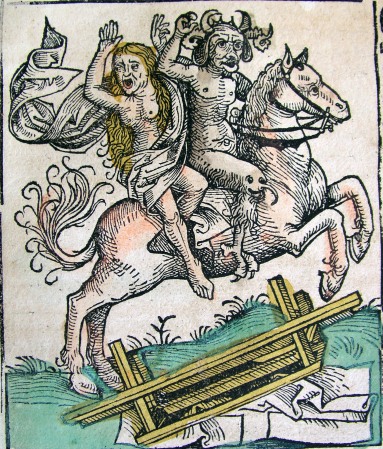
surprise___you__re_a_werewolf_by_mightywarlordIt starts with the main character, a Chinese Buddhist Were Fox who lives in present-day Moscow, consoling herself: “What else (or What the fuck) did you expect from life, A Huli?” A Huli is her name, supposedly meaning Fox A in Chinese. It is also a swear phrase in Russian, meaning “What the fuck?”

Continue reading “Drop the sense of entitlement towards life by Oxana Poberejnaia”

Pause, Stop and Re-evaluate your place within patriarchy and capitalism by Oxana Poberejnaia

oxanaThere are three vicious circles: patriarchy, samsara and wanton destruction of environment. All three lead ultimately to annihilation of life. All three are incredibly difficult to escape. One of the reasons for this difficulty is that there are pay-offs. Someone or something benefits from keeping the cycles going.

Men and Mothers-in-Law seemingly benefit from patriarchy. However, the privileges granted by patriarchy are based on a pyramid scheme of tyranny. You get to bully people who are below you on the patriarchal pecking order: women, men of the lower status, daughters-in-law. Everyone at the higher level gets to bully you. The top man lives in constant fear of de-throning. Continue reading “Pause, Stop and Re-evaluate your place within patriarchy and capitalism by Oxana Poberejnaia”

Birth, Death, and Regeneration: Why I Am Only a Kind of a Buddhist by Carol P. Christ

In a recent blog describing conversations with my friend Rita Gross, I said that I think of myself as a “kind of a Buddhist” because I have given up a great deal of the ego(tism) described by Buddhists. I also remarked that “I must be a Buddhist after all” because I accept my finitude and do not fear death. At the same time, I said that the idea of a relational world coheres with my experience and is more satisfying to me than the Buddhist theory of nondualism. When I speak of a relational world, I am referring to the worldview of process philosophy.

One of the central insights of Buddhism is the concept of “dependent origination.” This means that “no thing” exists in and of itself:  “all things” are related to and dependent upon “other things.” One of the key assumptions of western philosophy is that “things” exist in and of themselves: all things have an single, unchangeable “essence” or “nature.” Buddhism considers this assumption to be false: if all things are dependent on other things, then they cannot finally be separated from the web of dependence in which they exist. Buddhism insists, moreover, that the interdependent world is in flux. This means that what a thing-in-relationship is in one moment changes in the next.

Process philosophers, including Whitehead and Hartshorne, recognized that Buddhism affirms a central truth that western philosophy has denied: the truth that life is in flux and that no individual exists apart from or independent of others. Continue reading “Birth, Death, and Regeneration: Why I Am Only a Kind of a Buddhist by Carol P. Christ”

Relaxing Into an All-Encompassing World by Oxana Poberejnaia

oxanaI believe that as feminists what we are striving towards is not just equality between women and men, although this aspect is crucial. Feminism has contributed to developing of such disciplines and practices as deconstruction, environmentalism, LGBT rights, and animal rights.

Feminism walks in step with all the movements for more justice and freedom in the same way as patriarchy goes along with capitalism, exploitation and environmental degradation. Continue reading “Relaxing Into an All-Encompassing World by Oxana Poberejnaia”

REGRETS by Esther Nelson

esther-nelsonBoth my sisters claim to have no regrets about their lives.  I do.  It’s not so much that I regret specific things that happened to me in my life or even some of the particular choices I made although both the “happenings” and “choices” are a result of a larger regret.  Nor do I spend much time going over it all in my mind.  I don’t believe that listing all the “if onlys” and ruminating about “wrong turns” is productive.

Some people interpret the happenings in their lives as only positive.  If X hadn’t happened, then I would not have Y (a good thing).  Well, maybe, maybe not.  Or, they are convinced that because a particular incident occurred, they experienced Z (another good thing).  Is that particular incident a necessary precursor to the important and valuable Z experience?  How can we know?  And does that mean that those things leading up to Z cannot be regrettable?  By and large, it seems we’ve come to a place in our society where the things that happen in one’s life are ultimately constructed as positive. Continue reading “REGRETS by Esther Nelson”

Friendships That Save Lives: For Rita M. Gross 1943-2015, by Carol P. Christ

Carol Eftalou - Michael HonnegerWhen Rita Gross visited me in Lesbos two summers ago, we spent many long hours discussing our lives and work. Rita and I met at the Conference of Women Theologians at Alverno College in June, 1971 when we were young women. We did not know it then, but our lives would continue to be intertwined through our common interests, first in the Women and Religion section of the American Academy of Religion, and then through our work on Goddesses and feminist theology.

When we met, Rita was a convert to Judaism working on her dissertation on Australian Aboriginal women’s religious lives, and I was a Christian about to begin a dissertation on Elie Wiesel’s stories that would lead me to express my own anger at God. Continue reading “Friendships That Save Lives: For Rita M. Gross 1943-2015, by Carol P. Christ”