In gratitude for her life and work, FAR republishes her reflections on the Buddhist notion that female rebirth is an obstacle.
Buddhist teachings recommend appreciating obstacles because they are helpful to our practice. Without obstacles we would never develop profound understanding or compassion. Buddhists have also frequently claimed that female rebirth is an obstacle. If obstacles are of great benefit, shouldn’t women, who encounter more obstacles than men, rise to the top of the hierarchy of revered Buddhist teachers? But that has not happened.
Is this obstacle actually of benefit to women, as teachings on the helpfulness of obstacles would suggest? After practicing Buddhism for almost forty years, I have come to appreciate how much the many obstacles I faced over the years have taught me. For a woman of my generation (born 1943), none has been greater than the limitations placed on me as a woman, both by Western culture and by Buddhism. Continue reading “Buddhism and Feminism: Is Female Rebirth an Obstacle? by Rita M. Gross”
I have recently learnt about features assigned to women and men by a Tibetan Lama. Women are seen as having better access to qualities of space and therefore holding special kinds of wisdom that lead to Enlightenment. Men, on the other hand are better suited to create and act within space, and this they are rightful owners of the actions that lead to Enlightenment.
In popular Goddess spirituality it is also normal to find distinction between women and men’s core traits. The properties assigned to the “feminine” and the “masculine” usually follow the same pattern: Goddess stands for interconnectedness, and thus relations and caring for others. God (if there is a place for him) is about protection and action.
I am afraid to say that to me, this approach only embeds patriarchal order by putting women firmly in the sphere of domesticity, even if in the elevated role of “Domestic Goddess”, while men are still expected to go out, fight and thus organise and rule society, which women are expected to preserve.
In the 1930s two ancient storerooms in Afghanistan near what is now the Bagram US Air Base were discovered by French archaeologists and unsealed for the first time in about two thousand years. They contained artifacts from all over the ancient world, evidencing just how active trade then was along the complex network of routes known collectively as the Silk Road. Among the artifacts in one of the storerooms was a plaster statuette of Aphrodite (‘Bagram Aphrodite’).
Though it is not known what the motivation originally was for acquiring the Bagram Aphrodite, its presence in Afghanistan arguably evinces an interest in female spirituality–if not in the owner of the storerooms then among some of the people in the market for which she may have been destined. Evidence of such interest among Buddhists is to be found in the Flower Ornament Scripture (FOS), a compendium of sutras dated to approximately the same time (and possibly the same region) as the storeroom containing the Bagram Aphrodite. Female spiritual figures, both mortal and immortal, some portrayed as having official positions, others without any, are prominent in the final chapter of the FOS, so prominent that one scholar suggests Buddhist women of the time in some way influenced its composition (see Douglas Osto, Power, Women and Wealth in Indian Mahayana Buddhism).
I sometimes feel a bit awkward about not having read a lot of feminist books and not knowing a lot of feminist theory. However, I draw support from the example of Zen, “the teaching beyond letters.”
The number and scope of different Buddhist traditions might overwhelm non-Buddhists reading my ramblings or any other writings about Buddhism. Even Buddhists, as those who come to Manchester Buddhist Convention, of which I am a co-organiser, every year discover new Buddhist groups that have been hitherto unknown to them.
All these traditions claim to be an authentic form of Buddhism and those that are concerned with such things, trace direct lineage of teaching coming all the way from the Buddha. As the editor of the volume “Buddhist Scriptures” Donald S Lopez Jr notes (Penguin Classics, 2004), such diversity requires certain means of ensuring that this school’s particular teachings are still in line if not with the letter, then with the spirit of the historic Buddha’s teaching.
A two line fragment of Sappho’s poetry (S.120) reads:
But I am not one to keep venting my anger:
Rather I let some things in my heart go unspoken
Sappho’s word choices here make this as difficult as any of her fragments to appreciate in translation. Yet, not only do those choices make attribution of this fragment to Sappho secure, they also manifest her importance in an area for which she rarely receives attention: early Greek medical thinking. One reason her importance in that regard is largely unnoticed is that Western medicine in general has abandoned its own tradition, retaining only the nomenclature and some of the symbolism of early Greek medicine. Continue reading “Sappho’s Prescription For A Healthy Heart & the Taoist/Buddhist Concept of Forget (忘)”
Feminism can be loud and in your face. Feminists can be unapologetic and radical in their statements. I could never bring myself to be abrupt with proponents of patriarchal views. Being a middle class Brit from a Soviet background, I withdraw from awkward situations and prefer to keep discussion within civil forms of defined discourse at conferences and letters to my MPs and to the BBC.
People who know that I practise Buddhist disciplines might say that this also plays a part in my avoiding direct confrontation. It is true but only up to a point. I do not rush into an argument mostly because of my training not to rush into anything, but to first become mindful and see where the impetus for my action is coming from: is it something worthwhile or is it some undigested trauma from childhood? It is usually the latter. Continue reading “Cheeky Buddha by Oxana Poberejnaia”
This year’s Tibet House Benefit Concert coincided with a snowstorm in Manhattan and though snow is not uncommon in Manhattan (especially this past season), it is particularly associated with Tibet and its high, perennially snow covered peaks. The timing of the snowstorm was thus peculiarly appropriate, leading Robert Thurman, US President of the Tibet House, to muse in his opening remarks about there being Buddhas in the snowflakes.
I was lucky enough to attend that concert thanks to my wife and some of her colleagues being invited by Thurman to attend in appreciation for work they had done on a book consisting of a collection of speeches by the Dalai Lama, My Appeal to the World. Snow had been a topic of conversation at the dinner we had before the concert not just because of the coincidence of the snowstorm and concert, but also because one person in our group had recently broken her wrist slipping on what was left from an earlier snowstorm. She was lamenting being sidelined from her yoga practice, at which point I brought up the topic of the therapeutic benefits of bathing. As is typical of dinner conversations, that quickly morphed into a discussion of other issues; soon it was time for the concert and off we went.
Several weeks later, while taking a bath after my own yoga practice, as I often do, it occurred to me that being in a bathtub was analogous to being in a snowflake–a very large and warmed up snowflake. The basis for the analogy is that ‘buddha’ is not a name but commonly interpreted to be the past participle of a verb, the primary meaning of which is to awaken. The roots of Indo-European (IE) verbs only refer to bare existence or an action and as such can ‘belong’ to any noun (person, place or thing) of any gender (female, male or neuter). Any person of any gender can be ‘awake.’ As a participle ‘buddha’ is a hybrid–part verb and part noun–and thus specifies gender (masculine), but that is an artifact of grammar, a way of speaking, that manifests its interdependence with other elements of language and how that language is used at any particular point in time.
There are a number of fascinating implications in analyzing language in this way (what used to be called ‘speculative grammar’ in Medieval times), but the single most important is that by itself language is not particularly enlightening, but rather quite dependent upon the context in which it is used. It helps explain why the tradition of rejecting textual authority in favor of direct enlightenment, the ‘moment of zen,’ became particularly prominent in Chinese, Korean and Japanese Buddhism. The grammatical differences between Sanskrit and Chinese are relatively substantial compared, for example, to those between any one IE language and another IE language. Grappling with translating and interpreting first Sanskrit and then Chinese and then Korean or Japanese, seems to have heightened the sensitivity to the limitations of language, especially with respect to spiritual beliefs and practices.
This aspect of Buddhism can be readily demonstrated to share roots in an equally ancient tradition of Greek poetic culture. It seems, however, that the guardians of the text based religious traditions emanating primarily from regions controlled directly or indirectly, at one time or another, by Roman emperors, are more than happy to let that aspect of the Western heritage go unnoticed. Instead these guardians seem to emulate the command and control tactics of Roman emperors with what can be fairly characterized as intellectual imperialism.
Because of its importance to all such traditions, Song of Songs (Songs) is a useful example to cite. Only by walling off a substantial amount of evidence is it possible to prevent Songs from being seen to be in part or whole a product of female spirituality that celebrates sexuality in a manner a Buddhist would identify as tantric. Proof that is exactly what the guardians of the text based religious traditions have been doing is not hard to find, for the fact that few women have authoritative positions within any organization associated with such traditions is an artifact of just such a wall.
Such tactics ironically expose the vulnerability of these traditions to decline and fall. One way that might happen can be discerned in what happened to Buddhism as it spread east. It was creatively interpreted in harmony with a far more ancient tradition of nature worship associated with early Taoism, a tradition that privileges individual artistic expression, such as poetry, over textual study or ritualized recitation. That tradition is comparable to the Western philosophy of nature evidenced, for example, in the poetry of the ancient mystic Greek of Sicily, Empedocles.
Though I have referred to this philosophy in previous posts, I hope to discuss it in more detail in upcoming ones as it relates both to ancient traditions such as Taoism and Buddhism as well as to how spirituality might evolve in the future. Suffice it for now to say that what is essential is appreciating that experience itself is the ultimate, authoritative a priori of all spirituality. That can mean doing yoga, meditating upon snowflakes or sloshing about in a tub of water.
Eventually, though, it leads within, to what the poet Holderlin calls ‘Innigkeit,’ a state of inwardness that is itself speechless, but which is the source of poetic/artistic inspiration. That is in an essay on Empedocles, but given what was then known about him, Holderlin was largely projecting onto Empedocles his own beliefs (shared with his friend Schelling) about nature, with “all her melodies,” as the ultimate source of inspiration. Decades after that essay was written, Schelling used Innigkeit in a lecture on mythology to translate a key term from the Bhagavad Gita: yoga, a term that as used there many scholars today think betrays Buddhist influence. Several other translations were then available and it seems likely Schelling’s unprecedented choice of Innigkeit was an homage to Holderlin.
As it happens, substantial new fragments of Empedocles’s poetry were discovered in the 1990s. In 2004, after piecing together those fragments with many of the other previously discovered ones, Richard Janko suggested Empedocles should be thought of as the Greek equivalent of Buddha. Be that as it may, there is no question who Empedocles would say is in snowflakes: Aphrodite.
Stuart Dean has a B.A. (Tulane, 1976) and J.D. (Cornell, 1995) and is currently an independent researcher and writer living in New York City. Previously he worked in a variety of other capacities, including 15 years as a corporate attorney.
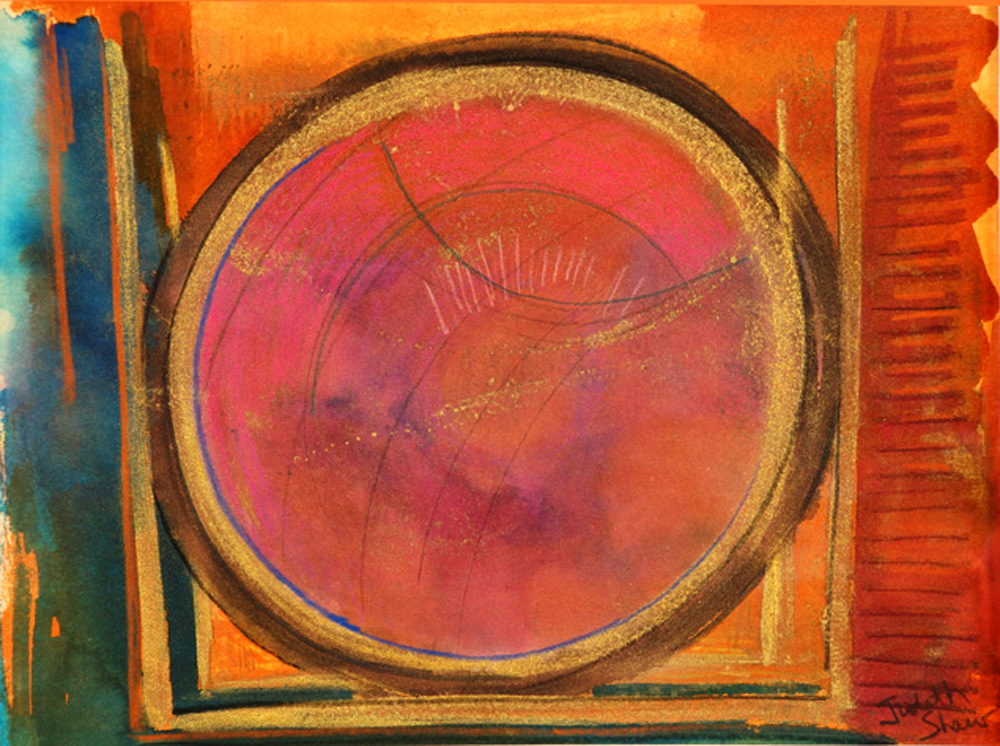
Dawn Mandala, ink and watercolor on paper, by Judith Shaw
Can geometry open our hearts and minds to spirit? Throughout time people around the world have thought so. Mandalas and Sacred Geometry symbols are found in many cultures both ancient and modern.
Mandala is a Sanskrit word which means “sacred circle.” In Buddhism, Hinduism and other ancient wisdom traditions of the East, the mandala has been used as a tool to facilitate contemplation and meditation. Through the process of studying and/or creating a mandala one can reach one’s center, one’s connection to Source. The circle, the first closed shape of Sacred Geometry, thus becomes a doorway to Oneness.
Traditional Hindu mandalas follow a strict form. Every mandala is created following the precise design of that form. One sees a further development of other Sacred Geometries within these traditional forms. First there is the squaring of the circle also known as “The Marriage of Heaven and Earth”, with the circle representing Heaven and the square representing Earth.
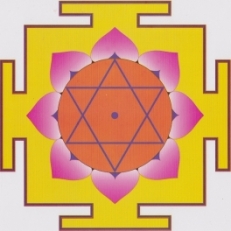
In the Hindu tradition, each design within this “Marriage of Heaven and Earth” is called a yantra mandala and functions as a symbol which reveals cosmic truths. Thus yantra mandalas become sacred geometric symbols of a particular Hindu deity.
One of the most famous yantra mandalas is the Shri Yantra, a symbol of Tripurasundari, a supreme Hindu Tantric Goddess. It depicts a series of precisely interlocking triangles, half pointing downward and half pointing upward. It forms a state of perfect balance and harmony and represents the union of the female and male principles. Also known as the Yantra of Creation or the Cosmic Yantra it is the most honored of all the Hindu yantras. The Shri Yantra becomes a door which can lead to the experience of Oneness.
Another goddess whose divine truths are revealed through the mandala is Lakshmi, Hindu Goddess of fortune, light, luck, and beauty. Meditating on the Lakshmi Yantra encourages spiritual progress and helps to overcome internal blocks.
Christianity has also used the mandala to represent Divine Oneness and to teach the wisdom of its tradition. The magnificent rose windows of the Gothic cathedrals are luminous examples of western mandalas. Complex sacred geometries were used in the architectural designs of the buildings themselves and of the rose windows.
The rose windows are a western representation of our human aspiration towards wholeness and balance. The rose windows operate on various levels; spiritual, emotional and intellectual. The instructional aspect of the rose windows is clearly seen by the subject matter – biblical stories, lives of the saints, astrological calendars, and morality stories to name a few.
In much the same way that the Hindu yantras symbolize the aspects of a particular deity, the rose windows typically show Christ or the Virgin or some other combination in the central rosette of the window. The gates at the cardinal points of the yantras depict the many paths available to reach the divine. In a similar fashion, the saints shown in the petals of a rose window can be seen as paths to Christ.
More than likely, mandalas were reintroduced into western thought through the Carl Jung’s pioneering work on the unconscious. Jung wrote: “I sketched every morning in a notebook a small circular drawing,…which seemed to correspond to my inner situation at the time….Only gradually did I discover what the mandala really is:…the Self, the wholeness of the personality, which if all goes well is harmonious.”
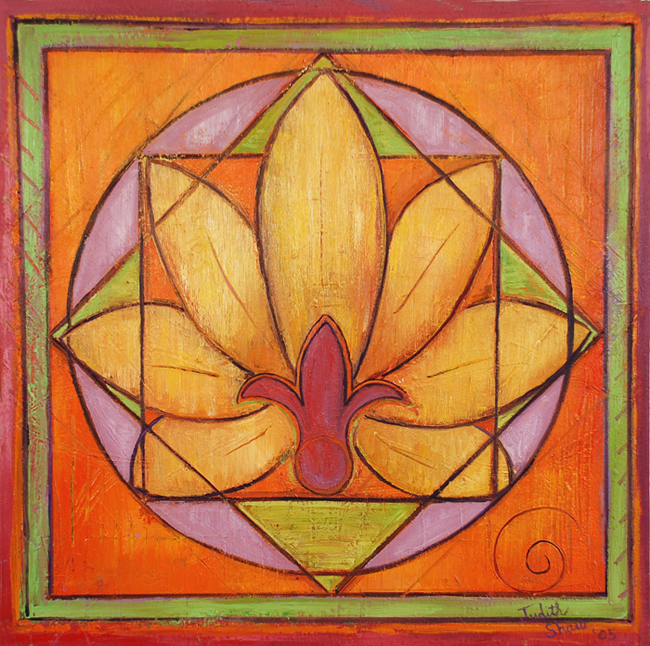
Lotus Mandala 1, oil on canvas, by Judith Shaw
Continuing in this tradition, artists and spiritual practitioners today have been exploring a more free-form style of the mandala. Within the basic foundation of the “squaring of the circle”, the artist then creates a personal, spontaneous design based on the concepts of balance, wholeness and oneness.
A quick google search reveals a multitude of mandala workshops being offered all around the world. Exploration of the mandala through these workshops offers a connection to your true self, an experience of sacred love, an opportunity to improve your life with intention, a deepening of your connection to nature, healing of emotional, mental, or physical pain, and a chance to be truly in the moment.
The mandala is a form that I have used in my own art since before I discovered the existence of Sacred Geometry. Even when not directly exploring the mandala, I find that often I want to draw a circle around the main image in my painting – seeking that experience of wholeness in the process of painting.
In future posts I will explore other elements of Sacred Geometry, all of which grow out of the mandala, the sacred circle.
Judith’s deck of Celtic Goddess Oracle Cards is available now. You can order your deck on Judith’s website. Experience the wisdom of the Celtic Goddesses!
Judith Shaw, a graduate of the San Francisco Art Institute, has been interested in myth, culture and mystical studies all her life. Not long after graduating from SFAI, while living in Greece, Judith began exploring the Goddess in her artwork. She continues to be inspired by the Divine Feminine in all of Her manifestations. Originally from New Orleans, Judith now makes her home in New Mexico where she paints and teaches part-time. She is currently hard at work on a deck of Goddess cards. Her work, which expresses her belief in the interconnectedness of all life, can be seen on her website.
There is a story in the collection called Avadanasataka (One Hundred Legends) of the Sarvastivadin school, one of the schools of early Indian Buddhism that did not survive to present day, relating one episode from the Buddha’s previous lives. The story is about king Padmaka who sacrificed his life to cure his subjects of a disease. Here is an academic article about this episode.
The Buddha was prompted to tell this story of his previous life in order to illustrate to his monks, once again, the workings of karma. All of the monks in the Buddha’s milieu were sick with a digestive disorder, while he remained well. The Buddha presented the story of king Padmaka as a proof that no good deed is ever lost and that what he had done then has an effect now in that the Buddha has good digestion.
We’re no longer shocked, albeit still horrified and sickened, by the images of violence that come at us daily from all around the globe. I’ve come to expect it. Beheadings. Burning people in cages. Shootings–“execution-style.” Bombings of all kinds–including drones and suicide. Perpetrators of such violent acts often claim God to be the motivator for their violent deeds.
Responses to that claim vary. Some people assure themselves that they were right all along–the God that motivates one to kill and destroy is indeed a God that demands such from “his” followers. “I knew all along their God to be a God of hate and violence–that’s why they do the things they do.” Other people insist that “God would never require a person to engage in destructive acts–not the ‘true’ God anyways.” Sometimes a proselytizing effort gets under way to inform people about this “true” God.


 Feminist foremother in the field of women and religion and Buddhist feminist theologian Rita Gross died on November 11, 2015 in her beautiful home in Eau Claire, Wisconsin, surrounded by symbols of Buddhist art and the loving presence of her cats. Rita suffered a massive stroke in late October, and in accord with her wishes to refuse extraordinary care, she was provided with hospice care in her home, which kept her comfortable as she died. Those who were with her said that she entered into an advanced meditative state in her last days.


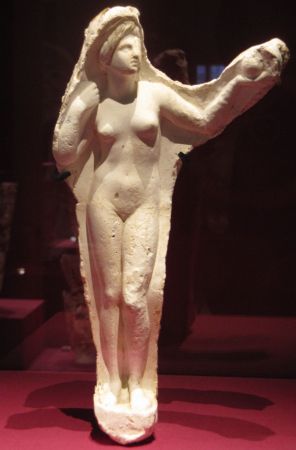 Though it is not known what the motivation originally was for acquiring the Bagram Aphrodite, its presence in Afghanistan arguably evinces an interest in female spirituality–if not in the owner of the storerooms then among some of the people in the market for which she may have been destined. Evidence of such interest among Buddhists is to be found in the
 A two line fragment of Sappho’s poetry (S.120) reads:






 Feminism and Religion