Do Man-Made Laws Trump the Authority of Jesus? Reflecting on the Meaning of Humility, Priestly Service, and the Issue of Women’s Ordination by Michele Stopera Freyhauf

Maundy Thursday – the imitation of Jesus’ act of service and submission is re-created.  Controversy surrounds the “disciples” – must they be all men?  Are women allowed?  Who steps into Jesus’ role?  Men, women, or both?  Why, when it comes to imitating the act of  humility and priestly service (rooted in our baptismal call), does a distinction of gender need to made at all?

As I progressed towards the intersection, I looked up to witness a grand procession of men dressed in white albs with stoles that often contained subtle hints of gold, worn in a manner to distinguish their role as priests and deacons.  They moved slowly down the sidewalk entering the Cathedral to begin their celebration of the Chrism Mass – a celebration of priesthood and priestly service within the Diocese where all priests and deacons gather to celebrate and re-affirm their commitment to ministry and service to the Church.  It is also during this Mass that the oils used in sacramental celebrations, used by each church, are blessed by the Bishop.

As I continued to watch, I could not help but search the processional line for those with a hair color other than gray.  I wanted to see  how many young priests were in that processional line.  What I found was no surprise –  an aging group of men with the sporadic appearance of younger priests.   The numbers stood as a staunch reminder that we, as a Church, may be faced with a severe shortage of priests in the future.  Something already known and planned for by the Diocese in its campaign to consolidate and close parishes.

Another sad observation was put on public display  –  the absolute absence of women. Continue reading “Do Man-Made Laws Trump the Authority of Jesus? Reflecting on the Meaning of Humility, Priestly Service, and the Issue of Women’s Ordination by Michele Stopera Freyhauf”

Is Baptism a Male Birthing Ritual? By Michele Stopera Freyhauf

Quite a number of years ago I had a conversation with one of my professors, a feminist theologian, who posed the question “Why do I need a man to purify my baby with the waters of baptism?  Is there something wrong or impure about the blood and water from a mother’s womb – my womb?”  Before you jump and shout the words Sacrament or removal of original sin, this question bears merit in exploring, especially in today’s world where women are taking a serious beating religiously, politically, and socially.  In today’s world, violations and rants are causing women to stand up and say STOP!  This is MY Body.  This outcry was provoked by chants of ethical slurs against women– Slut! Prostitute! Whore!  The cry got even louder when the issue of religion and government was raised in the fight of healthcare coverage of contraception. The cry got even louder with the enactment of the laws in Virginia and Texas (and many other states to follow suit) that forces women to undergo transvaginal ultrasounds in early stage abortions.  The mandatory insertion of a wand into a woman’s vagina (mandated by the government, mind you), is a violation and has women crying RAPE!

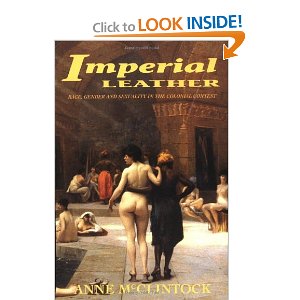
The memory of this conversation did not re-appear by chance, it was prompted by a book I read for my History of Sexuality Class – Imperial Leather: Race, Gender, and Sexuality in the Colonial Context by Anne McClintock who addresses the notion of baptism through origins, property, and power.  So many things are currently being taken away from women and reading McClintock’s assertion regarding male baptism is perplexing.  She believes that male baptism or baptism by a man takes women’s role in child bearing and diminishes it.  These are the same men who historically treated and regarded women as vessels.  She further asserts that this act is a proactive removal of creative agency with respect to a woman’s ability to have the power to name.  That is, the last name of the child belongs to the husband.  A point that supports the notion that patrimony marks the denial of women.  Anyone doing genealogy encounters a perplexing struggle to identify mothers because their names are essentially erased from memory and rarely attached to a child’s name. Continue reading “Is Baptism a Male Birthing Ritual? By Michele Stopera Freyhauf”

Pink Smoke Over the Vatican: A Review by Kate Conmy

Review: Pink Smoke Over the Vatican (2010)

Award-Winning Independent Documentary Film

Directed by Jules Hart

By Kate Conmy, MA.

Membership Coordinator of the Women’s Ordination Conference.

Last weekend I had the honor of joining over eighty Women’s Ordination Conference members and supporters in Claremont, California for a screening of “Pink Smoke Over the Vatican” followed by a distinguished panel discussion.  WOC board member Miriam Todoroff of Pilgrim Place hosted the event, along with Rev. Kathleen Jess, ECC, with local support from Theresa Yugar. “Pink Smoke Over the Vatican” has recently been made available for purchase, but for the past couple of years the film has starred in women’s ordination movement circles, drawing hundreds to cinemas, churches, universities, and homes for a peek at the controversial and moving film.

Fr. Roy Bourgeois has taken the show on the road, touring and speaking throughout the world (from Rhode Island to Rome) on women’s ordination and the important stories in the film. Fr. Roy’s involvement with women’s ordination is well documented, however, notably, “Pink Smoke Over the Vatican” is specifically mentioned in his First Canonical Warning from his Order, the Maryknoll Fathers and Brothers, insisting that his public support and promotion of the movie was a Holy Offense. More than just good press, this is a testament to the power contained within this film. Continue reading “Pink Smoke Over the Vatican: A Review by Kate Conmy”

Catholicism, Contraception, and Conscience: Church Imposed Teaching, God’s Gift of Free Will, and Political Rhetoric by Michele Stopera Freyhauf

Certainly one cannot turn on the news without seeing a story about the feud over the Catholic Church’s stance on forbidding the use of contraception and Obama’s Patient Protection and Affordable Care Act (PPACA) that mandates free contraception to women.  In preparing this article, I took the time to review many articles from liberal and conservative news outlets, law professors who are experts on constitutional law, and statements from the USCCB and Bishops.  Before asking questions, I want to outline the following points:

  1. In the literature reviewed, only two women, Sr. Carol Keehan and Sr. Mary Ann Walsh, made a statement against this policy stating that the government is interfering with the working of the Church.  Most voices heard and shouting the loudest are members of the clergy.
  2. Hospitals considered “Catholic” hire people of all faiths and various beliefs.  They also treat patients of all faiths.  They are not exclusively “Catholic.”
  3. Catholic identified Colleges hire professors and staff that are not Catholic.  Moreover, their student body is not totally Catholic.
  4. Catholic Charities, once again, hire non-Catholics.
  5. Insurance plans currently in place often offer contraception prescriptions at a zero to low co-pay price.  These plans are in-force at many Catholic Institutions.
  6. Under HIPAA, healthcare of employees are protected and the Employer, even the Catholic Church cannot violate the privacy of the patient, even if it is an employee.
  7. Birth Control Pills are often prescribed for women with endometriosis or other “female” reproductive disorders and not birth control.
  8. Women pregnant, carrying a dead baby, cannot have surgery due to risks are given medication to induce abortion are given. Continue reading “Catholicism, Contraception, and Conscience: Church Imposed Teaching, God’s Gift of Free Will, and Political Rhetoric by Michele Stopera Freyhauf”

Son of Man: An Updated Gospel Story of Jesus Set in South Africa by Michele Stopera Freyhauf

January 12, 2012

Son of Man is an updated story of the life of Jesus set in the fictional State of Judea that is modern day South Africa – complete with warlords and child soldiers.    It could easily be mistaken for modern day Rwanda or Darfur with its modern issues and political overtonesRoger Ebert stated, “The secret of the movie is that it doesn’t strain to draw parallels with current world events – because it doesn’t have to.”  The director draws parallels between the gospels and 21st century Africa.  According to Dartford-May, “we wanted to look at the Gospels as if they were written by spin doctors and to strip that away and look at the truth.”  The director “captures the rhythms of African life in both rural settings and sprawling townships.”  “Feather-clad young angels offer an eerie echo and reminder of Africa’s lost generations.”

The movie also sticks with what Eric Snider calls “Traditional African trial music, dance, and costumes” as a type of worship or or allusion to Jesus’ godhood.  Judea is in flux; warlords and corruption take center stage.  Poverty, violence, and oppression affect the all of the people.  The key idea is that Jesus is a freedom fighter – one that fights injustice and oppression.  The director does not emphasize “Jesus’ divinity so much as his leadership, good sense and compassion.”  Jesus is not violent and his followers, most of whom were former child soldiers, are encouraged to respond non-violently, which goes against their upbringing and training. Continue reading “Son of Man: An Updated Gospel Story of Jesus Set in South Africa by Michele Stopera Freyhauf”

The “Tenting” God and the Tenacity of Hope by Sheila E. McGinn, Ph.D.

Easter Sunday 2010 marked the last Mass at Historic Saint Peter Church in Cleveland, Ohio. After over 150 years of continuous use, the oaken doors of this sacred space on 17th and Superior were closed and locked. In rich irony, the building that once had been the womb of a vibrant inner-city Catholic community closed like a tomb on the very day when the Christian church around the world celebrated the feast of Christ breaking the bonds of death and rising triumphant from the grave. The official ecclesiastical act of “suppression” that closed the church building was intended likewise to roll the stone across the grave of the vibrant parish community that inhabited that domus ecclesiae. But Christians know that Resurrection happens. Easter cannot be stopped, not even by bishops.

Almost before he set foot in the door of the Chancery in Cleveland, Bishop Richard Lennon announced his intention to close one-third of the 180+ parishes in the diocese. Sixty-three parishes were to be selected for elimination based on the criteria of declining membership and financial dependency. Not surprisingly, many of the faithful were quite disturbed at this announcement. The diocesan spokesman sought to reassure them: “We don’t close parishes; we close empty buildings.” “Alright,” I thought, “maybe this won’t be so bad as it sounds.” And at first, that looked to be the case. Continue reading “The “Tenting” God and the Tenacity of Hope by Sheila E. McGinn, Ph.D.”

Of Human Life* By Carol P. Christ

Watching the last episode of the Australian series Brides of Christ in which Catherine leaves the sisterhood of the convent because of her disagreement with Humanae Vitae brought me right back to the Yale Roman Catholic chapel and the folk mass I attended regularly.  In 1968 just after the publication of Humanae Vitae, priest and co-graduate student Bob Imbelli preached a sermon on the doctrine of conscience, arguing that though it was incumbent on Catholics to think carefully about the papal encyclical on birth control, it was also the responsibility of every Catholic to follow her or his conscience on the matter.  In the episode, Sister Catherine encourages a Roman Catholic mother of six who has already self-induced more than one abortion to take the pill, but the woman decides she cannot go against the church’s teachings.  Catherine allows an editorial against Humanae Vitae to be published in the school newspaper even though she knows it will probably lead to the expulsion of one of her favorite students.

I had forgotten that Pope Paul VI issued the prohibition on birth control against the clear majorities of the Roman Catholic commissions instructed to study the matter.  In the episode, Sister Catherine, told by her bishop that she can no longer express her own opinions on birth control, tries to explain to her students that Roman Catholics cannot use birth control because it is against “natural law.”  This provokes one of the students to ask if people are not supposed to use birth control because animals don’t use it.  This question sparked an “ah-ha” moment for me.  Hmm, I thought, while “man” has invented birth control, “women” cannot use it because we are meant to remain “like the animals.” This debate really is about the question of whether women are human! Continue reading “Of Human Life* By Carol P. Christ”

The Undoing of Patriarchy in the Life of Tom Jorde (1922-2011)

Last week I attended the funeral of the one man, who in my feminist musings, was able to image the maleness of God as father, friend and pastor.  If I had thought about it, I would have given him the T-shirt that reads, “This is What a Feminist Looks Like,” but it never occurred to me until now.

A successful sales manager, Tom decided at the age of 36, and with 6 young children, to enter full-time ministry by enrolling in Pacific Lutheran Seminary at the GTU (in Berkeley).  Imagine undertaking an MDIV degree with that kind of responsibility?  As the adage states, “It takes a village,” and it did.  Marie, Tom’s wife, took charge of the kids while his four brothers help support him until his graduation in 1965.  Continue reading “The Undoing of Patriarchy in the Life of Tom Jorde (1922-2011)”

Birthing God at the Edges of Life, Death, and Beyond: Reflections on Mary, Motherhood, and Kali Part III By Tracy Sayuki Tiemeier

Tracy Sayuki Tiemeier, Ph.D., is Assistant Professor of Theological Studies at Loyola Marymount University in Los Angeles, CA. She teaches and researches in the areas of women and religion, interreligious dialogue, comparative theology, Asian and Asian American theology, and Hindu-Christian studies. Tracy also co-chairs the Los Angeles Hindu-Catholic Dialogue.

When I began my studies of Hinduism, I marveled in a dizzying array of gods and goddesses. While non-Hindus assume that Hinduism is polytheistic because of the multitude of gods and goddesses, the reality is far more interesting and complex. Hinduism really isn’t one religion, but a cluster of them. For some, there is one personal, divine God or Goddess, and all other gods and goddesses are either different forms of the ultimate divine or are lower, created beings (like angels). For others, there is one divine reality, but it isn’t a personal God or Goddess. For them, the different deities illustrate or symbolize different aspects of the divine, but are not themselves the one Ultimate Reality. What all Hindus recognize, however, is that there is one Ultimate, Divine Reality and that that divinity pervades all things. But that divine Oneness is so profound, so deep, so real, that no one image can capture the divine essence. Thus, even as Hindus are more monotheists than polytheists, they resolutely celebrate the multiplicity that inevitably comes when finite humans imagine the infinite divine. Continue reading “Birthing God at the Edges of Life, Death, and Beyond: Reflections on Mary, Motherhood, and Kali Part III By Tracy Sayuki Tiemeier”

Birthing God at the Edges of Life, Death, and Beyond: Reflections on Mary, Motherhood, and Kali Part II By Tracy Sayuki Tiemeier

Tracy Sayuki Tiemeier, Ph.D., is Assistant Professor of Theological Studies at Loyola Marymount University in Los Angeles, CA. She teaches and researches in the areas of women and religion, interreligious dialogue, comparative theology, Asian and Asian American theology, and Hindu-Christian studies. Tracy also co-chairs the Los Angeles Hindu-Catholic Dialogue.

Mary, her purity, and her role as Virgin Mother have become the primary language for talking about women and women’s place in the Church. The late Pope John Paul II held up Mary, both virgin and mother, as the perfect model for women. For the Pope, women’s sexuality and spirituality are united in a vision of woman’s personhood as that of nurturing self-gift. The calling of physical and spiritual motherhood is connected to women’s more receptive and nurturing nature. Men lead the Church, as Christ did, while women receive Christ and others in their homes and in the world, as Mary did. Mary’s receptive openness to God is manifest from the beginning in her consent to Jesus’ conception. Such receptivity is both biologically natural and spiritually essential. Mary as Virgin Mother shows both women and men the value and depth of the receptive, self-giving reality of womanhood. Continue reading “Birthing God at the Edges of Life, Death, and Beyond: Reflections on Mary, Motherhood, and Kali Part II By Tracy Sayuki Tiemeier”