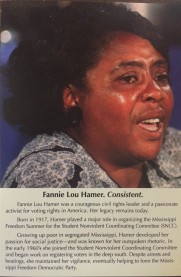
A few weeks ago, I came across a postcard that I was given at a conference last year. I got the postcard (advertisement?) because it has a picture of Fannie Lou Hamer on it, and in my home and office, I like to display images and quotes from inspirational women, especially black women. Hamer was a sharecropper from rural Mississippi who became a leader within the civil rights movement in the United States. I was happy to have something with her likeness on it. It was only later that I looked at the text on the front and back of the card, which read in part, ”Often called the ‘spirit of the Civil Rights Movement,” Hamer worked tirelessly on behalf of the rights of others—including the unborn. [She said,] ‘The methods used to take human lives such as abortion, the pill, the ring, etc. amounts to genocide. I believe that abortion is legal murder.’” I realized then that the card was distributed by an organization called Consistent Life, who, in support of a “consistent ethic of life,” is “committed to the protection of life threatened by war, abortion, poverty, racism, capital punishment and euthanasia.”
I was conflicted about the use of Hamer’s image for this organization’s purposes. It is true, Hamer did have those views about abortion and birth control. But I did not know if her image and story was being manipulated for a particular political and religious agenda—one I do not align myself with. I put the card in a box of other images and quotes. I didn’t display it, but I didn’t throw it away, either, which is why I came across it again a couple weeks ago as I was cleaning and decorating my home office. I had the same misgivings about the image as before, and I set it aside again. Continue reading “Fannie Lou Hamer’s Commitment to Life by Elise M. Edwards”
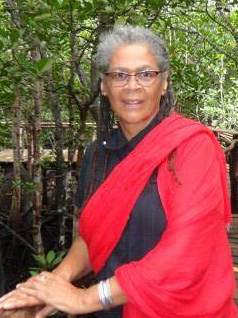
I am currently in Cape Town South Africa at a Queer Muslim International Retreat. Next month I will go to Jakarta Indonesia for a workshop focused on the same agenda: reform in Muslim communities towards the lives of dignity for lesbian, gay, bi-sexual, transgender, Queer and Intersex Muslims. It has been a long road and the end of the struggle is nowhere in sight. Still, there are important developments worth noting.
I am the fifth of eight children. My brother, just older than me, is gay. Although we are both in our 60’s now, it was evident that his sexual orientation was not normative heterosexual from very early. My first nephew, son of my older sister is also gay. Now in his mid-40’s his was also not a question of lifestyle choice. I love these two men and always have. That did not mean I was devoid of homophobic tendencies and subtle acts of discrimination against queer people. I wasn’t against them, but I did not see why I, who lived as a straight heterosexual woman, should have to pay any attention to the particularities of their life struggle. It was their problem and I could ignore it. So I did.
I was never guilty of vicious acts – teasing, name calling or bullying; I just put it out of my mind. As a Muslim, I would come to encounter a much greater awareness how the convenience of sitting on the fence was inadvertently a tacit approval of gross homophobic violations and that all I believed about a Merciful and Compassionate Creator of Justice required me to support the struggles to establish that divine justice and cosmic harmony and beauty everywhere and for everyone. Continue reading “LGBTQI Muslims and International Movements for Empowerment by amina wadud”
Notwithstanding the widespread belief that contraception is not consistent with the principles of Christianity, there is no basis for it. On the contrary, contraception was closely associated with early Christianity.
Matthew 19:12 is the only passage quoting Christ that is on point. Christ has been speaking about family law (adultery), acknowledging here that the issue is not relevant to eunuchs, including those who castrate themselves “for the kingdom of heaven.” At a minimum it seems problematic how this verse is to be understood today. Yet, the evidence for Christians castrating themselves in the first few centuries after Christ comes from a variety of sources, many of which are considered to be otherwise reliable. It is very difficult to see why Matthew 19:12 itself should not be taken both as evidence of the practice and Christ’s implicit endorsement of it.
A few days ago I had the pleasure of giving a talk at the Secular Student Alliance Conference on how non-believing persons can work with Churches. Amidst the chaos of conferences–managing your time, deciding which talks to attend, and making sure you have enough water (it was a Burning Ring of Fire outside in Tempe, AZ)–I got to meet some pretty incredible secular women.
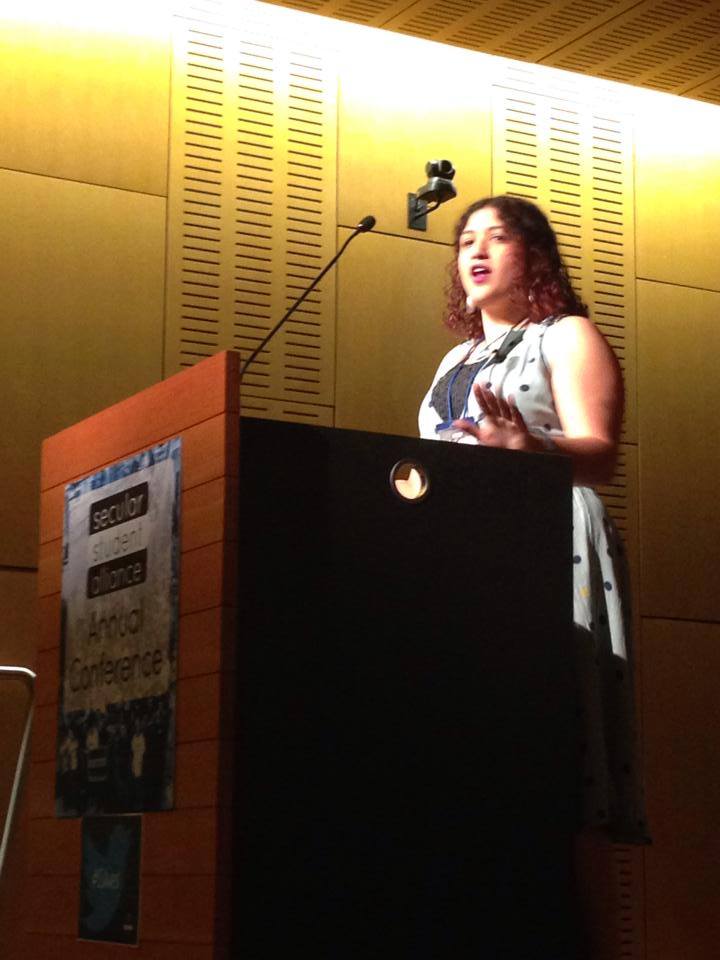
One of them was Heina Dadabhoy.
Heina speaking at SSA.
Former Muslim, blogger at Freethought Blogs, and overall bad-ass, Heina spoke about ways in which secular groups can create a more welcoming environment for ex-Muslims and Muslims beginning to doubt. Her talk, “Of Murtids and Muslims,” (a “murtid” is a public apostate) was not only about her experiences coming out as a secular humanist, but considered some of the absurd questions people ask her (and other ex-Muslims) about leaving Islam. “So did your parents try to honor kill you?” “Have you gone through FGM?” It was disturbingly humorous.
What I considered to be Heina’s main point, was that we should respect each others’ individual differences and not generalize and caricature all Muslims with the depictions of some. “Just because you read Ayaan Hirsi Ali’s book,” Heina notes, “does not make you an expert on Islam.” Heina made sure to emphasize the radical diversity that exists in Islam. She also spoke of the some of the issues that people go through when they leave Islam: How do I create a new identity when my old one was intricately tied up in my Muslim community, family, and culture? How do I navigate popular culture when I have missed a bunch of it? How do I find myself in this new secular world? Heina’s answers were refreshingly honest and insightful.
P.S. Aisha (one of Muhammed’s wives) should not simply be reduced to the young person Muhammed married; she was also a war leader, influential Muslim thinker, and someone who contributed greatly to early Islam. This is, of course, Heina’s insight.
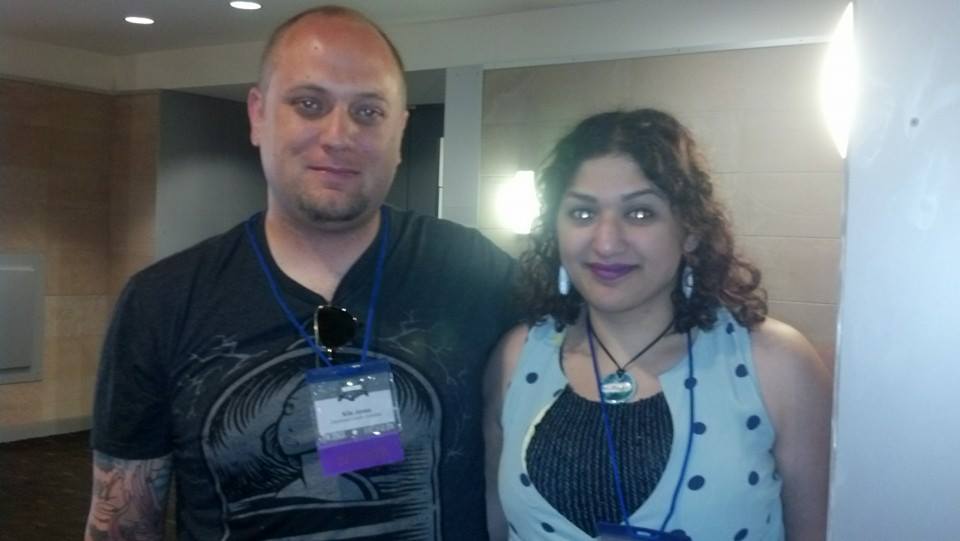
Me and Heina at SSA
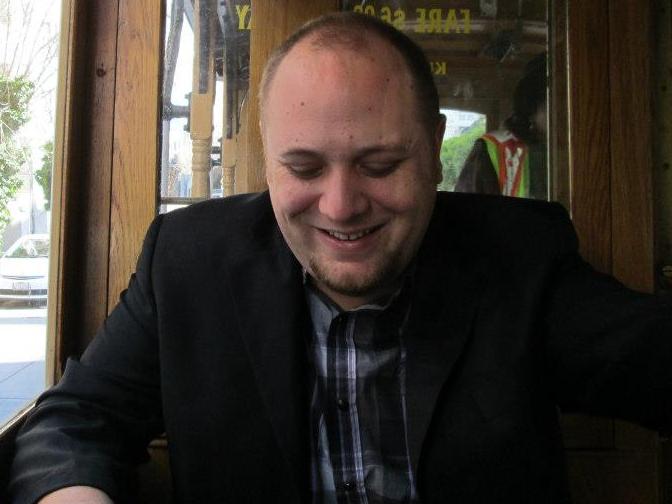
Another awesome secular woman I met, was Sarah Morehead.
Sarah. Photo from Apostacon.
Sarah is a former evangelical Southern Baptist, Executive Director of the “Recovering From Religion” project, and another overall bad-ass. She spoke on how to start up a Recovering From Religion group on your campus. Here is a blurb about Recovering From Religion,
“If you are one of the many people who have determined that religion no longer has a place in their life, but are still dealing with the after-effects in some way or another, Recovering From Religion (RR) may be just the right spot for you. Many people come to a point that they no longer accept the supernatural explanations for the world around them, or they realize just how much conflict religious belief creates. It can be difficult to leave religion because family and culture put so much pressure on us to stay and pretend to believe the unbelievable. If this is you, we want to help you find your way out. Don’t let people convince you that you just didn’t have ‘enough’ faith, or that you just haven’t found the “right” religion.”
Sarah and I chatted (and often laughed) about our old experiences as conservative Christians. We discussed some of the funny language (Christian-eze) we used to use, the various levels of guilt and shame that were cast upon us, and how science helps explain some of the interesting displays of piety often seen at Pentecostal services. Sarah’s jovial and welcoming demeanor was calming, and as an Executive Director for a project aimed at helping people “recover” from religion, I cannot think of a better person for the job.
Lyz. Photo by SSA.
The last woman I have in mind is Lyz Liddell.
Lyz is the Director of Campus Organizing for the Secular Student Alliance. I have an interview I did with her a while back, on this very blog! Besides running around with her headset on, standing on chairs for announcements, and generally keeping the world of SSA from not crumbling into oblivion, Lyz is a great motivation and example. If you are ever interested in starting a SSA group on your campus, talk to her.
To all those who attended this years SSA West, or who are involved with helping secular students: Unite!
Kile Jones holds a Bachelors of Theology (B.Th.) from Faith Seminary, a Masters of Theological Studies (M.T.S.) and a Masters of Sacred Theology (S.T.M.) from Boston University, and is a current Ph.D. in Religion student at Claremont Lincoln University. He also holds a Certificate in Science and Religion from the Boston Theological Institute. Mr. Jones has been published in Zygon: Journal of Religion and Science, Philosophy Now, Free Inquiry, World Futures, Human Affairs, and the Secular Web. He is the Founder/Editor-in-Chief of Claremont Journal of Religion (www.claremontjournal.com), and is the Founder/Director of Interview an Atheist at Church Day (interviewatheists.wordpress.com).
Phelps didn’t just live a life filled with hate but he also embodied the very reasoning why so many communities cannot cross that proverbial bridge to work together to see past their differences and maybe never will. In the case of Phelps, sticks and stones may break our bones, but words really do hurt.
Fred Phelps, an American Pastor who headed the Westboro Baptist Church in Topeka, Kansas died at the age of 84 on March 19, 2014. While some individuals leave behind legacies of their good deeds and loving memories, the only thing Phelps left behind was a family and church founded on the principle of hate.
A frequent eyesore at various events ranging from military funerals and gay pride gatherings to mainstream events that captured the attention of our pop-culture obsessed society, Fred Phelps and his clan believed it was their sacred duty to warn others of God’s anger over the growing acceptance of not only modernity in general but also issues like gay rights and abortion. From slogans and signs such as ‘God Hates Fags’ to ‘Thank God for IEDs (Improvised Explosive Devices), Phelps has caused many controversies both during his lifetime and after his death.
As I think about the incarceration of young black men for relatively minor drug crimes, and the murders of Trayvon Martin and Jordan Davis, I cannot help but compare the astonishing progress that Americans have made in overcoming prejudice against gays and lesbians to the astounding lack of progress we have made in overcoming prejudice against black Americans.
It is often repeated that the reason for changes in attitudes about gays and lesbians is the process of coming out—most people in America now know a lesbian or gay family member, friend, or co-worker. On the other hand, I would dare to speculate that many—perhaps most—Americans who are not African-American do not know a boy like Trayon Martin or Jordan Davis. If you do—count yourself lucky! Our society remains divided by race and class divisions (many of them a legacy of racism) that prevent many non-black Americans from knowing a single young black man. Continue reading “Segregation by Carol P. Christ”
One of my academic joys is interviewing people I find particularly interesting (see most of my posts here). This time I am honored to present a recent interview I did with Judith Butler.
Jesus loved sinners and Jesus would rather be dancing with me in West Hollywood on a Friday night than lugging through a swamp luring ducks into a trap with a duck caller made by a clan who think that my sexual actions are similar to that of an individual having sex with an animal.
To be able to walk down the street holding the hand of the one you love is a great feeling and an action that some of us aren’t able to perform without fear.
A line has been drawn in the sand between those who support gay rights and those who do not. While some call it being on the “right side of history,” I simply now refer to it as not sounding and looking like a bigot in the halls of history and in the various books, Facebook posts, and Tweets that our children will one day read. Continue reading “Yes, You’re a Homophobe by John Erickson”
Is care the beginning of ethics? Has traditional western ethical thinking been wrong to insist that in order to reason ethically, we must divorce reason from emotion, passion, and feeling?
In Ecofeminist Philosophy, Karen Warren criticizes traditional ethical thinking–advocating a “care-sensitive” approach to ethics. Traditional ethics, as Warren says, are based on the notion of the individual rights of rational moral subjects. Like so much else in western philosophy traditional ethics are rooted in the classical dualisms that separate mind from body, reason from emotion and passion, and male from female. In addition to being based in dualism, western philosophy focuses on the rational individual, imagining “him” to be separable from relationships with others. Western ethics concerns itself with the “rights” of “rational” “individuals” as they come into relationship or conflict with the “rights” of other “rational” “indiviudals.”


 A few weeks ago, I came across a postcard that I was given at a conference last year. I got the postcard (advertisement?) because it has a picture of Fannie Lou Hamer on it, and in my home and office, I like to display images and quotes from inspirational women, especially black women. Hamer was a sharecropper from rural Mississippi who became a leader within the civil rights movement in the United States. I was happy to have something with her likeness on it. It was only later that I looked at the text on the front and back of the card, which read in part, ”Often called the ‘spirit of the Civil Rights Movement,” Hamer worked tirelessly on behalf of the rights of others—including the unborn. [She said,] ‘The methods used to take human lives such as abortion, the pill, the ring, etc. amounts to genocide. I believe that abortion is legal murder.’” I realized then that the card was distributed by an organization called Consistent Life, who, in support of a “consistent ethic of life,” is “committed to the protection of life threatened by war, abortion, poverty, racism, capital punishment and euthanasia.”
 e of Hamer’s image for this organization’s purposes. It is true, Hamer did have those views about abortion and birth control. But I did not know if her image and story was being manipulated for a particular political and religious agenda—one I do not align myself with. I put the card in a box of other images and quotes. I didn’t display it, but I didn’t throw it away, either, which is why I came across it again a couple weeks ago as I was cleaning and decorating my home office. I had the same misgivings about the image as before, and I set it aside again. Continue reading “Fannie Lou Hamer’s Commitment to Life by Elise M. Edwards”
 I am currently in Cape Town South Africa at a Queer Muslim International Retreat. Next month I will go to Jakarta Indonesia for a workshop focused on the same agenda: reform in Muslim communities towards the lives of dignity for lesbian, gay, bi-sexual, transgender, Queer and Intersex Muslims. It has been a long road and the end of the struggle is nowhere in sight. Still, there are important developments worth noting.


 tor who headed the Westboro Baptist Church in Topeka, Kansas died at the age of 84 on March 19, 2014. While some individuals leave behind legacies of their good deeds and loving memories, the only thing Phelps left behind was a family and church founded on the principle of hate.


 Feminism and Religion