Low Impact Giving as a Holiday Gift to Mother Earth by Elisabeth Schilling

BeachAs the winter months approach, at least one “Christmas” gathering will be on my schedule. As this holiday has been co-opted by consumerism as evidenced by my memory of the throngs of sales and shoppers in large shopping centers to get “the perfect gift,” I wonder how to give the perfect gift to Mother Earth simultaneously. At the December meeting of my local chapter of the Sierra Club, one of the members passed out a list of gift ideas for a “low-impact” season. Some of the items on the list include or have inspired the following:

Gift Coupons for Services – cleaning out a garage, taking care of someone’s kids for the day, a home-cooked meal for a family, showing someone how to set up composting, teaching someone to knit.

Memberships/Lessons – Yoga classes from a studio, membership to a museum or a gym, art lessons, music lessons.

Gift Basket of Sustainability-Minded Products for Cleaning/Bath  

Donations in Honor of Someone

I am sure many of us are already creative in our gift giving. So hopefully you will all comment and share your low-impact gift traditions. For those of us who haven’t quite transitioned or have never fully thought of pursuing this course of action, there can be some resistance encountered in those who receive low-impact gifts. Continue reading “Low Impact Giving as a Holiday Gift to Mother Earth by Elisabeth Schilling”

“Respect: Dualism Subversion and So Much More in Survival Reality Television,” by Ivy Helman.

20151004_161012In “Ecofeminism and Wilderness,” Linda Vance believes that Western society defines wilderness by “… the absence of humans, we are saying, in effect, that nature is at its best when utterly separated from the human world. The idea of wilderness is thus an extreme manifestation of the general Western conceptual rift between culture and nature,” (62).  Reality television shows, focusing on survival or living off the land, often reproduce this dualistic way of thinking.

At the same time they reproduce another of Vance’s concerns, “I would argue that wilderness recreation “re-creates” more than the self: it also recreates the history of the conquest of nature, the subjugation of indigenous peoples, the glorification of individualism, the triumph of human will over material reality, and the Protestant ideal of one-on-one contact with G-d. And as for the elements of physical challenge and risk, I think it goes without saying that they appeal most to those for whom day-to-day mobility is a given, and for whom danger isn’t always close at hand,” (71).  However, by presenting this dichotomy, many of the shows also subvert the ideal of untouched wilderness, challenge the notions of human abilities and highlight our lack of embeddedness and embodiment when it comes to survival situations. Continue reading ““Respect: Dualism Subversion and So Much More in Survival Reality Television,” by Ivy Helman.”

The Wedding Dress by Natalie Weaver

Natalie Weaver editedA few weeks back, I was digging around for a picture, and in the process of looking for one picture I uncovered decades worth of memories. Here I was by the pool one Thanksgiving at my old apartment in California. That was where I cooked my first turkey. Here, in another photo, it was Christmas Eve at my mom’s house. I was with my best friend, wearing matching Santa hats. She was so beautiful as a girl. I have become accustomed to her as a woman and had forgotten how much I loved and admired her then as well. Weren’t we supposed to take off and travel the world together? And, then, here were the wedding photos of our Christmas wedding.

I noticed that it was an intimate party. At one point in the service, my father-in-law was holding my flowers since my sister was fixing my veil. He was chided the rest of the night for being my flower girl. I remembered that I did not have my hair professionally coiffed when I saw the backstage image of myself taking out bobby-pinned curls in lingerie before I dressed. Did I look like that? Who took that picture? The flowers were white roses, accented with holly berries and leaves, and my bouquet was a solid bundle of red roses.   Oh yes, and, here was our friend from Chicago… with his hair dyed blond? Why was he hanging out with my girlfriends in my room the night before I was married? And, didn’t my mom inadvertently catch his shirt on fire with some incense? Yes, that’s right. Very innocently, smilingly, moving casually, she patted out the near tragedy sparking on his back side, saying in her best southern accent, “Oh, my! We put a little hole in you, didn’t we?” A little disgruntled, he muttered, “That was a new shirt.”

The one great indulgence of the wedding was the dress itself. It was ivory with blush colored roses embroidered on the tulle overlay of the big skirt. I was not concerned that people would think me a non-virgin in ivory, but it was mentioned to me as a consideration. I loved the bustle in the back that was gathered from the generous material of the gown’s train so that I could walk and dance at the reception. The friendly ladies who sold me the dress came to the wedding specifically to make sure the bustle was perfectly drawn. The bodice had a gentle piping, which made the top sort of stand on its own. The same ladies also insisted that I have some extra padding in the top. Come to think of it, they seemed to have been globally concerned with the success of the garment and me in it. I wore a white silk wrap around my shoulders, which made me feel like Grace Kelly. The covering was my favorite part, which I added at the last minute. The photos prompted me to get out the dress once again, for I had not looked at it in the nearly fifteen years since I had it hermetically preserved following the wedding. So far, it had not yellowed. I was surprised to see how funerary it looked through the peep window, sealed up as it was in a box around cardboard shaped like my torso. It made me think that perhaps I should be buried in it some day. This thought has discomfited me with a complexity of sacramentality, morbidity, practicality, humor, despair, love and sorrow that I have yet to comprehend or shirk. Continue reading “The Wedding Dress by Natalie Weaver”

Stillness by Oxana Poberejnaia

oxanaI am visiting my home town in Russia for holidays. I have not been home for 3 years and I have not lived there for 12 years. Many things surprise me. One of the features of contemporary life in my home town is the relentless and often destructive onset of capitalism. As I have said already, currently patriarchy has joined forces with capitalism in order to suppress nature and oppress women.

One of the ways capitalism does this is by involving women and men into an endless rat race and by substituting their Wild Nature (as Dr Clarissa Pinkola Estés describes it) with an identity of a consumer. People willingly put on masks of consumers who live to make money and to spend it on entertainment which is sold to them.

Continue reading “Stillness by Oxana Poberejnaia”

Eating: Thinking about Bodily Practices, Pt. 1 by Elise M. Edwards

Elise EdwardsI am currently preparing to teach a course on bioethics in the fall. I plan on combining some common, secular materials on biomedical ethics with some theological material and some feminist readings. After all, in a course that centers around practices related to the body, birth, and death, there seems ample opportunity to introduce feminist themes. Some feminist perspective, of course, is typical, like when we will discuss abortion and contraception. (Or at least it is common in my courses where try to present multiple sides of an issue.) Anything related to conception, pregnancy, and birth is easily understood as a “women’s issue” and therefore something that feminists address. I’ve discussed abortion and contraception in previous posts on this forum.

However, I realized in going through readings for this course that I have not focused much on other practices related to the body in my scholarship or personal reflection. Specifically, I have not connected them to theological principles or feminist convictions. Perhaps not everything concerning the body is directly relevant to feminism. But I am sure if I thought about it, I would be able to make the connections. We are physical creatures and the feminist movement generally affirms recognizing our embodiment.

Continue reading “Eating: Thinking about Bodily Practices, Pt. 1 by Elise M. Edwards”

Who’s Got the Money by amina wadud

amina 2014 - croppedAfter doing my usual pre-travel research (expected weather, electrical plug usage and currency exchange rates) I tried to amply prepare for a continuous trip between India and Switzerland on one ticket: not too many clothes in my suitcase, but enough for the climate disparity. At the time I checked in, that disparity was something like 90 to 60 degrees (F) respectively. I opted for cotton clothes with layers and sandals with or without socks. As it turned out, India got hotter (nearly 100F) and Switzerland got colder (45F) with biting rain and winds. So I spent a LOT of my down time in my hotel room.

I had stuff to read, casual and work related and managed to keep myself busy. On occasion, I would turn on the TV. All the stations in Fribourg were in French or German with one exception: the financial news channel. I could only take that news for so long. My last day in Fribourg, there was a break in the news and instead they played back-to-back episodes of some program about the “super rich”. It turned out to be more distressing than the news. You’d expect people with so much money to have one thing you might wistfully dream about. But nope, I really have no interest in private planes or huge yachts with custom fitted gold faucets, or Ferraris and Lamborghinis. Yes, I would like to live near the beach, but a small bungalow would do me just as well—no need for the 25,000 square feet vacation home they were showcasing. Continue reading “Who’s Got the Money by amina wadud”

Identity as an enemy of Feminism by Oxana Poberejnaia

oxanaRita M Gross is her “Buddhism after Patriarchy” says that Buddhism is Feminism. I think I understand what she means.


The goal of Buddhist practice, Enlightenment, is often called Liberation. Liberation can be seen as the goal of Feminism too. In different schools of Buddhism is interpreted differently, but one of the classic explanation is that it is freedom from or absence of anger, lust and ignorance. Enlightenment is also described as a state of ego-lessness.


Rita M. Gross justifiably clarifies the Buddhist understanding of “ego” and “ego-lessness”, which is different from conventional Western notion of ego as “strength” or “scale” of personality. Rita M Gross points out that sometimes feminists say that women need larger egos, not smaller or no egos.

Continue reading “Identity as an enemy of Feminism by Oxana Poberejnaia”

Remember the Sabbath Day: The Cost of Difference by Linn Marie Tonstad

Linn Marie TonstadI grew up Seventh-day Adventist and was educated at Seventh-day Adventist schools all the way through college. I can tell endless quirky stories about growing up – about the time my parents gave me The Lion, the Witch, and the Wardrobe to read at the age of seven and I was certain, certain, that they had no idea what devilish literature they had given me (all those horrible hags and werewolves), so I promised myself never to tell them because they would feel so bad for having led me astray. (I figured it out when I reread the story at the age of nine.) About my joy in meeting missionaries from the Church of Jesus Christ of Latter-day Saints, or Jehovah’s Witnesses, at the train station on my way to and from school, so that we could proof text against each other. I was always certain that my marked Bible (marked with Sabbath texts, carefully traced with different colored pens, based on a pamphlet I had picked up somewhere) would eventually lead someone to the truth. (Again, I was nine.) As I entered adolescence, I became increasingly worried about the early Adventist dictum that the degree of responsibility you have as a believer is proportional to the degree of light you have been given – after all, I had a lot of light! In fact, I knew the truth.

But no stories like this will tell the truth of my relationship with the church. Yes, I grew up in ways that seem strange to many people: keeping Saturday holy starting Friday at sundown, without TV or movies until about the age of eleven, as a life-long vegetarian (although I became a pescetarian in my twenties), believing that Jesus Christ will return soon, having read the Bible cover to cover by the age of nine (do you see a pattern emerging?), and so on. Having spent the last decade plus outside Adventist institutions, I know much more than I did then about the ways in which my upbringing and beliefs were unusual by mainstream standards. Yet unlike many people who become theologians, and unlike many women who become feminist theologians, I never experienced the church as a particularly repressive site, even though the external forms of my life look very different now. I loved the church, and despite some unfortunate experiences with authority during my high school and college years, the church gave me gifts that I have valued ever since. Continue reading “Remember the Sabbath Day: The Cost of Difference by Linn Marie Tonstad”

Let’s Celebrate the Holiday Shopping Season by Barbara Ardinger

We’ve recently celebrated Thanksgiving, when I hope that, like me, you gave thanks to the deity of your choice for the wise and thoughty blogs we’ve been reading on this site. Now we’re well into the holiday season, which seems (at least in the malls) to start earlier every year. No matter what you call the December holiday, its origin lies in the winter solstice, which is the tipping point of the year’s dark season. The solar gods—Adonis, Amon-Ra, Apollo, Attis, Baal, Horus, Jesus the Christ, Lugh, Marduk, Mithra, Shamash, Sol Invictus, and the rest—are born or reborn now. These are the gods who live for a season or a year in great honor, after which they’re sacrificed, spend a season underground, and are then reborn. This happens every year at the winter solstice. (Just so you know: if Jesus was a real man, he was probably born in the spring or fall between 7 and 4 B.C.E. In 354 C.E., Bishop Liberius of Rome moved his official birth date to December 25 to match the birth date of the popular Roman god Mithra.)

Also born and reborn at the winter solstice is the light itself, the solar light and the temple light, too. We can think of the reborn light as literal light—a lamp in a temple that burns for eight days when it has fuel for only one—or metaphorical light, that is, learning, wisdom, and generosity. Hanukkah (which usually comes in December but which coincided with Thanksgiving this year) embraces both literal and metaphorical light. Continue reading “Let’s Celebrate the Holiday Shopping Season by Barbara Ardinger”

Water, Activism, and Thirsting for Change by Xochitl Alvizo

XA yellowMike Wilson’s persistent replacement of water sources in the desert for those who may be dying of thirst is part of his affirmation that we are all inextricably connected…the affirmation that our individual well-being cannot be separated from our collective well-being.

I carry two water bottles with me at all times, one for water and one for change – quarters, nickels, dimes, and pennies, as well as the occasional dollar bill. I carry the first bottle because, here in the U.S., I have the luxury of accessing potable drinking water, from which I am able to refill my reusable water bottle, almost everywhere I go. I don’t go anywhere without it. Even at a friend’s house or out to eat at a restaurant, when offered a glass of drinking water I simply pull out my water bottle and if needed refill it from the tap. No need to wash an extra cup. I especially find it necessary to have my water bottle with me when I am at conferences or business meetings where the default is to provide people with brand new single-use disposable water bottles that more often than not end up in the trash can instead of the recycling bin – which is often not even available. I carry my water bottle with me at all times.

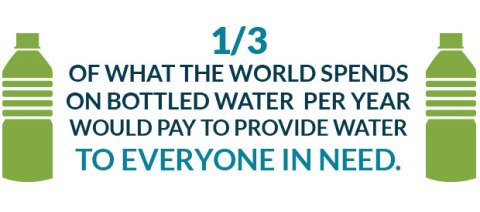
Sadly (and, criminally, really), people in the U.S., 90% of whom have access to perfectly good drinking water from their tap, are the top consumers of store bought bottled water – and unnecessarily so. The great irony is that 40% of bottled water comes directly from public water supplies – from the city’s public works for which tax-payers are already paying. Meanwhile, in many parts of the world people are literally dying of thirst and access to fresh drinking water continues to be a growing crisis. Single-use bottled water makes me angry, for unless water is being bottled in order to be transported to people in places that have no access to it, buying bottled water is unnecessary, indulgent, and willfully uninformed.blue planet, water crisis, Mike Wilson Continue reading “Water, Activism, and Thirsting for Change by Xochitl Alvizo”