Fannie Lou Hamer’s Commitment to Life by Elise M. Edwards

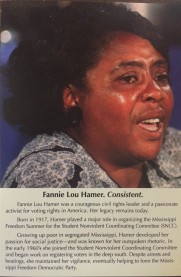
Elise EdwardsA few weeks ago, I came across a postcard that I was given at a conference last year. I got the postcard (advertisement?) because it has a picture of Fannie Lou Hamer on it, and in my home and office, I like to display images and quotes from inspirational women, especially black women. Hamer was a sharecropper from rural Mississippi who became a leader within the civil rights movement in the United States. I was happy to have something with her likeness on it. It was only later that I looked at the text on the front and back of the card, which read in part, ”Often called the ‘spirit of the Civil Rights Movement,” Hamer worked tirelessly on behalf of the rights of others—including the unborn. [She said,] ‘The methods used to take human lives such as abortion, the pill, the ring, etc. amounts to genocide. I believe that abortion is legal murder.’” I realized then that the card was distributed by an organization called Consistent Life, who, in support of a “consistent ethic of life,” is “committed to the protection of life threatened by war, abortion, poverty, racism, capital punishment and euthanasia.”

I was conflicted about the ushamere of Hamer’s image for this organization’s purposes. It is true, Hamer did have those views about abortion and birth control. But I did not know if her image and story was being manipulated for a particular political and religious agenda—one I do not align myself with. I put the card in a box of other images and quotes. I didn’t display it, but I didn’t throw it away, either, which is why I came across it again a couple weeks ago as I was cleaning and decorating my home office. I had the same misgivings about the image as before, and I set it aside again. Continue reading “Fannie Lou Hamer’s Commitment to Life by Elise M. Edwards”
Contraception, Christianity & Law by Stuart Dean

Stuart WordPress photoNotwithstanding the widespread belief that contraception is not consistent with the principles of Christianity, there is no basis for it.  On the contrary, contraception was closely associated with early Christianity.

Matthew 19:12 is the only passage quoting Christ that is on point.  Christ has been speaking about family law (adultery), acknowledging here that the issue is not relevant to eunuchs, including those who castrate themselves “for the kingdom of heaven.”  At a minimum it seems problematic how this verse is to be understood today.  Yet, the evidence for Christians castrating themselves in the first few centuries after Christ comes from a variety of sources, many of which are considered to be otherwise reliable.  It is very difficult to see why Matthew 19:12 itself should not be taken both as evidence of the practice and Christ’s implicit endorsement of it.

Continue reading “Contraception, Christianity & Law by Stuart Dean”

Hobby Lobby, Not Invited at the Spiritual Negotiating Table by Qumyka Rasheeda Howell

Q HowellSupreme Court Justice Ruth Bader Ginsburg said it best when she quoted Planned Parenthood of Southeastern Pennsylvania vs. Casey court case expressing her dissent on the Hobby Lobby decision made on Monday, June 30, 2014.

“The ability of women to participate equally in the economic and social life of the nation has been facilitated by their ability to control their reproductive lives.”

The Supreme Court ruled 5-4 in Burwell v. Hobby Lobby that closely held companies with religious objections can opt out of providing contraception coverage under the Affordable Care Act. The Supreme Court’s majority also rejected the Obama administration’s argument that for-profit companies cannot assert religious rights under Religious Freedom Restoration Act.  As the RFRA only refers to persons, closely held companies are designating themselves as persons in the case. Closely held companies such as Hobby Lobby are owned by one person or are family owned business and are not a publicly traded company. Justice Sonia Sotomayor agreed with Justice Ruth Ginsburg’s dissent that companies do not have such rights – publicly traded on not.

The Burwell v. Hobby Lobby was about asserting patriarchal power and retaining profit–not about religious freedom. The Obama administration argued that the contraception requirement was not a mandate because companies could have dropped their insurance coverage and offered their employees another insurance option. The truth to Hobby Lobby is they wanted to have the privileged advantage of tax breaks offered under the Affordable Care Act while securing more money by skirting the contraception requirement under the cloth of religious freedom. Continue reading “Hobby Lobby, Not Invited at the Spiritual Negotiating Table by Qumyka Rasheeda Howell”

On the Transmission of Life by Natalie Weaver

Natalie Weaver

Among the more controversial Roman Catholic documents is Humanae Vitae, the 1968 encyclical of Pope Paul VI on birth control.  This encyclical famously instructs against the use of artificial contraception methods in the regulation of birth.  This position is based on the theological warrant that the natural law of God’s reproductive design requires human sexuality, if it is to be moral, to be always nuptial, companionable, and open to new life.  The encyclical anticipates a number of reasons why people will object to this teaching, including: population problems, family and personal limitations, economic concerns, and so on.  It also anticipates that some will suggest procreative and unitive ends must be seen diachronically in the context of the fullness of nuptial sexuality, such that sexuality would be understood holistically rather than as a series of individual sexual acts.  Despite its acknowledgement of these concerns as legitimate, the encyclical argues that grave harm flows from the distortion of natural law and leads inevitably to the degradation of sexual dignity and nuptial integrity (for example, in making free sex more available to young people outside of marriage or cheapening male regard for women on account of women’s sexual objectification).  The encyclical thus opts for an approach that evaluates sexual morality in terms of individual sexual acts.

The perspective of the document has been critically unpacked for decades, and its instruction is in the very least unconvincing to many Catholic couples.   I find in my teaching that Catholic college students today are unfamiliar with the document’s language and rationale, even though they may know the basic instruction that Catholics aren’t supposed to use birth control.   Since this issue is both topical currently due to the healthcare legislation and since birth regulation is a requisite discussion in my course on sexual ethics, I have the students read the encyclical itself.  Now, this is a hard task because I know by and large what the student reactions will be.  Their most favorable reaction is generally that the document has no instructional or binding value for them.  Their least favorable reaction is that the document makes poor sense of the human situation today, especially because human sexual expression reaches well beyond the Church’s vision of normative, heterosexual, marital union. Continue reading “On the Transmission of Life by Natalie Weaver”

What About Contraception in Pope Francis’s Promise to the Poor? by Dawn DiPrince

Pope Francis, at nearly every opportunity – including the choice of his name, has symbolically expressed a commitment to the poor. In just a little over a month, he has declined the customary gold papal cross, the ermine-trimmed red velvet cape, and the showy red loafers worn by his predecessor. He has refused the palatial papal penthouse apartment and is currently living in a two-room suite among the Vatican’s cardinals.

In additional to a more austere lifestyle, Pope Francis has spoken out about the world’s poor. His namesake is St. Francis of Assisi, who famously worked for the poor and for peace. The Pope claims he was inspired to take the name Francis when remembering a friend’s urging to “not forget the poor.” More to the point, Pope Francis has stated that he wants “a Church which is poor and for the poor!” Continue reading “What About Contraception in Pope Francis’s Promise to the Poor? by Dawn DiPrince”

Standing in Cautious Optimism with the Election of the First Jesuit Pope by Michele Stopera Freyhauf

Freyhauf, Feminism, Religion, Durham, Old Testament, Blogger, Bible, Gender, Violence, Ursuline, John CarrollFrom the time Benedict’s successor was revealed, I believed that we were witnessing something different – hopefully change.  Pope Francis I embraces many “firsts” – which is probably why the Cardinals chose him.  Change and reconciliation seem to be at the forefront – something the Church so desperately needs today.  Francis is the first Latin American Pope, first Jesuit Pope, first Pope to use the name of Francis after St. Francis of Assisi, a Saint held in high regard by Catholics.  When I heard his chosen name, I immediately thought of St. Francis, to whom my favorite prayer is attributed.  This is a prayer that inspires me and speaks about how I try to live my life –  as one who strives for peace, and provides love, hope, and compassion.  St. Francis’ story is a powerful story of conversion from a life of great wealth to one of voluntary poverty.  Francis received a revelation from Christ to “rebuild my Church,” in a way that embraces peace and love as well as providing protection for all of creation.  The notion of “Protector” was a major theme in Pope Francis’ homily during his inauguration mass.

As an unlikely choice for Pope, mostly due to his age and health, Francis reminds me of another unlikely advocate for the people – a man chosen to be Archbishop because of his passivity and his ill-health – Oscar Romero.  Romero surprised the people who placed him in office and stirred things up when he became a staunch advocate for the people that he served.  Romero’s “moment of conversion” revealed something spectacular that changed Latin America.  In his role as leader, he found his voice and became a defender for the poor and oppressed.  It is because of Romero that I am hopeful that Francis will provide (or at least start the wheels in motion to provide) changes to the Catholic Church. Continue reading “Standing in Cautious Optimism with the Election of the First Jesuit Pope by Michele Stopera Freyhauf”

A Pro-Science, Skeptical Woman Speaks by Kile Jones

Kile Jones, atheistIn my last post, “Feminism and Religion: Where Do I stand?” I talked about how I support an atheistic, secular, and liberal feminism that criticizes organized religion and certain religious beliefs.  After reading the comments and responding to them, I figured that having a brief interview with a woman who holds these sorts of views would be a good way to introduce them to this blog.  I met Anondah Saide at a course at Claremont Graduate University titled, “Evolution, Economics, and the Brain,” taught by the Executive Director of the Skeptics Society and Founding Publisher of Skeptic Magazine, Dr. Michael Shermer.  Anondah was the TA for the course, and I found her comments in class to promote science, reason, and skepticism towards religious and spiritual claims of all kinds.  So without further ado, here is the interview: Continue reading “A Pro-Science, Skeptical Woman Speaks by Kile Jones”

Bringing African American Churches into Reproductive Justice by Mariam Williams

Mariam WilliamsI don’t expect to hear anything in church about the 40th anniversary of Roe v. Wade during the month of January,  the month marking 40 years since the U.S. Supreme Court made the decision to legalize abortion in this country. This is for a number of reasons: 1) it’s January, and at my church the pastor always starts off the year with a series of sermons that illustrate the church’s mission statement, and women’s choice may be off the subject; 2) Martin Luther King Jr. Day is this month, and if a black church is going to honor something or someone besides Jesus in the month of January, it should probably be MLK; and 3) I haven’t heard anything about abortion from the pulpit in a long time.

A local pro-choice movement leader asked me recently about how black churchgoers feel about abortion. I didn’t know what to say. The last time I heard it mentioned was in a Sunday School class in which a woman said that she almost aborted her daughter. It wasn’t a big confessional moment, just part of a longer testimony as to why she was happy her daughter was around, and it wasn’t received with any shock or fanfare. I can remember hearing once from the pulpit of my current church that while abortion might be wrong, the law shouldn’t interfere with what a woman chooses to do with her own body. Many years before that, in the church I grew up in, a preacher said that we would never find a cure for AIDS because the person who would have grown up to discover the cure was aborted. (What made him so sure of that? Who knows.) Continue reading “Bringing African American Churches into Reproductive Justice by Mariam Williams”

Blessed Are The Organized, by Amy Levin

It was a humid yet windy day in Broward County, South Florida. My long pants and sleeves were becoming hostile towards me as I proceeded to slip off my shoes, don my borrowed headscarf, and set up shop just outside the modest mosque in Pembroke Pines.  I waited patiently for prayers to end, hoping that my “Register to Vote” sign was placed in optimal eyesight of the female worshippers as they exited the prayer hall. All of my hope to expand the Florida electorate to help re-elect President Barack Obama was bundled in my mix of clipboards, voter registration forms, pens, and volunteer sign-up sheets.  Just moments after the Imam wrapped up the Friday afternoon prayers, two young women wearing full hijab sauntered out. “Oh, I’ve been meaning to register to vote,” one of them said. “Perfect.” Continue reading “Blessed Are The Organized, by Amy Levin”

The Dignified Life of Magdalene Rose: A Pro-Life Story? by Michele Stopera Freyhauf

As I enter this world, I know that I am so very blessed. My life will be one of worth.  As hard as people fought to see me take my first breath, they will fight for my life to be one of dignity and worth.  I am protected in a world that is pro-life – or so I thought.

My mother was raped, but the law did not recognize this violent act as rape because she became pregnant with me.  The law only recognizes legitimate rape as one that does not result in pregnancy.  I entered the world amidst controversy.  I was named Magdalene Rose. Magdalene because of the shroud of controversy that surrounded her – the false accusations of prostitution, the stigma that history assigned to her, and the hope of those who have tried to reclaim her as the first witness to the resurrection, a faithful disciple, and devoted minister.  Rose was chosen for the flower that can bloom even in the face of adversity; one that can push through the snow to reach the sun and spread its petals.

My mother is a single mom  She does the best she can – trying to keep us clothed and fed.  She works so much and I stay many nights with my grandmother or a neighbor.  She seems so tired, so worried, but yet always has a smile to share with me.  I am her blessing, a miracle born out of darkness.

We go to church every Sunday, but strangely, no one will sit by us.  We have to sit in the back.  I wonder why.  Certainly our clothes are a little worn – we rely on hand-me-downs and the thrift shop.  My mother dresses me in the finest dresses she can find, I feel so special. In God’s house, we are shunned.  People refuse to shake our hand even during the sign of peace.  This is the place where we should be welcomed.  This is where they proclaim the Gospel and teachings of Jesus.  Yet, the only sign of Jesus that seems to exist in this community is symbolized on the cross.

Continue reading “The Dignified Life of Magdalene Rose: A Pro-Life Story? by Michele Stopera Freyhauf”