The older I become the more I appreciate Nature as she is, Nature the Creatrix of the Earth. Nature creating without human intervention. The cycles of life and death are so intimately intertwined and never more evident than in the spring when each rotting log becomes home to ants who are feasted upon by black bears (whose primary protein source 93% comes from ants, grubs and larvae). Splintered detritus becomes the rich soil that supports the seedlings of the next generation of trees, even as the ground peppers the moment with the delicate three lobed trillium, lady-slipper, twin flower, partridge berry trailing arbutus, unfurling spirals – the birthing of ferns, and perhaps my favorite, wild lily of the valley soon to fill this forested glade with her intoxicating scent.
Outside my window, diversity reins as Royalty! Maples, ash, oak, beech moose maple, witch hazel, spruce hemlock, fir, balsam converse with one another, above and below ground – their language is made of pulsing vibrations, sound and scent. The naturally fallen white birch logs crisscross each other creating complex and unique patterns apparent to any artistic eye. The brook is wending her serpentine way to the sea, her spongy banks of sphagnum moss are steeped in emerald. The translucent papery thin leaves of the beech tree ripple in the slightest breeze.
Authorities have observed that climate change is a feminist issue because it disproportionately affects women. Among these, the United Nations has gone further to acknowledge that climate change is a feminist issue because women are on the forefront of adopting climate-change mitigating techniques and technologies. A recent UN report states that “women are key actors in building resilience and responding to climate-related disasters…” But overarching these admittedly important issues is the greater understanding – not mentioned by the UN report – that climate change is a feminist issue on the socio-spiritual level. This side of the issue is often overlooked because the institutions who compile reports are immersed in a masculine way of thinking.
What do I mean by a masculine way of thinking and why do I label it in this seemingly gendered way? Masculine values are those of winning, achieving, proving, succeeding, counting, controlling. pursuit of achievement and status; individual self-reliance; strength and aggression. The UN climate report cited above goes on to say that “Enacting good policies requires quality data, so that we can quantify the issue and measure improvement…” Reports such as this make their points by tabulating numbers and citing statistics, not seeing that these are already masculine ways of expressions and that numbers can only ever tell part of the story. These masculine traits and values are social constructs and not necessarily to be associated with the male biological sex. Both men and women and other-gendered can display masculine values and attributes but they are labeled masculine because society typically associates them with the male gender. Continue reading “Climate Change as a Socio-Spiritual Feminist Issue (Or 10 ways to be a leader in the era of climate change) by Nurete Brenner”
Arbor Day, Earth Day, May Day and Mother’s Day are deeply connected conceptually, etymologically, culturally and emotionally.
The tree, with its roots buried deep in the earth and its branches reaching upward toward heaven, spread wide to embrace all of eternity, is a prime symbol of life in many cultures. Trees have long been worshipped as beneficent spirits of bounty. Trees, after all, shade and feed us. Supply and sustain us. Serve us in endless ways. Trees breathe life into our lungs, the source of endless inspiration.
Possessing the potent powers of fertility, growth, resilience and longevity, the tree is widely seen as the progenitor of the world Family Tree. The Tree of Life. The tree goddess was seen as a sylph, an airy tree spirit who resides among the green leaves, sustaining and nurturing the vegetative forces. She is the symbol of the flow of life, a Mother Goddess who is Herself the Tree of Life.
Towards the end of Braiding Sweetgrass, mother, biologist, and member of the Citizen Potawami Nation Robin Wall Kimmerer sets out at the end of winter to visit a forest area near her home that she considers hers not in name but in virtue of her love and care for it. On arriving, she discovers that the forest is no more, having been clear-cut by the owner. The wildflowers and the plants she has harvested over the years have sprouted up, but Kimmerer knows that without the forest cover they will be burned by the sun and their places taken by brambles. Continue reading “Meeting the Windigo by Carol P. Christ”
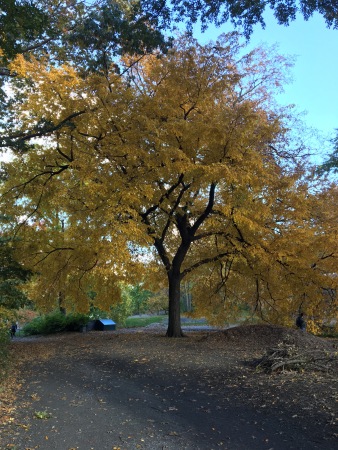
Almost every day, I walk in Central Park. There are certain trees there I’ve come to know: the gnarled cherry trees by the reservoir, the bending willows and tall bald cypress by the pond, the sycamores that drop their bark each summer, the hawthorn not far from Central Park West. Lately I’ve been taking photos of the trees to try to capture their essence, their posture in the world. The trees around me feel like friends, which is what an ancient midrash (interpretation/legend) called Genesis Rabbah says about trees: that they are friends to humankind. To me, they’ve always been a central manifestation of Mother Earth.
Currently, the national parks in the United States have no staff because of the government shutdown. Some people have taken the opportunity to cut down the rare and endangered Joshua trees in the Joshua Tree National Park—just for fun, I guess, or as a trophy of some kind. Meanwhile, President Bolsonaro of Brazil recently has indicted that he wants to remove protection for the rainforest, in order to allow development. It appears that my friends the trees have enemies. Sometimes the enmity is for personal/corporate gain, and sometimes the enmity seems to have no reason at all.
It’s Friday. I drive down PCH, Highway 1, at five-o-clock in the morning on my way to the airport. I left early and avoided the evacuation traffic. The sky is pitch black—not just dark, but black. Smoke cloaks the sky, sky presses against black mountains. I can’t actually see the ocean right next to me. I don’t look either, because the wind is pushing my car around on the freeway and I need to pay attention. Don’t look at the invisible water Sara, pay attention.
I admit to myself that I am afraid even though I am doing something I do every day.
I am getting on a plane. Why am I getting on this plane? I need to be here. I want to be here. But life goes on, doesn’t it? We hope that life goes on; even if we live like it does not. All I know is that I want to tell everyone I see that my home is burning. Not my house-home. Not mine. I’m safe just south of Ventura. I’m not on the freeway. I’m safe on a plane. But my home is burning. MY HOME IS BURNING. (Again.) Please somebody talk to me while my home is burning. But instead, I check the news and twitter reports every 5 minutes and worry about my students and my friends. I want to cry.
Climate scientists have been screaming the alarm for literally decades. Despite global efforts, they now say we have 12 years left to contain the damage: the difference between 1.5°C and 2°C warming means tens of millions of lives lost, not to mention the death of all coral reefs and half the world’s plants and insects. In the USA, our oligarchic, oil-funded government seems determined to drive our country off a cliff and take the rest of the world with us. What on this good, green Earth are we to do?
I have been thinking about this a while. Below is a seven-fold strategy that I pray may bring help, comfort, and inspiration to those who, like me, can feel utterly overwhelmed.
Face Reality
It astonishes me to have to include this, but so much money has poured into distractions and strategies to discredit climatology that we must still spread the word. We now know which approaches actually bring people along; a little bit of doom and gloom goes a very long way. Focus on empowerment, action, and most importantly, connection: how do climate issues affect people directly? How do they intersect with issues people already care about? (Hint: the climate affects all life and every place on Earth!) Continue reading “We Have 12 Years. Luckily, Climate Lovers Are Usually Feminist by Tallessyn Grenfell-Lee”
In folklore Old women are believed to control all aspects of Nature – Fire, Earth, Air and Water, but in myth and story they have a special relationship with water.
The title “witches in the weeds” emerged after I did some research on the Datura plant. This plant is usually associated with old women and sorcery in myth and story. For example, in European mythology, the dark goddesses, Hecate, and Baba Yaga are associated with Datura. Datura is considered to be a ‘witch weed’ and is categorized as a poison along with deadly nightshade, henbane and mandrake. The seeds and flowers have a history of creating visions, delirious states, and causing death. Datura thrives in wilderness areas. Old women, dark goddesses and Datura have a lot in common.
Women and birds have been associated since Neolithic times. Scholar and mytho-archeologist Marija Gimbutas unearthed many bird-women sculptures that were fashioned out of clay in “Old Europe”. Old women in particular are most often associated with owls, herons, crows, ravens, and black birds of all kinds. It is probably the relationship between women and birds that is one of the roots behind the belief that old women can fly. The other root behind flight can probably be found in the relationship between women healers and the plants they used. Plants like Datura contain alkaloid properties (scopolamine, hyoscyamine, and atropine) that are capable of producing visions of flight and are used by folk healers and medicine women and men. Continue reading ” Witches in the Weeds by Sara Wright”
On February 20, 2018, the Greek government issued a Presidential Decree mandating the formation of government bodies to monitor and protect the more than four hundred bird and wildlife habitats in Greece designated as part of the European law Natura 2000. This decision came after decades of government inaction regarding the enforcement of the Natura law it accepted as part of its entrance into the European Union.
Whether the Presidential Decree will result in protection on the ground remains to be seen, but it is an important step in the right direction. The Presidential Decree was issued after years of negotiations initiated by the European Commission to compel the Greek government to comply with the law. A Complaint to the European Commission regarding failure to protect the Natura wetlands of Lesbos on which I was the first author formed part of the basis of these negotiations.
a ditch drains a wetland to produce agricultural land
Almost as soon as I became a birdwatcher in 1999, I began to notice the degradation of bird habitats by dumping, drainage, and building, especially in wetland areas. Wetlands are seasonal bodies of water created by winter rains that dry out in the summer heat. Generally, they are shallow, which means that they are a perfect stopping over place for migrating birds. The most common visitors to wetlands are wading birds that stand in shallow pools and puddles without immersing their bodies in the water. Lesbos, the island where I began to watch birds, has some of the most important wetlands in Europe, visited by birds migrating from Africa to Europe in the spring for rest and feeding. Because of this, Lesbos is also a destination for birdwatchers.
Wetlands are not only important for birds. In rainy periods they act as a sponge between rivers and the sea and dry land, absorbing water that otherwise could cause flooding. The devastating flood damage to New Orleans in recent years is the result of building on wetlands. Similar damage occurs regularly wherever wetlands are drained, including on the island of Lesbos.
In 2001, I wrote a petition that was signed by over 600 birdwatchers and others urging the Greek government to protect the wetlands of Lesbos. I presented it at an open meeting in May 2001 organized by the Mayor of Kalloni, Lesbos, Aris Eleftheriou, to explain the plan to protect the wetlands of Kalloni which had been funded by the European Union. Instead of being congratulated for his work and vision, the mayor was met by an angry mob. Many of the Natura wetlands are privately owned fields traditionally used for grazing sheep and goats. As local economies were transitioning to tourism, landowners did not want any restrictions placed on their ability to drain and build on their land.
flamingos are now permanent residents of Lesbos
It was in this context that John Bowers, a longtime birdwatcher in Lesbos, an environmental economist, and the first to sign my petition, formed Friends of Green Lesbos, an international internet-based group dedicated to protecting the wetlands of Lesbos that soon counted over 800 members. I became its Vice President. In 2003, Friends of Green Lesbos, in co-operation with Idatinos, a local environmental group, drafted an internet letter and petition, that was automatically sent to the Greek government every time it was signed, asking the Greek government to fulfill its legal responsibility to protect the wetlands of Lesbos. The government responded that it was required to enforce the Natura law even though no specific Greek law had been passed specifying how this was to be done. A committee in the department of building and land development in Lesbos was created and charged with the responsibility of protecting the local wetlands.
We did not understand that this committee would not be monitoring the wetlands on a regular basis, but would only respond to complaints. This was clarified at a meeting organized by World Wildlife Fund in Athens in 2005. I was then put in touch with a new local environmental group, Nautilos en drasi that was also formed to save wetlands. Together with WWF, we began to draft complaints about the degradation of individual wetlands. These complaints, numbering well over fifty, were all decided in our favor. Fines were issued, but there was no mechanism to ensure compliance. Numerous meetings with the Governor of the island resulted in promises that were not kept. We finally realized that he was more interested in currying favor with landowners and developers than in enforcing the law.
In 2008 while lecturing at a conference in Ireland, I met a Green Party member of the European Parliament who encouraged me to write a complaint to the European Commission. After six months of intense effort, I completed a formal complaint of over 100 single-spaced pages, supported by two large files of documents, detailing the government’s failure to protect the wetlands under the Natura law. It was immediately approved by Friends of Green Lesbos and Nautilos en drasi, but it took over two years for World Wildlife Fund and Hellenic Ornithological Society to revise and sign it.
The complaint was submitted to the European Commission in September 2011. After several requests for additional documentation, the Commission found Greece in violation of the Natura law in Lesbos in October 2014. In August 2016 the Commission informed us that it had made our case part of horizontal negotiations with Greece regarding its failure to protect all of its Natura sites. The February 2018 Presidential Decree is the fruit of these negotiations. It is certain that the European Commission will continue to watch the situation in Greece to ensure that the government follows through with the monitoring and protection mandated by the new law.
This has been a long and tiring and often discouraging struggle of nearly two decades and it is still ongoing, but if the end result is the protection of all of the Natura sites in Greece, it will have been well worth it.
Others involved in Natura struggles in Lesbos besides John Bowers and myself include Eleni Galinou, Michael Bakas, Costas Zorbas, and Stellios Kraonakis, and in Athens, Foteini Vrettou, George Chassiotis, and Elias Tzirtzis of World Wildlife Fund Greece, and Malamo Korbeti of Hellenic Ornithological Society.