A Sojourn in Antartica by Marcia Mount Shoop

Marcia headshotOk, so it’s not Antarctica, it’s Indiana, but it sure feels like Antarctica lately.

At least it’s what I figure Antarctica must feel like: bone chilling wind that can cause hypothermia and frost bite in a matter of minutes; everything as far as the eye can see white—sometimes no horizon, or blue sky, or any distinction between the celestial world and ours. Continue reading “A Sojourn in Antartica by Marcia Mount Shoop”

SACRED RHYTHMS OF THE OLIVE HARVEST by Carol P. Christ

carol-christOlives are being harvested in the fields outside my town these days.  We have been having the first rains of the season.  The roads are wet and muddy, and the trees are partially shrouded in mist.  The fields are spread with black plastic nets, and people are hard at work, the men hitting the trees to make the olives fall, and the women picking up the olives from the nets.  The harvest will continue throughout the winter.

The olive press is busy. Cars and trucks come and go, unloading heavy bags filled with olives.  These days the bags are white, made of sturdy woven plastic. In Crete this fall several of us bought canvas olive bags, hand-woven by women.  These, along with baskets hand-woven by men, were still in use only a few decades ago.

olive harvest in Lesbos early 20th century by Theofilos Hajimichael

A friend who died a few years ago told me that “in the old days” there were no nets. The women and the children had to pick the olives up from the ground, often cutting their hands on thorns and stones.  The nets are a Goddess-send.  Between harvests, the nets are simply folded up and placed in the crotch of the tree. Here no one steals them.

In the fields where I walk some of the trees have enormous trunks. Some of them have two trunks, growing like sisters.  Many of them are 300, some perhaps 500, years old.  A man emerges from a field that has some particularly old trees.  I ask him how old they are. “Older than I am,” he replies. “They were here before I was born.  They will be here after I die.” Continue reading “SACRED RHYTHMS OF THE OLIVE HARVEST by Carol P. Christ”

Water, Activism, and Thirsting for Change by Xochitl Alvizo

XA yellowMike Wilson’s persistent replacement of water sources in the desert for those who may be dying of thirst is part of his affirmation that we are all inextricably connected…the affirmation that our individual well-being cannot be separated from our collective well-being.

I carry two water bottles with me at all times, one for water and one for change – quarters, nickels, dimes, and pennies, as well as the occasional dollar bill. I carry the first bottle because, here in the U.S., I have the luxury of accessing potable drinking water, from which I am able to refill my reusable water bottle, almost everywhere I go. I don’t go anywhere without it. Even at a friend’s house or out to eat at a restaurant, when offered a glass of drinking water I simply pull out my water bottle and if needed refill it from the tap. No need to wash an extra cup. I especially find it necessary to have my water bottle with me when I am at conferences or business meetings where the default is to provide people with brand new single-use disposable water bottles that more often than not end up in the trash can instead of the recycling bin – which is often not even available. I carry my water bottle with me at all times.

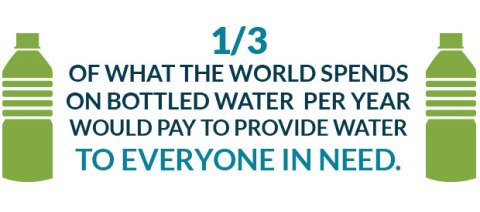
Sadly (and, criminally, really), people in the U.S., 90% of whom have access to perfectly good drinking water from their tap, are the top consumers of store bought bottled water – and unnecessarily so. The great irony is that 40% of bottled water comes directly from public water supplies – from the city’s public works for which tax-payers are already paying. Meanwhile, in many parts of the world people are literally dying of thirst and access to fresh drinking water continues to be a growing crisis. Single-use bottled water makes me angry, for unless water is being bottled in order to be transported to people in places that have no access to it, buying bottled water is unnecessary, indulgent, and willfully uninformed.blue planet, water crisis, Mike Wilson Continue reading “Water, Activism, and Thirsting for Change by Xochitl Alvizo”

WANGARI MUTA MAATHAI AND SACRED MOUNT KENYA by Carol P. Christ

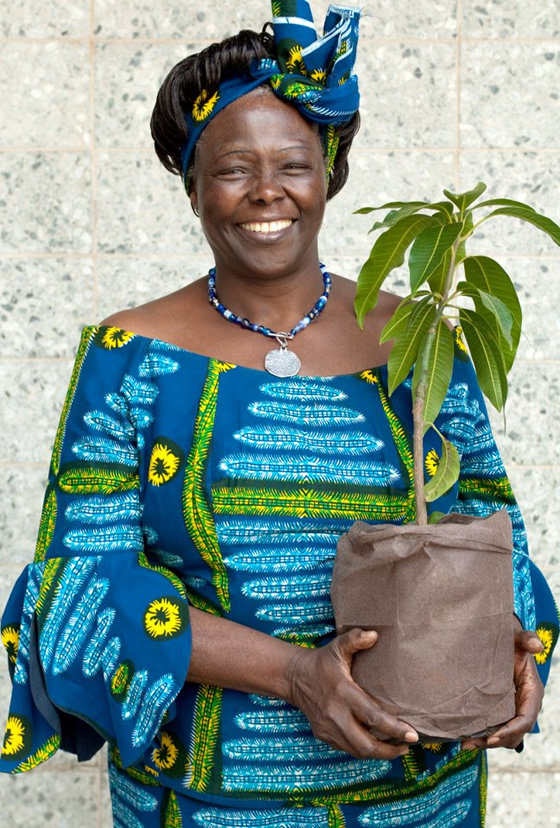
carol-christWangari-Maathai-1September 25, 2013 is the second anniversary of the death of environmental, peace, justice, and democracy advocate and Nobel Peace Prize recipient Wangari Muta Maathai.

Wangari Muta was born in 1940 in a round hut in rural tribal Kenya.  Wangari’s tribe considered the fig tree to be holy, and she was taught that one is never to cut a fig tree down or to use its branches for firewood.  Wangari spent many happy childhood hours in the shade of a fig tree that grew by a nearby stream.  Fig trees play an important role in the ecological system of the Rift Valley of Kenya.  Their roots penetrate the hard rock surface of the mountains to find underground water, thus opening channels where the water flows upward to fill streams and rivers.

As an adult Maathai learned that the fig tree she played under had been cut down by a settler with the result that the river had dried up.  This was happening all over Kenya on a massive scale to make room for cash crop plantations.  Rivers were silting up and widespread erosion threatened to turn the fertile Rift Valley into a desert. Crops were failing, animals were starving, there was no wood for cooking fires, and rural people were suffering.

Maathai  says that as she was thinking about this problem “It just came to me: ‘Why not plant trees?’ … This is how the Green Belt Movement began.”  Continue reading “WANGARI MUTA MAATHAI AND SACRED MOUNT KENYA by Carol P. Christ”

Feminism and My Existentialist Leanings by Xochitl Alvizo

In light of so much destruction in our world – from the violence inside individual homes to beyond and between national borders – how is it still possible to hope for and to live toward a vision of beauty and peace for the world?

It was at a community college in LA in my Psychology 4 class that I first formally encountered existentialism. When it came to the time of the semester to teach on that topic, our professor, Eric Fiazi, came alive in a new way, energetically teaching us about existentialism and Jean-Paul Sartre. Professor Fiazi dramatically gestured and sketched on the board as he explained the concept of ‘nothingness’ and Sartre’s well-known proposition that “existence precedes essence.”  Teaching psychology was for him a means of teaching what he truly loved, art and existentialism. He believed these subjects helped expand students’ horizons and helped make them happy and productive members of society. And so these class sessions were his favorite to teach – and mine to experience. Immediately, I was hooked.

I remember the moment he hit the chalk to the board – leaving a speck of a mark – telling us that the tiny little mark left on the great wide chalkboard was like our galaxy, tiny  against the great vastness of the universe; the earth, a particle of chalk-dust in comparison, and our individual lives, imperceptible in its midst (it now reminds me of Carl Sagan’s pale blue dot monologue). Engaging the students, he countered each one of their assertions that humans indeed have an essence, a meaning. “Humans are good by nature” – “Humans are inherently selfish beings” – “Humans are created in the image of god” – “We are each created for a purpose”; for each of these he gave a clear and logical retort. I was fascinated! What would it mean to live a life with no inherent meaning – with no essence to determine or guide our existence? How might it be different to live my life stripped of any assumed or inherited sense of meaning or purpose – to instead give these up and start from a presupposition of nothingness? Continue reading “Feminism and My Existentialist Leanings by Xochitl Alvizo”

For the Love of Gaia by Jassy Watson

For the Love of Gaia Jassy WatsonOn January 26, 2013 a rare, devastating tornado hit our community in Queensland, Australia, a coastal town on this sub-tropical coast. My family experienced nature’s elemental force firsthand and hopefully will never again. The tornado viciously shattered houses, peeled away roofs, uplifted cars and trees, and took down power lines, tearing apart everything in its path. With absolutely no warning, literally out of the blue, it formed over the churning sea, rapidly intensifying before striking land, awakening the vulnerability and fragility of all life in its midst.

When it struck, our four kids and I were waiting in our car while my husband ducked into a mate’s house to borrow a tool. We heard the sound of a roaring jet plane overhead, as my husband came running, screaming at us to get out of the car. Turning to my left, in a vision imprinted forever, a spiral of debris flew toward us. Scrambling, we got the kids out of their harnesses and safely indoors. I lagged behind, taking care of the children first, and fell out of the side door of the van with the wind’s impact. As I got up to run, a large piece of roofing tin flew straight for my head. I dove, seeking safety under the front of our running car. My life flashed before my eyes. All of us in a state of shock, the tornado was gone as quickly as it had come, we were unscathed except for a few minor cuts and bruises. It was only a few moments before the immediate danger passed. We ventured outside to inspect the damage, destruction surrounded us. Continue reading “For the Love of Gaia by Jassy Watson”

Bird Watching and Geology in the Body of Goddess by Carol P. Christ

carol p. christ 2002 color

The notion of the earth as the body of Goddess has taken on deeper meaning for me in recent years.  I have felt connected to nature all of my life.  Yet often, though not always, I have related to nature in general rather than in specific ways. Some years ago, after reading Hartshorne’s essay “Do Birds Love Singing?” I stopped for the first time in the wetlands of Kalloni, Lesbos, to see the flamingoes that live in the salt pans there.

Flamingo's-Kalloni3-Saltpan

One thing led to another, and I met someone with whom I spent the next six weeks visiting every pool and puddle where birds were stopping in Lesbos that spring.  Continue reading “Bird Watching and Geology in the Body of Goddess by Carol P. Christ”

Imix: Primal Mother and Dawn of a New Age by Michele Stopera Freyhauf

Michele FreyhaufIf you are reading this, then we survived another apocalypse.  People are fixated on end-times; especially predictions, prophecies, etc.  Specials on Nostradamus, the Book of Revelation, TV Evangelists looking for end signs plague television shows, movies, and writings.  Countdown clocks and reminders to repent are all around us.
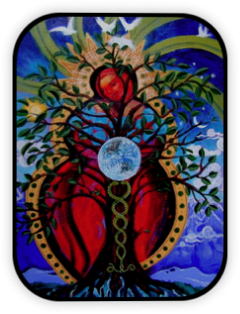
Original image found at http://www.dwayneedwardrourke.com/Pages/TIMEWAVE0728/page21/page21.html

What is unnerving is how we obsess about the end of the world instead of living in the world we have right now.

I would like to share a Mayan poem that I came across.  It is called “Imix”- a Mayan Oracle Interpretation translated by Ariel Spilsbury and Michael Bruner and I am drawn to it due to the imagery and symbolism:

I Am Imix, Primal Mother.

Still, dark womb of the patterned potential of becoming, sacred, interstellar genesis, I Am.

Nourishing, fertile abyss, I birth you.

Benevolent, my mighty cauldron of primal waters, enveloping the living seed. Eternal is my embrace. Continue reading “Imix: Primal Mother and Dawn of a New Age by Michele Stopera Freyhauf”

We’ll Have a Green Christmas… Together! by Tallessyn Grenfell-Lee

Many of us journey through Advent in a culture whose businesses frantically try to capitalize on the hope, peace, joy, and love promised by the season. Although many agree that consumerism contradicts the fundamental teachings of Jesus, I am not here to disparage every last Christmas tradition until we’ve pared our so-called celebrations down to nothing. Yet many of us wish our festivities could better reflect the heart of Jesus’ teachings and ministry. It’s harder to feel quite so celebratory once we understand the ways in which our choices affect our kindred – both human and otherkind, near and far.

Maybe the point is not to have some kind of pure, ideal Christmas. If we can acknowledge the imperfect world we live in yet at the same time lift up our communal journey toward greater healing and justice, we will feel the laughter and songs of the whole Earth intertwine with our own joys at Christmastime. When gifts to our loved ones also help others around the world, the warmth we feel at their own excitement grows deeper and more powerful when we can also sense the joy of our unknown kindred somewhere else. Our appreciation of festive decorations feels more authentic when we know our choices are helping reduce the impacts of climate change, or providing habitats for God’s little sparrows. Our traditions can bring us closer to one another, and help us feel the presence of our family – all of them – throughout the journey toward Christmas. Continue reading “We’ll Have a Green Christmas… Together! by Tallessyn Grenfell-Lee”

To Garden by Kathryn House

My work is transformed when I view the task at hand through verbs I learned through gardening: tend, nurture, sow, dig, weed, share, till, harvest, nourish, rest.

Yesterday was the autumnal equinox, which means that fall is officially here. Right on cue, the first leaves are changing from green to shades of gold and crimson. The air is crisp, and the nights are cooler. In the Northern Hemisphere, fall also marks the beginning of the harvest season. Tending a garden has certainly changed the way I think about food, but it has also given me a lens through which to reflect more broadly on community, justice, faith, and hope. I love that gardening invites me to consider a way of being that is governed by a rhythm all its own. This steady beat brings my tendency to rush without reflecting to a halt. Every garden is unique and every gardener has a different philosophy, of course. For myself and for the housemates with whom I have gardened over the years, these three raised beds have come to constitute a sacred space. A space of hospitality, of nurture and delight, they are a space around which we are reminded of finitude, of beginnings and endings, of gratitude. Continue reading “To Garden by Kathryn House”