Ode to Seeds by Janet Maika’i Rudolph

“In this is all that is.” 

Julian of Norwich (while purportedly holding a seed in her hand) – 14th century

“Even if I knew that the world would end tomorrow,

I would plant an apple tree today.”

Martin Luther

Have you ever had bedbugs or lice? If not, you’re lucky. If so, you understand just how hard they are to get rid of. Why is that? Because they are essentially seeds with legs.

Seeds need to be able to travel in order to be successful spreaders of life. For example, when an acorn falls from an oak tree, it probably can’t germinate right where it falls. The mama tree has already taken up all the earth/soil space as well as the water sources for its own roots. And the mama tree’s own leafy branches will block out access to the sun. So the innate goal of the seed is to move to find a more friendly space. Evolution has created all sorts of ways for seeds to use motion in the service of finding their own place to germinate. In the case of the acorn, there are squirrels. Because they are a food source, many of the acorns get taken to dens under the earth. Many of those are not eaten. Either they are forgotten or the squirrel in question meets another demise. An acorn that is nestled in a den under the earth, can have a potentially perfect environment to sprout far from its origins.

Continue reading “Ode to Seeds by Janet Maika’i Rudolph”

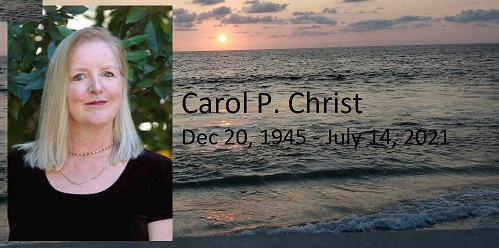
The Legacy of Carol P. Christ: Meeting the Windigo

Towards the end of Braiding Sweetgrass, mother, biologist, and member of the Citizen Potawami Nation Robin Wall Kimmerer sets out at the end of winter to visit a forest area near her home that she considers hers not in name but in virtue of her love and care for it. On arriving, she discovers that the forest is no more, having been clear-cut by the owner. The wildflowers and the plants she has harvested over the years have sprouted up, but Kimmerer knows that without the forest cover they will be burned by the sun and their places taken by brambles.

Kimmerer is overcome by anger and despair, her feelings for the land she loves merging with her knowledge that not only her forest, but the earth itself is being treated as nothing more than a product by so many—without second thought for all that is lost.

Continue reading “The Legacy of Carol P. Christ: Meeting the Windigo”

When Earth Meets the Son by Sara Wright

As I curl up

in my hatchback

open to sky

I am a snail

loving her shell
sun warms

me from behind
Autumn light
shimmers, leaves
a testament
to breeze

 some withered

by a freeze.
Burnt umber
Gold
Salmon
the understory
in full glory
Bare hardwoods 

peer down

 sentries stationed
Overhead
Acorn browned oak 
leaves smudge

 sage greens

dark crimson

bleeds
geese fly by

haunting goodbye
A dragonfly lands
on my foot
Not a grouse 
in sight
Hunted
in thickets
too thorny
for stealth
She’ll
live to see
another dawning
Scarlet pockmarked palms
lie face up

on the ground.

Warning.

 Signs are everywhere.
Insect ridden leaves –
puncture marks
deform once

smooth hands
some shriveled

beyond recognition.

Continue reading “When Earth Meets the Son by Sara Wright”

The Mixed Bag that is Toldot by Ivy Helman.

The parshah for November 26th is Toldot, Genesis 25:19-28:9.  In it, we have the struggles of Isaac and Rebecca to conceive, the relations between Abimelech and Isaac’s family, the birth of Esau and Jacob, and the loss of Esau’s birthright and his father’s blessing.  As we will see, this is a tricky portion from a feminist perspective because of Rebecca, yet, from an ecofeminist perspective, I find the way in which the portion discusses the interconnection between the water, the land, and divinity helpful.

Let me begin with the water and then we will look at Rebecca.  Toldot takes place in and around the city of Gerar in Philistine territory, while Abimelech ruled.  Isaac and his family travel through the land quite a bit between verses 26:16 and 26:32.  Most of this section pertains to them moving and then digging new wells, the covering of wells, and the finding of water.  What I find particularly interesting here is the way in which water and peace seem to go together.  For example, in 26:20-21, Isaac and his family have constructed a well but it is causing them to have troubles with the locals.  Isaac seeks peace and thus leaves.  In verse 26:26, Isaac is visited by Abimelech and eventually a formal peace is declared.  This is followed in 26:32 by Isaac’s servants finding water in a freshly dug well.  In other words, Isaac is willing to uproot his family time and again to cultivate peace; he is not willing to go to war over what in the desert really is a quite limited resource.  

Continue reading “The Mixed Bag that is Toldot by Ivy Helman.”

Legacy of Carol P. Christ: Tree-Hugging Is About Trees and So Much More Than Trees

This was originally posted March 11, 2019

Not too long ago I heard someone deride members of a seminar who were building labyrinths in the olive groves of Greece as “a bunch of tree-huggers.”  I bristled! I probably first heard of the Chipko tree-hugging movement which is led by women in the 1970s and 1980s. Because I love nature, I naturally assumed hugging trees is a good thing. Originally, I had no idea that the tree-hugging movement was about much more than saving trees from being felled in the interests of short-term profit.

I did not know that the deeper purpose of the movement is to save a way of life based on forest-culture that is being threatened by the imposition of western ideas and practices promoted by colonialism and its successor, the green revolution. Nor did I know that the traditional forest-culture of India is the provenance of women: more than 4000 years of observing and experimenting created a “women’s knowledge” passed down from mother to daughter.

Continue reading “Legacy of Carol P. Christ: Tree-Hugging Is About Trees and So Much More Than Trees”

Legacy of Carol P. Christ: “Calling All Women” to Save the Earth, signed and shared by Carol P. Christ

This was originally posted on April 1, 2019

I contend therefore that we have allowed these chemicals to be used with little or no advanced investigation of their effect on soil, water, wildlife and man himself. Future generations are unlikely to condone our lack of prudent concern for the integrity of the natural world that supports all life. Rachel Carson, Silent Spring

Today we are faced with a challenge that calls for a shift in our thinking, so that humanity stops threatening its life-support system. We are called to assist the Earth to heal her wounds and in the process heal our own – indeed to embrace the whole of creation in all its diversity, beauty and wonder. Wangari Maathai

I want you to feel the fear I feel every day. And then I want you to act. Greta Thunberg

We are calling all women and our allies to come together to save the earth that sustains us all. Is it any wonder that from Rachel Carson to Wangari Maathai to the emerging young leader Greta Thunberg, women have been in the forefront of environmental movements for a century? As daughters, sisters, mothers, grandmothers, and aunts, we have long cared and advocated for the most vulnerable among us, the very young, the very old, the disabled, those who are the first to suffer the consequences of climate catastrophe and the many kinds of pollution that are poisoning the earth we share.

Continue reading “Legacy of Carol P. Christ: “Calling All Women” to Save the Earth, signed and shared by Carol P. Christ”

Whale Continues Singing to Me by Judith Shaw

The mystery evoked by Whale continues to fill my heart as Whale images fill up papers laid out on my drawing table.

Continue reading “Whale Continues Singing to Me by Judith Shaw”

In Memoriam: Rosemary Radford Ruether by Elizabeth Ann Bartlett

Yet another of my great feminist and spiritual teachers has died.  Rosemary Radford Ruether, ecofeminist Catholic theologian, died on May 21st.  Her work challenged my thinking and gave me new understandings and perspectives. She was a prolific writer, authoring hundreds of articles and 36 books, and was the quintessential scholar and historian of world religions and ecofeminist thought and theologies. A scholar of the scholastics, she examined the three strains of Western thought: the Hebraic tradition; Platonic-Gnostic; and Pauline-Augustinian in all their complexities to develop an understanding of the nature of Western thought and its implications for the domination of women, nature, and colonized others. As she described her own approach, she drew out the contradictions and complexities in these theologies, careful “to see both negative and positive aspects . . . and to be skeptical of exclusivist views on either side.”[i] Her thought and writing was ever-expanding, and always striving “to see the dominant system of patriarchy, including its racism, classism, and colonialism, in critical perspective,” and to put herself “in places where in solidarity with its victims, I can see it from its underside.”[ii]To this end, she brought together the ecofeminist theologies of women from around the globe, particularly the global south.[iii] Her thought also grew to include critiques of militarism and corporate globalization.  Needless to say, I cannot begin to encompass all of her contributions here. So I will focus on the ways her thought has most deeply influenced and inspired my own, as well as my students’.

Continue reading “In Memoriam: Rosemary Radford Ruether by Elizabeth Ann Bartlett”

On the Good and the Bad of Behar by Ivy Helman

The Torah portion for May 21, 2022 is Behar (Leviticus 25:1 – 26:2).  In it, the Israelites receive instructions for sh’mita and yovel – two types of sabbatical years.  These years attempt to set up right relations between the community, the inhabitants of the land, and the land itself.  From an ecofeminist perspective, not all is as idyllic as the Torah wishes it to seem.   

Behar begins with sh’mitah, a sabbatical year that takes place every seventh year.  During sh’mitah, the land must lay fallow.  Both humans and animals can eat from what the land will naturally grow.  

Continue reading “On the Good and the Bad of Behar by Ivy Helman”

From the Archives: Frozen 2: Can the Christian Church Hear its Gospel Song? by Trelawney Grenfell-Muir

This was originally posted on March 5, 2020

The first time I saw Frozen 2, I was impressed by the ecofeminism and the efforts to respect the Sami culture. The second time, I thoroughly enjoyed the superb music and the character development. The third time… was a religious experience.

Other contrubutors have written wonderful reviews of Frozen 2, and I agree wholeheartedly that its animation reinforces the sexist idea that females should be tiny compared to males, except for our eyes, which should be larger than our wrists. These disempowering representations saturate today’s media, and I regularly spend a whole lot of time deconstructing them with my daughters.

However, there is a lot to love about Frozen 2, and as a Christian, I found myself resonating with several of the symbolic truths the film offers. I spent some time looking into the Sami religion, to see how much of it was incorporated into portrayals of the Northumbra. I knew that Disney had consulted with Sami representatives to portray their culture with respectful accuracy. The Sami history is an all too familiar tale of violent imperial conquest allied with Fundamentalist Christian Dominionism. The wounds of Sami history certainly give me terrible grief as a white American and a Christian, and I hope that the anti-colonialist messages of the film spread awareness of such violence in my country. 

Continue reading “From the Archives: Frozen 2: Can the Christian Church Hear its Gospel Song? by Trelawney Grenfell-Muir”