La Llorona by Sara Wright

The legend of La Llorona has been a part of Hispanic culture in the Southwest since the days of the conquistadores. Though the tales vary from source to source, the one common thread is that La Llorona is a woman named Maria who is always dressed in a white gown, the spirit of a young Mexican mother who drowned her children in the river in a moment of rage or abandonment by her lover and then took her own life in her deep shame and sorrow. La Llorona’s disembodied spirit is said to haunt the rivers at night – especially the Rio Grande – where she can be heard weeping in remorse for her dead children. Children are cautioned not to go out after dark because La Llorona might murder or drown them too. Because the tale of the Weeping Woman originated with the Patriarchal Spanish conquest I have always been suspicious of the various versions of this story believing that its meaning has been distorted.

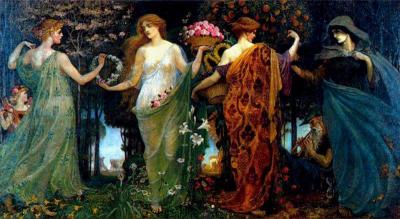
Immediately what comes to mind is the Mater Dolorosa, Our Lady of Sorrows, or Mother of Sorrows. All refer to the Virgin Mary, the only goddess left in Christianity. Our Lady of the Seven Sorrows is another name used to refer to this goddess. The Mater Dolorosa is also a key subject for Marian art in the Catholic Church.

Continue reading “La Llorona by Sara Wright”

The Exclusion and Embrace of Trans-women within Feminist Spirituality by Kelly Palmer

Women-only circles have long existed within the Goddess movement, the Red Tent movement for example exists as an inter-faith, grass-roots movement for women only to come together to claim safe and sacred space. But too often ‘women-only’ in fact means ‘cis women only’. Trans women are not allowed. This has been the topic of much heated debate in recent years, culminating last year in the publication of ‘Female Erasure’ an anthology of essays on gender politics and feminist spirituality that has led to calls for the editor Ruth Barrett to be expelled from her thealogical seminary on grounds of transphobia. Barrett and many of her contemporaries openly call for the exclusion of transwomen from women-only Goddess circles and respond to criticism by saying that asking for ‘women born women only’ space is not meant to be antitrans but simply carving out a space for people with similar life experience – in the same way that people of specific ethnic minorities may gather, or LGBTQ people. Surely, they may say, the answer is for trans women to create their own spaces?

There are two problems with this. Firstly, trans women are in a significant minority, making access to groups of other trans women practicing Goddess spirituality difficult. If a local woman’s circle is their only means to practicing their religion with others, and they are excluded by this on the basis of their genitalia, this exclusion is incredibly hurtful and undermines not just one’s ability to practice a faith but one’s very identity and esteem. Secondly, it is not just local, personal groups that are practicing this exclusion, but large and public gatherings, making very public pronouncements that trans women are not welcome. They have been excluded from womens rituals at PantheaCon in 2011 and Michigan Womyns Music Festival has a policy of excluding trans women from the entire event.

Continue reading “The Exclusion and Embrace of Trans-women within Feminist Spirituality by Kelly Palmer”

The Four Phases of the Feminine Way by Elisabeth Schilling

For so long I’ve been wandering in the maiden stage, but now I am a mother, to myself, since I’ve made hard decisions to loosen or cut ties with people who have not always acted in my best interest in their attached and, at least to me, manipulative ways; I have long felt a mother to whatever group of students I have the honor of guiding; and I moonlight as a card reader/astrological guide where I feel I can nurture and provide compassionate advice to those who desire a connection from the universe. The way I practice is that I allow my empathy and research about ourselves to encounter the client’s own internal wisdom. There is not anything that qualifies me to be a teacher or reader any more than anyone else. We are all guru to each other when we listen closely.

I am not sure why I have never wanted to be a mother of a child. Not-wanting has felt very natural to me. Now that I have put some distance between myself and my own mother, her voice and so her desires are not so much hovering over me. I feel free and good about my decisions, about following the path that is normal for me.

But what I really love about the four phases of the feminine way – maiden, mother, maga, and crone — is that we do not necessarily need to always identify with the stage that aligns with our age or any rites of passage. I remember going to a goddess ceremony in California where we could speak from any of the perspectives we felt aligned with that at the time and explain why.

Continue reading “The Four Phases of the Feminine Way by Elisabeth Schilling”

Sustaining Myself by Molly Remer

37880751_2142186212660256_8002693145366102016_nI touch the earth and offer gratitude
for this land I call home.

I reach towards the sky and offer gratitude
for sun, moon, and stars.

I place my hand on my heart
and breathe deep, offering gratitude

for all that I am and all that I have
and for the many blessings of my life…

June 2016

I am finishing my last semester of college teaching. I have four children ranging from 18 months to 12 years and a thriving home business. I am exhausted. I feel wrung out, weary, overloaded, sped up, and on the edge of collapse. My dominant fantasy, the one that pops unbidden to my mind as I work through my never-ending to-do list is to just lie on the floor, flat on my back. I tell my husband, “this isn’t a sustainable pace for me. If I keep going like this, something bad is going to happen to me.”

I keep going.

Continue reading “Sustaining Myself by Molly Remer”

On Chronic Illness and Justice by Ivy Helman

29662350_10155723099993089_8391051315166448776_oFor almost four years, I’ve been living with the long-term effects of an inner ear lesion.  The lesion is long gone but its side effects are not.  Throughout the day, I feel a combination of unsteadiness and sudden, unpredictable sensations of movement.  On better days, the unsteadiness is almost non-existent and the feelings of movement are minimal.  On worse days, I’m troubled with a type of brain fog that makes it hard to concentrate as well as disrupting unpredictable sensations of being on a boat that can’t pick one direction in which to move.  It’s frustrating, tiring and demoralizing.
Summer is the season of worse days.  There is really nothing I can do to feel better.  Even staying well-hydrated and taking it easy often doesn’t steady the boat.  So, instead, I often continue my life as normal.  Then, I lay in bed at night and hope sleep comes soon. Continue reading “On Chronic Illness and Justice by Ivy Helman”

A Nurturing Environment is Not a Luxury by Elisabeth Schilling

There are two tarot card decks that have accompanied me on my trip overseas this summer: Alana Fairchild’s Rumi Oracle and Lee Bursten’s Tarot of Dreams. In recent readings, I have been presented with messages of place, thus the topic of my post.

But first, Seneca, Stoic philosopher born around the time of Jesus, cautions that people traveling to escape their difficulties are sometimes no better when they have arrived to a distant land because they have not become rid of themselves. Likewise, zen philosophy suggests that it is not our circumstances that matter so much as the peace and calm we create in our inner landscape. Nhat Thich Hanh or Ram Dass or Pema Chödrön (maybe all 3) have a metaphor for the tumultuous ocean – that the sea is often rocky, but it is always calm in the deep beneath. Yet, I see all this as a reminder to be mindful about the added layers of suffering we can create and advice for difficult times when we can’t leave yet. Regardless, I think any wisdom cannot discount the need for a nurturing, healing space when at all possible.

Continue reading “A Nurturing Environment is Not a Luxury by Elisabeth Schilling”

Wild Snail Festivals by Molly Remer

“It’s a wild snail festival out here!”
—Tanner (age 3)

This spring we took a family mini vacation to Table Rock Lake, about three hours away from home.

At its best, working and schooling from home with our family of six feels like a beautifully seamless integration of work and life—there is no need to compartmentalize or draw distinctions between “life” and “work,” because it is ALL just life and living. At its worst, it feels like the work bleeds into everything else in an all-consuming way and the to-do list just never ends and something or someone is always getting overlooked or shortchanged. We find that it is helpful for us all sometimes to just all step away and be somewhere else, while the to-do list stays at home! We try to take at least five family adventures/trips a year (some of them small and some more involved).

Continue reading “Wild Snail Festivals by Molly Remer”

Spiritual Ideas, Existential and Eastern, in Jonathan Livingston Seagull by Elisabeth Schilling

Peaceful Solitude

After my year of teaching high school students, I found a kinship with them in their frustrations, longing, apathy, hopelessness, and hope. Fortunately, we studied together Jean Paul Sartre, whom I want to get to know more intimately, but we, the teens and myself, could take the spiritual answer to our questions about the meaning of life (is there one? What is it?): The meaning of life is to give it meaning.

I am not sure about their generation, but adolescence for me, in mine, was about discovering, not necessarily creating. Of course, now I think it is a little of both.

Sometimes I wonder if there is also a lesson. Being an academic, perhaps I love learning and teaching. I demonstrate my love as Jonathan Livingston Seagull does, by offering to others, perhaps a specific community of others, those who have chosen or must be in a state of learning (easily found in institutions of high school and college), the truths I have gathered (59). Of course ‘truth’ is a word that tastes a bit tannic, for it needs to be rolled around by the tongue a bit to be cleansed; perhaps to mitigate its toxic potential, we can never consume it undigested, but must gestate it and transform it within our warm bodies, just at the cliff, before we allow it to permeate our organs in a chemical structure that serves us.

Continue reading “Spiritual Ideas, Existential and Eastern, in Jonathan Livingston Seagull by Elisabeth Schilling”

Celtic Myth, Moon Blood, and the White Beauty Standard by Marisa Goudy

My woman’s body is entering the dark time of the moon, even with blinding white snow lashing the windows, even with a full moon tracing its way far above thick clouds. My mood is black and soon I’ll be flowing red, and the snow will just drive on white, white, white.

In The White Goddess, Robert Graves tells us: “…the New Moon is the white goddess of birth and growth; the Full Moon, the red goddess of love and battle; the Old Moon, the black goddess of death and divination.”

The Celt in me feels cradled by this imagery, even if, as Judith Shaw and Carol P. Christ have pointed out elsewhere on this site, the idea of maid, mother, and crone is a modern invention, not gift from the past. I agree with Christ:  “My suggestion is that we give up the idea that the details of contemporary Goddess Spirituality are rooted in and authorized by tradition. We can instead acknowledge that though we are inspired by the past, we are the ones who are creating contemporary Goddess Spirituality.”

Continue reading “Celtic Myth, Moon Blood, and the White Beauty Standard by Marisa Goudy”

Inner Garbage (Fear) vs. Inner Goddess (Love) by Vanessa Soriano

I’m sitting on my meditation pillow for the thousandth time searching for clarity.  Initially, going within feels like traversing a jungle; swinging from one thought branch to another.  I’m itching for some peace and I’m almost certain this isn’t the way to it.  But, I’ve been here before and I won’t quit breathing through the discomfort.  I know I will greet the inner goddess soon enough.  Getting past the noise is part of accessing her wisdom.  The noise teaches me discernment (if I allow it to).

Eventually, the monkey mind gathers up all the branches and turns them into a prodigious figure that blocks the sun inside.  Hello darkness my old friend.  Inner garbage (fear) makes her entrance.  I’m still breathing.  Eyes closed.  Determined through slow, rhythmic breaths, to move past her.  I know I cannot run from her.  She’s faster and outwits me every time.  Continue reading “Inner Garbage (Fear) vs. Inner Goddess (Love) by Vanessa Soriano”