One of the loudest refrains I perceive in the Bible is the message that good spirituality means giving everything away. It is a radical concept that begins in an obvious way with material things, especially those that we have in excess. The wisdom here is not too difficult for me to grasp: one cannot meet the Lord if s/he is wrapped up in the routines of acquisition and hoarding.
But, this is only the beginning. The teaching reaches down much deeper than the critique of riches and speaks in some totalizing fashion to the very essence of personal being. It seems to say to me that good spirituality involves letting the self be so entirely poured out of the ordinary instincts and behaviors of self-consciousness and self-preservation, of the self qua self, that it is capable of receiving the inpouring of God’s wisdom and light.
Put another way, the self has to condition itself to receive that which is genuinely extrinsic, that which is outside itself, and that encounter cannot occur so long as one is self-absorbed. This insight, of course, is not exclusively biblical or Christian. Indeed, it is perhaps the most common point of agreement among all the great spiritual traditions. Continue reading “Give Away All That You Have, and Then You Shall Receive…by Natalie Kertes Weaver”
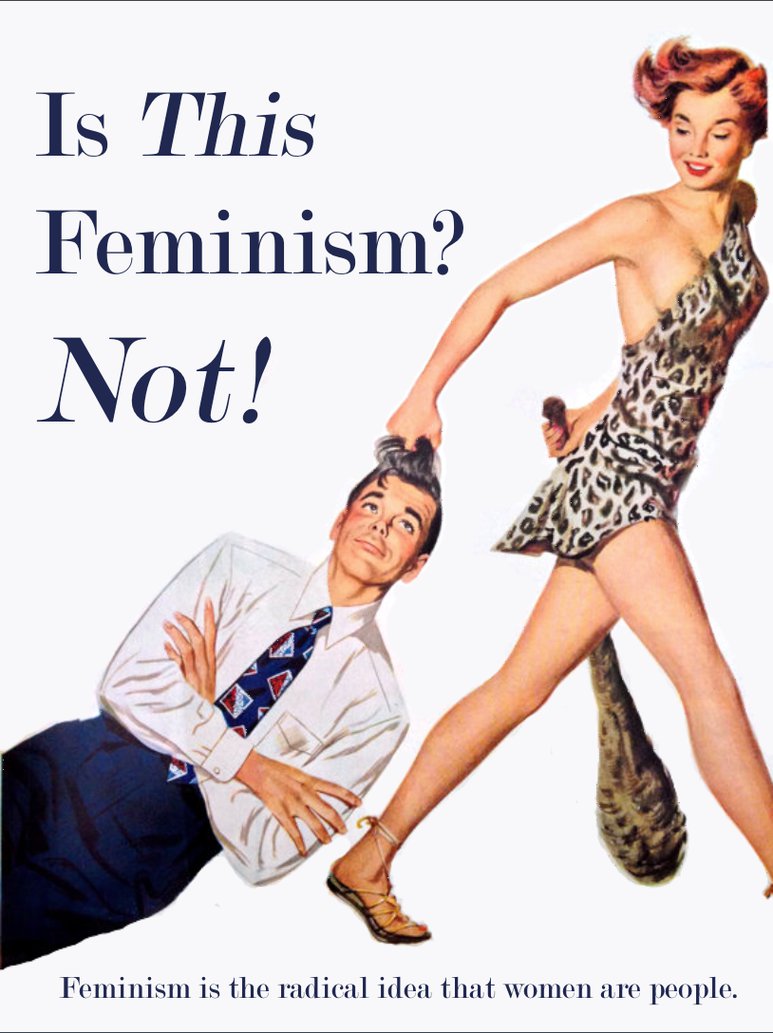
It is so easy to blame feminism for the ills of the world – mainly because of continued misconceptions and misunderstandings about the definition or meaning of feminism. Feminism is responsible for poverty, bad leadership, wars, the polar vortex, the list goes on. Feminism is still considered a derogatory term that serves to incite prejudice against those who label themselves as one. In fact, negative connotations surrounding feminism are exacerbated in today’s culture, especially in the media. Fox News seems to be the poster child of “femiphobia” – a term coined by Stephen Ducat and defined as “wanting to repress every man’s feminine side and demonize the feminine and gay wherever we see them.” Elisabeth Hasselbeck and Nick Adams, in a recent interview, illustrate this femiphobic viewpoint by blaming feminism for raising a culture of “wimps” and “wussies” and thus compromising the U. S.’s national security and weakening its global presence. In other words, feminism is to blame for the problems of the world.
According to Adams, men around the world are no longer allowed to be “manly” and that this phenomenon is a “dangerous” problem:
American men are of course very susceptible to it. It’s really important particularly in America given the leadership role that America has in the world that American men be allowed to be men.
What does in mean to be a man and how is Adams defining that stereotype? While I am aware of the discussion of gender identity and roles even gendered stereotypes, this post is not about what those roles mean. Rather, for this point of discussion, I want to address the issue of masculinity, feminism, and what it means to be a “wimp” as portrayed by popular media.
With that caveat in mind, I ask the following questions:
Is the author suggesting a move to a “hypermasculinity”?
Is Adams identifying masculinity with aggression and violence in a world where feminists and perhaps all women are demonized?
In a society dominated by the “alpha male” character trait,male honor and pride are paramount. Is Fox News telling men to replace so-called passive behavior with pride, abrasiveness, authoritarianism, and arrogance–in such a world if where women are demonized, then assaultand rape will follow. The call for “real men” or “hyper-masculinity” therefore provides a real potential to move us further towards a misogynistic rape culture of violence–in the direction of barbarianism.
The start of the Spring 2014 semester is right around the corner, which means that many academics like me are madly trying to put the finishing touches on their syllabi.
The process of doing so has always been equal parts exciting and stress-inducing. Right now, however, I am feeling the pain. Why?
A former evangelical Christian friend of mine sent me information on the intriguing documentary God Loves Uganda. The newly released documentary addresses how the American evangelical movement has prompted a political and social shockwave in the country of Uganda. While missionaries are typically associated with delivering aid and improving the conditions of third world countries, the spreading of Christian values and ideals has inflicted suffering upon ethnic communities through evangelical indoctrination.
The intent of the film is to raise awareness of the political and social brutality that the evangelical missionaries are instigating; specifically through their teaching that homosexuality is a sin and should be dealt with accordingly. In Uganda this means death. Given the rise of globalization, transnational religious actors have been more enabled to engender other nations with their respective religious beliefs, often with minimal regard for the cultural and political landscape of the nation they wish to transform. Continue reading “Evangelical Missionaries Preach Death in Uganda by Andreea Nica”
Jesus loved sinners and Jesus would rather be dancing with me in West Hollywood on a Friday night than lugging through a swamp luring ducks into a trap with a duck caller made by a clan who think that my sexual actions are similar to that of an individual having sex with an animal.
To be able to walk down the street holding the hand of the one you love is a great feeling and an action that some of us aren’t able to perform without fear.
A line has been drawn in the sand between those who support gay rights and those who do not. While some call it being on the “right side of history,” I simply now refer to it as not sounding and looking like a bigot in the halls of history and in the various books, Facebook posts, and Tweets that our children will one day read. Continue reading “Yes, You’re a Homophobe by John Erickson”
Is care the beginning of ethics? Has traditional western ethical thinking been wrong to insist that in order to reason ethically, we must divorce reason from emotion, passion, and feeling?
In Ecofeminist Philosophy, Karen Warren criticizes traditional ethical thinking–advocating a “care-sensitive” approach to ethics. Traditional ethics, as Warren says, are based on the notion of the individual rights of rational moral subjects. Like so much else in western philosophy traditional ethics are rooted in the classical dualisms that separate mind from body, reason from emotion and passion, and male from female. In addition to being based in dualism, western philosophy focuses on the rational individual, imagining “him” to be separable from relationships with others. Western ethics concerns itself with the “rights” of “rational” “individuals” as they come into relationship or conflict with the “rights” of other “rational” “indiviudals.”
Among the more controversial Roman Catholic documents is Humanae Vitae, the 1968 encyclical of Pope Paul VI on birth control. This encyclical famously instructs against the use of artificial contraception methods in the regulation of birth. This position is based on the theological warrant that the natural law of God’s reproductive design requires human sexuality, if it is to be moral, to be always nuptial, companionable, and open to new life. The encyclical anticipates a number of reasons why people will object to this teaching, including: population problems, family and personal limitations, economic concerns, and so on. It also anticipates that some will suggest procreative and unitive ends must be seen diachronically in the context of the fullness of nuptial sexuality, such that sexuality would be understood holistically rather than as a series of individual sexual acts. Despite its acknowledgement of these concerns as legitimate, the encyclical argues that grave harm flows from the distortion of natural law and leads inevitably to the degradation of sexual dignity and nuptial integrity (for example, in making free sex more available to young people outside of marriage or cheapening male regard for women on account of women’s sexual objectification). The encyclical thus opts for an approach that evaluates sexual morality in terms of individual sexual acts.
The perspective of the document has been critically unpacked for decades, and its instruction is in the very least unconvincing to many Catholic couples. I find in my teaching that Catholic college students today are unfamiliar with the document’s language and rationale, even though they may know the basic instruction that Catholics aren’t supposed to use birth control. Since this issue is both topical currently due to the healthcare legislation and since birth regulation is a requisite discussion in my course on sexual ethics, I have the students read the encyclical itself. Now, this is a hard task because I know by and large what the student reactions will be. Their most favorable reaction is generally that the document has no instructional or binding value for them. Their least favorable reaction is that the document makes poor sense of the human situation today, especially because human sexual expression reaches well beyond the Church’s vision of normative, heterosexual, marital union. Continue reading “On the Transmission of Life by Natalie Weaver”
The time for false solidarity is over…Let’s us stop talking about it, let us just dig deep inside of ourselves and find a way to do it.
Fifty years ago in response to President Kennedy’s assassination Martin Luther King Jr. wrote: “Our nation should do a great deal of soul-searching …” It is these words of Martin King’s that echo in my mind fifty years later as news headlines continue to be filled with stories of innocent young black bodies falling victim to a social climate that nurtures racialized fears and breeds racialized violence. If the deaths of Renisha McBride, Jonathan Ferrell, Jordan Davis, and Trayvon Martin tell us nothing else, they proclaim loud and clear that we are a people in need of a “great deal of soul-searching.” For me, this time for soul-searching is nothing less than a kairos time. Continue reading “Moral Courage by Kelly Brown Douglas”
I think classroom discussions can be a good forum for modeling the kinds of discussions students might have in their families, peer groups, faith communities, and political contexts. But sometimes I really wish I wasn’t the one responsible for leading the discussion.
I started a new position this year as a lecturer in Christian Ethics. This semester, the high moments of my week are my two 75-minute sessions of an Introduction to Christian Ethics class. I have less than 20 students and they are smart, kind, engaging, talkative, and respectful. They also come to class prepared and eager to participate in discussion. I love it. I count myself as blessed for having the opportunity to teach them. But there have been several days when I haven’t wanted to go to work and face them. Continue reading “A Reflection on Leading Discussions about Difficult Ethical Issues by Elise M. Edwards”


 One of the loudest refrains I perceive in the Bible is the message that good spirituality means giving everything away. It is a radical concept that begins in an obvious way with material things, especially those that we have in excess. The wisdom here is not too difficult for me to grasp: one cannot meet the Lord if s/he is wrapped up in the routines of acquisition and hoarding.






 Feminism and Religion