My Feminist Perspective of Authority – Part 1 by Elise M. Edwards

I make a distinction between power and authority.  Authority is a personal characteristic based on a relationship of trust between me and a text, a person, or their work.  Power, on the other hand, is operative with or without trust.

This past weekend, I had the honor of participating in a workshop on Living Texts: Celebrating Feminist Perspective and Theo/alogy, Authority, and the Sacred in the Academy.  The workshop was organized for the Women’s Caucus of WECSOR, a regional association of national organizations who study religion.  I was delighted to connect with new friends, mentors and sisters interested in feminism and religion, including some of my co-contributors on this site –Theresa Yugar, Sara Frykenberg, and Corinna Guerrero .  There were two panels that shared our reflections about authority from either student perspectives or diverse professional perspectives.  I shared my experiences as a student.  This workshop was a gathering where women scholars in religion could discuss the challenges and promises of our voices in the academy.  Because our dialogue was so inspiring to me, I thought I’d continue the discussion here. Continue reading “My Feminist Perspective of Authority – Part 1 by Elise M. Edwards”

On Being in the Moment By Ivy Helman

Time.  We mark years, months, days, hours, minutes and seconds. We mark seasons.  We mark life events.  We live our lives in time: both circular and linear.  Time began before we did and time will continue after we cannot experience it any further.   Some say we repeat time with rebirth.  Others suggest that we only have one lifetime of which we should make the most.  Still others suggest there is existence outside of time with concepts like infinity and eternal life.  We sure do write, discuss and ponder time a lot, but do we ever really experience it?  Meaning: what would it be like to live in the moment, to be aware of and completely conscience within an instance of time, not thinking of the past, not worrying about the future, but being fully present in the here and now?

Sci-fi geek that I am, I often recall the Star Trek: The Next Generation movie entitled Insurrection when Captain Picard and Anij discuss experiencing a moment of time.  Anij explains to Captain Picard, “You stop reviewing what happened yesterday. Stop planning for tomorrow. Let me ask you a question. Have you ever experienced a perfect moment in time?”  A few lines of dialogue later, she picks up the topic again by describing what being present is like. ”We’ve discovered that a single moment in time can be a universe in itself. Full of powerful forces. Most people aren’t aware enough of the now to even notice.”  The visual effects show water stopping and a butterfly’s slow flight if I remember correctly.  Captain Picard is obviously caught up in these moments of time as well as being mesmerized by Anij herself.  The power of both the moments of time and Anij herself is palpable. Continue reading “On Being in the Moment By Ivy Helman”

Is Baptism a Male Birthing Ritual? By Michele Stopera Freyhauf

Quite a number of years ago I had a conversation with one of my professors, a feminist theologian, who posed the question “Why do I need a man to purify my baby with the waters of baptism?  Is there something wrong or impure about the blood and water from a mother’s womb – my womb?”  Before you jump and shout the words Sacrament or removal of original sin, this question bears merit in exploring, especially in today’s world where women are taking a serious beating religiously, politically, and socially.  In today’s world, violations and rants are causing women to stand up and say STOP!  This is MY Body.  This outcry was provoked by chants of ethical slurs against women– Slut! Prostitute! Whore!  The cry got even louder when the issue of religion and government was raised in the fight of healthcare coverage of contraception. The cry got even louder with the enactment of the laws in Virginia and Texas (and many other states to follow suit) that forces women to undergo transvaginal ultrasounds in early stage abortions.  The mandatory insertion of a wand into a woman’s vagina (mandated by the government, mind you), is a violation and has women crying RAPE!

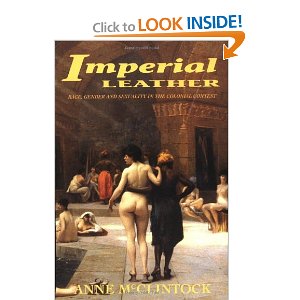
The memory of this conversation did not re-appear by chance, it was prompted by a book I read for my History of Sexuality Class – Imperial Leather: Race, Gender, and Sexuality in the Colonial Context by Anne McClintock who addresses the notion of baptism through origins, property, and power.  So many things are currently being taken away from women and reading McClintock’s assertion regarding male baptism is perplexing.  She believes that male baptism or baptism by a man takes women’s role in child bearing and diminishes it.  These are the same men who historically treated and regarded women as vessels.  She further asserts that this act is a proactive removal of creative agency with respect to a woman’s ability to have the power to name.  That is, the last name of the child belongs to the husband.  A point that supports the notion that patrimony marks the denial of women.  Anyone doing genealogy encounters a perplexing struggle to identify mothers because their names are essentially erased from memory and rarely attached to a child’s name. Continue reading “Is Baptism a Male Birthing Ritual? By Michele Stopera Freyhauf”

My First Experience at a Women-Only Conference by Grace Yia-Hei Kao

“This ain’t your daddy’s conference!”

I knew that I was going to be attending a totally different type of conference than I had ever been to before when I received the following instructions on additional items to pack: (1) my own mug with which to drink coffee or tea (“we will go green in this conference as much as possible”), (2) 3 oz. of water “from a source of nature near your home” to be offered during “opening worship,” and (3) a small, modest, pre-owned, homemade, or inexpensive “earth-honoring gift for exchange.”

Continue reading “My First Experience at a Women-Only Conference by Grace Yia-Hei Kao”

Beyond “Liberal” Female Piety or “Women Read the Qur’an Too” by Amy Levin

I’m a teacher’s assistant for an undergraduate course at New York University called, “What is Islam?” The other day in class, my professor asked the students whether or not the Qur’an is considered a “book”. Fraught with anxiety over inheriting such a problematic scholarly tradition of defining and delineating what “religion” is, I kept quiet. While my professor was aiming more for something sounding like, “a book is read, while the Qur’an is recited,” I kept thinking about the physicality and sacrality of the Qur’an (among other authoritative religious texts) and the way it is handled, revered, preserved, loved, an constantly under interpretation. It was about a week later when news broke out that U.S. soldiers in Afghanistan were guilty of burning several copies of the Qur’an on their military base, followed by an unfortunate slew of casualties including at least 30 Afghan deaths and five US soldiers. Continue reading “Beyond “Liberal” Female Piety or “Women Read the Qur’an Too” by Amy Levin”

“If You Allow Gay Marriage…” by John Erickson

“We need to start examining the underlying questions of counter-cultural relationships that view one man marrying many women to be hip because we begin to see that although a polygamist idea of marriage may be sexy from a popular culture standpoint, the thought of legally recognized gay marriage always then gets likened to bestiality.”

… you have to allow polygamy, bestiality, and everything else!” The title for my post this week is a quote from an individual I used to associate with.  This individual, haling from a conservative evangelical background, tried to explain to several others and myself the reasons why gay marriage would eventually lead to the repeal of anti-polygamy and bestiality laws across the United States.

The problems that I have with this particular argument are conflating gay marriage with religious freedom.  Activists and scholars can draw comparisons to anti-polygamy cases such as the 1878 U.S. Supreme Court case Reynolds v United States and the 1882 Edmunds Act and 1887 Edmunds-Tucker Act that disfranchised and led to the imprisonment of Mormon polygamists. But in the end, gay marriage is not about religious freedom but rather human rights.

I often feel that there is this need both within and outside religious communities to promulgate the idea that LGBTQ individuals want to get married within the sanctified walls of “the church” just as much as heterosexual couples do.  Although I do not want to disqualify those who desire to see LGBTQ equality within their faith based communities, buying into a heternormative ideal of what traditional marriage should look like needs to result in LGBTQ individuals asking why marriage should be performed in sacred spaces in the first place The normative traditions that have often defined marriage have also served as shackles keeping LGBTQ couples in the mindset that to achieve fully marriage equality with their heterosexual counterparts is to fully immerse themselves within the same traditions and practices. Continue reading ““If You Allow Gay Marriage…” by John Erickson”

Preying on Victims: Radical Christianity and Exploitation of Tragedy in the Name of God By Michele Stopera Freyhauf

It is our moral responsibility, whether we identify as Christians or not, to pray for not prey on the victims of tragedies.

Over the last month, dare I say years, society has witnessed or been subjected to an all out war from radical Christians across America deploying the wrath of God and reveling in the tragedy of others to perpetuate their apocalyptic message of rhetoric and terror.   As I hear the news over the last few months, an old Billy Joel song starts to play in my head “We didn’t start the fire.”  Whether we started the fire or not, we should not feed the flames of hatred but figure out a way to extinguish it.

Here is a brief synopsis of current events that reflect this hatred and radicalism perpetuated in the name of God – examples of Christianity terrorizing or preying on victims through their actions.

The Westboro Southern Baptist Church: Preying on Victims at Funerals and Thanking God for their Tragic Deaths

Original Picture found at http://www.newsnet5.com

Their web address says it all: www.godhatesfags.com.  This group, which one cannot call Christian but rather “hate-mongers,” threatened to burn the Qur’an, was banned from Facebook for spreading hatred against homosexuals, and recently had the audacity to picket funerals of Americans killed in natural disasters, most recently, a teen-age shooting victim, Daniel Parmertor (age 16), from Chardon, Ohio.  Thankfully, volunteers across Ohio and a local group of bikers formed a human barricade to keep these people away from the funeral and grieving family and community.

This group preys on tragedy.  They “praise God for sending a shooter to a High School in Ohio.”  They “praise God for killing a coast guard member.’  They praise God for killing UK Singer Davy Jones.”  They also picketed the funerals of the Arizona shooting victims where Congresswomen Gabrielle Giffords was shot and six others, including federal Judge John M. Roll was killed stating, “God sent the shooter to shoot you!  And He’s sitting in Heaven laughing at you!”  The article goes on into quite graphic detail, which you can read for yourself  but concludes with the statement “Thank God for his Righteous Judgments!”  This group picketed over 47,500 funerals and events to date. One has to wonder what bible they are reading and what God they are praying to. Continue reading “Preying on Victims: Radical Christianity and Exploitation of Tragedy in the Name of God By Michele Stopera Freyhauf”

A FEMINIST TAOIST VOICE PART 2: MY DIALOGUE WITH ELISA FON, ACUPUNCTURIST, TAOIST, FEMINIST AND FRIEND by Sara Frykenberg

Taoism is a philosophy that, for me, has been around so long because it is meant to move and change with society…

Acupuncturist, healer and friend, Elisa Fon and I began a discussion of Taoism and feminism in Part 1 of this interview.  Elisa defined her vision of feminism and Taoism, explained Taoism’s relational and yet, individual emphasis on what is particular in each of our experiences and considered the basic relationship of yang and yin.  Part 2 picks up where she and I left off, returning to the discussion of yin, yang and supposed dualisms.

Sara: I was wondering if you could talk a little about the complementarity of yin and yang?

Elisa:  In Taoism any type of imbalance should be adjusted.  So any major abundance or deficiency of yin or yang would be considered unhealthy. Yin and yang are interrelated: without one aspect of this relationship the other couldn’t exist. Day comes and it brings certain dynamic energy with it: the light is transformed to energy for plants.  But night is equally valuable, the nurturing yin, where things fall asleep, heal themselves and prepare to go forward again in the morning.  They are considered mutually interchangeable too.  If you had an over excess of yin at some point it would actually become yang.  It’s a fluid cycle.  Like we see in the yin/yang Taiji symbol, there is yin found within yang and yang within yin at all times. Continue reading “A FEMINIST TAOIST VOICE PART 2: MY DIALOGUE WITH ELISA FON, ACUPUNCTURIST, TAOIST, FEMINIST AND FRIEND by Sara Frykenberg”

A FEMINIST TAOIST VOICE PART 1: MY DIALOGUE WITH ELISA FON, ACUPUNCTURIST, TAOIST, FEMINIST AND FRIEND by Sara Frykenberg

“So it all kind of depends… even in men compared to men, and women compared to women, you would have to have a counterpart to judge something as yin or yang—you are never statically just yin or just yang…”

Elisa Fon is a student of acupuncture, graduating this semester from Yo San University in Santa Monica, CA.  She also studies reiki, energy healing, meditation and yoga.  Elisa and I have known each other for most of our lives as friends, as one another’s support and as chosen family.  Over the last few years, however, we have more consciously fostered an intentional aspect of our intimacy: a challenge to each other to live more authentically, to walk counter-abusively and to live towards physical, spiritual and emotional empowerment.  One privilege of this relationship has been the opportunity to create a language together in order to speak across our differences and share our respective passions: feminist theo/alogies (mine) and Chinese medicine/ healing arts (Elisa’s).

Searching for a way to better understand and teach feminist Taoism, I reached out to Elisa for dialogue and language, which gave birth to the following interview about the relationship of one feminist to Taoism, or a Taoist to feminism. Continue reading “A FEMINIST TAOIST VOICE PART 1: MY DIALOGUE WITH ELISA FON, ACUPUNCTURIST, TAOIST, FEMINIST AND FRIEND by Sara Frykenberg”

Catholicism, Contraception, and Conscience: Church Imposed Teaching, God’s Gift of Free Will, and Political Rhetoric by Michele Stopera Freyhauf

Certainly one cannot turn on the news without seeing a story about the feud over the Catholic Church’s stance on forbidding the use of contraception and Obama’s Patient Protection and Affordable Care Act (PPACA) that mandates free contraception to women.  In preparing this article, I took the time to review many articles from liberal and conservative news outlets, law professors who are experts on constitutional law, and statements from the USCCB and Bishops.  Before asking questions, I want to outline the following points:

  1. In the literature reviewed, only two women, Sr. Carol Keehan and Sr. Mary Ann Walsh, made a statement against this policy stating that the government is interfering with the working of the Church.  Most voices heard and shouting the loudest are members of the clergy.
  2. Hospitals considered “Catholic” hire people of all faiths and various beliefs.  They also treat patients of all faiths.  They are not exclusively “Catholic.”
  3. Catholic identified Colleges hire professors and staff that are not Catholic.  Moreover, their student body is not totally Catholic.
  4. Catholic Charities, once again, hire non-Catholics.
  5. Insurance plans currently in place often offer contraception prescriptions at a zero to low co-pay price.  These plans are in-force at many Catholic Institutions.
  6. Under HIPAA, healthcare of employees are protected and the Employer, even the Catholic Church cannot violate the privacy of the patient, even if it is an employee.
  7. Birth Control Pills are often prescribed for women with endometriosis or other “female” reproductive disorders and not birth control.
  8. Women pregnant, carrying a dead baby, cannot have surgery due to risks are given medication to induce abortion are given. Continue reading “Catholicism, Contraception, and Conscience: Church Imposed Teaching, God’s Gift of Free Will, and Political Rhetoric by Michele Stopera Freyhauf”