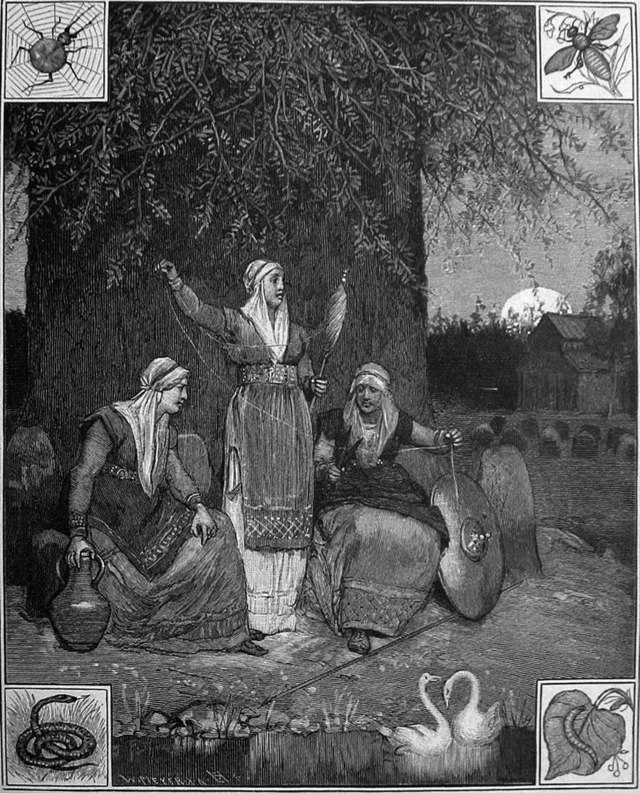
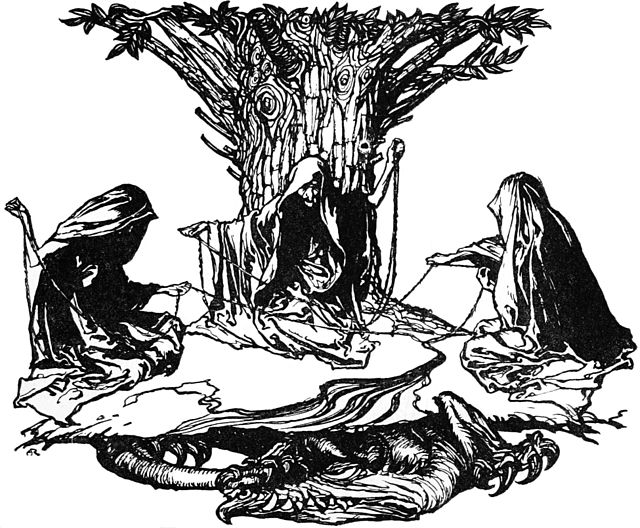
In 2020, I began writing my biography because some weird things were happening in my life including some which were time-bending. To help make sense of it, I wrote up “conversations” with the mythical characters of Persephone, Inanna and the Norns of the Norse. Throughout my bio, I speak to the Norns as an out loud meditation on the nature of time, fate and energy.
The three Norn sisters are Urd, Verdandi and Skuld. Their names come from Old Norse which is not a spoken language. The actual translation of their names is open to speculation. In general, here are their common meanings.
Urd – past
Verdandi – happening or present
Skuld – future or debt.
By mythological tradition, they show up at a child’s birth and then weave their “fateful” decisions about that child’s life into a tapestry. They are considered more powerful and fearsome than the gods because even the gods are ruled by the hands of fate (or Norns in this case). They were also treated as oracles where kings and warriors went to consult them much as was done in Delphi Greece.[1]
we need a god who bleeds now a god whose wounds are not some small male vengeance some pitiful concession to humility a desert swept with dryin marrow in honor of the lord
we need a god who bleeds spreads her lunar vulva & showers us in shades of scarlet thick & warm like the breath of her our mothers tearing to let us in this place breaks open like our mothers bleeding the planet is heaving mourning our ignorance the moon tugs the seas to hold her/to hold her embrace swelling hills/i am not wounded i am bleeding to life
we need a god who bleeds now whose wounds are not the end of anything
This was originally published on September 9, 2015
This essay is inspired by Donna Henes’s brilliant post, I am Mad. Too often as spiritual women, we are told we have to perform niceness all the time, even if it means compromising our boundaries and principles.
Mainstream religions tell us we must forgive those who mistreat us. Too many women in very abusive situations literally turn the other cheek–to their extreme detriment. As Sherrie Campbell points out in her essay The 5 Faults of Forgiveness, the obligation of forgiveness oppresses survivors of abuse because it makes it all about the perpetrator and not about the healing, dignity, or boundaries of the survivor.
In my own Catholic upbringing I learned to swallow my anger and rage until it erupted in depression and burning bladder infections. My background did not teach me to skillfully dance with anger and it’s been a difficult learning curve for me. But I learned the hard way that owning my anger was crucial if I wanted to stand in my power and speak my truth.
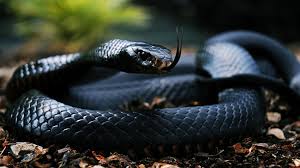
Once when I felt a particularly strong need to break out of a dysfunctional situation, I had a powerful dream of a black snake, as beautiful as it was terrifying. In the course of the dream, I realized that the huge black snake was my own repressed anger, power, and strength. The beautiful inner self longing to be claimed.
Meek and mild women don’t make history. Hildegard von Bingen, whose feast is coming up on September 17, famously spoke her mind and ferociously stuck up for what she thought was right, famously locking horns with Emperor Barbarossa himself. She also defied her archbishop and suffered an interdict as a consequence, nearly dying an excommunicant. But she was a strong woman who would not be silenced. We should all be so brave and bold.
Claiming our true spiritual power means claiming each part of ourselves, including our fierceness. Our scary side.
Fierceness means embracing our gut wisdom. Voicing the sacred NO to protect ourselves and our loved ones from compromising situations.
I see modern day women like holistic healer Susun Weed embodying this fierceness as she empowers women and girls to recognize the sacredness of their own bodies, the holy mysteries inherent in menstruation, childbirth, and menopause, which are too often pathologized in male-dominated medicine.
Over the years I’ve learned to trust and act on my own inner knowing and discernment. To know when to say NO. By using strong, no bullshit women like Hildegard and Susun Weed as my role models.
Each time I trusted myself enough to act on my gut wisdom, to trust the inner NO, and speak my truth, it has served me well, although it’s sometimes been a painful learning process.
Anger and fierceness wake us up to what is wrong and needs to be changed. There is so much energy in anger that can be harnessed for healing and transformation. Fierceness is the strongest, most protective form of love, the ferocity with which a mother bear defends her cubs.
Coiled inside each one of us is a snake of great power. Let us all dance in our power and strength.
Minoan Snake Goddess, ca 1600 BCE, Knossos, Crete
Mary Sharratt is committed to telling women’s stories. Please check out her acclaimed novel Illuminations, drawn from the dramatic life of Hildegard von Bingen, and her new novelRevelations, about the mystical pilgrim Margery Kempe and her friendship with Julian of Norwich. Visit her website.
My daughters came to me after Sunday School one day, concerned about a story they had heard in which God drowned almost everyone on Earth. So I sat down and thought about why a community might want to tell that story, and what valuable wisdom might be lifted from it for my children. Here is what I told them:
God/ess has many faces, which help us understand different things we need to know at different times. Sometimes we think of God/ess as Crone, an old, old woman crowned with silver hair as an emblem of her wisdom, who helps us learn to let go of anything that is holding back the wellness of our community and ourselves.
When I was in my twenties and in therapy I had a recurrent dream in whicha strange man was chasing me and caught up with me and started to strangle me and I could not scream. I was asked to act this dream out by my therapist, who told me that this time I would scream. I could not. She got up and came over and put her hands around my neck and started to squeeze. I still could not scream.
Two decades later I had a dream in which I was a baby and suffocating in my crib. I asked my current therapist if she thought someone had tried to suffocate me when I was an infant. Her answer was simple: “There is no need to think about this happening when you were an infant. You have been silenced all your life.”
When I was a child, my father used to punish us by taking off his belt, sitting down, asking us to pull down our pants and lie across his lap, and then lashing our bare bottoms with his belt. This was typical child-rearing practice in the 1950s and 1960s. Rita Nakashima Brock was the first to name it for me as child abuse. Nonetheless, when we got older, my brother and I preferred to be spanked, rather than to have our 25 cents a week allowance taken away from us. At least, we thought, being spanked was over in a minute, while losing your allowance was something you would suffer for a long time.
Sometimes we think of Greek myth as a pre-patriarchal or less patriarchal alternative to the stories of the Bible. After all, Goddesses appear in Greek myths while they are nearly absent from the Bible. Right?
So far so good, but when we look more closely we can see that Greek myth enshrines patriarchal ideology just as surely as the Bible does. We are so dazzled by the stories told by the Greeks that we designate them “the origin” of culture. We also have been taught that Greek myths contain “eternal archetypes” of the psyche. I hope the brief “deconstruction” of the myth of Ariadne which follows will begin to “deconstruct” these views as well.
Ariadne is a pre-Greek word. The “ne” ending is not found in Greek. As the name is attributed to a princess in Greek myth, we might speculate that Ariadne could have been one of the names of the Goddess in ancient Crete. But in Greek myth Ariadne is cast in a drama in which she is a decidedly unattractive heroine.
Moderator’s Note: The blog was originally posted May 18, 2015
A friend who is a spiritual teacher speaks often “bringing back the values associated with the Divine Feminine.” For her this has to do with helping women to understand the beauty of our bodies and the importance of ways of being such as giving and caring for others that have been associated with the undervalued so-called “feminine” side of the masculine-feminine polarity. Though she also speaks about the Goddess, I think she prefers the term “the Divine Feminine” because of the implication that men too have their “Divine Masculine.”
This friend has a wonderful husband who is a teacher in his own right and who often ends up spending a lot of his time among powerful women who enjoy talking about the Goddess. In these conversations he sometimes speaks of the need for men to “recover the Divine Masculine” if they are to become whole.
Moderator’s Note: The was originally posted on January 20, 2014
Last week I reflected on Angela Yarber’s insightful essay and painting on Jephthah’s daughter. For those who did not read the earlier posts, the story of Jephthah’s daughter is found in the Hebrew Bible. Jephthah’s daughter was sacrificed by her father after he swore in the heat of battle that if his side won, he would sacrifice the first person he would see on returning home. Angela called us to reflect on who Jephthah’s daughter is in our time.
Old woman (witch or fairy) spinning. Woodcut attributed to Holbein from Boethius, De consolatione philosophiae 1547
The Pendle Witches
As a spiritual person, I am fascinated with women’s experience of the sacred. We women, for the past five-thousand years of patriarchy, have been side-lined and marginalized by every established religion in the world. But in every age, there have been women who have heroically rebelled against this patriarchal stranglehold to claim their authentic spiritual experience. Often it has involved looking within rather than without for spiritual guidance.
Thus far in my essay series, A Visionary History of Women, I’ve discussed Hildegard of Bingen and Margery Kempe who carved out their own woman-centered paths as mystics.
But what about women whose mystical experiences fell outside of the parameters of any organized religion?
One of the most important texts I have ever read was J. Kelly Gadol’s essay, “Did Women Have a Renaissance?” She points out that while elite European men were experiencing a Renaissance, women’s rights and lifestyle choices were becoming increasingly constricted during this period. The Renaissance was a very dangerous time to be female–women were the primary targets of the mass witch-hunting hysteria sweeping across Europe. Witchcraft persecutions were not a phenomenon of medieval superstition, as is commonly believed, but of the Renaissance and the Reformation, stretching up to the dawn of the Age of Enlightenment.
Anton Woensam’s idea of the perfect Renaissance woman: silent and obedient
The pre-Reformation Catholic Church, for all its problems and abuses, at least offered a space for female mystical and visionary experience. However, the hard-line Protestantism that followed the Reformation offered no space at all. If you saw visions or whispered prayer charms or left offerings at a holy well or lit a fire on midsummer eve to protect your cattle, you were suddenly seen as a witch, in league with the devil.
In winter 2002, I moved to Lancashire, in northern England. The back of my house looked out on Pendle Hill, famous for its legends of the Pendle Witches of 1612, the amazing real women at the heart of my novel Daughters of the Witching Hill.
In 1612, in one of the most meticulously documented witch trials in English history, seven women and two men from Pendle Forest were hanged as witches, based on testimony given by a nine-year-old girl.
The most notorious of the accused was Elizabeth Southerns, alias Old Demdike. Allow me to introduce you to a woman of power who changed my life forever.
This is how Thomas Potts describes her in The Wonderfull Discoverie of Witches in the Countie of Lancaster, the official trial transcripts.
She was a very old woman, about the age of Foure-score yeares, and had
been a Witch for fiftie yeares. Shee dwelt in the Forrest of Pendle, a vast
place, fitte for her profession: What shee committed in her time, no man
knows. . . . Shee was a generall agent for the Devill in all these partes: no
man escaped her, or her Furies.
Bess Southerns was a wisewoman of longstanding repute. What fascinated me was not that she had been arrested on witchcraft charges, but that she practiced her craft for decades before anyone dared to interfere with her or stand in her way. Cunning craft, the art of using charms to heal both humans and livestock was her family trade. When interrogated by her magistrate, she freely admitted to being a wisewoman and healer, even bragged about her familiar spirit Tibb, who appeared to her in the likeness of a beautiful young man.
At the time of her arrest, she lived in a place called Malkin Tower. Widow and matriarch of her clan, she lived with her widowed daughter and her three grandchildren, the most promising one being Alizon, a teenager who showed every promise of becoming a wisewoman as mighty of her grandmother.
In England, as opposed to Scotland and Continental Europe, witchcraft persecutions had been rare. Bess had been able to practice her craft in peace. This all changed when the Scottish King James I ascended to the English throne. King James was obsessed with the occult and had even written a book called Daemonologie—a witchhunter’s handbook—that his magistrates were expected to read.
The tide was turning for Bess and her family.
When a pedlar suffered a stroke after exchanging harsh words with Bess’s granddaughter Alizon, the local magistrate, eager to make his name as a witchfinder, played neighbors and family members against each other until suspicion and paranoia reached frenzied heights.
Alizon, first to be arrested, was the last to be tried at Lancaster in August, 1612. Her final recorded words on the day before she was hanged for witchcraft are a passionate tribute to her grandmother’s power as a healer. John Law, the pedlar Alizon had supposedly lamed, appeared before her. John Law, perhaps pitying the condemned young woman, said that if she had the power to lame him, she must also have the power to cure him. Alizon sadly told him that she lacked the powers to do so, but that if her grandmother, Old Mother Demdike, had lived, she could and would have healed him and restored him to full health.
Other novels have been written about the Pendle Witches, but mine is the only one to tell the story from Bess and Alizon’s point of view. I longed to give these women what their own world denied them—their own voice, their own story.
May the voices and visions of our motherline guide us to claim our own voice, our own story, our own vision, our own power. May we all be wisewomen walking forward.
Mary Sharratt is committed to telling women’s stories. If you enjoyed this article, you might want to check out her novel Daughters of the Witching Hilland visit her website.
I find it interesting how certain or settled we often expect our little ones to be instead of getting curious about them or acknowledging that they are curious.
My daughter, Hazel, is six years old and will be starting first grade next week. She loves cats, swimming, her cousin, and food. Purportedly, Chinese style barbecue pork buns come first in her heart, even before mommy and daddy (though we are a close second). She also prefers to run instead of walk; and has recently declared that she is Taoist and Shinto. This determination came after some discussion which went something like this:
Sitting at the kitchen table one morning, Hazel declares “My best friend asked me if I was a Christian and I told her I was. I am a Christian.”
Mommy the agnostic is a little surprised. Daddy, the atheist, is biting back a retort—he is somewhat hostile towards Christianity. I am only hostile to abusive, hetero-Patriarchal Christianity. I say to Hazel, “Oh. That’s interesting. Do you know what that means?”