Sometimes I’m asked where I get my inspirations for verses to explore. In this case it was from the God Squad’s Rabbi Marc Gellman who discussed Psalm 93 in a recent column. In his analysis, he used Psalm 93 to wax poetic about how powerful god is outside of nature. In fact, he declared that the worship of nature is idolatry because it only points toward God but can’t completely match God’s majesty. Ahem and Excuse me! With my ire raised, I had to go and look at the Hebrew from my own Mystic Pagan perspective. Rabbi Gelman looks at these verses and his take-away is that “God is more powerful than even the most powerful storm.” Ahem and Excuse me again!
After delving into the Hebrew words, I see a whole other side to this powerful Psalm. I see the “power of God” [as he would say] or the “beauty of the divine [as I would say],” is that most awesome ability to midwife creation and birth. In other words, to make love manifest. I see in Psalm 93, an esoteric poem bursting with motion that begins by creating a place (Earth) for life to exist. This poem is filled with sound vibrations, thunderous surf, the movement of water and descriptions of thresholds. As the motion unfolds, one is invited to participate in the energies [powers] of the divine pouring out through these threshold gateways.
Once again, I find myself writing about a man in power getting caught abusing women. It turns my stomach. The ink is barely dry on my blogpost about Bill Cosby. This time it’s Andrew Cuomo, the governor of my state, New York.
The title for this blogpost came from a comment made by news anchor, Nicolle Wallace as she was hosting a discussion of men behaving badly. The history of holding powerful men to account is a slim one at best. When I think about the Bill Cosby case, I realize that the laws are working as they were designed to – to protect men. We still have an ex-President who hasn’t been called to account for anything. We have two Supreme Court justices who are credibly accused of abuse. And they have achieved the pinnacles of power, for life. There are just too many instances of abusers rising to power for it be accidental.
And if by some happenstance, a powerful man is called to account, the work and the time involved are staggering. As I write this, New Yorkers are discussing how to remove Andrew Cuomo from the governorship. Whether he is impeached or resigns, that is just baseline accountability. There is also talk about criminal prosecution. Go Letitia James (the NY Attorney General)! Still, I will believe that when I see it. Cuomo has been our governor for over 10 years. Those of us living in New York, have long been aware that Cuomo isn’t just a bully but a long-time abuser. But then so were Bill Cosby and Harvey Weinstein. In fact, their crimes went on so long that statues of limitations ran out in many cases.
This year, more than ever before, I note a very subtle shift that is occurring as we approach the middle of July. Lots of humidity – and I confess – I love the sweet summer scent as long as it isn’t hot. The days are losing a minute or two of light. Instead of slamming out of bed in the pre-dawn hour I find myself sleeping until 6AM and my dogs want to sleep in until 9 on gray foggy mornings like today. The birds are quieter, their songs less intense although my feeder is visited by hoards of youngsters, many of which are still being fed by their parents.
The Wood thrush has moved deeper into the forest, so it is the Mourning doves who begin my day with song. Most of all, I notice the richness, the vibrancy of deep summer green. Even though my flower garden is on fire with primary colors, I can’t seem to soak in enough greening to satisfy my hungry heart..
Subtle changes like this probably go unnoticed by most but for me they are signs of the goddess coming into her own…I am curious if anyone else senses this shift of energy.
I wrote the prose and poem this morning July 14th for Carol’s blog not knowing at that time that this most compassionate woman, feminist scholar, mentor, friend had died shortly after midnight. When I saw the notice on the Internet I was stunned. It seemed so impersonal to receive such heartbreaking news in this manner. When I came back to read this piece I realized that indeed, Midsummer had given birth to a Goddess and her name was Carol Christ.
Our sister friend, Laura Shannon, emailed us early in the morning to share the news that “Carol passed peacefully in her sleep last night at 12.11 am on July 14th. Alexis (Masters) was with her.” Carol died in the company of friends.
The community of Feminism and Religion (FAR) grieves the death of Carol P. Christ.
Our sister friend, Laura Shannon, emailed us early in the morning to share the news that “Carol passed peacefully in her sleep last night at 12.11 am on July 14th. Alexis (Masters) was with her.” Carol died in the company of friends.
Her writings here on FAR have been a gift to countless many of us for years. She recently emailed me to let me know that she would need to step back from writing her weekly FAR post for the foreseeable future, and, that if she could pull it off, she would send in her swan song soon. That moment didn’t come and that’s ok. There is no finale for a person such as Carol. We are changed and blessed because of her presence in our lives. Her legacy will be long and enduring.
I invite you all who would like to share a short tribute in honor of Carol Christ to send it here to FAR so it can be published as part of this post. This will serve as a running tribute that we can keep adding to. It will be a space to share, to grieve, and to celebrate her life. Send in your reflections to feminismandreligionblog@gmail.com. You may also share in comments below as well.
No single one of us can capture all that Carol has meant to us and to the world –– it is only right to hear from the many voices as we celebrate this most brilliant friend and teacher of ours.
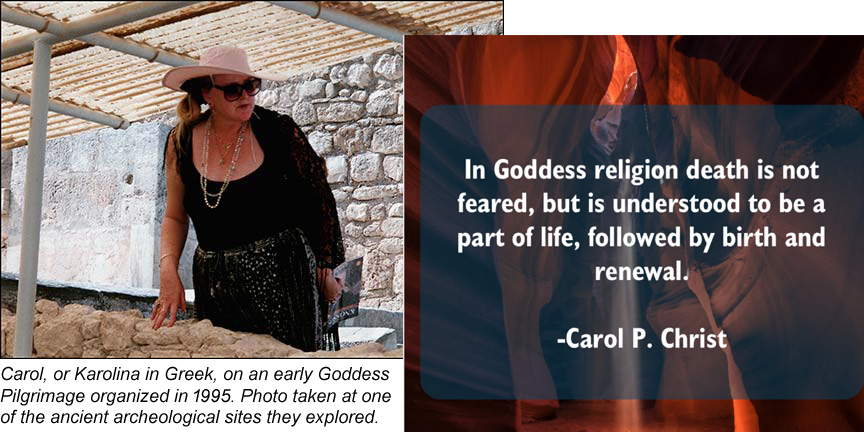
“In Goddess religion death is not feared, but is understood to be a part of life, followed by birth and renewal.” — Carol P. Christ
Carol married intellect with heart centering –– she had a formidable intellect but always spoke from her heart.
In view of learning of Carol’s death I find these words from Janet’s post today inspiring:
“Who is she that shines through like the morning star, beautiful as the moon, radiant as the sun awe-inspiring as a cascade of starlight?”
On a personal level, Carol’s words were essential on my journey away from god by way of the Goddess. Her courage required me to dig deep to embrace my own version of the “hubris” exhibited by male “god makers” and “system builders.” Carol’s quote below inspired many us to take on the two-fold task of unearthing the patriarchal symbol system woven into the fabric of our socialization and of replacing it with words of truth, communities of support, ceremonies of meaning, and images of the goddess, all inspired by stories of the very beginning when the divine was imagined as female.
The reason for the continuing effects of religious symbols is that the mind is uncomfortable with a vacuum. Symbol systems cannot simply be rejected, they must be replaced. Where there is no replacement, the mind will revert to familiar structures at times of crisis, bafflement, or defeat. (Carol Christ, Womanspirit Rising)
–– Patricia Lynn Reilly, Author of A God Who Looks Like Me
Carol was a wonderful friend and colleague. She loved to read my work in progress (brilliantly, often several times in a row before she wrote back to me) and I hers.
Her essay on patriarchy was the best I have ever read. I asked her to contribute it to the anthology, Foremothers of the Women’s Spirituality Movement: Elders and Visionaries. The day after she sent it to me, I found that the essays fir the book had to be personal. I felt terrible. I emailed her to tell her, and she said it wasn’t a problem. The next day she had a new, wonderful, perfect essay for me.
Although I knew she didn’t have many months to live, I am still stunned by this loss.
–– Miriam Robbins Dexter
Carol was and will remain one of the foremothers and most brilliant voices of the Women’s Spirituality movement. At the conference on “The Great Goddess Re-Emerging” at the University of California at Santa Cruz in the spring of 1978, Carol delivered the keynote address, “Why Women Need the Goddess: Phenomenological, Psychological, and Political Reflections.” Christ proposed four compelling reasons why women might turn to the Goddess: the affirmation and legitimation of female power as beneficent; affirmation of the female body and its life cycles; affirmation of women’s will; and affirmation of women’s bonds with one another and their positive female heritage (Christ 1979).
In her most recent article, for the Encyclopedia of Women in World Religion: Faith and Culture, Christ wrote about the Goddess religion and culture of her beloved island of Crete, and the roles women played in that “egalitarian matriarchal” civilization. Her eloquent words speak not only to the Goddess religion of ancient Crete, but also to the spirituality and ethical values she also cherished, which are much needed in our own culture today.
As discerners and guardians of the mysteries, women created rituals to celebrate the Source of Life and to pass the secrets of agriculture, pottery, and weaving down through the generations. The major rituals of the agricultural cycle involved blessing the seeds before planting, offering the first fruits of the harvest to the Goddess, and sharing the bounty of the harvest in communal feasts. These rituals establish that life is a gift of the Goddess and institute gift-giving as a cultural practice. As women controlled the secrets of agriculture, it makes sense that land was held by maternal clans, that kinship and inheritance passed through the maternal line, and that governance and decision-making for the group were in the hands of the elders of the maternal clan. In this context, the intelligence, love, and generosity of mothers and clan mothers would have been understood to reflect the intelligence, love, and generosity of the Goddess.*
Honor, blessing, and gratitude to you for your life, Carol. You told us many times you did not fear death. You did not speculate on what comes after. Whatever goddess is, surely you reman in her embrace.
A wise woman committed to the spiritual freedom of women and a teacher of life and struggle has set out to meet the infinite. I thank life for giving me the joy of walking part of the way in this world, in the company and wisdom of women like her.
Thanks for everything my dear Carol. For the ideas and enthusiasm with which you always supported my work. For creating community and safe spaces For lovingly and intensely vindicating the transcendence of the humanity of women
Blessed journey our woman, teacher and guide. May the divine that you found in all women receive you today in her loving arms.
That was Karolina’s last message to me, on June 18th, 2021. I like to think it was also her last message to the universe, as she climbed back into the lap of the Goddess early on the morning of July 14th.
I’d sent her a selfie of me with a new haircut, a few inches shorter, as she’d suggested some time earlier. “Yessssss” was her immediate, characteristic reply. Two days later I forwarded an even better photo. It was surprising not to hear back from her, and I should have been concerned. Instead, I let two weeks go by before reaching out again. And then it was too late.
“Yessssss” was Karolina’s full-hearted response to life, and part of how she nurtured her friends and acquaintances. I will carry that “yessssss” with me till the end of my days, always grateful to have known and been nurtured so generously, so unfailingly by her. Her soft voice, her gentle laugh, her quiet glamor, her deep engagement with all the details of life … I could talk with her about my cats, my husband, my writing, my childhood, my haircut. Nothing was too small or too large, nothing too complex or too simple.
“Intelligent embodied love” is how Karolina described the ground of being, and intelligent embodied love was what she herself embodied and radiated, even as she suffered through her cancer and its treatment. For this past year, she devoted herself to making her new home as beautiful as possible. The last room she finished was the “guest room study,” and how I would have liked to have joined her there. Instead I will simply carry her “yessssss” in my heart.
Rabena yer’hamou – Que Dieu la berce dans sa matrice – “May she be cradled in the womb of the Goddess.” Blessed be.
Carol was my second cousin. In 2016, we spent about 10 days in France and Germany tracking down places where our ancestors lived. Like her Feminism and Religion research and writings she was a meticulous in her ancestry research and fearless about meeting strangers and asking questions. One of the places where are relatives came from was Saarland St Nikolaus-Rosbruk. We were having lunch by the river when she saw this tree that she wanted to embrace. Here is a picture of her by the tree. I love her expression.
Best to all, Bill Christ
I’ve been so honored to blog with Carol here at FAR over the last seven or so years and doubly honored that she wrote an endorsement for my new book just last month.
Carol was a tremendous role model and influence for me and she will be deeply missed. She impacted so many lives with her work and her depth of purpose and strength of character were so palaple, even across many miles. When I first read “Why Women Need the Goddess” it touched a chord within me that continues to reverberate through this day. Her work and writing shaped my own thealogy profoundly. In her honor, I chose one of her books off my shelf—She Who Changes—and randomly opened to a page, which, fittingly, was about how death is a part of life:
“For process philosophy, the whole universe is alive and changing, continually co-creating new possibilities of life. Every living individual is born, grows, and then dies. The world is a web of changing individuals interacting with, affecting, and changing each other. The body is the locus of changing life. Not to be embodied, not to change, is not to be alive…” –Carol P. Christ. (She Who Changes: Re-imagining the Divine in the World, p. 45)
I read this quote aloud during a small women’s circle the same day Carol died, a circle that, in some way, may not have existed without the gift of her presence in this world.
–– Molly Remer
Remembering Carol P. Christ
I am so grateful and glad that a circle of Carol’s friends and colleagues champion her accomplishments and celebrate her life.
I might be her oldest friend in this group, definitely more a personal friend than a professional colleague. We were in the same freshman dormitory on the same dorm corridor that was made into a social group at Stanford. Both of us felt a bit out of place, she—at the time–a political conservative from Orange County California, and I one of 17 Asians in a class of 1,200 from the small town of Gilroy, California.
Never her academic peer, we still spent time together studying, finding our way, and hanging on to our independent thinking. And we stayed in touch when we both relocated to the East Coast, she to Yale and I to New York City. I have attached a photo of Carol at her wedding in 1979 when she was living in northern California. Much later I met her family when her mother died and I knew of the family static that she worked to understand and make peace with. We stayed in touch through all these decades. I visited twice in Lesbos with my mother, sister and best friend, and she visited here in Oakland.
I saw Carol not through her scholarly achievements but from what I saw as her kind of priestess bearing. Always her forthright sense of what would make the world a better place, calling out the wrongs but being understanding, always with her oar in the water. I also saw her as a warm friend who could laugh about the foibles, not worry about binging on good television, enjoy a good meal with friends, and tend to her garden and pets.
Carol should not have suffered the pain of conflicts, even if those experiences sharpened her mind. She should not have suffered from debilitating illness. . .and she died too young. She told me once that she stayed in Greece because it was the most beautiful place she had ever been. Though I never liked having good friends so far away, it seemed that gave her joy and solace.
We will miss her.
–– Gail Kong
I was profoundly influenced by the keynote address Carol gave in 1978 at the Great Goddess Re-Emerging Conference in Santa Cruz, CA. I was one of the 500 women listening to her words “Why Women Need the Goddess”. The impact of her observation about the power of symbol systems on each of us individually and the influence symbol systems have on all of us collectively, helped guide my own life.
We met in the fall of 2017 when I was one of ten women on the Goddess Pilgrimage. Carol described herself as a “feminist and ecofeminist writer, activist, and educator”. Please view this eighteen minute video of Carol speaking at the Harvard Divinity School where she spoke about her life. This was the 2014 Religion and the Feminist Movement Conference: https://www.youtube.com/watch?v=YwYygffNCAg.
I’m always moved by women speaking on their own behalf about their lives with no intermediary to interpret their life from afar. You will certainly gain a sense of who Carol was in her world.
My lesbian partner, Jeanne Neath, and I had reservations to join the 2021 Pilgrimage. To ease my grief at Carol’s death, I’ve gathered ten more candid photos of Karolina on some of the earlier Pilgrimages. You can see those photos on my blog http://paulamariedaughter.com/. Carol put incredible energy into each day of those two weeks she escorted us around the various sites that linked us to the ancestors.
Carol dared to examine the deeply embedded beliefs of our patriarchal institutions including academia and religion. She invented a new life for herself. She ‘shed the skin’ of an academic. Karolina was determined to reach other women like herself willing to look beyond the familiar goddesses of the patriarchy to discover the much more ancient Earth Goddess of our Neolithic and Paleolithic ancestors.
Many of us now acknowledge Carol/Karolina as a beloved ancestor.
Blessed Be, Paula Mariedaughter
One of Carol Christ’s books early on, in 1980, that impressed me deeply was Diving Deep and Surfacing – Women Writers on Spiritual Quest, published by Beacon Press. It helped me rediscover my spiritual path. I actually incorporated the phrase “diving deep and surfacing” in a process of self-understanding and awareness. — feeling grateful.
When I first learnt how patriarchy plotted and schemed to write the Goddess out of existence and by extension, the history of all women; not stopping at the written word, using violence and the threat of violence too; I was furious. This was the first time I experienced rage. Not fully knowing our history means we exist in a world of numb. To discover is to feel. To feel is to be alive. This is why Carol’s work is so important – because it links women to their collective past and to their collective future. The anger has subsided and now I ride a wave of certainty, connected to an international movement of powerful women. Understanding our story is empowering. Empowerment is Carol’s legacy.” – Claire Dorey
I met Karolina in 2018, when I was in Lesvos working as a volunteer with refugee organisations, so ours was a very short friendship by comparison with most of her other friends. We kept in touch when I went back to Sydney, and then picked up again where we had left off when I returned to Lesvos in early 2020 for another few months of volunteer work, before the Covid pandemic intervened. After that we kept in touch via Skype.
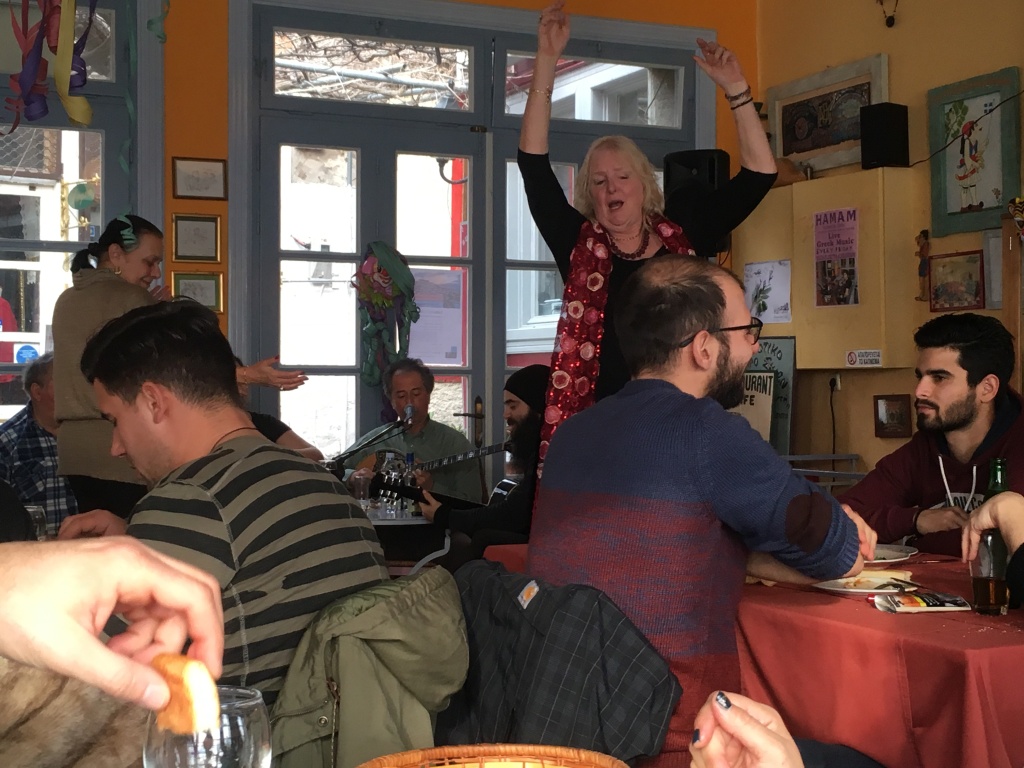
I was a bit younger than Karolina, but we shared the same feminist background and had a broadly similar outlook on life. In the short time that we spent together we shared a lot of long lunches with copious amounts of red wine. It was great for me, because Karolina could order meals in Greek, so we always ate interesting local food. She loved to dance, so if there was music she would be on the dance floor! Karolina knew a lot about Greek Orthodoxy and local customs. I spent a memorable “Clean Monday” with her in 2018, when she donned a tutu as part of a dance troupe, and then danced the afternoon away in Maria’s Taverna… (Clean Monday is the start of the 40 days of Lent in the Greek Orthodox Church).
Even though we didn’t know each other for very long, I think that we both valued our friendship, perhaps for different reasons. From my perspective, I loved staying in Karolina’s beautiful old house in Molyvos at weekends, bird watching in the salt marshes at Kalloni, and going to out-of-the-way places to eat. As well as intellectual stimulation she also provided some relief from the intensity of my refugee work, which was very welcome!
I thought it was incredibly brave of Karolina to leave Lesvos and move to Crete, and I’m glad that she got to enjoy her new apartment in Heraklion, however briefly. I would love to have visited her there, but Covid and her illness meant that was not to be. I will miss her.
This is the 5th in a series of work I have been doing to translate passages of the bible into poetry that strips out the patriarchal overlays. You can read the previous posts.
In this installment I am grouping together some passages that deal with vibrational energy and its role in creation. We humans often express sacred vibration as song or chant. When we get into the vibrational flow they are truly uplifting. In the translations below, I have kept two of the words in Hebrew because of their wonderful vibrational essences:
This blogpost is a rewrite and an update from one I wrote on Jan 26, 2020 (I’m Getting Triggered by the Impeachment Trial and I Bet I am Not Alone). I was writing about The Former Guy’s 2nd impeachment trial which rattled my bones and hurt my heart. How often have we seen angry men (and sometimes women) abusing women, abusing the earth, abusing the vulnerable, abusing immigrants, abusing power? And yet the pattern never seems to end. In many cases, they not only get away with it, it is actually celebrated.
In that 2020 blogpost I included Bill Cosby’s case as a success story. Look how hard it had been, how many years, how many accusers it took for justice to give us the illusion of being meted out. And now pulled away.
In January 2020 there was a blunder (or so they called it) at the National Archives’ in their exhibit titled “Rightfully Hers.” They put up an image of the 2017 Women’s March and blurred out the protest signs. Oh, the irony to blur out women’s voices in an exhibit named Rightfully Hers. Yes, they apologized. But they had to get caught first.
I remember back when I worked in biology, some of the labs used animal models, like zebrafish or fruit flies, for their research. Some of my family members even worked with mice, helping to develop insulin treatments for diabetes that would mean fewer needles for children; or treatments for burn victims that directly helped the children at the Shriner’s hospital across the street. Their work really inspired me. Partly because of the ways it was helping so many people, of course. But also because of the way they talked about the mice.
I’m not here to defend or condemn experimental mouse models. What I want to talk about today is sacrifice. Because in these labs, the taking of an animal’s life is never described as killing. Every single time an animal dies, it is called a sacrifice. Every time.
This is the 4th in a series of work I have been doing to translate passages of the bible into poetry that strips out the patriarchal overlays. You can read the previous ones here: Part 1, Part 2, and Part 3.
In this installment I have picked out some passages I really like but that I feel their power and beauty have been deeply hidden. I seek to reveal those hidden wisdoms.
To review; my usage of the 2 main names of divinity:
YHVH or LORD, I translate as Vibration.Being
EL or god, I translate as All-Potential Powers.
I discuss my reasons for these translations in my prior posts referenced above.
Genesis 3:6
And when the woman saw that the tree was good for food, and that it was pleasant to the eyes, and a tree to be desired to make one wise, she took of the fruit thereof, and did eat, and gave also unto her husband with her; and he did eat. KJV (King James Version)
and the woman saw that the function of the tree is for nourishment and that he is yearning to the eyes and the tree was a craving to make calculations and she took from his produce and she ate and she gave also to the man with her and he ate Benner Mechanical Translation[i]
When the woman saw the tree, she recognized herself She recognized and remembered beauty and wisdom She took its seeds within her in knowing wholeness She gifted its seeds to her husband in knowing wholeness MPV (Mystic Pagan Version – my own translations)
Note for Genesis 3:6 – the word for “food” in the KJV version of this passage is “maakal” (Strong’s 3978). The word used for to eat is “akal” (Strong’s 398). Both are built on the root word “kl” which means complete or whole and traditionally refers to how food or nourishment makes us whole.[ii] I would add that in the context of spirit, it is that essence or element that we fill ourselves with to achieve a sense of wholeness.
Genesis 49:25
Even by the God of thy father, who shall help thee; and by the Almighty, who shall bless thee with blessings of heaven above, blessings of the deep that lieth under, blessings of the breasts, and of the womb: KJV
from the mighty one of your father, he will help you, and with Shaddai [my breasts] he will respect you, presents of the sky from upon the presents of the deep sea stretching our underneath presents of the breasts and bowels. Benner
The All-Potential Powers of your ancestors Who watches compassionately over you With nourishment from the dripping milk of the cosmos And blessings from the misty cauldrons of the goddess Tiamat Blessings of the breast, and the loving womb MPV
Notes on Genesis 49:25: this passage had to have been a very old pre-biblical blessing. We don’t often see blessings that are clearly given by female divinity figures, or in this case, a divinity that has breasts and womb. Even in the conservative, male-centric King James Version the blessing is of the breast and the womb. The word for breasts is “shad.” To take this theme a step further, the phrase El Shaddai or Shaddai appears 48 times in the Bible. In English, El Shaddai is usually translated as “God Almighty” and Shaddai as “Almighty.” Sometimes they are translated as “God, the One of the Mountain.”[iii] Both are almost always referred to in scholarly discussions with the pronoun “he.”
I have put the following two passages together because they speak to the same theme. One is a Psalm and the other a Proverb. I really like them because they both speak to the condition of our hearts. As some of you know I am an alaka’i of Aloha International. That is a spiritual guide of Huna or Hawaiian Adventure Shamanism. I love the lessons of Huna which foremost and foundationally remind us to keep a loving and open heart. Aloha not only means hello and good-bye, it means “the breath [ha] we all share,” and it means LOVE. Picture this, the Hawaiian people greet and part from each other which a statement of connection and love. The first principle of Huna is “the world is what you think it is.” The lesson behind this is that what is in our hearts will shape our experiences and ultimately our world. I believe that this is the lesson behind these biblical passages. (I have also included the New International Version for Proverb 4:23 because I think it is particularly beautiful.)
Psalm 37:4
Delight thyself also in the LORD; and he shall give thee the desires of thine heart. KJV
Cherish thyself in harmony with Vibration.Being And gifts will be returned as per the radiance of thy heart. MPV
Proverbs 4:23
Keep your heart with all diligence, For out of it spring the issues of life. KJV
Above all else, guard your heart, For everything you do flows from it. (New International Version)
Treasure your heart in lovingkindness, For it is the wellspring of your life.
Janet Maika’i Rudolph. “IT’S ALL ABOUT THE QUEST.” I have walked the spirit path for over 25 years traveling to sacred sites around the world including Israel to do an Ulpan (Hebrew language studies while working on a Kibbutz), Eleusis and Delphi in Greece, Avebury and Glastonbury in England, Brodgar in Scotland, Machu Picchu in Peru, Teotihuacan in Mexico, and Giza in Egypt. Within these travels, I have participated in numerous shamanic rites and rituals, attended a mystery school based on the ancient Greek model, and studied with shamans around the world. I am twice initiated. The first as a shaman practitioner of a pathway known as Divine Humanity. The second ordination in 2016 was as an Alaka’i (a Hawaiian spiritual guide with Aloha International). I have written three books: When Moses Was a Shaman, When Eve Was a Goddess, (now available in Spanish,Cuando Eva era una Diosa), and One Gods. In Ardor and Adventure, Janet.now available in Spanish. Cuando Eva era una Diosa
One of the key factors to me that differentiates feminist spiritual paths from many dominant religious traditions and frameworks is the recognition and acknowledgement of the body as a source of wisdom, a source of pleasure, a source of learning, and a source of knowing. Not viewed as unclean, dirty, or as something to be mistrusted or transcended, we can return to our bodies again and again, dropping down into our bellies, bones, and blood, returning to center, and returning home to ourselves. Those who embark into thealogy quickly realize that it is a spirituality better lived than analyzed. My own experience of my goddess-oriented path is an intensely embodied one. I am here on this earth, in this body, my feet on the ground, my eyes on the sky, listening, feeling, and sensing. This, to me, is sacredness in motion, this is the Goddess right in front of me, she is witnessed in the very fact that my pulse beats in my wrist and that my eyes alight on those three crows coasting lightly into the treetops.
Sara Avant Stover, writing in the Book of SHE says: “Our bodies aren’t indentured servants here to labor for us until we take our dying breath. They are sacred chalices . . . . Our bodies always tell the truth and hold the information we need to thrive” (p. 43).
And, one of my favorite quotes of all comes from Camille Maurine in Meditations Secrets for Women who writes: “Your body is your own. This may seem obvious. But to inhabit your physical self fully, with no apology, is a true act of power.
At one time, I would have focused my attention primarily on women and encouraging women to trust their bodies, to listen to their bodies, and to honor their bodies. I’ve come to see that a goddess-centered approach to ethics, values, and embodied spiritual experience includes all people who have a body. In my heart of hearts I would like all people to value their bodies, honor their bodies, trust their bodies, and listen to their bodies. I think if this was true, the fundamental way in which we relate to, treat, and care for one another would change and the feminist values of cooperation, compassion, and empathy would come to form the foundation of society. Every single one of us begins life within someone else’s body. We enter the world through someone’s body. And, we have a body that interacts with other bodies for our entire lives. This is altogether simple, obvious, and profound. Our bodies are our seats of reality, of being human, of being present in the world. A life firmly rooted in concept of the body as sacred, no longer allows room for violation of or harm to others.
Carol Christ writes in Rebirth of the Goddess: “The rituals and symbols of Goddess religion…[bring] experience and deep feeling to consciousness so that they can shape our lives; helping us broaden and deepen our understanding of our interdependence to include all beings and all people; binding us to others and shaping communities in which concern for the earth and all people can be embodied.”
When I talk to other people about self-trust and building self-trust, I often encourage them to check in with their bodies for a physical response to a decision, idea, choice, or happening. Where does it land in your body? What do you feel inside when you think about making this decision or taking this action? Does your body respond with a “yes” or a “no” when you think about this idea? For me, the sensation comes in my chest, around my heart—a lightening or expansion or a contraction or heaviness. This is not what all people will experience, perhaps you feel the answer in your belly, in your head, around your jaw. Perhaps you feel it as a color, sensation of warmth or coolness, or as a “rightness of being.”
I must also acknowledge that many people have experienced some form of physical trauma or abuse in their lives and that these experiences can complicate our relationships with our bodies, our sense of intuition, and our trust in ourselves. If your body has been a site of violation, it may be more difficult or complex to connect to this body-based sense of “knowing” or intuition that I reference and I do not wish to oversimplify what can be a complex and multilayered personal experience of embodiment.
If you mentally walk through your body, what do you see?
What is your body as home like for you? How re-sourced is it?
What needs attention within you?
Do you have a sense of your inner and outer ground?
What do you feel in your belly, right now?
I have been leading a process this year called #30DaysofGoddess and one of the things I suggest on some of the days is to offer a “body prayer.” Since people have asked for additional guidance with what that means, I sat on my yoga mat one morning and let a body prayer emerge. After I moved through the motions, I typed it out and I offer it to you now (as well as prayercard version of it). May it nourish you.
A Body Blessing: Fold your hands in front of your heart, feel your palms warm and your pulse beat. Kiss your fingertips. Raise your hands and cradle your face with love and then, move one hand to the top of your head and one to your heart. Pause. Cross your arms over your chest, one hand on each shoulder and sway back and forth gently. Kiss your palms and lay them upon your belly. Run your hands down your legs. Wiggle your toes. Fold your hands in prayer pose and bring them back to your heart-level. Breathe deeply and then open your hands. Gaze into them. Envision the day’s potential nestled there. What do you see in your own cupped palms? Kiss your fingertips again and whisper what it is you need to hear. Say: thank you.
Note: I do have a companion video about the body as home here.
Molly Remer’s new book Walking with Persephone is now available for pre-order from Womancraft Publishing. Her prayerbook, Whole and Holy: a Goddess Devotional was published in November. Molly has been gathering the community to circle, sing, celebrate, and share since 2008. She plans and facilitates women’s circles, seasonal retreats and rituals, mother-daughter circles, family ceremonies, and red tent circles in rural Missouri. She is a priestess who holds MSW, M.Div, and D.Min degrees and wrote her dissertation about contemporary priestessing in the U.S. Molly and her husband Mark co-create Story Goddesses, original goddess sculptures, ceremony kits, mini goddesses, and more at Brigid’s Grove. Molly is the author of Womanrunes, Earthprayer, Sunlight on Cedar, the Goddess Devotional, She Lives Her Poems, and The Red Tent Resource Kit and she writes about thealogy, nature, practical priestessing, and the goddess at Patreon,Brigid’s Grove, Feminism and Religion, and Sage Woman Magazine.
This is the 3rd in a series of Biblical poetry where I am “translating” verses of the Bible. You can read the first two here: Biblical Poetry and Biblical Poetry, Part 2.
One of my primary purposes of doing this work is to strip away patriarchal veneers that have been layered upon original teachings. I reach into ancient pagan knowledge in order to reclaim what I believe to have been lost.
Below is each verse in 3 versions. First is the King James Version (KJV) for familiarity, the second is Jeff Benner’s Mechanical Translation (Benner) which uses a consistent translation for each word. I use his translations to get a better sense of how the words originally fit together.[i]










 Feminism and Religion