Greenness, Whiteness, Blackness, and the Nature of the World by Marisa Goudy

There’s magic in hiking alone, but as women, we’ve been taught to worry about venturing far on our own. In fact, we’ve been taught to worry about a lot more than that.

Though once I merely shrugged off the warnings and the horror stories, confident that I was wrapped in some sort of “not me” protective veil, I don’t usually take my safety for granted anymore. Maybe it’s because I’ve outgrown the belief that I’m invincible. Maybe it’s because I’m a mother and have a different understanding of the fragility of life and the female body. Maybe it’s because that murderer on the Appalachian Trail went by the nickname “Sovereign,” appropriating the powerful, beautiful word that is so essential to my life’s work.

This particular day, however, my desire to be outside was more compelling than my new bend toward caution. I called my husband to tell him just where I’d be, joking that he needed to know where to look for me if I didn’t pick up the girls from camp on time.

Continue reading “Greenness, Whiteness, Blackness, and the Nature of the World by Marisa Goudy”

The Devil’s Bargain: “If You Can Convince a White Woman” by Carol P. Christ

This week’s news from America. Where to begin? When will it end?
The President of the United States is a racist who incites racist violence. Republicans have been slow to condemn the President and are not likely to pass a complete ban on assault weapons and to make those currently in circulation illegal.

After reading a speech condemning hate speech and gun violence that he obviously didn’t write, the President scheduled a round-up of brown people working in chicken-packing factories in Mississippi to coincide with his unsympathetic visits to the cities of Dayton and El Paso, where two recent mass killings by assault weapons occurred. The next morning, we were greeted by images of little children coming home from school in small towns in Mississippi to find their parents missing. We were told that none of the surviving victims of the El Paso shooting wanted to meet the President.

This is not the America I want. But it is the America that many Americans seem to want. I would like to think that women as a group reject the President and his agenda. Sadly, this is not true. Continue reading “The Devil’s Bargain: “If You Can Convince a White Woman” by Carol P. Christ”

We Are Not Alone: Embodying and Re-enacting Ancient Wisdom by Carol P. Christ

A few nights ago, on the way to dinner, two friends and I passed by a small church near the old fortress in Ierapetra, Crete. The liturgy was broadcast via microphone and a crowd of people gathered outside the church. “Must be some kind of name day,” one of my friends commented, but I could not think of a saint celebrated on August 1.

We decided to light candles and make our prayers. I asked one of the Greek women the reason for the ceremony. “This is the first night of our celebrations for the Panagia,” she responded, referring to the Assumption of Mary that would occur on August 15. I looked around and saw that indeed many of the women were wearing black. “Of course,” I thought to myself. Continue reading “We Are Not Alone: Embodying and Re-enacting Ancient Wisdom by Carol P. Christ”

Plant Trees, Trees, and More Trees by Carol P. Christ

I dream that all of us who are suffering burn-out because of national and world politics come together to plant and nurture trees. Scientists say that planting ONE TRILLION TREES would neutralize two-thirds of carbon emissions and reverse climate change. Yes, we need to march, to organize, and to vote. But it is also important to embody our commitment to life and the living. Putting our hands in the soil, tenderly teasing the roots of the trees we plant as we nestle them into the earth, we move from our heads to our bodies, re-membering the interdependence of life.

This has already begun to happen in India—a country where what Vandana Shiva named “maldevelopment” has produced massive deforestation. At the Paris climate change conference India pledged to “make India green again” by reforesting 235 million acres of land. The government allotted 6.2 billion dollars to support the plan. What was not expected was the overwhelming enthusiasm of those who volunteered to plant trees. Continue reading “Plant Trees, Trees, and More Trees by Carol P. Christ”

What to Do About Bullies by Deanne Quarrie

I could probably go on and on about this topic, so in the interest of education I offer the following information gathered in my own recovery. Why would I write about bullying at all?  Are we not Goddess lovers, one and all?  How would such behavior ever come into a spiritual path that believes all life is sacred?

Well, we all come to this path with all our old baggage. That baggage may include jealousy, fear, and a desire for the wrong kind of power, that which attempts to control others.

Bullying is not merely, as many believe, an occasional stinging comment made by a significant other at the breakfast table, a bad day with the boss, or children wrestling on the playground.

Bullying is cruelty deliberately aimed at others with the intent of gaining power by inflicting psychological and/or physical pain.

Bullying behaviors are varied: name calling, humiliation, spreading rumors, gossiping, public ridicule, scape-goating or blaming, isolating, assigning poor work conditions and job assignments, or denying holiday and vacation time in the workplace, or more obvious punching, hitting, kicking, taunting, ostracizing, sexualizing, or making ethnic or gender slurs, etc.

Continue reading “What to Do About Bullies by Deanne Quarrie”

Poem:  “How to Survive a Four Letter Word” by Marie Cartier

What is taken from a woman?

When someone breaks her open and fills her with nothing of herself,

and then leaves?

She has to find all the pieces of herself.

That’s why they call it—recovery.


You have to recover.

It doesn’t always happen. You’re not put back together

exactly the same. The pieces were broken.

Still are, just glued back together.

It’s a four letter word:  rape.

Continue reading “Poem:  “How to Survive a Four Letter Word” by Marie Cartier”

Happy Birthday Isis: Isis Isis…Ra! Ra! Ra! by Karen Tate

I wanted to pull myself away from the ugliness out there and take time to honor the Egyptian Goddess, Isis, as Her birthday is recognized to be in the latter part of July.  My husband, Roy, and I formed the Isis Ancient Cultures Society and the Iseum of Isis Navigatum, in Los Angeles, sometime ago and for more than a decade, in Her name, we sponsored Moon Circles to promote diversity, Salons to teach, and we put out a quarterly newsletter when you still had to fold and mail them – remember that?  But the premier events every  year were the Isis Birthday Tea and the Isis Navigatum or Festival of Isis, every March.    Our aim was to reconstruct Isis rituals in a modern context and make them relevant  for today.

We put on the Isis Tea in prestigious locations like aboard the Queen Mary and the Isis Navigatum in various public locations including The Japanese Gardens, in the San Fernando Valley, and on the beach on Point Dume, in Malibu, California.  So detailed were our events, sometimes the public joined us thinking we were a movie crew and our organization was written about by a anthropologist/folklorist citing the detail and depth of the material culture of contemporary Isian devotees.

Continue reading “Happy Birthday Isis: Isis Isis…Ra! Ra! Ra! by Karen Tate”

Sappho’s Poems as an Ethos for Women’s Ritual by Jill Hammer

Photo by: Zac Jaffe

For by my side you put on

many wreaths of roses

and garlands of flowers

around your soft neck


and with precious and royal perfume

you anointed yourself.


On soft beds you satisfied your passion.


And there was no dance

no holy place

from which we were absent.


–Sappho (trans. Julia Dubnoff)


Sappho, the poet from Lesbos (630-570 BCE), was considered one of the greatest poets of her time—one of her epithets was “the tenth Muse.” I discovered the poems of Sappho in my thirties and was utterly captivated.  I had newly embarked on a relationship with a woman and Sappho’s love poetry (though by no means exclusively lesbian) supported the expression of eros between women.  Yet even more than that, Sappho’s poems supported an erotic relationship between self and world—a relationship that included ritual as a form of intimacy.  I’m not a Greek scholar—I experience Sappho’s poems in translation. Yet the translations I read back then were a revelation: a world in which women lived in circle with one another.

Continue reading “Sappho’s Poems as an Ethos for Women’s Ritual by Jill Hammer”

And We Are Singing, Singing for Our Lives! by Carol P. Christ

Last week I wrote about the grief I feel for the state of my nation (the United States) and of the world. A few days later one of my favorite writers, Katha Pollitt, asked why we are not all in the streets all the time, keeping alive the enormous energy that came together in the first of the women’s marches against Trump and that continued for several months thereafter in protests women’s rights, for immigrants, for the planet.
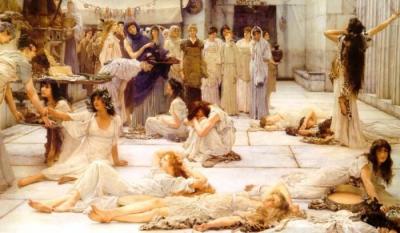
After reading Pollitt’s essay, I thought: we should be weeping and wailing in the streets. Instead of pink hats we should be wearing black, the color of mourning. But then I pulled myself up short. In the symbolism of our Old Europe, black is the color of rebirth and regeneration: the dark place where seeds must be placed if they are to germinate, the color of rich and fertile earth. If we are going to protest the racism of the Donald and his followers, we must be careful not to repeat the Indo-European binary in which light is associated with truth and goodness, while the devil and all that is evil is dark.

Nonetheless, I like the idea of acknowledging our grief for all that is being lost publicly and with others. Continue reading “And We Are Singing, Singing for Our Lives! by Carol P. Christ”

Temple Magdalen by Elizabeth Cunningham

The Women of Amphissa, 1887, by Lawrence Alma-Tadema

Since I began writing for FAR in July 2012, I have written about Mary Magdalen, or excerpted a passage from one of my novels, near or on her July 22 Feast Day. For why I made the controversial choice to depict her as a prostitute, see last year’s post. The below excerpt is from The Passion of Mary Magdalen. I made this selection in remembrance of all the refugees in the world today. In this passage, Judith, a Jewish widow whose family was driven from the land by tax collectors, returns to the place where Maeve (my fictional Celtic Magdalen) and her friends have recently founded a Temple to Isis on the outskirts of Magdala. Maeve has just invited Judith to join them. (Edited for brevity.)

She stared at me, her eyes full of anger and longing.

“I will not be a slave and a whore where I was once a wife, the one who made the challah bread, who said the Sabbath prayers over it. This was our place, my husband’s and mine. We brought the best we had to the temple, the finest oil and wine, the unblemished kid—”

“Goats? You kept goats? You know how to make cheese?”

She sat quietly for a moment before she answered. “How can I live here with you?” she wondered. “I don’t understand.”

Continue reading “Temple Magdalen by Elizabeth Cunningham”