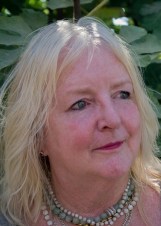
Challenging Christian Feminists to Re-Imagine the Goddess by Carol P. Christ

From the 1993 Re-Imagining Conference:

Our mother Sophia, we are women in your image:
With the hot blood of our wombs we give form to new life.
With the courage of our convictions we pour out our life blood for justice.
Sophia-God, Creator-God
let your milk and honey pour out,
showering us with your nourishment.

From my reflections on the Re-Imagining Conference presented at Hamline University on Novemeber 1, 2018:

One reason the creative re-imagining of God as female has not taken hold in churches and synagogues is fear of paganism and the Goddess. The creators of the Re-Imagining Sophia ritual took great care to guard against this charge by connecting it to Bible and tradition. Commenting on the reasons for the backlash against the Re-Imaging Conference, Sylvia Thorson-Smith stated:

One was the liturgical use of the biblical image of Sophia – but blown up as evidence of Goddess worship. Second was the milk and honey ritual – an ancient part of early Christianity, but attacked as a pagan substitute for communion.

While I understand her reasons for doing so, “the lady doth protest too much, methinks.” Continue reading “Challenging Christian Feminists to Re-Imagine the Goddess by Carol P. Christ”
When the Gods Retire by Barbara Ardinger

Come with me in your imagination to an old land, a Demi-Olympus, a fabled and possibly invented land to the north of Mount Olympus, home and throne of the fabled Olympian gods. It is to this Other Olympus that the gods have retired. Now they reside in the Divine Rest Home whose proprietor is a black goddess. Not African black, She is as black as space, and if we look closely at Her, we can see galaxies and constellations and comets in Her. She is the Ur-Goddess, the Divine Creatrix, eldest of all, and She answers to the name Mama. (Note: many years ago, I actually saw this goddess after an all-day asthma attack that nearly killed me. She was in the ER with me.)

Helping Mama run the Divine Rest Home are Gaea, the mother of all life, and the Titans and Titanesses, who are older than all the gods who have come to the Divine Rest Home to…well…rest. The Titans and Titanesses held numerous important stations in the primeval universe and should probably retire, too, but they just keep going. That’s probably a good thing, as most of the retired gods need a great deal of attention.

Continue reading “When the Gods Retire by Barbara Ardinger”

Women’s Ritual Dances and the Nine Touchstones of Goddess Spirituality-Part One by by Laura Shannon

In Rebirth of the Goddess, feminist theologian Carol P Christ offered a list of ‘Nine Touchstones of Goddess Spirituality’.[1] She revisited the Nine Touchstones in an interview with Karen Tate on Voices of the Sacred Feminine titled ‘Gratitude and Sharing: Principles of Goddess Spirituality‘, and in an inspiring series of blogs on this site recently exploring each touchstone in depth.

In her incisive analysis of the ethics of Goddess religion, Christ argues that Goddess spirituality can offer the ‘ethical guidance that we need to combat the forces of evil in our world’, and that this ethic is not imposed from a set of rational principles nor from a transcendent God known through the prophetic traditions of the Bible, as suggested by Rosemary Radford Ruether.[2] Rather, the ethics of Goddess spirituality are discerned through intuition and reflection on the world of which human beings are a part.[3]

Continue reading “Women’s Ritual Dances and the Nine Touchstones of Goddess Spirituality-Part One by by Laura Shannon”

I Was Brainwashed to Believe I Wasn’t Human. Now I’m on a Mission Against that Cult-Part 3

Trigger warning: rape, sexual assault, domestic abuse, graphic sexual content

In Part 1 of this story, I introduced a discussion of Johan Galtung’s theory of cultural violence as it relates to my experience as a young woman in an abusive relationship. To recap:

Cultural violence is: “…any aspect of a culture that can be used to legitimize violence in its direct or structural form. Symbolic violence built into a culture does not kill or maim like direct violence or the violence built into the structure. However, it is used to legitimize either or both.”

Cultural violence against women is: Normalization and promotion of pornography, prostitution, degradation, and sexual objectification of females in media, predominantly male language in civic, business, and religious institutions, gender roles and stereotypes, misogynist humor, gaslighting, minimizing or denying any of these forms of violence.

Continue reading “I Was Brainwashed to Believe I Wasn’t Human. Now I’m on a Mission Against that Cult-Part 3”

Hear Me by Winifred Nathan

image1.png

I found the confirmation hearings of now Justice Kavanaugh deeply disturbing. I have ideas for preventing a replay.

First, secret keeping doesn’t work. For too long girls/women have suffered in silence with their secret while boys/men move along often without any sense of guilt about  their “fun”. When the victim/survivor keeps her secret, the perpetrator remains in control.  An important  step for the victim to regain control is to tell her story.  Then the next step … she needs to be heard.   Dr. Blasey Ford spoke, but her distracters did not hear her.  They questioned her credibility. She was criticized for her years of silence, and her lack of memory of details.  What I learned from this is that the victim/survivor must be prepared to speak, and that this preparation must start well before it occurs.

Continue reading “Hear Me by Winifred Nathan”

Lifting the Veil – #WontBeErased by Joyce Zonana

Samhain is upon us. Halloween. The Day of the Dead. All Saints’ Day. All Souls’ Day. That liminal time of year when the doorways to what the Celts called the Otherworld, Annwn in Welsh, are open. In New York City, we have the 45th annual Village Halloween Parade, a queer extravaganza of puppetry, masquerade, and cross-dressing that draws some 60,000 participants and over 2 million onlookers. Elsewhere, we have children in costume and lawns covered with plastic skeletons and illuminated ghouls. Everywhere, if we’re lucky, we might catch a glimpse of  “the piper at the gates of dawn,” the vision granted Rat and Mole in Kenneth Grahame’s The Wind in the Willows: “something very surprising and splendid and beautiful”—Pan the goat-god, boundary-crosser, Friend and Helper, trans-being.

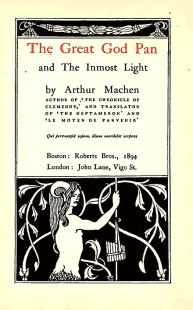
jz-headshotJust last week—a few days after the New York Times reported on the Trump administration’s efforts to define transgender out of existence—I read for the first time Welsh writer Arthur Machen’s 1894 novella, The Great God Pan, today considered a classic of horror fiction. Condemned as “morbid” and “abominable” by most critics when it was first published, the tale was hailed as “un succès fou” by Oscar Wilde, recuperated in the 1920s by H. P. Lovecraft, and particularly praised more recently by Stephen King, who called it “maybe the best” horror story “in the English language.”
440px-Title_page--The_great_god_Pan
Original edition with cover illustration by Aubrey Beardsley

The “queer” tale (the word “queer” recurs frequently throughout) is told by a series of straight-laced Victorian men, each of whom is horrified by the unspecified behavior and bearing of a mysterious woman, Helen Vaughan. Readers are led to suspect that Helen is guilty of some sort of sexual excess or transgression, but nothing is specified until after her suicide, when the medical examiner reports that he was “privileged or accursed” to see the “skin, and the flesh, and the muscles, and the bones, and the firm structure of the human body that I had thought to be unchangeable, and permanent as adamant, beg[i]n to melt and dissolve”: Continue reading “Lifting the Veil – #WontBeErased by Joyce Zonana”

Goddess Pilgrimage: A Sacred Journey for Women by Carol P. Christ

A pilgrim leaves home and sets off on a journey, seeking healing, revelation, and direction in her life. She finds companions along the way whose stories reflect her own, validating her quest and shedding light on her journey. According to anthropologists Victor Turner and Edith Turner, pilgrimages have common structural elements. A pilgrim separates from family and friends, work and obligations. She steps across a threshold into “liminal space” in which daily routines are suspended, opening herself to discovering new ways of being and living.

For spiritual pilgrims, the goal is a place or places said by others to be a “sacred” because healing or revelation have occurred there through the intervention of a deity, a saint, or spirits. The place is often on a mountain, in a cave, or near a spring. Along the way, pilgrims meet and share stories as in the Canterbury Tales. Some pilgrims say that the experience of sharing community with other seekers is as important as the revelation gained at the destination. When the pilgrim returns home, she must re-integrate into the community she left behind or find a new one. Continue reading “Goddess Pilgrimage: A Sacred Journey for Women by Carol P. Christ”

Troubling Our Souls: Selling Arms to Saudi Arabia, the War in Yemen, and the US Military Industrial Complex by Carol P. Christ

There is a very big elephant in the room. Apparently it is invisible because even the left is not discussing it. This elephant is the civil war in Yemen to which Saudi Arabia has contributed 19,000 (19,000!) deadly (deadly!) air strikes that have been alleged to have caused 60,000 (60,000!) civilian (civilian!) deaths (deaths!). These air strikes have been carried out with arms purchased from the US and its allies. The UN estimates that 22.2 million Yemeni civilians are in need of immediate humanitarian aid and that 13 million are at the risk of starvation. Yet a Saudi-led blockade is preventing food and other supplies from entering the country.

In the wake of the disappearance of legal American resident and Saudi journalist Jamal Khashoggi, the left castigates Saudi Arabia for a vicious murder. The US President warns congress not to cut off arms deals with Saudia Arabia because to do so would threaten more than half a million US jobs in the military industrial complex. Continue reading “Troubling Our Souls: Selling Arms to Saudi Arabia, the War in Yemen, and the US Military Industrial Complex by Carol P. Christ”

Love a Good Fail, and Fiona Apple is my Liturgy this Morning by Elisabeth Schilling

I am falling in love with failure. At least I’m trying. It is time I have to.

We shouldn’t, lovely womyn, be short on our accomplishments. It doesn’t matter how slow going we’ve been, what we haven’t done yet, or what we haven’t quite obtained. We have to focus on the great strides we’ve made despite all the seeming nothings. If we fail, that means we put ourselves out there. Many times I submit a request or offer myself, the answer is silence, but other times the answer has been “yes.” I just haven’t heard many yesses because I don’t really try all that often. I’m timid, beat myself up, get down on myself, give up. Failure feels most like failure, though, the bad kind, when I’m indecisive and I don’t or can’t act. Not committing to something or deciding feels like a weight or blades inside. How can I love this failure? Or, at least, how can we be compassionate toward ourselves when we are in this situation?

I get Esther in Sylvia Plath’s The Bell Jar, at least from what I can gather from this quote: “I saw my life branching out before me like the green fig tree in the story. From the tip of every branch, like a fat purple fig, a wonderful future beckoned and winked. One fig was a husband and a happy home and children, and another fig was a famous poet and another fig was a brilliant professor, [. . .] and another fig was Europe [. . .]. I saw myself sitting at the crotch of this fig tree, starving to death, just because I couldn’t make up my mind which of the figs I would choose.”     Continue reading “Love a Good Fail, and Fiona Apple is my Liturgy this Morning by Elisabeth Schilling”

Women v. Religion: The Case Against Faith and for Freedom BOOK REVIEW by Katie M. Deaver

In the book, Women v. Religion: The Case Against Faith and for Freedom, editor Karen L. Garst puts together the voices of women from a variety of backgrounds in an effort to present a case against faith.

While the introduction to the full volume suggests that women ought to turn away from all forms of religion the majority of the individual pieces that the book features focus on the Abrahamic religions: Judaism, Christianity, and Islam.  The included pieces are written from a variety of disciplines and viewpoints, some feature historical facts and timelines, while others are the raw and difficult personal stories of women struggling to leave the religions they were raised within.

Most of the articles dig into many of the traditional critiques of religion.  For example that the Abrahamic faiths are inherently patriarchal, and cannot be redeemed for women.  Others take these traditional arguments against religion a step further and argue that in addition to religion being a tool for female subjugation, religion has in fact inhibited Western progression and is a key reason why the United States has not yet had a female president, and why women continue to have to fight for their bodily and human rights.

Continue reading “Women v. Religion: The Case Against Faith and for Freedom BOOK REVIEW by Katie M. Deaver”