

 When I learned about the Navajo Beauty Way, I understood it to be a path in which human beings respect all beings in the web of life and live in harmony with them. But I didn’t understand why this path was called the “Beauty Way.” As a young woman, I knew that my worth was defined by many in terms of my ability to conform to ideals of female beauty promulgated in movies, tv, and advertising. I didn’t believe the Navajos were talking about beauty in that sense, but because of my conditioning, I was not yet able to fully grasp what they might mean by beauty. I would have called the way they were describing a “Way of Harmony” or a “Way of Respect for Life.”
Still, I wondered: why the Beauty Way?
Marija Gimbutas described the societies of Old Europe as peaceful, settled, agricultural, highly artistic, matrifocal and probably matrilineal, and worshipping the Goddess as the power of birth, death, and regeneration in all of life. Though I am impressed with the beauty of the many small works of art Gimbutas reproduced and interpreted in The Language of the Goddess, I sometimes inadvertently omit the words “highly artistic” when repeating in her definition of the culture of Old Europe. I have tended to view the fact that Old Europe was peaceful and matrifocal as more important than the fact that it was highly artistic.Yet this judgment is wrong. In calling the cultures of Old Europe “highly artistic,” Gimbutas was trying to convey her understanding that appreciation of the beauty of life was fundamental within them.
We have been taught that “high” or “great” art is most often monumental in size. The Pyramid of Giza is over 230 meters (756 feet) tall. The Great Sphinx of Giza is 20 meters (66 feet) high. The Parthenon rose to 14 meters (45 feet) and the statue of Athena inside it was 9 to 11 meters (35-40 feet). It is telling that we use the words “high” and “great” (originally measures of size) to describe the value of artistic creations.

The purpose of monumental works of art is to diminish the viewer, to make the her feel small, to induce her to bow down, to worship, and to obey a power or powers greater and higher than herself.
In contrast, the small scale of the art of Old Europe does not diminish anyone or anything. Its purpose is not to make anyone one want to bow down. Instead small works of art make the viewer feel comfortable, welcomed, and part of the beauty of life that is depicted.

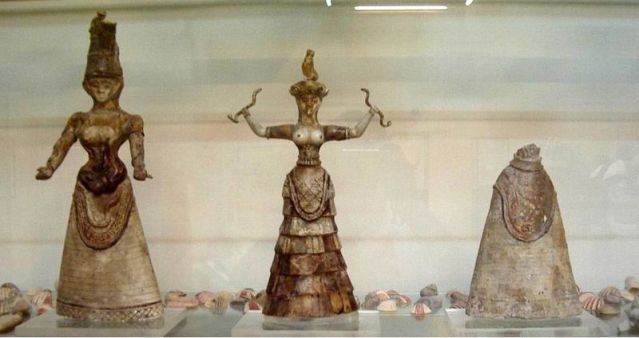
Marija Gimbutas viewed ancient Crete in the Bronze age as the final flowering of the culture of Old Europe. In Crete too, everything is on a small scale. Though the so-called Palaces or Sacred Centers are large, the rooms within them are small. There is not a single room where crowds could have bowed down to a King or Queen. Nor are there images of deities larger than life. The famous Minoan Snake Goddesses are less than 15 inches tall and the well-known pitcher Goddesses are even smaller. Such objects would have been held in hands during rituals or set on low benches in small rooms lit by oil lamps.
When my friend’s daughter Klia was seven years old, she spent her afternoons collecting stones by the sea. One day I asked her if the stones spoke to her. “Of course,” she replied. “What do they say?” “They say, ‘we are very beautiful.’”
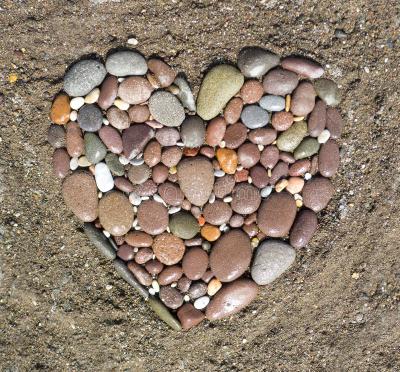
Klia intuited the meaning of the Beauty Way. It has nothing to do with artificial beauty standards. It has nothing to do with size. It is recognizing beauty everywhere and in everything. When we do so, we walk in beauty, in the grace and joy of life. And yes, the Beauty Way has ethical implications, for no one who truly recognizes beauty could want to harm it. This was understood by the Navajos, the Old Europeans, and the ancient Cretans, and many others. Only we seem to have forgotten. We can remember.
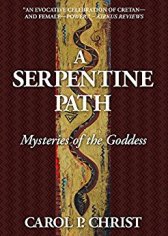
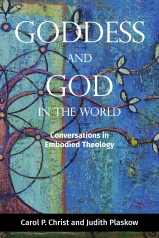
Carol P. Christ is an internationally known feminist writer and educator living in Molivos, Lesbos, who volunteers with Starfish Foundation that helps refugees, assisting with writing and outreach. Carol’s new book written with Judith Plaskow, is Goddess and God in the World: Conversations in Embodied Theology. FAR Press recently released A Serpentine Path: Mysteries of the Goddess. Join Carol on the life-transforming Goddess Pilgrimage to Crete. Carol’s photo by Michael Honegger.
 Like many in the FAR community, I participated in the world-wide

 Stories about refugees in the island of Lesbos (where I live) are no longer front page news. Yet according
 Throughout my life I refrained from hard core cursing and substituted certain four letter words with modified publicly suitable words. I just didn’t think it was becoming of me to curse, but if and when I did do it it was about something pretty major, and I would softly let it out.
 This past summer, my friend and I were perusing the exhibits at the
 When I began to research our family tree, my father told me that his grandfather George Christ emigrated from Germany because he was a socialist. I eventually learned that it was not George Christ but his parents, Thomas Christ and Anna Maria Hemmerlein, who emigrated from Bavaria. Thomas died in 1863 when George was an infant and George died in 1895 when my grandfather was an infant, which explains how their stories got confused.
 Feminism and Religion