On Difference by Ivy Helman.

untitled.pngThere is no correlation between difference and danger.  Yet, differences are regularly considered threatening.  In fact, much of Western society’s patriarchal energy is spent categorizing, controlling, managing and fighting difference.  Difference is so ingrained within the psyche that most differences are understood to be antithetical, perhaps even unbridgeable, opposites.  Good/bad, black/white, rich/poor, women/men and human/animal are just a few examples.  To further amplify this distinction, patriarchy considers one aspect of the difference more valuable than the other.  

Feminism seeks to end this value-laden, polarization of difference.  In its earliest days, many feminists were convinced that advocating sameness was the best solution.  Abolition, the Equal Rights Amendment (ERA) and the right to vote were parts of this liberal agenda.  While sameness worked in some respects especially in terms of ending slavery and gaining the right to vote, the sameness platform also, albeit perhaps unknowingly and considerably to a lesser degree, bought into patriarchal views of the dangers of difference.  For example, ending slavery did not end racism nor did gaining the right to vote mean that women were equipped or allowed to think independently of their husbands.  Other first-wave feminists who advocated women as pure and moral persons and elevated motherhood fared little better playing into the patriarchal ideals of biological determinism and essentialism.       Continue reading “On Difference by Ivy Helman.”

A Feminism of the Right? by Race MoChridhe

Race MoChridheAs I read Carol Christ’s post, This Is How Liberal Democracy Dies, I was reminded of the women with whom the bulk of my research time lately has been spent—the Madrians, a Goddess movement that flourished in Britain and Ireland from the early 1970s until the mid-1980s. Like Christ, the Madrians believed that society was headed in a self-destructive direction and could best be reoriented through women’s wisdom. Like Christ, they admired Greek culture and looked to matrifocal Old Europe for inspiration. Like Christ, they found in both their experience of womanhood and in the model of that past a blueprint for a radically different kind of politics, but a politics that could scarcely be more unlike Christ’s.

They were environmentalists, pacifists, critics of capitalism, teachers of universal salvation, and often proudly-identifying lesbians, who advocated for women’s leadership in the home, in government, in education, and in religion. They were also Traditionalists, monarchists, and nationalists, who advocated for the fourfold social order, obedience to ecclesiastical authority, and the use of corporal punishment. Regularly seen at Goddess conferences and in the pages of magazines like The New Ecologist, they identified as feminists during their initial years, but by the early 1980s their writings self-identified as anti-feminist, offering a considered critique of a movement they had come to see as aligned with policies of the left which they believed robbed women of agency and sublimated them to a neutered, Enlightenment concept of the citizen that presumed masculine traits and values as its normative ideal. Continue reading “A Feminism of the Right? by Race MoChridhe”

Doctrine and Fidelity by Elise M. Edwards

elise-edwardsThis past week, I was listening to Krista Tippett’s podcast On Being as she spoke with Pádraig Ó Tuama.  He is a poet, theologian, and leader in the Corrymeela community of Northern Ireland. As he spoke about several things related to the challenges of belonging, reconciliation, and fractured communities, he said, ”The measure of Christian fidelity is more than the positions we take.”

I agree.  I interpreted his statement as a condemnation of the ways Christian doctrines and moral positions too often take priority over other matters of faith.

Continue reading “Doctrine and Fidelity by Elise M. Edwards”

It’s a Small Thing in Relation to Everything Else: Or Is It? by Carol P. Christ

carol-p-christ-photo-michael-bakasYesterday morning when I learned about the Open Letter to Attorney General Sessions: Join Us In Selma On the Right Side of History, I paused Joy Reid’s interview with William Barber II in order to search for the petition site. The letter’s authors invited the Attorney General to join them in Selma to commemorate the 52nd anniversary of “Bloody Sunday” when peaceful marchers demanding the right to vote were attacked with billy clubs and tear gas. The Letter also asks the Attorney General, who was born in Selma, to join them in a non-partisan commitment to ensure the right to vote for all Americans. The letter calls upon the Justice Department to restore the protections against voter suppression enshrined in the Voting Rights Act.
I was pleased to sign the Open Letter because I have been thinking about how those who came together in the Women’s March and other marches can channel their energy into registering voters, helping them get the identification required by “voter suppression laws” enacted with the purpose of disenfranchising voters of color and elderly voters in nearly half of all US states. I believe it is imperative to focus a part of our energy on helping people to get the necessary ID’s while at the same time working to throw out every single rascal who voted for these laws. We must take back the state legislatures that have the power to enact voting laws. And we must do what we can to make sure that everyone who wants to vote is able to vote.

While I was adding my name to the petition, I was asked to check if I am a faith leader. Continue reading “It’s a Small Thing in Relation to Everything Else: Or Is It? by Carol P. Christ”

Reflections on Death, Evil, and Divinity by Carol P. Christ

carol-p-christ-photo-michael-bakasIn our book Goddess and God in the World, Judith Plaskow and I discuss and debate our contrasting and conflicting views of the nature of divinity and the cause of evil. In the passage that follows, I respond to Judith’s questions.

This brings us to the major philosophical issue that divides us: the nature of divine power and the relation of divine power to the world. It is fair to say that our major difference in this regard is whether the divine power is personal, conscious, intelligent, loving, and good. You ask, “If all we know of that exists is a mixture of the good and the bad . . . , if our creativity and the creative power that births and sustains the world brings forth both good and evil, then how can the Goddess be less than ambiguous? How can the Goddess be ‘the ground of all being’ if she does not ‘form light and create darkness, make weal and create woe’ (Isa. 45:7)? This question lies at the heart of our differences.

. . .

You ask whether “evil finally has less metaphysical warrant or reality than good” in my worldview. Continue reading “Reflections on Death, Evil, and Divinity by Carol P. Christ”

After the WOMEN’S March…What Do We Do Now? by Marie Cartier

Marie & Deb
Marie & Deb

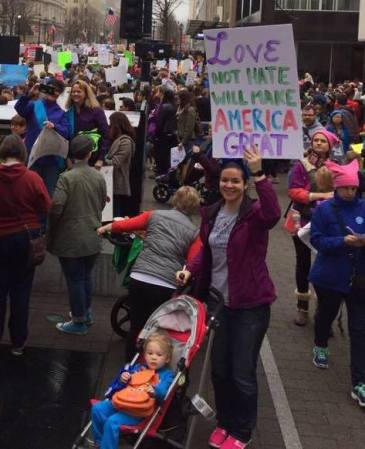
I am sitting here with my friend Deb—and like so many conversations we are all having right now, we ask each other— “…after the March…what do we do now?” Of course, we are speaking of the world-wide Women’s March that happened the day after the inauguration, January 21, 2017. I created a photo essay of the March for my last post here at FAR to document the energy and passion of that day.

The day after the March I was due for a rehearsal for a production in West Hollywood of the Vagina Monologues, a performance by Hollywood NOW that would benefit Planned Parenthood. At that first rehearsal, the entire cast, led by our director, decided that our production would be a response to the question above. In fact, we began the play by marching in from the back with signs from the Women’s March, many of us wearing “pussy hats” we wore in the actual March. Pictures of our amazing event are here.

So…that was February. And now here we are at the end of the month and…as my friend Deb says, “Now what?” Continue reading “After the WOMEN’S March…What Do We Do Now? by Marie Cartier”

Parenting and Politics: How I’m Showing Up by Katey Zeh

16143366_10101473904784794_642748390961867304_n

When I was ten weeks pregnant I gave an impassioned speech in front of the Supreme Court during the Hobby Lobby hearings about why universal access to contraception was part of my own religious understanding. I’d wanted to share about my own planned pregnancy, but at that point I wasn’t far enough along to feel comfortable telling that in a public way.

I didn’t know it at the time, but that would be my last protest for almost three years. After the birth of my daughter I cut my travel significantly. I spent most of my weekends in the cocoon–or what sometimes felt more like the prison–of our home rather than out in the public square.  As someone deeply ensconced in the activism world this turning inward felt like I was betraying the causes and the people for whom I cared deeply. How could I be an effective advocate if I couldn’t show up?

Over the last few months I’ve done a lot of reflecting on how parenting has shifted the way that I think about myself as an activist. Whether rooted in parental love, self-preservation, or some combination of these two, I’m less willing to put myself in harm’s way than I was before I became a mother. Continue reading “Parenting and Politics: How I’m Showing Up by Katey Zeh”

Authoritarian Followers: What’s Feminism and Religion Got to Do with It? by Carol P. Christ

carol-p-christ-photo-michael-bakasThere are two types of authoritarians: those who jump out in front and say “follow me, only I can solve the problem”; the far greater number of authoritarian personalities are those who want to be told how to think, what to do, “this is daddy, I’ll take care of you.” Those are the people who are the followers and while some of those would like to be leaders themselves, most of them are just happy to follow, and they don’t want to ask questions, and they want to be told what to do and how to think. And that’s a very scary lot. —John Dean

On her Saturday  program on MSNBC, Joy Reid asked former Nixon White House Counsel John Dean why those who support Trump seem so uninterested in facts that show a deeply troubled and compromised presidency. Dean’s response was that the authoritarian personality does not want to think. Continue reading “Authoritarian Followers: What’s Feminism and Religion Got to Do with It? by Carol P. Christ”

Welcome to the Resistance by John Erickson

john-womens-marchThere comes a time in all of our lives when we have to make important decisions. What do I believe in? Who do I want to be? What and who will I stand up for? There has been a lot going on in the world lately and a lot of it, sadly, is pretty awful. While people are learning pretty quickly that elections have very real and long-lasting consequences, what is critical to make clear in the next 4 years of this fascist regime isn’t just that we are taking to the streets to make our voices heard, but that we are willing to disrupt society at every turn to make sure that people on the other side of the proverbial political coin know we will not go gently into that good night.

I’ve been questioning G-d a lot lately; wondering what has happened to that shining “City on a hill” that John Winthrop called for in his 1630 sermon “A Model of Christian Charity.” The idea that the United States of America is “G-d’s country” is based in an American exceptionalism based not only the rich bounty of land and resources many would soon benefit from, but also on the potential for a different kind of society that America represented in a world full of monarchs. Continue reading “Welcome to the Resistance by John Erickson”

Mindful of the Bond We Share in these Trying Times by Vibha Shetiya

vibpicI’m sitting in my parents’ balcony in Pune, India, on a quiet morning. Well, this being a bustling Indian city of six million, it can’t really be quiet. As I sit with cup of tea in hand, I try and meditate – I’ve been practicing mindful meditation of late, and so, rather than block out the noises, I embrace the various sounds that make up this Monday morning.

I count the variety – sparrows gently chirping away while a noisy crow tries to outdo them in a contest he easily wins, a street hawker starting his day (and ours) on a rather cacophonous note, the sweeper from the neighbouring complex pouring his heart and soul into cleaning the grounds that will need re-sweeping in an hour or two, the put-putting rickshaw carrying squawking kids to the school down the alley, chirping chipmonks that temporarily develop wings as they fly from branch to branch in a cheerful chase, the honking car warning of its over-the-limit speed (reaffirming the fact there are two things we Indians especially love: honking for no reason, and breaking traffic rules), my mother’s footsteps as she peers out to see what I’m doing by myself…nine in all.

In the past I would have tried hard to block these out, straining to keep my mind on my breathing, worrying I’ll never find a quiet enough spot to help me master (hah!) the art of meditation. But today, I am grateful. Grateful that I am a part of a larger picture. And as I scan my body from head to toe, feeling the tension most in my shoulders while the cold mosaic tiles below keep me momentarily grounded to the fullness of living, I remind myself that I am just a speck in this montage called life. Continue reading “Mindful of the Bond We Share in these Trying Times by Vibha Shetiya”