

I once dreamed I was giving a lecture on a spiritual philosophy called magmatheism. The literal meaning, I thought when I awoke, would be something like “belief in the divinity of molten rock.” I had the sense this dream was trying to tell me something about what I had come to believe and know. When I asked my friends what they thought magmatheism was, they gave answers that delighted and intrigued me.
One said: “the belief that God/Goddess dwells below the ground and every once in a while erupts out gloriously.”
Another said: “By studying the ways in which rock is liquid, we can understand the oneness of all things… Our separation is an illusion. We are part of the whole.”
A third said: “Honoring the magnetic pull to earth.”
A fourth said: “The unmanifest that creates the foundation of all life.”
The dream told me something real about the power of dreaming. It let me know that a life physically and spiritually connected to the earth—the life I was trying to live and to encourage others to live—did not only occur when I was awake, but when I was asleep. The dream told me that the earth was speaking to me in my dreams. As dream tender Stephen Aizenstat writes, “Dream images are not representations of our personal nature only, but are also informed by the subjective inner natures of the things and creatures out there in the world. (Aizenstat, S. Dream Tending: Awakening to the Healing Power of Dreams. New Orleans, LA: Spring Journal, Inc. (2011), pp. 149-150).
 Before he told the story of how his people received the sacred pipe,
  I have recently noticed an interesting thing: just like the Buddhist goal of ending suffering requires consideration of others, so often feminist change requires thinking about other women.
 Our first ritual on the Goddess Pilgrimage to Crete is a death ritual in which we honor the memory of those who have gone before us. Like so many things on the pilgrimage, the death ritual evolved. I did not consciously plan to begin with death. Rather, the death ritual inserted itself at the beginning of the tour. Now I understand that the timing is right.
 Let’s see if the following course of events makes sense. A few Wednesdays ago, I was thinking about possible topics for this post considering it would be Mother’s Day. In the midst of thought, the warning sirens in Prague began. They were only being tested but, nontheless, I immediately thought of tornados. You see tornados, as awful and devastating as they are, make me think of thunderstorms and lightning. I love a good thunderstorm, the louder the better.
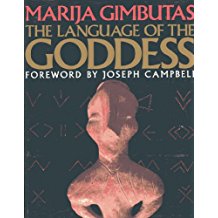 Marija Gimbutas coined the term “Old Europe” c.6500-3500 BCE to describe peaceful, sedentary, artistic, matrifocal, matrilineal and probably matrilocal agricultural societies that worshipped the Goddess as the power of birth, death, and regeneration in all of life.
 While waiting to get off a plane last week, I overheard a serious young woman explaining a recent theological insight to her half-asleep and equally young husband. “You see,” she began, “what I just learned is that though He owes us nothing and does not reward us for our good deeds, nonetheless, He takes pleasure in them.”
 In her 1975 manifesto, “
