This week, the Christian season of Lent began. Ugh. Lent can be so somber and serious and gloomy. Last year, I didn’t want to place myself in that frame of mind. I was experiencing grief and self-doubt and loneliness, and felt that an extended period of reflection about self-denial, Christ’s suffering, and the sinful condition of humanity might pull me into an unhealthy depression. Also, I questioned why I should seek silence and solitude when I was already experiencing too much of it. I felt isolated.
This year is different for me. Once again, I’m entering the season with a grieving heart. I’m mourning the death of my cousin. But I do not feel isolated. I am not self-doubting. This January, I spent four continuous days with mentors and peers in academia who poured love and wisdom and inspiration into me. The women in our group sought each other out and had honest and authentic conversations about the successes and struggles in our lives. We affirmed self-care. We affirmed milestone birthdays. We affirmed our bodies, despite the physical limitations we sometimes feel. We affirmed the tough decisions some had made, the transformations some were pursuing, and the exciting opportunities that had developed for others since we last met over the summer.
It was a powerful experience, but there was pain, too. We confronted fear, rejection, anxiety, exhaustion, and frustration. I felt blessed—divinely gifted—to have an opportunity to speak honestly with my sisters in the spirit about the people and issues on our hearts: challenges with students, systemic racism and sexism, menopause, children, research questions, financial decisions, romance, and health.
“Light and Darkness” is a song written and arranged to one of the oldest known European melodies by Ariadne Institute founding Co-Director Jana Ruble, following her first Goddess Pilgrimage to Crete. Every year since then, we have sung it in the caves of Crete during our rituals. A pilgrim told us that she learned it at the (Christian) Re-Imagining Conference. Last spring another pilgrim said that she knew it because her choral group sings it. You can listen to “Light and Darkness” and see pictures of an altar in a cave on a new video created by Goddess pilgrim PJ Livingstone after the 2015 spring tour.
She appeared on a hill on December 9, 1531. She spoke to Juan Diego in his native tongue of Nahuatl; the language of the Aztecas. She asked for a church to be built at that very site in honor of her, the Virgin Mary. Juan Diego took the request to the local priest, but his story was not believed. On December 12, following further instructions from La Virgen, Juan Diego was able to find and pick roses not native to Mexico. He rolled them up in his tilma and returned to the priest. When he unrolled his tilma to present the roses, there on the tilma was the image of La Virgen de Guadalupe; she was as dark as the natives themselves.
Natives across Mexico and throughout the Americas endured the brutal realities of conquest, and experienced the relegation to second class citizens during the colonial period in Mexico. In particular, native women experienced oppression two-fold. This is evident in the fact that native men had privileges and opportunities within the public sphere of society which were denied to women, such as holding particular types of public service positions.
So how is it that millions of natives across the continent converted to Catholicism, the religion used by their oppressors to justify the horrors and atrocities inflicted upon them? The appearance of La Virgen to Juan Diego. She is seen as the blending of the Indigenous and European cultures. A Huffington Post article, Everything You Need to Know About La Virgen de Guadalupe, explains, “Her image has been used throughout Mexican history, not only as a religious icon but also as a sign of patriotism.” Indeed, she has appeared as a symbol even in the most pivotal of moments, such as the fight for Mexican independence and the Mexican Revolution. The authors of the study The Evolving Genre of ‘Our Lady of Guadalupe’: A Feminist Analysis, also note that she has become “. . .the ideal model for womanhood and motherhood.” Continue reading “La Virgen de Guadalupe: New Feminist Portrayals by Jose Duran”
“The pictures that line the halls speak volumes about the history of racism and sexism and they shape the future in powerful ways.”–Simon Timm
The author of these words recently posted a short video on Youtube entitled “Mirror Mirror on the Wall: The Legacies of Sexism and White Supremacy at Yale Divinity School.”* The video begins with a catchy little ditty with the words, “God is not a man, God is not a white man.” It tracks paintings and photographs of professors and other luminaries in the field of theology on the walls of the Yale Divinity School. By Timm’s count: 99 white males, 6 women, and 3 blacks. The single black woman is counted in both categories.
Standing as a stark and graceful contrast to the corruptions of freedom of religion, expression, and human rights we hear about every day, there was a grand display of feminine empowerment and beauty at the most recent Burning Man festival, an event in Black Rock City, Nevada. It was a magnificent temple created for Mazu—the Chinese Goddess of the Sea. Her temple and its towering lotus flower were built, and soon thereafter ritualistically burnt, in the simplistic beauty of the desert.
An aesthetically calming temple honoring her came about by the collaboration of Project Manager Nathan Parker and Taiwanese arts foundation, the Dream Community. When I arrived at Burning Man and first saw the temple, I was in awe. The open, octagonal building created from bamboo was rustically elegant. It was designed to be indicative of a structure floating in water. Two piers stretched outwards on either side, while an eye-catching arbor framed the path to the entrance. Blue LED lights flickered on the ground in wave patterns around the temple to create the essence of water encircling the goddess’s temple. A towering 40-foot pink lotus flower sat atop the structure, while fire breathing dragon statues flanked the four corners. Once inside, a center pillar held burning incense, notebooks and pens for reflections, and small strips of papers inscribed with prayers for people to take.
The title of the essay Über die Diotima (hereafter, the ‘Essay’ (translation here (pp400-419))) by Friedrich Schlegel (hereafter, ‘Friedrich’) suggests it is focused on Plato’s portrayal of Diotima in the Symposium. That portrayal, though, is but a starting point for Friedrich, who attempts to demonstrate that Diotima was a particular type of woman he associates with other ancient Greek women, including Sappho. The Essay is ostensibly of little relevance today, largely because knowledge of ancient Greece has evolved substantially since Friedrich’s time. In particular, a compelling case has been made that far from being related to ancient Greek women, Diotima is a fictional figure used by Plato “to vanquish Sappho” (Jantzen, Foundations of Violence, p193).
Yet, the Diotima Friedrich principally had in mind was not the one in Plato’s Symposium, but rather Caroline Schelling (hereafter ‘Caroline’), who was–for a time–his sister in law. On the third anniversary of his meeting Caroline he wrote a letter to her, reminding her of that anniversary and thanking her “for everything you have done for me and my development” (Caroline was almost a decade older than Friedrich, who was then in his early 20s, and yet to establish a name for himself as a scholar). Towards the end of his letter he asks her to read the Essay “once more and mark in pencil those passages in which you believe a small change might be necessary.” While his ‘once more’ suggests Caroline had previously given him input, the fact that in a letter to her from almost a year earlier Frederick refers to her, somewhat flirtatiously, as the “independent Diotima” relative to her ‘god’ (Frederick’s brother, August) confirms his identification of her with the subject of the Essay.Continue reading “The German Diotima by Stuart Dean”
With Black History Month fast approaching, it is fitting to investigate the latest call to get rid of it.
This investigation may seem futile to some feminists/womanists since we know denials of racism are part of life in white supremacy patriarchy. As a feminist theologian, however, I’ve got nothing in my tool kit if I lose my hope for redemption and transformation. The following is my attempt to not give up on the possibility that white supremacy culture can be dismantled.
White patriarchy has all kinds of messengers of its narrative—not just white men of privilege, but anyone who has internalized the muscle twitches of white supremacy. This time, the messenger is Stacey Dash, an African-American actress and contributor to Fox. Ms. Dash chastised Spike Lee and Jada Pinkett Smith for saying they will boycott the Oscar awards because of the all-white list of nominees. She called their protest “ludicrous.” She added that if we want to end segregation, we need to “get rid of BET and Black History Month.”
Having a person of color deny the existence of systemic racism is a big win for white supremacy patriarchy. A person of color as the carrier of white supremacy culture is a Trojan Horse full of social capital for those in power—enough to fool scores of people into thinking they are justified in their misconceptions about race. Dash’s protest of the protest comforts everyone who is tired of all the “whining” and “anti-white” rhetoric they hear in the #blacklivesmatter movement.
A brief scroll down through #OscarsStillSoWhite encapsulates white supremacy apologetics rhetoric. Actress Charlotte Rampling suggests that Black actors just weren’t good enough to make it. Actor Michael Caine asks Black actors to “be patient.” Others say that since Denzel Washington won two Academy Awards the Oscars can’t be racist. And there are several using the tired old accusation of “reverse racism.”
All the bases of white defensiveness are covered: asserting the inferiority of people of color, the benevolent call to be patient, the case in point of the person of color who “made it,” and the accusation of Black on white “racism.” The tenacity of this defensiveness is remarkable. And it is time for its demise.
Why can’t the race discussion in the United States break through this moral inertia? I believe it is because of the two archenemies of healing and justice: moral lethargy and willful blindness.
No matter how many times white patriarchy’s apologists want to accuse people of color of “reverse racism,” they cannot alter the very nature of racism itself. Racism is only racism when it comes with the power of systems, institutions, cultures, and a societal pay off. Racism is a system of privilege based on race in which there is power to create disadvantage with things like access to power, social capital, and accumulation of resources.
If people of color think too many white people and not enough Black people have access to the social capital of the Academy Awards, that is not racism. That is an observation. There is no payoff to this observation. There is no power imbalance solidified. There is no oppression created. If people of color even just don’t like white people, that is not racism. That may be a racialized bias, but it is not racism.
All biases based on race do not equal racism. Some of those biases are a result of racism. But not all of them are expressions of racism. Racism is, at its core, about power: the power to create and entrench advantage and disadvantage. And many of the subtleties of systemic racism and racialized biases carry with them the power to entrench disadvantage for people of color and advantage for people who are identified as white.
It is moral lethargy and willful blindness that keep so much of American culture from seeing the contours of racism and its resulting racialized disadvantage.
Moral lethargy is failing to listen to the cues of our conscience when racism is pointed out. Defensiveness is the way moral lethargy gets its way. If you push back against the narrative you don’t want to hear with enough denial, then you don’t have to change. Moral inertia is like eating too much sugar—at first, you are hyped up on indignation, and then you slump back into a poorly nourished fog of familiar ethical fatigue.
Willfull blindness takes more effort to maintain itself. It requires a counter narrative to the one we choose not to see. And so, it gets filled up with rights and wrongs, shaming and blaming, and all sorts of other value judgments and norms that are seen as “right,” “good,” and “common sense.” This willful blindness then can actively NOT see racism, because it sees all the ways people of color are, themselves, the problem. And every day, this willful blindness is infused with more reasons not to see what we need to see because of what we think we see all around us.
If it sounds circular, it is because it is.
Willful blindness is a tightly wound system of millions of tiny little choices not to see what is right in front of our eyes because of what we’ve trained our eyes to see.
Racism depends on moral lethargy and willful blindness from all kinds of well-meaning people. These habits are racism’s lifeblood. Overt racism is just the gravy. The everydayness of moral lethargy and willful blindness do the heavy lifting to keep the systems of racism working smoothly.
Someone I dearly love recently lent me a very sensible piece of advice: “You should forgive.” I know he resorted to these words out of love because he didn’t like seeing me in pain, a sentiment for which I was and remain grateful. I also know he wasn’t judging me when he brought it up, nor was he pressuring me into doing something I wasn’t ready for.
I truly understand how forgiving someone who has deeply hurt you can set you on the path to freedom. In the sense that forgiveness can loosen the chains that bind you to the past, the anger, the deep sense of betrayal, helping you learn to live again; that forgiveness is not so much about the other person but about the self. I have watched shows in which victims of horrific crimes or their family members have chosen to forgive, not always out of a sense of human bonding towards the aggressor, but because they could not live with the debilitating anger and hatred festering inside, and so chose to forgive to set themselves free. Continue reading “Forgiveness is a *choice* by Vibha Shetiya”
In this sixth reflection on the life of Hafsa bint Sirin and in blogs to follow, I will be emphasizing that her much praised great piety was not incompatible with social engagement, or even sometimes a good dose of family drama.
Hafsa bint Sirin was the oldest child of freed slaves. Her parents had been taken as captives and most likely distributed as war spoils to the Prophet’s companions, Abu Bakr al-Siddiq and Anas b. Malik. Because her parents had been enslaved by such significant companions, and after their release became clients and treated like foster family, certain social advantages were open to her that might not have been for a free woman of no connection.
Let me pause here to say that there is no point in pretending, as some do, that slavery in Islam meant that the people they enslaved or clients were “like family,” in any way that makes sense to us now. The wealth of legal injunctions discussing the rights an owner had over those they enslaved makes the point. Likewise, innumerable calls to be good to enslaved people in piety literature demonstrates just how often the free had to be reminded to treat those they enslaved well. Furthermore, conversion to Islam did not mean that enslaved people were set free. I make this point because I do not want the successful story of Hafsa’s family to give the impression that Muslims who enslaved others were somehow less ethically culpable than slave owners in the Americas, nor do I want to minimize the Hafsa’s own purchase of a woman for household labour (who goes unnamed yet is also a transmitter of her story). I look at Hafsa’s story to demonstrate how women’s histories were transformed and worked for elite male purposes, this includes the histories of those who were enslaved. I address this aspect of pious women’s history in my piece on pious and mystic women in The Cambridge Companion to Sufism.
It is often said that with the coming of Islam Arab tribal social hierarchies were upended. While this is true to some degree, in practice, the social levelling that came with Islam was more of a redistribution of status than the elimination of it. Social status came in many modes and often hand in hand with great piety and great poverty. Those who sacrificed everything to join Muhammad early on and fought alongside him had the greatest rank. Those physically nearest to him or his companions had the greatest opportunity to learn about him and transmit his teachings. So even a slave of a household of one of the Prophet’s Companions would have been able to establish higher social connections based on mere proximity to these elites than a wealthy free man who lived in outside Medina.
First as enslaved servants and then clients of close companions of the Prophet, Hafsa’s parents, Sirin and Safiyya, were able to claim such connections and Sirin was eager to make use of them. Sirin had run a coppersmith business before his enslavement. He seems to have been eager to reclaim his lost status. Safiyya was the perfect wife in this regard. She was an appropriate match as a former slave, but she would also have raised him in status through her clientage relationship to the Prophet’s best friend and father-in-law, the first caliph of the Muslim community, Abu Bakr al-Siddiq. Throughout her life, Hafsa’s mother enjoyed relationships with the extended family of Abu Bakr as well as the Prophet’s wives. She was so well-esteemed, it is said that when she died three of Muhammad’s wives laid her out along with other notable companions.
The depiction of Sirin’s wedding to Safiyya bears the mark of a lavish and somewhat awkward event. He is said to have held a celebration (walima) for seven days, most likely paid for by Anas b. Malik, which would have been ostentatious by prophetic standards. Anas was a highly regarded companion, a transmitter of many hadith, but seems to have a sense of wealth that was out of keeping with some other companions of the Prophet. It is reported that Anas demanded 40,000 dirhams or more from Sirin for his freedom. Sirin could hardly afford this. He was forced to go toʿUmar ibn al-Khattab, Muhammad’s close friend and the third caliph, for help facilitating his release. At the wedding party, the esteemed companion Ubayy b. Kaʿb stopped by, bringing other companions with him and praying for the couple. Ubayy b. Kaʿb was an early companion of the Prophet, one of his scribes and the possessor of a personal copy of the Qur’an. But notably Ubayy refused to eat at the celebration, saying he was fasting, which would have been considered a slight directed at Anas.
Despite this implied criticism, Anas held great status and was able to give Sirin and his spiritually and intellectually precocious children the best opportunities for success. Through her father and mother’s connections, Hafsa, her two sisters Umm Sulaym and Karima, and her brothers Muhammad and Yahya–not to mention her half-siblings, some of whom also transmitted hadith–would have grown up in the deeply intertwined social, scholarly, and devotional circles of the Companions and Followers in Medina and Basra. Because her family had access to these elite social circles, Hafsa had the opportunity to memorize the Qur’an by the age of twelve as well as sit with companions such as Umm ʿAtiyya, Abu al-ʿAliya, and Salman b. ʿAmir from whom she transmits hadith. Ultimately, she became known as a reliable scholar and a woman of great piety and was taken seriously in influential circles (as we saw when she argued the legal status of women’s right to pray the ʿeid prayer at the mosque).
Later Anas contracted a second marriage for Sirin to one of his former slaves, then, again decades later, to one of his nieces as a third or fourth wife, thus elevating Sirin from client to family. Given Sirin’s multiple marriages, Hafsa grew up around many siblings in what was likely to have been a bustling compound of rooms. Her father tried to make space for his children’s devotional needs. It is said that he built separate prayer spaces of wooden planks for her, Muhammad, and Yahya. But such quiet spaces devoted to piety did not keep Hafsa from family drama arising from Sirin’s marriages.
When Anas offered Sirin his niece in marriage, Hafsa was supportive of the match despite her mother’s clear objection. Hafsa may very well have accepted the multiple marriages. She may have felt some advantage to them given her close relationships with her siblings and the social ties it further afforded them. Marriage was primarily a social arrangement for families, not solely a matter of legitimating desire or love. Or she may simply be portrayed this way to promote what male transmitters would consider a proper pious response highlighted against that of her mother. Whichever the case, it is reported that when given the news, she congratulated her father for a tie that would raise them from a clientage relationship to family with Anas. But when Hafsa delivered the news to her mother, Safiyyah insulted Hafsa for supporting her father and retorted, “Tell your father, ‘May you be distant from God!”’
To be continued…
(Accounts are taken from Ibn Saʿd’s Tabaqat al-kubra, her transmissions of hadith, and Ibn al-Jawzi’s Sifat al-safwa). Thanks goes to Yasmin Amin for clearing up a few matters, including the nature of Safiyya’s message to Hafsa’s father [literally, may God keep you young, but meaning, may you be delayed in meeting God and so distant from God]).
Laury Silvers is a North American Muslim novelist, retired academic and activist. She is a visiting research fellow at the University of Toronto for the Department for the Study of Religion. Her historical mystery series, The Lover: A Sufi Mystery, is available on Amazon (and Ingram for bookstores). Her non-fiction work centres on Sufism in Early Islam, as well as women’s religious authority and theological concerns in North American Islam. See her website for more on her fiction and non-fiction work.
In recent years “the Sacred Feminine” has become interchangeable with (for some) and preferable to (for others) “Goddess” and “Goddess feminism.” The terms Goddess and feminism, it is sometimes argued, raise hackles: Is Goddess to replace God? And if so why? Does feminism imply an aggressive stance? And if so, against whom or what?
In contrast, the term “sacred feminine” (with or without caps) feels warm and fuzzy, implying love, care, and concern without invoking the G word or even the M(other) word–about which some people have mixed feelings. Advocates of the sacred feminine stand against no one, for men have their “sacred feminine” sides, while women have their “sacred masculine” sides as well.
Nothing lost, and much to be gained. Right? Wrong.
Perseus with the Head of Medusa: Sacred Masculine and Sacred Feminine?
When Goddess feminism emerged onto the scene early in the feminist movement, it had a political edge. It was about women affirming, as Meg Christian crooned in “Ode to a Gym Teacher,” that “being female means you still can be strong.” Goddess feminism arose in clear opposition to patriarchy and patriarchal religions. It was born of an explicit critique of societies organized around male domination, violence, and war; and of the male God or Gods of patriarchal religions as justifying domination, violence, and war. In this context, “the sacred masculine” was not understood to be a neutral or positive concept. To the contrary, the male Gods of patriarchy were understood to be at the center of symbol systems that justify domination.
The terms “the masculine” and “the feminine” were floating around and sometimes evoked in early feminist discussions, but when examined more closely, they were rejected by most feminists as mired in sex role stereotypes. The psychologist Carl Jung, for example, associated the masculine with the ego and rationality and the feminine with the unconscious. True, he argued that modern western society had developed too far in the direction of the masculine and needed a fresh infusion of the feminine in order to achieve “wholeness.” This sounded good, but when feminists looked further, they discovered that Jung and his followers harbored a fear of the uncontrolled feminine.
Jungians consider the unconscious to be the repository of undisciplined desires, fears, and aggressive feelings that require the rational control of the ego. Though strong and intelligent women were among Jung’s most important followers, Jung and his male companions retained a fear of independent women, speaking of women who developed their rational sides fully enough to argue with men and male authorities as “animus-ridden,” a term not meant as a compliment.
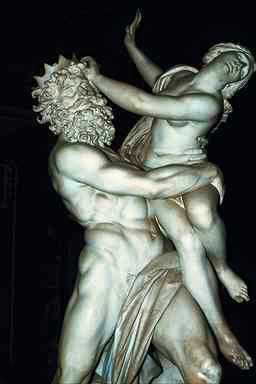
Hades Abducting Persephone: Marriage of Sacred Masculine and Sacred Feminine?
Jungians, following Erich Neumann, understand the progress of history through an evolutionary model in which humanity began in a matriarchal stage in which the unconscious reigned. This period of culture, which spawned the image of the Great and Terrible Mother, was primitive and irrational. Matriarchy was naturally superseded by patriarchy, in which the individual, the ego, and rationality emerged. In the patriarchal stage of culture, male Gods and heroes were the primary symbols, and rationality reigned supreme.
The patriarchal stage of culture had its limitations, which were revealed in the two World Wars of the twentieth century and the nuclear and environmental crises that followed. Rational man, Jungians argued, had come to the point where he needed to reconnect with his feminine side. The unconscious feminine was now understood to be a nurturing matrix that included the body, nature, and feeling, from which rational man should and could never fully separate himself.
The great archaeologist Marija Gimbutas also spoke of two cultures within Europe, an earlier matrifocal one she called Old Europe and a later patriarchal one. The Jungian Joseph Campbell endorsed Gimbutas’ work, leading some to assume that Gimbutas and Jungians hold similar theories of human history. In fact they do not: Gimbutas did not subscribe to an evolutionary theory of culture. She would never have said that the earlier matrifocal culture “had to be superseded” by the later patriarchal culture “in order for civilization to advance.” The clear conclusion to be drawn from Gimbutas’ work is that the patriarchal culture was in almost every way inferior to the one it replaced.
For Gimbutas, the agricultural societies of Neolithic Old Europe were peaceful, egalitarian, sedentary, highly artistic, matrifocal and probably matrilineal, worshiping the Goddess as the powers of birth, death, and regeneration. These societies did not evolve into a higher stage of culture, but were violently overthrown by Indo-European invaders. The culture the Indo-Europeans introduced into Europe was nomadic, patriarchal, patrilineal, warlike, horse-riding, not artistic, worshiping the shining Gods of the sun as reflected in their bronze weapons. Gimbutas did not look forward to a new “marriage” of matrifocal and patriarchal cultures. Rather she hoped for the re-emergence of the values of the earlier culture. Her theories had a critical edge: she did not approve of cultures organized around domination, violence, and war.
This critical edge is exactly what is lost when we begin to substitute the terms “sacred feminine” for “the Goddess” or “Goddess feminism” and “sacred masculine” for “patriarchy” and “patriarchal Gods.” When we allege that we all have our “masculine and feminine sides,” and that it is important “to reunite the masculine and the feminine,” it is easy to forget that in our history, the so-called sacred masculine has been associated with domination, violence, and war.
If we hope to create societies without domination, violence, and war, then we must transform the distorted images of masculinity and femininity that have been developed in patriarchy. We must insist that domination, violence, and war are no more part of masculinity or male nature than passivity and lack of consciousness are part of femininity or female nature. It may feel good to speak of reuniting the masculine and the feminine, but feeling good will not help us to transform cultures built on domination, violence, and war.


 his week, the Christian season of Lent began. Ugh. Lent can be so somber and serious and gloomy. Last year, I didn’t want to place myself in that frame of mind. I was experiencing grief and self-doubt and loneliness, and felt that an extended period of reflection about self-denial, Christ’s suffering, and the sinful condition of humanity might pull me into an unhealthy depression. Also, I questioned why I should seek silence and solitude when I was already experiencing too much of it. I felt isolated.
 “Light and Darkness” is a song written and arranged to one of the oldest known European melodies by Ariadne Institute founding Co-Director Jana Ruble, following her first Goddess Pilgrimage to Crete. Every year since then, we have sung it in the caves of Crete during our rituals. A pilgrim told us that she learned it at the (Christian)
  She appeared on a hill on December 9, 1531. She spoke to Juan Diego in his native tongue of Nahuatl; the language of the Aztecas. She asked for a church to be built at that very site in honor of her, the Virgin Mary. Juan Diego took the request to the local priest, but his story was not believed. On December 12, following further instructions from La Virgen, Juan Diego was able to find and pick roses not native to Mexico. He rolled them up in his tilma and returned to the priest. When he unrolled his tilma to present the roses, there on the tilma was the image of La Virgen de Guadalupe; she was as dark as the natives themselves.
 La Virgen de Guadalupe
 Standing as a stark and graceful contrast to the corruptions of freedom of religion, expression, and human rights we hear about every day, there was a grand display of feminine empowerment and beauty at the most recent


 from Cascade Books in October 2015, is
  Someone I dearly love recently lent me a very sensible piece of advice: “You should forgive.” I know he resorted to these words out of love because he didn’t like seeing me in pain, a sentiment for which I was and remain grateful. I also know he wasn’t judging me when he brought it up, nor was he pressuring me into doing something I wasn’t ready for.
 In this sixth reflection on the life of
  ears “the Sacred Feminine” has become interchangeable with (for some) and preferable to (for others) “Goddess” and “Goddess feminism.” The terms Goddess and feminism, it is sometimes argued, raise hackles: Is Goddess to replace God? And if so why? Does feminism imply an aggressive stance? And if so, against whom or what?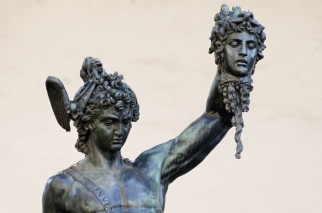
 A Serpentine Path: Mysteries of the Goddess
 Feminism and Religion