Carol P. Christ’s Legacy: Why Don’t Feminists Express Anger At God? by Carol P. Christ

Moderator’s Note: We here at FAR have been so fortunate to work along side Carol Christ for many years. She died from cancer in July, 2021. Her work continues through her non-profit foundation, the Ariadne Institute for the Study of Myth and Ritual and the Goddess Pilgrimage to Crete. To honor her legacy, as well as allow as many people as possible to read her thought-provoking and important blogs, we are pleased to offer this new column to highlight her work. We will be picking out special blogs for reposting. This blog was originally posted July 9, 2012. You can read it long with its original comments here.

My relationship to God changed when I accused “Him” of everything I thought “He” had done or let be done to women—from allowing us to be beaten and raped and sold into slavery, to not sending us female prophets and saviors, to allowing “Himself” to be portrayed as a “man of war.”

In the silence that followed my outpouring of anger, I heard a still small voice within me say: In God is a woman like yourself. She too has been silenced and had her history stolen from her. Until that moment God had been an “Other” to me. “He” sometimes appeared as a dominating and judgmental Other, and at other times as a loving and supportive Other, but “He” was always an “Other.” I as a woman in my female mind-body definitely was not in “His” image. 

Continue reading “Carol P. Christ’s Legacy: Why Don’t Feminists Express Anger At God? by Carol P. Christ”

From the Archives: That Which Is Sacred by Max Dashu

Moderator’s note: This marvelous FAR site has been running for 10 years and has had more than 3,600 posts in that time. There are so many treasures that have been posted in this decade that they tend to get lost in the archives. We are beginning this column so that we can all revisit some of these gems. Today’s blogpost was originally posted June 30, 2012. You can visit it here to see the original comments.

We are going through a huge cultural shift toward restoring the female to her full radiance. However you want to define that, it is rising now, through us.

That which is Sacred, what should we call it? We’ve been told to name it he, him, his. That it was blasphemy to do otherwise, to say she, even as they desecrated the Divine with comparisons to mortal overlords, those cruel masters, despoliators, persecutors. No. Reconsider. That fearful address to an authoritarian punisher takes us far from true reverence. Rather revere the roots of Being, manifesting in all Nature around us, within us. The profound silence, and the Deep calling to the Deep.

Deeply I go down into myself. My god is Dark and like a webbing made of a hundred roots that drink in silence. ― Rainer Maria Rilke

Continue reading “From the Archives: That Which Is Sacred by Max Dashu”

From the Archives: #MeToo and the Idolatry Trap by Tallessyn Zawn Grenfell-Lee

Moderator’s note: This marvelous FAR site has been running for 10 years and has had more than 3,600 posts in that time. There are so many treasures that have been posted in this decade that they tend to get lost in the archives. We are beginning this column so that we can all revisit some of these gems. Today’s blogpost was originally posted January 20, 2018. You can visit it here to see the original comments.

Really – everywhere we look – there are dead white guys. National holiday? Most likely in honor of a dead white guy. Statue on a green? Founder of a major Christian denomination? Dead white guy. Classic literature, painting, play, music ‘everyone’ is supposed to know about? Yup, probably by a dead white guy.

It’s a little exhausting.

It’s easy to develop a pretty negative attitude about all these dead white guys. I mean, some of them were pretty questionable if not downright oppressive people. Enough, already! Am I right?

Yes! Yes. Well… sort of. The thing is, some of them really did say and do wonderful, important things. I suppose we should not dismiss an entire portion of our history just on race and gender alone. And, truth is, I have a confession to make. I kind of really love the insights of some of these folks. I guess it’s easy to complain about all these dead white guys… until you fall in love with one of them.

Continue reading “From the Archives: #MeToo and the Idolatry Trap by Tallessyn Zawn Grenfell-Lee”

Vigil by Sara Wright

The third day
dawns under a cloud.
 Mourning doves
spread their wings
across leaden skies.
I am walking on air.
Two restless
nights – a huge
truck in the yard –
Blocked,
my stomach lurches.
I read Tributes
 in a daze.
Fierce Little Flower
Warrior Woman
fights
 a torrent of waves.
She is bridging
 raging waters
forging a New Story.

“Weaving the Visions.”
Oh, now I remember
where it all
began.

She hugged a tree.
 I plant a seed.
Listening to rounds of
 “light and darkness”
 I let my body lead.

 A serpentine path
guides me
 back to
Her Garden.
Cradled by Ancestors
Rooted in Body
I shed another
  patriarchal skin.

Continue reading “Vigil by Sara Wright”

A Tale of Dos Equis: Separating From My Husband by Caryn MacGrandle

After thirteen years filled with marital strife, I recently moved out.  For financial and logistical reasons, we are staying married, focusing on our two children and have put into place a ‘3-3-3’ schedule.

Three days, our daughters are with me.  Three days, they are with him.  And three days, we are all together at our old home. 

I believe that it is a great transitionary plan as it is making the adjustment for our daughters easier, but it is not always the easiest on me.

I call him my Dos Equis as yes, he is husband number two. Perhaps I am a slow learner, but I believe I have been ‘on path’. 

Dos Equis wanted us to all go on vacation together, and so we recently drove to Destin, Florida.  He feels that our relationship is ‘normal’ and that I have perniciously turned off some essential switch withholding my wifely duties and my support for him.

But it is not normal. 

Although I would suppose that far too many of you can relate.

Continue reading “A Tale of Dos Equis: Separating From My Husband by Caryn MacGrandle”

What Does a Woman Want? by Esther Nelson


Sigmund Freud (1856–1939), well-known Austrian neurologist and founder of psychoanalysis, “…said once to Marie Bonaparte: ‘The great question that has never been answered, and which I have not yet been able to answer, despite my thirty years of research into the feminine soul is, ‘What does a woman want?’” (“Was will das Weib?”) ― Sigmund Freud: Life and Work (Hogarth Press, 1953) by Ernest Jones.


I don’t believe Freud ever answered the question posed here satisfactorily.  Women’s desire—even today—hovers in the taboo category.  After all, in our hierarchal, patriarchal society women’s wants/desires are mediated through social structures and institutions that favor men.  It’s easy to overlook since we all are spawned and then swim in those patriarchal waters.

Continue reading “What Does a Woman Want? by Esther Nelson”

Grown Little Girl, Grow Little Girl by Chasity Jones Selenga


I have newly found myself a wife and in the throes of motherhood. In many feminist circles, I have encountered anti-family and anti-wifehood sentiments. The understanding is that to be a wife, and, to be a wife that chooses to start a family, is an oppressive position to occupy as well as the antithesis of the feminist movement. Though I am not typically a fan of tough physical, emotional, soulful labor, these two positions have been the highlights of my life so far.

My daughter embodies both my husband and me, physically. However, she is and will become her own person-soul. She is so young, but her soul is eternal, and has experienced eternity. I am here to help her navigate remembering who she is. She inhabits the intersection of Blackness, divinity, femininity, and infinity. Motherhood has greatly increased my capacity of appreciation for women and what women are capable of doing. Especially from the intersection of Blackness and woman-ness. From the capacity to create, labor, and deliver life to the task of raising Black children in a country that would have them annihilated, emotionally traumatized, and made to accept they are inferior.

Continue reading “Grown Little Girl, Grow Little Girl by Chasity Jones Selenga”

How I Learned to Love Snakes (a poem) by Marie Cartier


Can I recall a time when my resilience surprised me?

My mother always said, “If you feel bad, go out into the garden and eat worms.” Sigh. We didn’t have a garden. My resilience. My head hits the counter, as my father’s hand slams into the back of my head. I am locked in a closet. I am. That would be my mother as I grew up. Kicked up. Weeds grow. They do. What is surprising to me at sixty is not my resilience, but the fact that I never leaned back. Stopped. Being resilient is the inside and out of my blood type—moving through all of my veins. I am surprised if I cut myself there is blood left. But there is. I still bleed.

This is resilience.

Can I recall a time when resistance was the only option?

My father. I am twelve. My best friend is over. I go in the other room with him. I have to. She hears this, my best friend. I resist shame like a knife blade I hold. I leave the room with the blade held out. Shame then holds out a cloak promising me something. A space to hide maybe. I resist. I am in a cold fever. My best friend and I sit; we are watching a documentary on TV. My mother sits behind us. She says to no one, “Things happen at everyone’s house. I bet things happen at your house, too.” My best friend and I say nothing. I resist feeling. On the TV are flamingoes and I will hate flamingoes for the rest of my life.

This is resistance. Continue reading “How I Learned to Love Snakes (a poem) by Marie Cartier”

Re-Visioning Medusa: Part I by Sara Wright


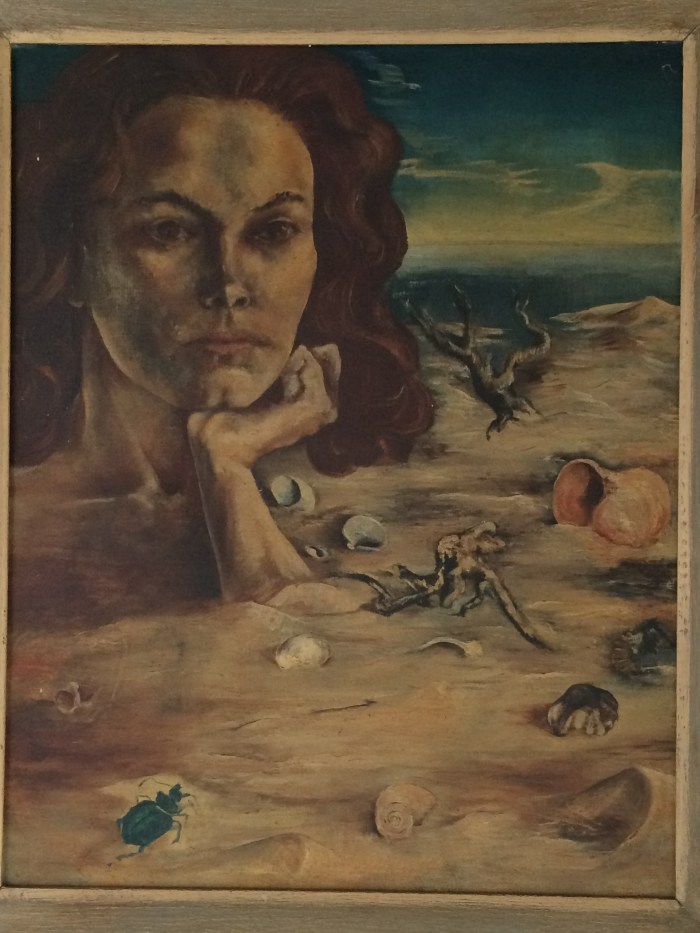
All through my childhood a self-portrait, painted by my mother hung above my parents’ bed. I was fascinated by this image of the stern face of my very beautiful mother with her long wavy chestnut hair. In the painting my mother’s body was buried in the sand up to her neck. Behind her, churning waves cascaded onto the shore. A blue sky was visible. A few seashells were scattered around and a large shiny green beetle was crawling over the sand. On the surface this image of my mother with her long curly hair seemed quite serene but as a child the painting disturbed me. It was as if this painting held a key – but to what? My father loved the painting and often commented on it…

I can remember playing at the seashore. My father would dig holes and bury both his children up to their necks in the warm sand that also held us fast…

I had one reoccurring childhood nightmare of waking up and not being able to breathe. Continue reading “Re-Visioning Medusa: Part I by Sara Wright”

Not My Story Anymore by Esther Nelson

The meaning we derive from stories—especially religious stories we’ve heard and become familiar with since infancy—shape how we perceive and understand the world.  Our beliefs are an amalgam of “my story” (my individual life experience in a specific context) shaped by another story.  Who I am is heavily informed by particular narratives and their (often) codified interpretation.

I was raised on the doctrine of substitutionary atonement.  Doctrine is an interpretation of story, the substance of which is thought of as “truth” by believers.  The story informing substitutionary atonement is a familiar one, especially to those in Christian circles.  Jesus of Nazareth, a Jew living during the Roman occupation of much of the Mediterranean region, was crucified circa 30 C.E.  Jesus was a teacher who attracted many followers and often spoke (according to the writers of the gospels) of a coming Kingdom of God.  This threatened Roman rule so the Romans killed him.

Is the story factually true?  Perhaps.  As with so many narratives that are passed down through generations, there are many versions.  We find meaning (or not) in the story we have at hand.  On one level, Jesus’ crucifixion demonstrates the lengths governments will go to in order to keep themselves in power, showing the oppression, fear, and suffering people endure under despotic rulers.  On another level, substitutionary atonement (Jesus died to pay for humanity’s sins) is an interpretation of that story.  So often the stories we carry with us, along with a specific interpretation (doctrine), become conflated.  Rarely do we stop and unravel the story from the meaning we’ve been given and sometimes appropriated. Continue reading “Not My Story Anymore by Esther Nelson”