The Hunger Games, Holy Week, and Re-imaging Ritual by Xochitl Alvizo

Being passive spectators of violence and injustice, even if mournfully so, is not just a thing of Panem, it is our everyday reality.

In The Hunger Games Suzanne Collins takes the reality of an unjust society and gives it an imaginative makeover. In Panem, most people are kept at such extreme levels of hunger that even when they do eat they cannot fill the hollowness that has settled in their stomachs, while others are deciding on the next cosmetic alteration they will undertake – whiskers, jewel implants, or green-tone skin color? The disparate conditions between the rich and the poor, the few and the many are absurdly and starkly portrayed but done so in a way that we can still recognize our world in theirs. And at the center of this world is the state imposed ritual of punishment and control, the yearly Hunger Games – a nationally televised competition that all the people of Panem are required to watch. The 12 districts watch mournfully as two kids from each of their districts compete to the death, and the wealthy watch gleefully, for the games are the height of their excesses and entertainment. The yearly Games conclude when one kid, the lone ‘victor’, is left standing. All while the nation watches. Continue reading “The Hunger Games, Holy Week, and Re-imaging Ritual by Xochitl Alvizo”

Grievances Against the GOP from a (former?) Republican Woman by Katie German

I was raised in a conservative, Republican, military family. I support personal freedom and personal responsibility. I support the military. I support a balanced budget. I support individual rights and the constitution. I support small government. But I find myself increasingly separated from the Republican Party, and this is why:
 
I cannot align myself with a party that repeatedly acts to restrict the rights of women, to deny women protection from abuse and violence, and to trample the rights of women to make their own medical decisions. I cannot support a party where individual rights and freedoms are only protected for people with a penis (so long as they are not gay). 
On February 16, 2012, there was a hearing by the Oversight and Government Reform Committee regarding the Affordable Care Act, which concerned the availability for contraception through insurance provided through religiously-affiliated employers. Out of the ten witnesses called, only two were women. When other representatives asked that other female witnesses be called to testify regarding contraceptives, Chairman Darrell Issa refused their request on the grounds that the scope of the committee was limited to the 1st Amendment implications and not to the matter of contraceptives themselves.
 
Republicans in Virginia, Oklahoma, Colorado, Wisconsin and Mississippi have advanced “Personhood” acts/bills declaring that a fetus has the full legal rights of a person, beginning at fertilization. Such laws would make in-vitro fertilization, stem-cell research, the morning-after-pill andall abortions (medically necessary or not) illegal. It could also be interpreted to make standard birth control options such as the Nuva ring, the pill, IUDs, and birth control patches illegal. Democrat Vivian Watts in VA attempted to amend the bill in Virginia to specify that contraception would not be banned under the Personhood bill, but Republicans voted 64-34 against adding this amendment. Any abortion or even cases of miscarriage due to negligence could be charged as manslaughter or homicide. Another attempt at amending the bill was proposed by Democrat Jennifer McClellan on Feburary 13, 2012. Continue reading “Grievances Against the GOP from a (former?) Republican Woman by Katie German”

My Feminist Perspective of Authority – Part 1 by Elise M. Edwards

I make a distinction between power and authority.  Authority is a personal characteristic based on a relationship of trust between me and a text, a person, or their work.  Power, on the other hand, is operative with or without trust.

This past weekend, I had the honor of participating in a workshop on Living Texts: Celebrating Feminist Perspective and Theo/alogy, Authority, and the Sacred in the Academy.  The workshop was organized for the Women’s Caucus of WECSOR, a regional association of national organizations who study religion.  I was delighted to connect with new friends, mentors and sisters interested in feminism and religion, including some of my co-contributors on this site –Theresa Yugar, Sara Frykenberg, and Corinna Guerrero .  There were two panels that shared our reflections about authority from either student perspectives or diverse professional perspectives.  I shared my experiences as a student.  This workshop was a gathering where women scholars in religion could discuss the challenges and promises of our voices in the academy.  Because our dialogue was so inspiring to me, I thought I’d continue the discussion here. Continue reading “My Feminist Perspective of Authority – Part 1 by Elise M. Edwards”

Feminism In Theology By Andrew Tripp

At the outset, I need to name and own my identities as a large white male. I have privilege and voice that makes me hesitant to even write to the audience of this blog. While I consider myself a feminist, I have met some who have told me that as a man I cannot be a feminist. Such folks have told me that I lack the existential knowledge of the systemic pressure put on women, and at best I can be an ally.  With that said, if it was not for feminism in theology, I do not know if I could be a theologian.

When I first began attending church as an adult, I went because I hungered for community, for authentic relationships. My tradition has more female clergy than male clergy, and like many churches, the mothers of the church often have been the true leaders. The church I grew up in had a female board president, a female pastor, and I grew up assuming female leadership was part of religious life. For me, religion was about community and I was far more certain of my salvation through community and relationships than with any kind of doctrinal stance. Then I came to seminary, and saw just how different my experience had been from most folks. Classmates were part of traditions that might ordain women, but wouldn’t provide them with the opportunity for prestigious positions. Professors made blatantly sexist comments, and this was in a “liberal” school. Continue reading “Feminism In Theology By Andrew Tripp”

Is Baptism a Male Birthing Ritual? By Michele Stopera Freyhauf

Quite a number of years ago I had a conversation with one of my professors, a feminist theologian, who posed the question “Why do I need a man to purify my baby with the waters of baptism?  Is there something wrong or impure about the blood and water from a mother’s womb – my womb?”  Before you jump and shout the words Sacrament or removal of original sin, this question bears merit in exploring, especially in today’s world where women are taking a serious beating religiously, politically, and socially.  In today’s world, violations and rants are causing women to stand up and say STOP!  This is MY Body.  This outcry was provoked by chants of ethical slurs against women– Slut! Prostitute! Whore!  The cry got even louder when the issue of religion and government was raised in the fight of healthcare coverage of contraception. The cry got even louder with the enactment of the laws in Virginia and Texas (and many other states to follow suit) that forces women to undergo transvaginal ultrasounds in early stage abortions.  The mandatory insertion of a wand into a woman’s vagina (mandated by the government, mind you), is a violation and has women crying RAPE!

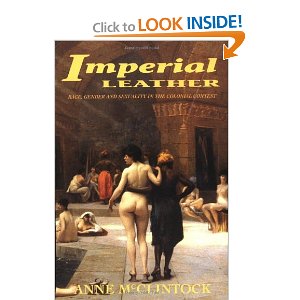
The memory of this conversation did not re-appear by chance, it was prompted by a book I read for my History of Sexuality Class – Imperial Leather: Race, Gender, and Sexuality in the Colonial Context by Anne McClintock who addresses the notion of baptism through origins, property, and power.  So many things are currently being taken away from women and reading McClintock’s assertion regarding male baptism is perplexing.  She believes that male baptism or baptism by a man takes women’s role in child bearing and diminishes it.  These are the same men who historically treated and regarded women as vessels.  She further asserts that this act is a proactive removal of creative agency with respect to a woman’s ability to have the power to name.  That is, the last name of the child belongs to the husband.  A point that supports the notion that patrimony marks the denial of women.  Anyone doing genealogy encounters a perplexing struggle to identify mothers because their names are essentially erased from memory and rarely attached to a child’s name. Continue reading “Is Baptism a Male Birthing Ritual? By Michele Stopera Freyhauf”

Waking up Muslim on 9/11 by Jameelah Medina

I have often stated that I went to sleep as an African American woman on September 10, 2011 and woke up Muslim on 9/11. It may seem odd to say this since I am a third-generation Muslim; however, my reason for doing so is that my life as an American Muslim now has two main eras: 1) pre-9/11 and 2) post-9/11.

In the pre-9/11 era of my life, I felt more black than Muslim because my color was a point of conflict and controversy throughout my life. I grew up in two areas as a child—an urban area with majority Latinos/as and then in a very rural area with majority whites. In both areas, being black was not so popular. I was called “mayate,”which is a bug but also the Mexican term for “nigger.” I was also called, “tar baby,” “nigger,” “African booty scratcher,” and a host of other hurtful names as a young black child.

In the post-9/11 era of my life, the main part of my identity that people focus on is my religion instead of my color. On 9/11, I went from being a nigger to being a “towel head,” from being a tar baby to being a “terrorist,” and from being the stereotype of an unruly and angry, loudmouthed black woman to being the stereotypically seen-but-not heard, oppressed Muslim woman in need of saving. As a Muslim, I suddenly was a potential threat and un-American, while as a Muslim woman I was also pitied and looked down on as misfortunate for being in a religion that oppresses me. In my life, white privilege and white monoculturalism have turned into Christian privilege and Christian monoculturalism. Continue reading “Waking up Muslim on 9/11 by Jameelah Medina”

My First Experience at a Women-Only Conference by Grace Yia-Hei Kao

“This ain’t your daddy’s conference!”

I knew that I was going to be attending a totally different type of conference than I had ever been to before when I received the following instructions on additional items to pack: (1) my own mug with which to drink coffee or tea (“we will go green in this conference as much as possible”), (2) 3 oz. of water “from a source of nature near your home” to be offered during “opening worship,” and (3) a small, modest, pre-owned, homemade, or inexpensive “earth-honoring gift for exchange.”

Continue reading “My First Experience at a Women-Only Conference by Grace Yia-Hei Kao”

Beyond “Liberal” Female Piety or “Women Read the Qur’an Too” by Amy Levin

I’m a teacher’s assistant for an undergraduate course at New York University called, “What is Islam?” The other day in class, my professor asked the students whether or not the Qur’an is considered a “book”. Fraught with anxiety over inheriting such a problematic scholarly tradition of defining and delineating what “religion” is, I kept quiet. While my professor was aiming more for something sounding like, “a book is read, while the Qur’an is recited,” I kept thinking about the physicality and sacrality of the Qur’an (among other authoritative religious texts) and the way it is handled, revered, preserved, loved, an constantly under interpretation. It was about a week later when news broke out that U.S. soldiers in Afghanistan were guilty of burning several copies of the Qur’an on their military base, followed by an unfortunate slew of casualties including at least 30 Afghan deaths and five US soldiers. Continue reading “Beyond “Liberal” Female Piety or “Women Read the Qur’an Too” by Amy Levin”

Why Not ‘Feminine Divine’? by Judith Laura

It twists my gut like an intestinal bug when people use the term “feminine divine” or “divine feminine” when what is meant is female deity. I keep thinking that like many gut bugs, it might just go away on its own—but no such luck.

Here’s how I see the history, the herstory, of this linguistic corruption. From what I remember, “divine feminine” (or “feminine divine” or “sacred feminine”) came into usage sometime in the 1980s by people, some of them authors, who wanted to refer to a female deity (or female deities, or female aspects of the divine) but didn’t want to use the word Goddess or wanted to talk about the subject in a non-religious, even not specifically spiritual, context. Often they also didn’t want their views to be construed as feminist. Sometimes these were participants in the New Age movement or people approaching the newly emerging Goddess movement from a psychological standpoint (“it helps women feel better” or “it helps women find themselves”). It was not unusual for them to speak of the “feminine within” for women and the “inner feminine” for men. For women, what was usually meant was that they had an outer feminine and an inner feminine, and that the inner feminine was spiritual. For men, there was the implied constraint that their feminine part was of course tucked away “within” where only they would be aware of it. These ideas seem to be rooted in the Jungian anima-animus concept.

Though I think that helping women “feel better” or “find themselves” may be a worthy goal and is part of the picture for some interested in Goddess, it is not by any means the full picture and it diminishes the power (and empowerment) of Goddess by making the role of the divine less than in other religions or spiritual paths. Continue reading “Why Not ‘Feminine Divine’? by Judith Laura”

On Cooking and Eating by Ivy Helman

In patriarchal heterosexist societies women do most if not all of the cooking for their families.  Women are also usually assigned the tasks of cleaning, raising children, tending the family garden, gathering water and anything else that is considered part and parcel of caring for the family.  These feminine tasks are often devalued compared to the activities men spend their time doing.  I wholeheartedly support the reevaluation of the significance of these tasks and the movement toward shared responsibility for family life among heterosexual couples, however that is not what I want to discuss today.

I want to explore the religious and spiritual significance of the food cooked by our mothers, grandmothers, aunts, sisters and female friends, especially those dishes we would consider to be comfort food.  Every person, every family has their own idea of what meals are comfort foods.  Bubbe’s matzah ball soup on Shabbat maybe?  Aunt Betsy’s Easter ham?  Mom’s turkey, gravy and oyster stuffing on Thanksgiving?  Your sister’s famous mac and cheese?    Continue reading “On Cooking and Eating by Ivy Helman”