

Hawk, beautiful and deadly, soars high in the air – circling and circling – its piercing eyes focused below. Spotting Hawk, one is amazed by its elegance and power while feeling a strange and ancient connection to this magnificent bird. Yet it strikes fear in the hearts of small animals.
Continue reading “Hawk – A Soaring Visionary by Judith Shaw”Category: Folklore
Behold! The Treasures of Eden by Janet Maika’i Rudolph
The place and purpose of the Garden of Eden is a topic of endless fascination and interpretation. This blogpost looks at two biblical passages and the word eden itself to see what we can learn about its meanings. At its most basic, Eden is a garden of treasure and delight.
As I’ve written before, the written form of Ancient Hebrew words comes from the hieroglyphic tradition of Egypt. The pictures of the letters form a picture puzzle or rebus. The word roots are generally two or three letters. I use script called Semitic Early for my baseline of study.
Continue reading “Behold! The Treasures of Eden by Janet Maika’i Rudolph”Elephant – Earth’s Gentle Giant by Judith Shaw
Elephants amble along through forest and savannah in unity with each other, generally causing no harm. They have long symbolized intelligence, power, wisdom and loyalty.
Continue reading “Elephant – Earth’s Gentle Giant by Judith Shaw”Spider Wisdom – Creation and Destruction Part 2 by Judith Shaw
In addition to being viewed as a Creator Goddess and a Destiny Weaver, Spider is associated with many other aspects of life. Some of these aspects fall into what we would consider the light – the good – and others are dark dangers – the dark side of life.

Patience, Resourcefulness/Protection, Good Fortune
Though spiders have eight eyes they have very poor eyesight. Instead they have infinite patience, waiting quietly in their webs for prey.
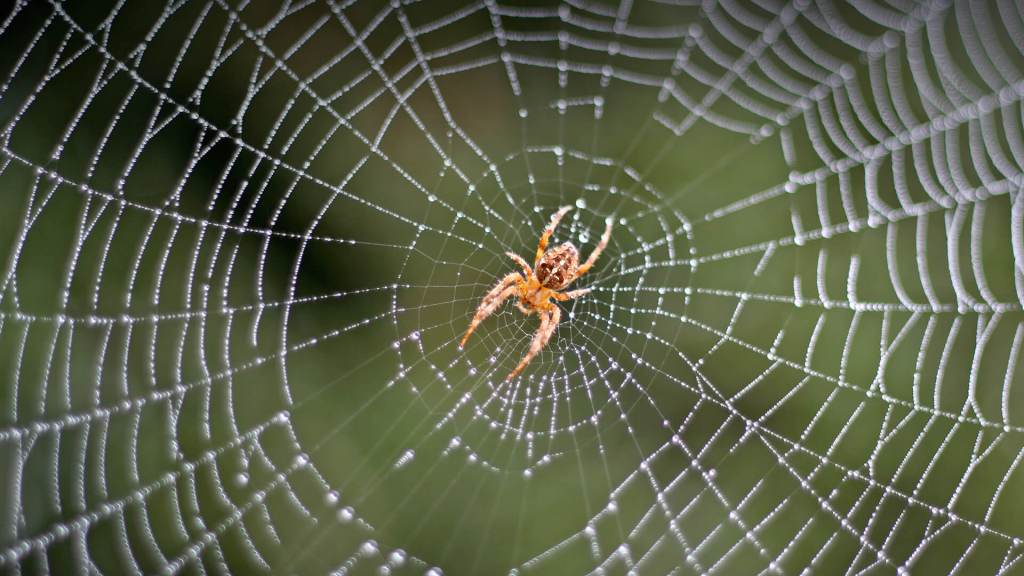
Spider is credited with inspiring King Robert the Bruce of Scotland with its patience. A 14th century legend tells of a time when Bruce had suffered various military defeats against the English. While hiding in a cave he observed a spider trying and failing repeatedly to climb its silken thread. But it persevered and eventually reached its web. Bruce was inspired. He decided to persevere in his efforts, came out of hiding, and eventually won Scotland’s independence from England.
Spiders are important to our gardens. They eat more insects than both birds and bats.
Long ago people used spider webs to stop bleeding. Now science has discovered that spider webs contain Vitamin K – a coagulant which stops bleeding.

The Torah recounts a story of how Spider protected David, before he become King of Israel. As King Saul’s soldiers pursued him, David hid in a cave. A spider built a huge web across the cave entrance. The soldiers saw the cave but did not investigate, thinking that no one would crawl through a spider web to gain entrance.
Similarly a story from Islamic tradition depicts Mohammad hiding in a cave from pursuing soldiers. Here also a spider spun a web across the opening, protecting Mohammad.
A Hopi legend about Spider Grandmother tells how she protected a village by spinning a magical web over the whole village, which when doused with water gave protection from being burned down by its enemies.
Spider Woman of Dine (Navajo) mythology helps and protects her people. She helped them to destroy the monsters that roamed the land as they emerged from the third world into this world. She chose the top of Spider Rock in Canyon de Chelly – the Dine ancestral home – as her home. Children were warned that misbehaving would make Spider Woman angry. She would cast her web like a net, as some spiders do, to catch the naughty child, bring him up to her home and devour him. It was said that the top of Spider rock is white because of the bleached bones of those naughty children.

The Celts saw spider as a helper and believed that killing one would bring bad luck.
Spider appears frequently in Chinese legends as lucky beings, bringing happiness and wealth. Spider charms are worn for good luck.
Wisdom, Interconnection, Transformation
A Hopi legend tells of Spider Woman helping Tiyo on his journey to the underworld. He begins with a visit to Spider Woman who gives him a serum to subdue his enemies. Then she accompanies him to the ‘Far-Far-Below River’ to offer advice during his trials. With her help Tiyo completes his journey successfully and returns to his people with greater wisdom and knowledge.
Egyptian Creator/Spider Goddess, Neith, often depicted veiled, wove this veil at creation to hide herself from humanity. As humans are not capable of understanding the fullness of divine mysteries the veil offers folds and strands that are thinner, allowing humans a glimpse at divine source and higher understanding.
African and some Native American stories portray Spider as a trickster god whose tales are part of a rich storytelling tradition which convey wisdom and moral lessons.

Spider symbolizes Maya (illusion) in Hindu Mythology. Vedic philosophy characterizes Spider as the weaver of the veil of illusion, hiding the ultimate truth of reality. In addition, Indra’s net, envisioned like a spiderweb with jewels at each vertex, illustrate the belief that all things are connected.
Though spiderwebs are stronger than steel, by weight they don’t usually last very long. Sometimes spiders destroy their own webs. Spider, with it eight (infinity symbol) legs and eyes symbolizes the infinite cycles of transformation as Spider continually creates, destroys and creates again, reflecting the essence of our natural world and its infinite cycles of birth, death and rebirth.
Dark Dangers – cunning, deception, intrigue, death
Only a small number of spider species are dangerous to humans with venom that can cause localized pain to a person. Further, there are only about 25 spider species with venom that can cause serious illness in humans. And yet arachnophobia, the fear of spiders, is one of the most common fears worldwide.
Many folktales and myths warn of the dangers associated with Spider.
Athena, Greek Goddess of Wisdom and Handicraft was a skilled weaver. Arachne, a mortal and gifted weaver, got carried away with her talents and boasted that her work was better than that of Athena. Athena was furious and a contest was arranged between the two. Not only was Arachne’s weaving beautiful it also depicted the gods in a bad way. Athena destroyed Arachne’s work in a rage.
Arachne, ashamed to see what her arrogance had wrought, hung herself. Athena took pity on her – turning the rope into a web and Arachne into a spider. Through her death and transformation, Arachne was able to weave her beautiful tapestries for eternity.
Japanese mythology tells of the Spider Princess, Jorōgumo, who transformed into a beautiful woman and entraped men with her deception.
To Christians Spider symbolizes the Devil as the Devil prepares its trap for human souls like the spider prepares its web for prey.
When a spider is finished with its web many species roll it up and consume it.
In ancient Indian tradition Brahma, the creator of all things, was seen as a spider weaving the web that is our universe. Sacred text says that one day she will devour the web – our universe – and then weave another.
Divinatory
Spider calls you to transform – to imagine your world anew. A time of creativity is at hand – a time of magic – a time to manifest your true destiny. Spider reminds you that with patience you can best reach your goal.
At the same time Spider calls you to recognize the dark side of life – the ways in which you or others might be deceptive, or engaged in intrigue.
Spider reminds you of the eternal cycles of life, death and rebirth.
Spider awakens your memory of the interconnection of all life, allowing you to integrate problem areas into a more wholistic perspective on life and reminding you of the system of interdependency in which we live.
Sources: Ancient Origins, Cultural Depictions of Spiders, Britanicca, UniGuide
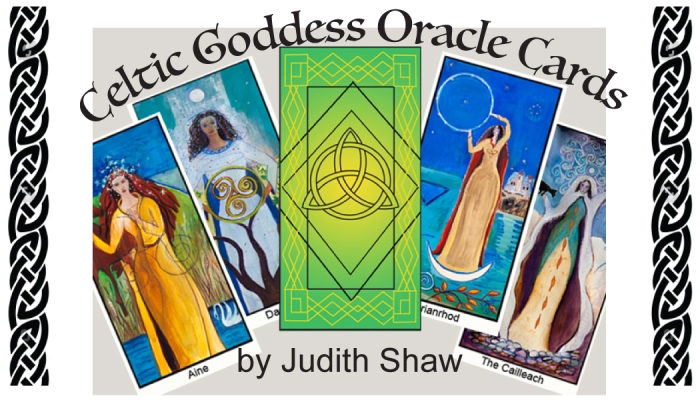
Judith’s deck of Celtic Goddess Oracle Cards is available now. You can order your deck from Judith’s website – click here. Experience the wisdom of the Celtic Goddesses!
Judith Shaw, a graduate of the San Francisco Art Institute, has been interested in myth, culture and mystical studies all her life. Not long after graduating from SFAI, while living in Greece, Judith began exploring the Goddess in her art. She continues to be inspired by the Goddess in all of Her manifestations. She is now working on her next deck of oracle cards – Animal Wisdom. Originally from New Orleans, Judith makes her home in New Mexico where she paints as much as time allows and sells real estate part-time. Give yourself the gift of one of Judith’s prints or paintings, priced from $25 – $3000.
Leonora Carrington’s THE HEARING TRUMPET – Book Review by Sally Abbott
Long a fan of Surrealist artist Leonora Carrington, I was initially hesitant when the New York Review of Books reissued her 1974 novel, The Hearing Trumpet. I didn’t know what to expect when this extraordinary painter picked up a pen.
To my delight and surprise, Carrington shows the same artistry and whimsy in her writing that she does in her painting. She also reveals herself to be an astute feminist and aficionado of the Goddess, well-versed in arcane lore, with which she accents her fantastical world. The Hearing Trumpet is full of British humor and eccentricity, set in a finely spun, other-worldly landscape.
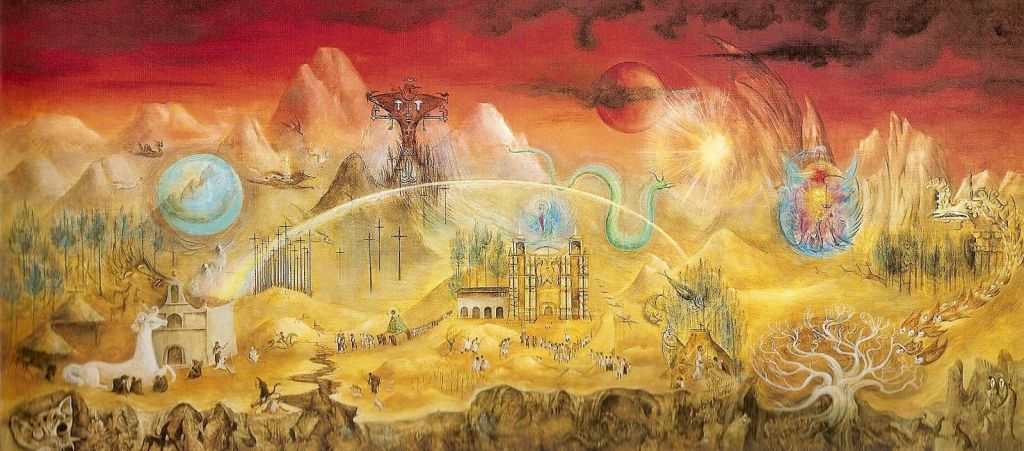
Her heroine Marian Leatherby is a 92-year-old, who lacks teeth, is hard of hearing, and sports a beard–a whimsical, endearing character who loves cats. She has been given a hearing trumpet by her great friend Carmella, and thereby learns that her son and his wife plan to send her away to an old folks’ home run by a Dr. Gambit and the Well of Light Brotherhood.
Continue reading “Leonora Carrington’s THE HEARING TRUMPET – Book Review by Sally Abbott”Rabbit, The Feminine, and The Moon by Judith Shaw
 Rabbit plays in tall grasses, dances in the moonlight, nibbles on nature’s greens, then freezes if danger is sensed. With a thump as a warning, rabbit hops away in a flash, disappearing down its rabbit hole.
Continue reading “Rabbit, The Feminine, and The Moon by Judith Shaw”
Delilah Reclaimed by Janet Maika’i Rudolph
 *This post includes a call for stories at the end.
In my previous blogpost, I wrote about the Biblical tale of Samson and Delilah and why it was likely written in a manner to hide older pagan mythos. You can read it here: Delilah Lost. I promised to share my own myth about the story and tell it as best as I can. Here it is:
Samson was known as one of the strongest forces in the galaxy, a shining light in the sky. Humans would one day recognize his rays of light as his hair. In the infinity of time, his attention was drawn to movement in the star system known as Sorek. Looking more closely, he saw a woman dancing in dazzling motion while draped in star dust and star light. He could hear the slight tinkle of bells as she shimmered. It was as if the heavens themselves were shouting ha-la-hu-ya at her beauty. She noticed his gaze and winked back at him, tempting him with her swirls and her sparkling eyes. He was enthralled. Continue reading “Delilah Reclaimed by Janet Maika’i Rudolph”
Dancing for Forgiveness and Reconciliation – Part Two By Laura Shannon
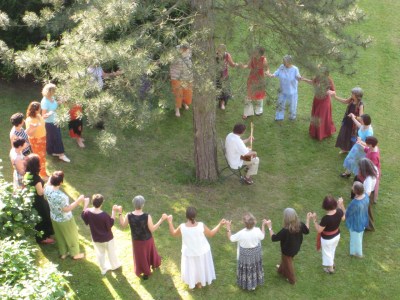 In Part One of this article, I described dancing Jewish, Romani, and Armenian dances for forgiveness and reconciliation with groups in Germany and all over the world. I also offered danced rituals of remembrance at former concentration camps and other places scarred by the atrocities of war.
I went to camps including Dachau and Auschwitz, to genocide memorials and sites of massacre throughout Eastern Europe, in Australia, and the Americas. At first, my prayers were private: I brought flowers, lit candles, danced my grief, and spent time in meditation. I tried to visualise the prisoners in those places, sending them my deep sorrow and regret back through time. I wanted to let them know that they are remembered and mourned by people from their future. My prayers contained a fervent apology as well as a soul commitment to do my part in this lifetime to overcome prejudice and stand for peace.
In time I invited others to dance with me for healing and peace. We danced at former camps in Germany, including Bad Gandersheim, a subcamp of Buchenwald, and on many occasions in Steyerberg, a former prison camp and forced-labour munitions factory which is now the site of an intentional community called Lebensgarten (‘Garden of Life’), a centre for permaculture, non-violent communication, and other ecologically and spiritually oriented ways of living.
Continue reading “Dancing for Forgiveness and Reconciliation – Part Two By Laura Shannon”
Dancing for Forgiveness and Reconciliation – Part One By Laura Shannon
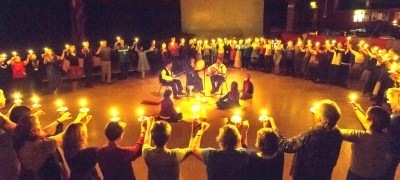
When I first began researching traditional circle dances in the mid-1980s, I was amazed to find that the peoples who have suffered the worst of human experience – oppression, exile, genocide, war – also produce the most vibrant and joyful music and dance. Armenian, Jewish, Kurdish, and Romani (Gypsy) dances, in particular, were passionate affirmations of life, despite the horrors these peoples have gone through in their history. The dances seemed to hold clues to the mystery of moving on with life after trauma.
This was something I was desperate to learn how to do. Barely 20 at the time, I was struggling to keep my dignity and optimism while growing up female in a woman-hating world. The trauma of a violent rape on my 18th birthday had robbed me of my joy for life – but I could experience joy again in those dances.
Early on in my research and teaching, therefore, alongside the women’s dances which were always my main interest, I began to focus on the traditional dances of persecuted peoples, which I called Dances of Exile and Homecoming. These songs and dances seemed to have an inherently therapeutic potential, profoundly moving for people from any background and any culture.
Continue reading “Dancing for Forgiveness and Reconciliation – Part One By Laura Shannon”
Cat – Mysterious and Magical by Judith Shaw
Cat moves elegantly through our lives with grace, independence and an unquenchable self-assurance. “My dog believes its human; my cat believes its god” is a saying reflected by the beliefs of our ancestors. Since Neolithic days cats have been associated with goddesses.
Cats, domesticated members and the smallest of the family Felidae in the Carnivora order, are a study in balance – between quiet calm and powerful action, independence and connection, the seen and unseen.
Continue reading “Cat – Mysterious and Magical by Judith Shaw”
 Feminism and Religion