I believe love that enters through the kitchen feeds others with care and compassion.
El amor entra por la cocina (love enters through the kitchen) is a popular saying in Spanish. The process of preparing a meal and sharing it, forges communal bonds that go beyond simply something transactional. It’s more than giving and receiving.
I was very young when I lost both my grandmothers but whenever I think about them, I picture them in the kitchen. I remember the smell and taste of their meals and the stern focus of their gaze while cooking as if they were pouring their intentions over the meal. Feeding others where their love languages.
Soon it will be Wives’ Feast Day, a holiday celebrated in Ireland and northern England on February 2, the same day as Imbolc, Candlemas, and St. Bridget’s Feast Day. On this holiday, women (in Old English, “wife” meant simply woman) would gather together and enjoy making and sharing delicious foods with each other, honoring themselves and their work providing nourishment and other aspects of making a “home.”
When you think about it, this delightful tradition is quite remarkable. Feast days are generally associated with saints, so, in a way, this feast day recognizes the sacredness of all women and also their daily labor. This echoes to me Old European cultures that connected women’s baking and weaving to divinity by placing workshops in goddess temples and associating goddesses with these tasks. Today, women work in many jobs not directly associated with food production, but still labor to make our communities and planet better “homes” in many other ways.
The move to Portugal all but forced me to heal my relationship with time and productivity, to create a life that was sustainable and nurturing.
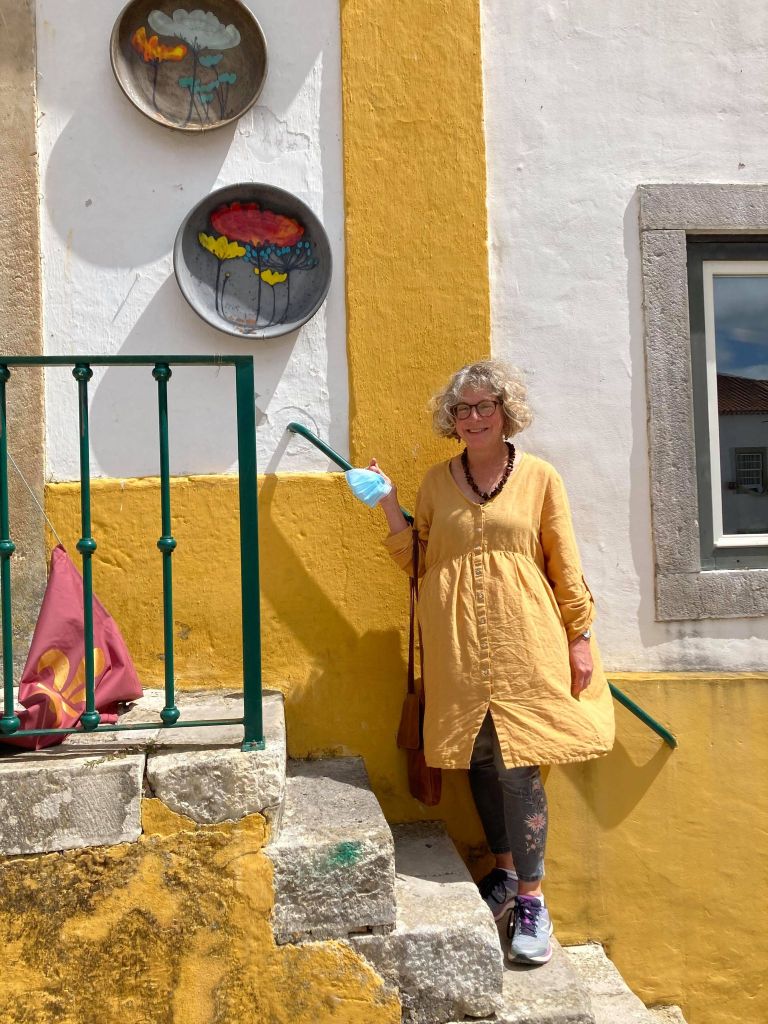
Hanging out in Obidos, the closest town to my village. Photo by Erika Mailman.
One year ago, I published my essay, The Grace of Letting Things End, about my bittersweet experience of leaving England in the wake of Brexit for a new life in Portugal.
One year later, my life in Portugal still feels radically new.
Time passes differently in Portugal. I set my intention, from the outset, to embrace this move as an opportunity to slow down and live a more authentic life.
My day-to-day life has irrevocably changed.
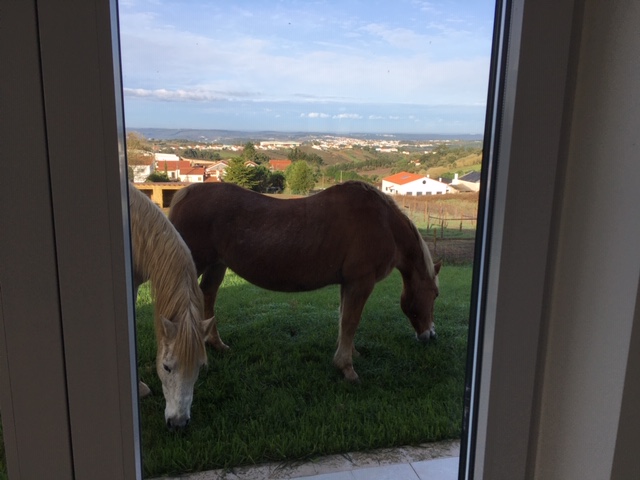
I’ve gone from being a livery yard customer in England, with all the drama and conflict this sometimes entailed, to becoming an independent small holder with two horses on my property to care for all by myself. Practically, this has translated into a lot more work, but also a lot more peace.
The ponies decided to help with the lawn mowing
I’ve also been devoting considerable time and energy into learning Portuguese. My husband and I have been taking classes once or twice a week for nearly a year now and are making slow but steady progress.
But the most deep-seated change has been to my whole relationship to work and life. In the UK, I led a very productivity-centered life, existing from deadline to deadline with barely any time to breathe in between. I often felt too busy and wrapped up in my projects to meet friends for lunch.
For years I have struggled to heal my dysfunctional relationship with time management, embracing lifehack after lifehack. I’ve all but abandoned social media. I’ve done my utmost to milk every single hour of the day in order to become more productive. This pattern led to disillusionment and epic burn out, something more and more women are facing, particularly those who balance the demands of their careers with childcare and other care-taking duties.
Even writers and artists can fall down the hole of the Cult of Productivity, taking the creative process, which is at its essence slow and organic, and trying to force it into an industrial process with regular, reliable yields that are judged on how well they can be monetized. Even the refuge of spirituality can be compromised if it’s just another task on a never-ending to-do list.
Thus, despite my official intention to slow down, I found myself trying doggedly to replicate my old hectic, tunnel-vision working schedule in Portugal only to discover that it just didn’t work here. I hit a brick wall. Because I couldn’t sustain the same level of busyness AND care for two horses AND learn a challenging new language AND keep my initial intention of slowing down and enjoying the life I moved here to experience.
Something had to give. The move to Portugal all but forced me to heal my relationship with time and productivity, to create a life that was sustainable and nurturing. No lifehack could help me anymore, because I’d already given up television. I don’t even watch Netflix.
We hear a lot about the Slow Living Movement, but actually slowing down involves so much more than decluttering your closet or posting pictures of photogenic hipsters in hammocks on Instagram.
Moving to Portugal forced me to slow down. Because life is slow here. It’s no accident that the Slow Food Movement had its birth in Italy, another slow country in southern Europe. Food is also big in Portugal. In fact, I like to joke that LUNCH is the national religion. No matter how busy or important you think you are, the whole world stops for lunch. Shops close. People pour out of offices and go to restaurants for beautiful, affordable meals. Proper, cooked meals, mind you. Not a sandwich or salad to be inhaled at speed. To say you are too busy to meet your friends for lunch in Portugal would be sacrilege. Even in the height of the pandemic when all the restaurants were closed, people went home for lunch and ate with their families.
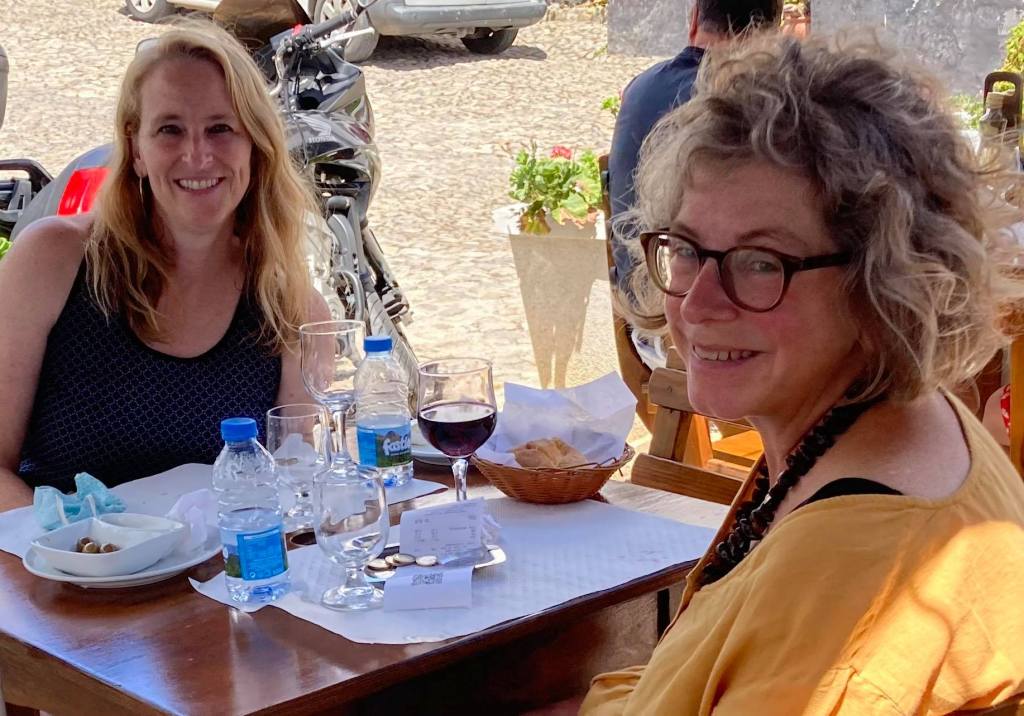
Converting my visiting writer friend Erika Mailman to the religion of LUNCH!
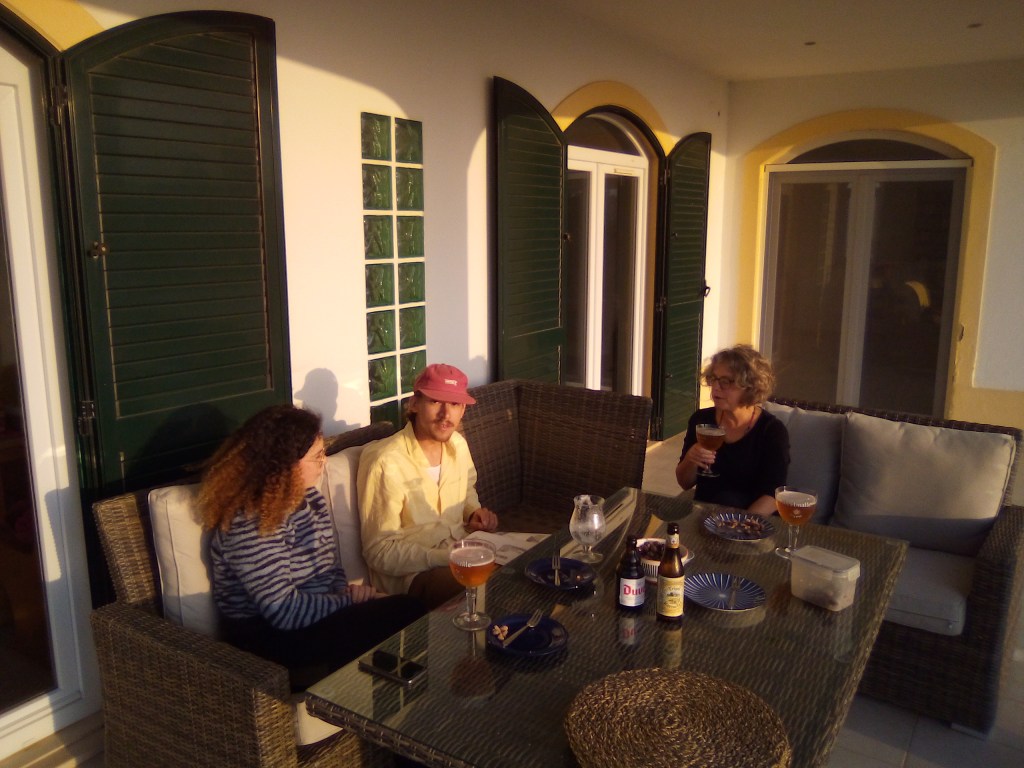
Any culture that prioritizes good food also prioritizes human relationships. My social life here is unlike anything I’ve experienced anywhere in the world. I’ve met wonderful Portuguese people, such as our local Priestess, Luiza Frazao, as well as new friends from the U.S., the U.K., Canada, Columbia, the Netherlands, Israel, Russia, Germany, Spain, Poland, Hong Kong, and Belgium. My husband and I have made so many friends in our village. We can walk to each other’s houses and invite each other for dinner or go on long walks together. The other foreigners who move to Portugal have made the conscious decision to make time for friendship, not just shove it into a twenty minute “let’s meet for coffee” slot. I haven’t had this much fun since I was a student.
Other things are slow here, too. The post office can be painfully slow. My New Yorker subscription has gone AWOL and I’ve resigned myself to reading the digital version. Plumbers and technicians come when they come. Just when you think they’ve forsaken you, they manifest at your door. But then again neighbors I’ve never met before also show up unexpectedly with gifts of apples for the horses. One day an old man pulled his tractor up in front of our house and presented me with two sapling banana trees.
What I’ve discovered is if I give up any notion of trying to control the clock or manage time, it becomes more expansive. When I’m with my horses or laughing with friends, time disappears and I’m living in an eternal now. The same is true when I’m deep in my writing flow or trying to speak my best Portuguese to thank my neighbor for the banana trees. In a rich and authentic life, there is time for everything.
Life Balance is a feminist issue, because too many women have been brainwashed by the Cult of Productivity for far too long and this has kept too many of us chained to a patriarchal machine that eats us up and spits us out when we’re too broken to go on doing anymore. Let’s rebel and meet our sisters for lunch!
Mary Sharratt is on a mission to write women back into history. Her acclaimed novel Illuminations, drawn from the dramatic life of Hildegard von Bingen, is published by Mariner.Her new novelRevelations, about the mystical pilgrim Margery Kempe and her friendship with Julian of Norwich, is now available wherever books and ebooks are sold. Visit her website.
This past year (2020) has been a year of tremendous upheaval and unwelcome change for most of us due in large part to the COVID-19 pandemic. It’s the second time in my life (first time I was in my 40s) where I’ve responded to stress with anorexic behavior—not consuming enough calories to sustain a healthy weight.
So much has happened since my last post. From the inauguration of President Joe Biden and Vice President Kamala Harris, the GameStop Investment, the military coup of Myanmar, the 2nd Impeachment Trial and Republican Acquittal of Donald Trump, a catastrophic Artic Freeze of Texas, and other states, and the upcoming “no holding back, tell all” from the Duke and Duchess of Sussex. But what I really want to focus on this month is on something that is struggling to maintain publicity and support despite its importance; The Farmer’s Protest/Strike in India.
Will our families gather for Thanksgiving feasts this year? Will aunts and uncles and cousins come from near and far to sit around our dining room tables? Does anyone have a table that’s big enough for social distancing? As I write this before November actually arrives, it seems unlikely that we’ll have few traditional holiday events in our homes (or anywhere else) this year. Well, my friend, who cares? Let’s pretend our feasts will be just like they’ve always been.
Back before the turn of the century, I belonged to a group that met every month in my friend Sandy’s family room for companionship, study (we worked our way through two excellent books by Julia Cameron: The Artist’s Way and The Vein of Gold), celebrations of birthdays and other special events, and rituals honoring various goddesses. We also had potluck suppers. (That was when I found out I can’t even be in the same room with jalapeño chili peppers.) It was a friendly, caring group of about twenty-five women and a few men. Alas, many of these people have moved away, a few have died, and a couple have just disappeared. I miss this group. Continue reading “Happy Thanksgiving by Barbara Ardinger”
Last week a friend of mine started a post asking people to share something that they’ve enjoyed or appreciated since shelter-at-home orders began across the country and globe. This friend was in no way trying to minimize the very difficult situations that so many of us find ourselves facing during this pandemic. Rather, the list she elicited and generated helped to create, at least for me, a moment of hope or peace—a moment that I suspect many of us need right now.
Inspired by my friend (who has quite a talent for pointing out the potential for joy or happiness), I would like to add to her list here by sharing a couple of my “moments of beauty” in the hopes I can share this hope or peace. Continue reading “Moments of Beauty by Sara Frykenberg”
With every wonderful, heart-wrenching, deeply researched, and inspiring post I read on F.A.R., I feel less inclined to share my own somewhat out-of-step contributions to this world. Nevertheless, I keep reminding myself that they are the things that I do, and I do them because I feel compelled, and have consistently been compelled in those two specific directions — art and agriculture/wildcrafting — since childhood. Also, the paintings and prints are a product of my always thinking about and feeling into both feminism and spirituality, and the fruits of the intersection of the two. So here is another offering.
I’ve always had a fondness for the visual aspect of playing cards, and collect books on them. One image of an uncut sheet of cards printed in 1585 in Frankfurt, where the black and white cards were jammed in every which way on large sheets of paper, inspired the look of these four prints, The Cuisine Cards.
They are conceived as celebrating food and cultures from various parts of the world. The face cards are non-hierarchical in terms of rank and gender. The 10 is a Table of the suit’s food, then there are the Shaper, Mover, and Taster, who, although usually carrying on in a certain sequential order, each contribute equal value to the whole experience of eating food. Two suits have all female face cards and two all male.
It is mid November and shiny crimson Pomegranates catch the discerning eye in food markets; even Walmart carries them!
Why do these beautiful and very ancient fruits appear during this dark time of the year?
One answer to this question is that in the northern hemisphere the fruit of this deciduous shrub ripens anywhere from September to February. The reverse is true in the southern hemisphere when the fruits ripen during March, April and May. It is important to remember that in the southern hemisphere the seasons are reversed, so in both northern and southern parts of the globe these fruits appear in the fall, during the darkest months of the year.
Pomegranates are native from Iran to northern India and have been cultivated throughout the Middle East, Asia and the Mediterranean region for millennia. (Today they are also grown in California and Arizona, so they no longer need to be imported). The shrub was domesticated as early as the 5th millennium BC. Pomegranates were the first trees to be domesticated in the Mediterranean.
This week’s Torah parshah is Behaalotecha: Numbers 8:1 to 12:16. By now, much of what comes to pass should sound familiar. The parshah starts with another discussion of leadership and the priesthood. It then prescribes a second Pesach for those who happened to be ritually unclean for the first one and describes the consequences of not participating in the first Pesach if you had been ritually clean. Next, the Israelites’ wanderings through the desert are detailed which includes the divine appearing as natural phenomena and the very loud rumblings of the Israelites’ tummies. Finally, the parshah ends with a discussion of Moses’ wife and Miriam’s punishment.




 Will our families gather for Thanksgiving feasts this year? Will aunts and uncles and cousins come from near and far to sit around our dining room tables? Does anyone have a table that’s big enough for social distancing? As I write this before November actually arrives, it seems unlikely that we’ll have few traditional holiday events in our homes (or anywhere else) this year. Well, my friend, who cares? Let’s pretend our feasts will be just like they’ve always been.
 Last week a friend of mine started a post asking people to share something that they’ve enjoyed or appreciated since shelter-at-home orders began across the country and globe. This friend was in no way trying to minimize the very difficult situations that so many of us find ourselves facing during this pandemic. Rather, the list she elicited and generated helped to create, at least for me, a moment of hope or peace—a moment that I suspect many of us need right now.
 This week’s Torah parshah is Behaalotecha: Numbers 8:1 to 12:16. By now, much of what comes to pass should sound familiar. The parshah starts with another discussion of leadership and the priesthood. It then prescribes a second Pesach for those who happened to be ritually unclean for the first one and describes the consequences of not participating in the first Pesach if you had been ritually clean. Next, the Israelites’ wanderings through the desert are detailed which includes the divine appearing as natural phenomena and the very loud rumblings of the Israelites’ tummies. Finally, the parshah ends with a discussion of Moses’ wife and Miriam’s punishment.
  Feminism and Religion