Remembering My Saints by Katie M. Deaver

My mother and I have always been very interested in our personal connection to the spirit realm.  This connection, for us, is an important one.  We pay attention to the signs and messages that remind us of our continued connection to those we love who no longer occupy our own physical time and space.  Each cardinal, butterfly, and ceaselessly repetitive number (310 in our case) promises the continuation of relationship with the ones we miss so dearly.

A few years ago my mother and I were able to see a live show at the Chicago Theater featuring Long Island Medium Teresa Caputo.  Even with hundreds of people in the audience, specific moments of Caputo’s readings spoke to images and memories that resonated and connected to our experiences.  The show allowed us to once again be reminded of the continued connection between us and those special ones who we love and miss. Continue reading “Remembering My Saints by Katie M. Deaver”

Writing Through the Body: Betty Smith’s A TREE GROWS IN BROOKLYN by Joyce Zonana

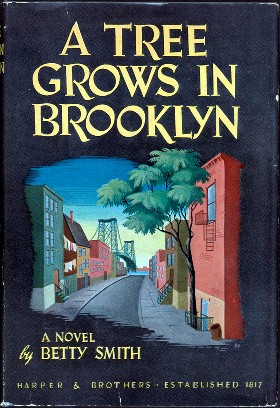
 TreeGrowsInBrooklynIn her 1975 manifesto, “The Laugh of the Medusa,” French feminist Hélène Cixous urges women to write: “Writing is for you, you are for you; your body is yours, take it. . . . Women must write through their bodies, they must invent the impregnable language that will wreck partitions, classes, and rhetorics, regulations and codes . . .”

“The Laugh of the Medusa” remains a thrilling essay, challenging and inspiring women to “return to the body” and to language.  “Woman must write woman,” Cixous insists, “for, with a few rare exceptions there has not yet been any writing that inscribes femininity.”

Although Cixous may not have been aware of it, Betty Smith’s beloved, perennially popular 1943 novel, A Tree Grows in Brooklyn is one of those “rare exceptions” that “inscribes femininity” in precisely the way she advocates. This autobiographical novel, so often dismissed as sentimental or as a children’s book, is actually written through the female body—which may explain its lasting popularity and power. Continue reading “Writing Through the Body: Betty Smith’s A TREE GROWS IN BROOKLYN by Joyce Zonana”

Public Art and Personal Transformation by Jessica Bowman


Public Art Sculptures

Borrego Springs, CA

Artist: Ricardo Breceda

Photo: Jessica Bowman


Public Art displays like the image above, a dragon that appears to be moving through the sand dunes of Borrego Springs, California offer tremendous insight into the time and era of the society when it was created, the surrounding community, the patron of the work and of course, the artist. In the case of this artwork and several other similar sculptures found in the barren but beautiful landscape within the Anza-Borrego Desert State Park the subject matter supports the wildness of the region and invites the viewer to consider the area before the impacts of modern civilization.  In this case, it isn’t difficult to imagine such an untamed time as there are miles and miles of sandstone, treeless mountains and desert brush with very few people anywhere to be found. Also in this case, the artwork is absolutely appropriate for the environment in which it is placed.

“If private art suggests an intimate exchange, public art gathers a congregation.  While I have observed that all art is to some degree public, pubic art merits its name in virtue of the fact that the creation of a public is its point of departure.  Public art presupposes the public sphere and produces a public in relation to that concept.  Unlike popular or mass art, it does not assume a preexistent generic audience to be entertained or instructed but sets out to forge a specific public by means of an aesthetic interaction.” (Hein, pg. 49)

Continue reading “Public Art and Personal Transformation by Jessica Bowman”

Remembering Sor Juana Inés de la Cruz’s Life and Legacy: Champion of Universal, and Non-Human Rights November 12, 1648/51 – April 17, 1695 by Theresa A. Yugar

She studies, and disputes, and teaches,
and thus she serves her Faith;
for how could God, who gave her reason, want her ignorant?

—Sor Juana Inés de la Cruz, Villancico, or, “Carol”, in celebration of St. Catherine of Alexandria (1692)

05.Yugar 1The reason for this blog, and for writing it on this day, is to celebrate and remember the life and legacy of Sor Juana Inés de la Cruz.

In 1994, I was exposed, by chance, to the life and writings of 17th century Novohispana feminist Sor Juana Inés de la Cruz. I am the product of twelve years of Catholic education, eight years of which were in an all-women setting. Again, by chance, I learned about Sor Juana in a liberation theology class while studying feminist theology at Harvard Divinity School. In this class, I learned about Sor Juana’s bold advocacy of the right of women to be educated. This spurred me to learn more about this Catholic Latina theologian whom I would later discover was the last great author of El Siglo de Oro (Spain’s Golden Age), recognized in her era as an esteemed poet, mathematician, astronomer, and more. This was the beginning of my life-long passion to reclaim the legacy of Sor Juana and her-story within the Christian, non-Christian Western tradition, and in Spanish and Mexican history. Continue reading “Remembering Sor Juana Inés de la Cruz’s Life and Legacy: Champion of Universal, and Non-Human Rights November 12, 1648/51 – April 17, 1695 by Theresa A. Yugar”

Alice Paul & the Women Who Will Keep Marching by Kay Bee

Hedwig Reicher as Columbia on the steps of the Treasury Building in Washington, DC, March 3, 1913.

The day before Woodrow Wilson’s inauguration, the 1913 Women’s Suffrage Parade took place in Washington, D.C. to demand the attention of the incoming administration and advance the cause of suffrage. Organized primarily by Alice Paul, 8,000 women marched on Washington on March 3, 1913.

Alice Paul is an often overlooked figure in American suffragette history. She’s no longer as common a name as Susan B. Anthony or Elizabeth Cady Stanton. Her early feminist contemporaries weren’t always very fond of her, for that matter. Many found her “too radical,” especially after her return from training with the British suffragettes, where she was arrested multiple times. But Alice Paul knew how to get things done. Continue reading “Alice Paul & the Women Who Will Keep Marching by Kay Bee”

It Takes a Village: Responding to the Needs of Rosemary Radford Ruether by Cynthia Garrity-Bond

Rosemary Radford RuetherAs many of you may already know, on August 24, 2016, feminist theologian and scholar Rosemary Radford Ruether suffered a significant stroke. There has been some speculation from those who know or have known Rosemary about her current condition.  Here is the short of it.  While Rosemary has made progress, her doctors and therefore Medicare feel it is insufficient to warrant continued physical and speech therapies. Those who interact with Rosemary on a daily or weekly basis disagree with this medical prognosis.  The stroke damaged the part of Rosemary’s brain that allows for communication, therefore she, at this time, is not able to speak.  That said, Rosemary recognizes individuals, is able to respond to some commands and engage in therapeutic exercises.  The more attention and care she receives the greater her capacity grows for a more meaningful life that includes a level of agency.  

The first year of a stroke demands ongoing therapies in order to truly assess a clear diagnosis.  To what degree Rosemary will recover from her stroke is uncertain, but at the minimum ongoing therapies will prove beneficial towards her overall quality of life.  Unfortunately, Rosemary does not have secondary health insurance that will cover the cost of these badly needed therapies.   For example, one month of Physical Therapy at 3x/week and Speech Therapy 2x/week amounts to $3,289.00.  Put another way, 15 minutes of physical or speech therapy costs $41.00.  To be effective, Rosemary should have, at the minimum, five hours of combined therapy per week.   Continue reading “It Takes a Village: Responding to the Needs of Rosemary Radford Ruether by Cynthia Garrity-Bond”

Mother Demdike, Ancestor of My Heart, Part 1 by Mary Sharratt


beltaine-pendle-view

Pendle Hill, seen from the back of my house, in May.

mary sharrattThe Soul of Gaia is the numinous earth beneath my feet, her soil cradling the bones and the stories of the ancestors who have died into the land and become part of the ever-living spirit of the place.

An expat writer, my home is everywhere and nowhere. A wanderer, I have lived in many different places, from Minnesota, my birthplace, with its rustling marshes haunted by the cries of redwing blackbirds, to Bavaria with its dark forests and dazzling meadows and pure streams where otter still live. But I don’t know if any place has touched me as deeply as Lancashire, England, my home for the past fifteen years. Continue reading “Mother Demdike, Ancestor of My Heart, Part 1 by Mary Sharratt”

The God of Abraham, Sarah, and Hagar by Race MoChridhe

race-mochridheThe morning air is hot around the pillars of Jerusalem stone, but the congregation is already tired. The prayers are old, pro forma and remote, drawing power now from the sound of the Hebrew more than from the meaning of the words. “Thank you for mercifully restoring my soul to me…” intones the small group of gathered men, “and for not making me a woman.”

The voices are smooth and practiced, unmixed with the rustling of pages except for a teenager who cannot recite from memory, whose Hebrew is still bad enough that he has to pay attention. This boy tires of waking, and wonders why God did not make him a woman—why he will never be a thing as close to his maker’s image as a woman seems to him to be. Continue reading “The God of Abraham, Sarah, and Hagar by Race MoChridhe”

Nominating Holy Women Icons by Angela Yarber

Who is your Holy Woman Icon?

When I began the academic study of religion in 1999, I was struck by the pantheon of male saints, venerated, honored, painted, adored, perhaps even worshipped. From virtually every tradition, men reigned supreme—in leadership, iconography, decision-making, worship—which is one of the myriad reasons groups like Feminism and Religion must exist. To combat this oppressive supremacy.

In 2010, I decided to put my wonder and this patriarchal dis-ease on canvas. I painted a triptych of Sophia, the feminine Greek word for wisdom often understood as the feminine face of Jesus, for a group triptych exhibition. Inspired stylistically by the art of Shiloh Sophia McCloud and He Qi, I endeavored to give traditional iconography a folk twist in an attempt to make it more accessible, perhaps a bit less brooding and intimidating. Emboldened by the works of womanist and feminist scholars in religion, my icons aim to subvert traditional—and often patriarchal—depictions of a virtually all-male sainthood. Though there are surely some women depicted Catholic and Orthodox iconography, and a robust number of women and goddesses in Hindu iconography, I found myself at a loss when it came to positive, affirming, and empowering icons of women across the vast spectrum of religious and spiritual traditions. Continue reading “Nominating Holy Women Icons by Angela Yarber”

Power & Restraint: A Feminist Perspective on Mormon Sisterhood: A sculpture series by Page Turner, presented by David Volodzko

David VolodzkoHistory offers few instances of women helping create scripture. Hinduism’s sacred Rigveda may have been partly composed by women, and scholars believe the biblical Book of Ruth was possibly written by a woman, but the evidence for each is wanting. And while Muhammad’s widow was entrusted with the manuscript that would become the Quran, its scribe was a man named Zayd ibn Thabit. The only clear exception to this is the Book of Mormon, which Joseph Smith partially dictated to his wife Emma. The central role of Mormon women in the church was therefore fixed from the start.

In 1842 Joseph Smith organized the church sisters into a philanthropic organization known as the Relief Society. Among other things, the Relief Society sent women to medical school and opened cooperative stores. Operating independently from local bishops, it afforded Mormon women unprecedented independence. In fact the early Mormon Church was a feminist pathfinder. The first Mormon pioneers arrived in Salt Lake City in 1846, and by 1870 Utah Territory became the second place in the Union (after Wyoming) to give women the right to vote—nearly fifty years before the Nineteenth Amendment. But Mormons wanted freedom for all women, and that same year the Relief Society held a meeting in which the renowned poet Eliza Snow entrusted Bathsheba Smith with a mission to travel “all through the South” preaching “retrenchment [restriction of government spending] … and women’s rights.” Continue reading “Power & Restraint: A Feminist Perspective on Mormon Sisterhood: A sculpture series by Page Turner, presented by David Volodzko”