Second Class Citizen by Sara Wright

Second Class Citizen


When he backed me

up against the tree

inching towards me

menacingly

with his big powerful car

I couldn’t believe

what was happening.

I was holding the space

for a car full of dogs

waiting to park

just behind him.


He got out of the car

And I said

You can’t do this

this spot is taken.

Six feet tall, he sneered

You can’t save spaces

in a parking lot.

Continue reading “Second Class Citizen by Sara Wright”

When the Gods Retire by Barbara Ardinger

Come with me in your imagination to an old land, a Demi-Olympus, a fabled and possibly invented land to the north of Mount Olympus, home and throne of the fabled Olympian gods. It is to this Other Olympus that the gods have retired. Now they reside in the Divine Rest Home whose proprietor is a black goddess. Not African black, She is as black as space, and if we look closely at Her, we can see galaxies and constellations and comets in Her. She is the Ur-Goddess, the Divine Creatrix, eldest of all, and She answers to the name Mama. (Note: many years ago, I actually saw this goddess after an all-day asthma attack that nearly killed me. She was in the ER with me.)

Helping Mama run the Divine Rest Home are Gaea, the mother of all life, and the Titans and Titanesses, who are older than all the gods who have come to the Divine Rest Home to…well…rest. The Titans and Titanesses held numerous important stations in the primeval universe and should probably retire, too, but they just keep going. That’s probably a good thing, as most of the retired gods need a great deal of attention.

Continue reading “When the Gods Retire by Barbara Ardinger”

I Was Brainwashed to Believe I Wasn’t Human. Now I’m on a Mission Against that Cult-Part 3

Trigger warning: rape, sexual assault, domestic abuse, graphic sexual content

In Part 1 of this story, I introduced a discussion of Johan Galtung’s theory of cultural violence as it relates to my experience as a young woman in an abusive relationship. To recap:

Cultural violence is: “…any aspect of a culture that can be used to legitimize violence in its direct or structural form. Symbolic violence built into a culture does not kill or maim like direct violence or the violence built into the structure. However, it is used to legitimize either or both.”

Cultural violence against women is: Normalization and promotion of pornography, prostitution, degradation, and sexual objectification of females in media, predominantly male language in civic, business, and religious institutions, gender roles and stereotypes, misogynist humor, gaslighting, minimizing or denying any of these forms of violence.

Continue reading “I Was Brainwashed to Believe I Wasn’t Human. Now I’m on a Mission Against that Cult-Part 3”

Women v. Religion: The Case Against Faith and for Freedom BOOK REVIEW by Katie M. Deaver

In the book, Women v. Religion: The Case Against Faith and for Freedom, editor Karen L. Garst puts together the voices of women from a variety of backgrounds in an effort to present a case against faith.

While the introduction to the full volume suggests that women ought to turn away from all forms of religion the majority of the individual pieces that the book features focus on the Abrahamic religions: Judaism, Christianity, and Islam.  The included pieces are written from a variety of disciplines and viewpoints, some feature historical facts and timelines, while others are the raw and difficult personal stories of women struggling to leave the religions they were raised within.

Most of the articles dig into many of the traditional critiques of religion.  For example that the Abrahamic faiths are inherently patriarchal, and cannot be redeemed for women.  Others take these traditional arguments against religion a step further and argue that in addition to religion being a tool for female subjugation, religion has in fact inhibited Western progression and is a key reason why the United States has not yet had a female president, and why women continue to have to fight for their bodily and human rights.

Continue reading “Women v. Religion: The Case Against Faith and for Freedom BOOK REVIEW by Katie M. Deaver”

The Exclusion and Embrace of Trans-women within Feminist Spirituality by Kelly Palmer

Women-only circles have long existed within the Goddess movement, the Red Tent movement for example exists as an inter-faith, grass-roots movement for women only to come together to claim safe and sacred space. But too often ‘women-only’ in fact means ‘cis women only’. Trans women are not allowed. This has been the topic of much heated debate in recent years, culminating last year in the publication of ‘Female Erasure’ an anthology of essays on gender politics and feminist spirituality that has led to calls for the editor Ruth Barrett to be expelled from her thealogical seminary on grounds of transphobia. Barrett and many of her contemporaries openly call for the exclusion of transwomen from women-only Goddess circles and respond to criticism by saying that asking for ‘women born women only’ space is not meant to be antitrans but simply carving out a space for people with similar life experience – in the same way that people of specific ethnic minorities may gather, or LGBTQ people. Surely, they may say, the answer is for trans women to create their own spaces?

There are two problems with this. Firstly, trans women are in a significant minority, making access to groups of other trans women practicing Goddess spirituality difficult. If a local woman’s circle is their only means to practicing their religion with others, and they are excluded by this on the basis of their genitalia, this exclusion is incredibly hurtful and undermines not just one’s ability to practice a faith but one’s very identity and esteem. Secondly, it is not just local, personal groups that are practicing this exclusion, but large and public gatherings, making very public pronouncements that trans women are not welcome. They have been excluded from womens rituals at PantheaCon in 2011 and Michigan Womyns Music Festival has a policy of excluding trans women from the entire event.

Continue reading “The Exclusion and Embrace of Trans-women within Feminist Spirituality by Kelly Palmer”

I Was Brainwashed to Believe I Wasn’t Human. Now I’m on a Mission Against that Cult – Part 2 by Trelawney Grenfell-Muir

Trigger warning: rape, sexual assault, domestic abuse, graphic sexual content

In Part 1 of this story, I introduced a discussion of Johan Galtung’s theory of cultural violence as it relates to my experience as a young woman in an abusive relationship. To recap:

Cultural violence is: “…any aspect of a culture that can be used to legitimize violence in its direct or structural form. Symbolic violence built into a culture does not kill or maim like direct violence or the violence built into the structure. However, it is used to legitimize either or both.”[1]

Cultural violence against women is: Normalization and promotion of pornography, prostitution, degradation, and sexual objectification of females in media, predominantly male language in civic, business, and religious institutions, gender roles and stereotypes, misogynist humor, gaslighting, minimizing or denying any of these forms of violence.

Part 1 ended right before my ex convinced me to leave MIT and move with him to Minnesota. I had been trying my best to please him by sculpting my appearance to match his preferences, believing that it was my job as a female partner to try to satisfy my male partner sexually.

Continue reading “I Was Brainwashed to Believe I Wasn’t Human. Now I’m on a Mission Against that Cult – Part 2 by Trelawney Grenfell-Muir”

Mamma Mia and the Mother-Daughter Connection by Katie M. Deaver

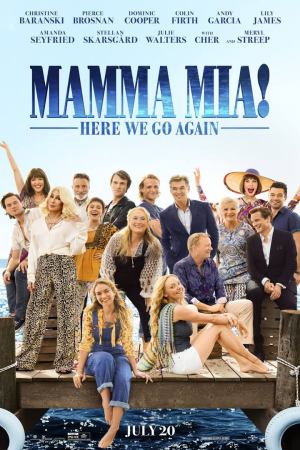
A couple of weeks ago I went to see the new Mamma Mia: Here We Go Again! movie.  In addition to being a fan of movies inspired by musicals I also loved the emphasis that was placed on the mother/daughter relationship in the first Mamma Mia and had heard that this new installment would continue to focus on that relationship.  It definitely didn’t disappoint!

This second movie takes place five years after the original Mamma Mia, and roughly a year after the death of Donna Sheridan, with Donna’s daughter Sophie preparing for the grand reopening of the Hotel Bella Donna.  This second movie also features lots of flashbacks where we are able to see a young Donna arrive at the island of Kalokairi as well as see how she first meets Sam, Bill, and Harry, her daughter Sophie’s three possible fathers.

As one might imagine, even if you aren’t familiar with the movie there is a lot going on, but the part that I found most intriguing was the very end of the movie.  At this point Sophie has given birth to her own baby and is bringing the child to the church to be baptized.  During the ceremony Donna’s spirit is there at the font with her daughter and new grandchild and you could feel this amazing sense of connection and love between not only three generations but across the lines of physical and spiritual presence and space.

Continue reading “Mamma Mia and the Mother-Daughter Connection by Katie M. Deaver”

The Four Phases of the Feminine Way by Elisabeth Schilling

For so long I’ve been wandering in the maiden stage, but now I am a mother, to myself, since I’ve made hard decisions to loosen or cut ties with people who have not always acted in my best interest in their attached and, at least to me, manipulative ways; I have long felt a mother to whatever group of students I have the honor of guiding; and I moonlight as a card reader/astrological guide where I feel I can nurture and provide compassionate advice to those who desire a connection from the universe. The way I practice is that I allow my empathy and research about ourselves to encounter the client’s own internal wisdom. There is not anything that qualifies me to be a teacher or reader any more than anyone else. We are all guru to each other when we listen closely.

I am not sure why I have never wanted to be a mother of a child. Not-wanting has felt very natural to me. Now that I have put some distance between myself and my own mother, her voice and so her desires are not so much hovering over me. I feel free and good about my decisions, about following the path that is normal for me.

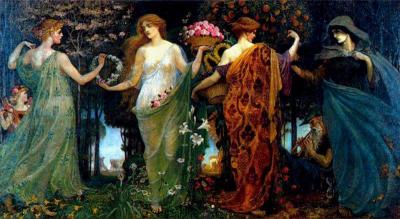
But what I really love about the four phases of the feminine way – maiden, mother, maga, and crone — is that we do not necessarily need to always identify with the stage that aligns with our age or any rites of passage. I remember going to a goddess ceremony in California where we could speak from any of the perspectives we felt aligned with that at the time and explain why.

Continue reading “The Four Phases of the Feminine Way by Elisabeth Schilling”

Thus Saith Eve BOOK REVIEW by Katie M. Deaver

“I am the Queen of Sheba and I am not impressed.”  This is the first line of one of the monologues from chris wind’s book Thus Saith Eve.  This book features 18 stories of biblical women, and a 19th, Lilith, from Jewish mythology.  Each monologue offers a new interpretation and gives a voice to the women that we think we know.

In this book the voices and personalities of women such as Noah’s wife, Mary of Bethany, Zipporah, and Vashti are reimagined in an exciting and empowering way.  Each of the stories also features an appendix where the reader can learn more about the biblical or mythological context of the woman who is telling her story.

As in her other works, wind uses historical people, events, and understandings to build a truly wonderful source of feminist fiction.  In addition to being an extremely enjoyable and thought provoking read, the monologues can also be used for audition and performance pieces.  On her website wind explains that two of the monologues, “I am Eve” and “I am Mary” can be performed with specific musical selections in the background.  You can find those selections linked to her website above.


Continue reading “Thus Saith Eve BOOK REVIEW by Katie M. Deaver”

The Red Dress by Vibha Shetiya

VibhaIt was my twelfth birthday and I was in New York vacationing with my parents and brother. New York was a world away from the sleepy town of Luanshya, Zambia where I was from (and which I loved).  The noise, the lights, the gigantic stores, and oh, the people. So many of them! My heart could barely contain the excitement.

It was one of these stores that had coaxed out my blossoming womanhood. I had spotted the perfect outfit at Macy’s. It was a red dress that fell slightly below my knees, delicate flower patterns adding that extra touch to the femininity I was ready to embrace. Although Luanshya couldn’t compete with the thrill of the Big Apple, I was now ready to embark upon my own exciting journey towards womanhood. And, I would take a little bit of New York back with me. Continue reading “The Red Dress by Vibha Shetiya”