Mamma Mia and the Mother-Daughter Connection by Katie M. Deaver

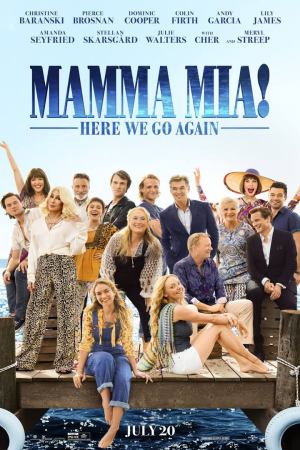
A couple of weeks ago I went to see the new Mamma Mia: Here We Go Again! movie.  In addition to being a fan of movies inspired by musicals I also loved the emphasis that was placed on the mother/daughter relationship in the first Mamma Mia and had heard that this new installment would continue to focus on that relationship.  It definitely didn’t disappoint!

This second movie takes place five years after the original Mamma Mia, and roughly a year after the death of Donna Sheridan, with Donna’s daughter Sophie preparing for the grand reopening of the Hotel Bella Donna.  This second movie also features lots of flashbacks where we are able to see a young Donna arrive at the island of Kalokairi as well as see how she first meets Sam, Bill, and Harry, her daughter Sophie’s three possible fathers.

As one might imagine, even if you aren’t familiar with the movie there is a lot going on, but the part that I found most intriguing was the very end of the movie.  At this point Sophie has given birth to her own baby and is bringing the child to the church to be baptized.  During the ceremony Donna’s spirit is there at the font with her daughter and new grandchild and you could feel this amazing sense of connection and love between not only three generations but across the lines of physical and spiritual presence and space.

Continue reading “Mamma Mia and the Mother-Daughter Connection by Katie M. Deaver”

The Four Phases of the Feminine Way by Elisabeth Schilling

For so long I’ve been wandering in the maiden stage, but now I am a mother, to myself, since I’ve made hard decisions to loosen or cut ties with people who have not always acted in my best interest in their attached and, at least to me, manipulative ways; I have long felt a mother to whatever group of students I have the honor of guiding; and I moonlight as a card reader/astrological guide where I feel I can nurture and provide compassionate advice to those who desire a connection from the universe. The way I practice is that I allow my empathy and research about ourselves to encounter the client’s own internal wisdom. There is not anything that qualifies me to be a teacher or reader any more than anyone else. We are all guru to each other when we listen closely.

I am not sure why I have never wanted to be a mother of a child. Not-wanting has felt very natural to me. Now that I have put some distance between myself and my own mother, her voice and so her desires are not so much hovering over me. I feel free and good about my decisions, about following the path that is normal for me.

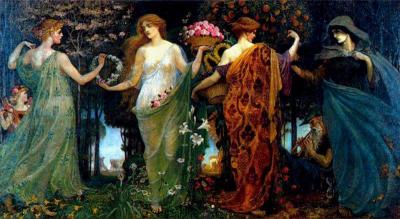
But what I really love about the four phases of the feminine way – maiden, mother, maga, and crone — is that we do not necessarily need to always identify with the stage that aligns with our age or any rites of passage. I remember going to a goddess ceremony in California where we could speak from any of the perspectives we felt aligned with that at the time and explain why.

Continue reading “The Four Phases of the Feminine Way by Elisabeth Schilling”

Thus Saith Eve BOOK REVIEW by Katie M. Deaver

“I am the Queen of Sheba and I am not impressed.”  This is the first line of one of the monologues from chris wind’s book Thus Saith Eve.  This book features 18 stories of biblical women, and a 19th, Lilith, from Jewish mythology.  Each monologue offers a new interpretation and gives a voice to the women that we think we know.

In this book the voices and personalities of women such as Noah’s wife, Mary of Bethany, Zipporah, and Vashti are reimagined in an exciting and empowering way.  Each of the stories also features an appendix where the reader can learn more about the biblical or mythological context of the woman who is telling her story.

As in her other works, wind uses historical people, events, and understandings to build a truly wonderful source of feminist fiction.  In addition to being an extremely enjoyable and thought provoking read, the monologues can also be used for audition and performance pieces.  On her website wind explains that two of the monologues, “I am Eve” and “I am Mary” can be performed with specific musical selections in the background.  You can find those selections linked to her website above.


Continue reading “Thus Saith Eve BOOK REVIEW by Katie M. Deaver”

The Red Dress by Vibha Shetiya

VibhaIt was my twelfth birthday and I was in New York vacationing with my parents and brother. New York was a world away from the sleepy town of Luanshya, Zambia where I was from (and which I loved).  The noise, the lights, the gigantic stores, and oh, the people. So many of them! My heart could barely contain the excitement.

It was one of these stores that had coaxed out my blossoming womanhood. I had spotted the perfect outfit at Macy’s. It was a red dress that fell slightly below my knees, delicate flower patterns adding that extra touch to the femininity I was ready to embrace. Although Luanshya couldn’t compete with the thrill of the Big Apple, I was now ready to embark upon my own exciting journey towards womanhood. And, I would take a little bit of New York back with me. Continue reading “The Red Dress by Vibha Shetiya”

Four Worlds Poem by Sara Wright

They came from

Life giving Waters,

emerging from a Lake

at the Beginning of time.

Avanyu –

Serpent,

Spirit of the River

pecked into stone

or painted

on canyon walls

embodies their story.


The Tewa settled above

the Great River Banks.

Roaring water flowed

through tributaries

mountain gorges.

The People gave thanks.

  Water meant Life.

Each village was the center

of the Tewa’s First world.


Bound together by

Women who tended

holy household shrines,

prayed for rain,

created fires,

gathered seed,

ground food,

grew babies,

dug clay to shape

earthen pots.

This was the Second world

of the Tewa.

Continue reading “Four Worlds Poem by Sara Wright”

The Three Mothers: Feminine Elements and the Early Kabbalah by Jill Hammer

For over ten years, I’ve been teaching a work of early Jewish mysticism known as Sefer Yetzirah, or the Book of Creation.  There are widely differing opinions on the book’s origin and dating, but many scholars date it to the sixth century.  Its core concept can be described simply: the Divine used the Hebrew letters as metaphysical channels to create the different aspects of reality: the directions, the elements, the planets, the months of the year, and so forth.  Each letter is a channel by which God creates a unique form or entity, and meditating on the letters provides us with a connection to divine creative power. In its discussion of the letters, Sefer Yetzirah shows a strong connection to feminine imagery, and thus helps the later kabbalah develop its own link to the feminine.

Sefer Yetzirah shows influences from Aristotle to Gnosticism, and is often viewed as a work of Jewish philosophy.  However, it is also a work of meditation, giving the reader instruction on how to focus and connect to the divine. Scholars such as Richard Hayman and Marla Segol have noted that the book’s structure and content connect it to magical literature: for example, the book has a deep concern with “sealing” the space of the world: letters of the Divine Name are used to seal the six directions of the universe.  In a similar way, ceremonial magicians of the ancient world used sealing ritual, including the incantation bowls that were buried in the corners of a home to keep out evil forces.  The book, like much ceremonial magic of the region, also discusses the elements.  However, Sefer Yetzirah has a three-element system rather than a four or five-element system.  The three formative elements are air, water, and fire.

Continue reading “The Three Mothers: Feminine Elements and the Early Kabbalah by Jill Hammer”

My Heroine’s Journey: Writing Women Back in History by Mary Sharratt

Alma Maria Schindler

We have been lost to each other for so long. My name means nothing to you. My memory is dust.             

This is not your fault or mine. The chain connecting mother to daughter was broken and the word passed into the keeping of men, who had no way of knowing. That is why I became a footnote, my story a brief detour between the well-known history of my father and the celebrated chronicle of my brother.

Anita Diamant, The Red Tent

I am an expat author. My home is everywhere and nowhere. A wanderer, I have lived in many different places, from Minnesota, my birthplace, with its rustling marshes haunted by the cries of redwing blackbirds, to Bavaria with its dark forests and dazzling meadows and pure streams where otter still live, to my present home in the haunted moorlands of Pendle Witch country in Lancashire, England. My entire adult life has been a literal journey of finding myself in the great world.

For as long as I remember, I longed to be a writer. As a novelist I am on a mission to write women back into history. To tell the neglected, unwritten stories of women like my pioneering foremothers who emigrated from Bohemia (now the Czech Republic) in the 1860s to break the prairie soil of southern Minnesota.

To a large extent, women have been written out of history. Their lives and deeds have become lost to us. To uncover their buried truths, we must act as detectives, studying the sparse clues that have been handed down to us. We must learn to read between the lines and fill in the blanks. My heroine’s journey, in other words, is about reclaiming the lost heroines of history. My quest is to give voice to ancestral memory of that lost motherline.

Continue reading “My Heroine’s Journey: Writing Women Back in History by Mary Sharratt”

A Feminist Retelling of Noah’s Ark by Trelawney Grenfell-Muir

My daughters came to me after Sunday School one day, concerned about a story they had heard in which God drowned almost everyone on Earth. So I sat down and thought about why a community might want to tell that story, and what valuable wisdom might be lifted from it for my children. Here is what I told them:
God/ess  has  many  faces,  which  help  us  understand  different  things we  need  to  know  at different  times.  Sometimes we think of God/ess  as  Crone,  an  old,  old  woman  crowned  with  silver  hair  as  an  emblem  of  her  wisdom,  who helps  us  learn  to  let  go  of  anything  that  is  holding  back  the  wellness  of  our  community  and ourselves.  Continue reading “A Feminist Retelling of Noah’s Ark by Trelawney Grenfell-Muir”

“The Burning Lava of a Song” by Joyce Zonana

Aurora’s autobiographical narrative is a passionate paean to poets as the “only truth-tellers, now left to God”; she celebrates them as agents for personal and social transformation. As we come to the end of this National Poetry Month in the U.S., where truth is under siege, it’s worth recalling Aurora Leigh and its daring exploration of poetry, gender, divinity, and social justice.

jz-headshotI was in graduate school when I first read Aurora Leigh, Elizabeth Barrett Browning’s fiery 1856 epic about a young woman claiming her vocation as a poet despite Victorian society’s patriarchal strictures. The poem was not on any assigned reading-list; I’d simply stumbled across it while doing research for my dissertation. The opening lines brazenly assert the speaker’s authority and ambition:

OF writing many books there is no end;
And I who have written much in prose and verse
For others’ uses, will write now for mine,–
Will write my story for my better self . . .

Encountering those words, I was immediately possessed by Aurora’s voice and vision, a welcome change from all the male poets and critics I’d been reading. I devoured the verse novel’s nine books in one night. The poem became the centerpiece of my dissertation, and I studied and enthusiastically taught it for years.

Continue reading ““The Burning Lava of a Song” by Joyce Zonana”

Please, Let’s Give Feminists a Break by Sara Wright

Please, Let’s Give Feminists a Break.

I remember so vividly entering graduate school in my early forties and being told I was an “eco – feminist” by my professors. What does that phrase mean I asked having no relationship that I knew of to feminism. Feminists, I thought vaguely, naively, even stupidly, burned bras and hated men…

I was asked to read “Woman and Nature; The Roaring Inside Her” by Susan Griffin to help me see who I was, and after finishing this one book I submerged myself in feminist writings like a starved woman – child. My teachers were right. I was a feminist – an eco –feminist because I had already made the connection between what was happening to the Earth and what had happened to me. Every tree that was chopped down was a part of me, every stream that was polluted was a part of me, every animal that was slaughtered was a part of me because I was a part of Nature. I owed my life to Nature, the only mother I had ever had. I loved Her, honored her, became her fierce advocate and in the process She eventually taught me to love myself.

Continue reading “Please, Let’s Give Feminists a Break by Sara Wright”