Time’s Up for Bullies by Mary Sharratt

The Virgin Mary says #Time’s Up for Bullies: illumination from a 13th century manuscript

Bullying is rife in our society and it’s not just school kids who have to deal with it. Bullies flourish in the work place, in academia, in spiritual and religious communities, and, of course, on social media. Although female bullies exist, women, from my experience, are more likely to experience the most severe forms of bullying at the hands of entitled males. I would even argue that female-on-female bullying is a direct symptom of patriarchy’s attempts to divide and conquer us.

Just as #Me Too and #Time’s Up blew the whistle on sexual assault and workplace harassment, I believe we are in desperate need of a #Time’s Up for Bullies movement. One thing is certain–our current methods of dealing with bullies seem agonizingly ineffectual, to say the least. Continue reading “Time’s Up for Bullies by Mary Sharratt”

Navigating Social Space as Power-Struggle, Pt. 2 by Elisabeth Schilling

Disclaimer/Trigger Warning: This post contains details about unwanted sexual advances. Read Part I here.

After Sicily, I went to the English countryside for an intended two weeks in a work exchange. A retired, but part-time, lecturer of Greek and Latin in his 60s was moving house and needed help packing and cleaning and cooking. There would, in a day or two, also be a male student from Lithuania and a Brazilian couple joining the communal house, and I found the position through workaway.info, a site one must pay for that I used three years ago with no problem.

On one hand, I have to use sites like this from time to time due to financial reasons. On the other hand, after traveling alone for awhile, I long for the communal exchange. I enjoy helping someone learn a language, cook for their family, organize their clutter because of the conversations along the way. They have a house and extra food. I have the time (my two classes I teach at university online do not take much) to help. If the people involved are mindful and truly grateful for community and shared work and resources, it can be a sacred return to a way of life where people can practice sharing, non-greed, and carrying each other’s burdens. We practice living with strangers, with all the challenges that presents, instead of isolating ourselves in presumed comfort. Continue reading “Navigating Social Space as Power-Struggle, Pt. 2 by Elisabeth Schilling”
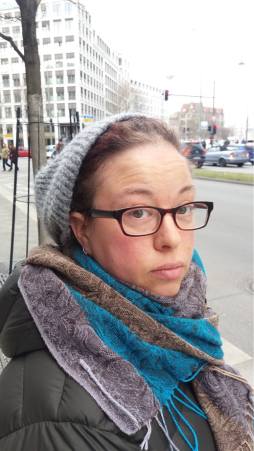
Navigating Social Space as Power-Struggle, Pt. 1 by Elisabeth Schilling

The space we take up by our bodies is an element of the sacred. As we move from bed in waking, through our houses and then out into the world, if any of that movement places a woman in close proximity with a man or men, she might do well to observe how the male presence may modify her behavior, from adjusting orientation, position, and flow.

I was in Sicily for four weeks, and as I lived about 15 km from the town center, I took the bus. There is no on-the-minute bus schedule for my stop, but I could calculate when the bus would depart from the station and how long it might take to get to where I lived. Sometimes if felt like the bus just wouldn’t come. Continue reading “Navigating Social Space as Power-Struggle, Pt. 1 by Elisabeth Schilling”

Vayeitzei: Rachel and the Practice of Niddah by Ivy Helman

29662350_10155723099993089_8391051315166448776_oThis parshah contains the account of Jacob’s marriages to Leah and Rachel, (who happen to be his cousins) as well as the birth of his 11 sons and one daughter.  It describes the long amounts of time Jacob worked for Laban in order to marry Laban’s daughters, and recounts the trickery of Laban giving first Leah, the older daughter to Jacob, before allowing Jacob to marry who he wanted to, Rachel.


Like the relationship between Hagar and Sarah, there is animosity between Leah and Rachel over Jacob’s love as well as the ability to bear children.  This animosity spreads to the maids of Leah and Rachel, Zilpah and Bilhah respectively, as they are used by the sisters to conceive children on their behalf.  One can see also this animosity in how Leah and Rachel name their sons.  Yet, the parshah also contains two aspects that seem at odds with such a patriarchal perspective.  First, there are five named women who play key roles in the goings-on.  Second, Rachel is an active agent.  Continue reading “Vayeitzei: Rachel and the Practice of Niddah by Ivy Helman”

Second Class Citizen by Sara Wright

Second Class Citizen


When he backed me

up against the tree

inching towards me

menacingly

with his big powerful car

I couldn’t believe

what was happening.

I was holding the space

for a car full of dogs

waiting to park

just behind him.


He got out of the car

And I said

You can’t do this

this spot is taken.

Six feet tall, he sneered

You can’t save spaces

in a parking lot.

Continue reading “Second Class Citizen by Sara Wright”

When the Gods Retire by Barbara Ardinger

Come with me in your imagination to an old land, a Demi-Olympus, a fabled and possibly invented land to the north of Mount Olympus, home and throne of the fabled Olympian gods. It is to this Other Olympus that the gods have retired. Now they reside in the Divine Rest Home whose proprietor is a black goddess. Not African black, She is as black as space, and if we look closely at Her, we can see galaxies and constellations and comets in Her. She is the Ur-Goddess, the Divine Creatrix, eldest of all, and She answers to the name Mama. (Note: many years ago, I actually saw this goddess after an all-day asthma attack that nearly killed me. She was in the ER with me.)

Helping Mama run the Divine Rest Home are Gaea, the mother of all life, and the Titans and Titanesses, who are older than all the gods who have come to the Divine Rest Home to…well…rest. The Titans and Titanesses held numerous important stations in the primeval universe and should probably retire, too, but they just keep going. That’s probably a good thing, as most of the retired gods need a great deal of attention.

Continue reading “When the Gods Retire by Barbara Ardinger”

I Was Brainwashed to Believe I Wasn’t Human. Now I’m on a Mission Against that Cult-Part 3

Trigger warning: rape, sexual assault, domestic abuse, graphic sexual content

In Part 1 of this story, I introduced a discussion of Johan Galtung’s theory of cultural violence as it relates to my experience as a young woman in an abusive relationship. To recap:

Cultural violence is: “…any aspect of a culture that can be used to legitimize violence in its direct or structural form. Symbolic violence built into a culture does not kill or maim like direct violence or the violence built into the structure. However, it is used to legitimize either or both.”

Cultural violence against women is: Normalization and promotion of pornography, prostitution, degradation, and sexual objectification of females in media, predominantly male language in civic, business, and religious institutions, gender roles and stereotypes, misogynist humor, gaslighting, minimizing or denying any of these forms of violence.

Continue reading “I Was Brainwashed to Believe I Wasn’t Human. Now I’m on a Mission Against that Cult-Part 3”

Fuck This Sexist Shit by Trelawney Grenfell-Muir

Our whole lives, we are taught to be nice. To be considerate of others. To play fairly. To fess up when we mess up. Do unto others, turn the other cheek, respect your elders, obey the rules.

And for what? For what?

So some hyper-entitled coldhearted sneering rapist fuckheads can cheat and steal and lie and game the system until rape survivors are criminals and rapists are victims, while they rob us all blind, crush our freedoms, and rip away our future?

Fuck this sexist shit.

I am so done with this fucking misogynist society, where the president of the most powerful world empire mocks a rape survivor and laughs about assaulting women.

Continue reading “Fuck This Sexist Shit by Trelawney Grenfell-Muir”

Kingdom of Women BOOK REVIEW by Katie M. Deaver

In her novel, Kingdom of Women, Rosalie Morales Kearns imagines a reality that is post-patriarchy, and post male violence while showing us what near-future women had to go through in order to get to that reality.  Morales Kearns weaves this story through the voices of multiple characters.  One of these characters is Averil Parnell, a female Catholic priest. Part I of the book opens with a woman visiting Averil to seek her counsel in regards to taking revenge on her male college professor who has been harassing her ever since she refused to sleep with him.

While Averil seems to be of little help with this particular conversation, we learn that Averil was one of the twenty three original female priests that were to be ordained by the Catholic Church. On the day of their joint ordination however, the Cathedral Massacre took place and twenty two of the female seminarians were killed in cold blood.  Averil then, is most definitely a woman who understands the yearning for revenge, the feeling of survivors guilt, and the expectation to be a wonderful priest for her dear friends who had that chance ripped away from them.

At the same time this conversation is taking place it has become clear that small groups of vigilante women are popping up around the world and punishing men for acts of violence against women.  The male dominated government of course sees all these punishing acts as coincidental, explaining them away in one way or another, or ignoring them completely, never imagining that it is in fact the beginning of women rising up to truly end male dominance and violence.

Continue reading “Kingdom of Women BOOK REVIEW by Katie M. Deaver”

I Was Brainwashed to Believe I Wasn’t Human. Now I’m on a Mission Against that Cult – Part 2 by Trelawney Grenfell-Muir

Trigger warning: rape, sexual assault, domestic abuse, graphic sexual content

In Part 1 of this story, I introduced a discussion of Johan Galtung’s theory of cultural violence as it relates to my experience as a young woman in an abusive relationship. To recap:

Cultural violence is: “…any aspect of a culture that can be used to legitimize violence in its direct or structural form. Symbolic violence built into a culture does not kill or maim like direct violence or the violence built into the structure. However, it is used to legitimize either or both.”[1]

Cultural violence against women is: Normalization and promotion of pornography, prostitution, degradation, and sexual objectification of females in media, predominantly male language in civic, business, and religious institutions, gender roles and stereotypes, misogynist humor, gaslighting, minimizing or denying any of these forms of violence.

Part 1 ended right before my ex convinced me to leave MIT and move with him to Minnesota. I had been trying my best to please him by sculpting my appearance to match his preferences, believing that it was my job as a female partner to try to satisfy my male partner sexually.

Continue reading “I Was Brainwashed to Believe I Wasn’t Human. Now I’m on a Mission Against that Cult – Part 2 by Trelawney Grenfell-Muir”