white femininity: whitemalegod’s secret weapon By Christena Cleveland, PhD

For the first several weeks of my walking pilgrimage, I debated whether to visit the famous Black Madonna of Orcival. It wasn’t the walking distance that deterred me; She lived in a gorgeous Romanesque cathedral nestled in a charming medieval mountain town only fifteen miles away. Rather, I was hesitant to visit Her because I knew that, after a thousand years of being Black, She had undergone a mid-twentieth-century “renovation and restoration” process that whitened Her skin. I knew from photos that Her once gorgeous melanated skin was now a ghastly beige-ish pink. The incredible Black Madonna of Orcival now appears to be a white woman.

Continue reading “white femininity: whitemalegod’s secret weapon By Christena Cleveland, PhD”

From the Archives: Rape is Not a Political Platform – Rape is a Violent Crime! By Michele Stopera Freyhauf

Moderator’s note: This marvelous FAR site has been running for 10 years and has had more than 3,600 posts in that time. There are so many treasures that have been posted in this decade. They tend to get lost in the archives. We are beginning this column so that we can revisit some of these gems. Today’s blogpost was originally posted August 23, 2012. You can visit it here to see the original comments.

Just when you think you have heard it all, here we go again – another politician with “open mouth-insert foot” syndrome.  Discussing his zero-tolerance policy for abortion, Missouri Representative Todd Akin made the following statement last Sunday about pregnancies that result from rape:

“from what I understand from doctors, that’s really rare.  If it’s a legitimate rape, the female body has ways to try to shut that whole thing down.  But let’s assume that maybe that didn’t work or something.  I think there should be some punishment, but the punishment ought to be on the rapist and not attacking the child.”

Continue reading “From the Archives: Rape is Not a Political Platform – Rape is a Violent Crime! By Michele Stopera Freyhauf”

Persephone Rises, Part 1 by Sara Wright

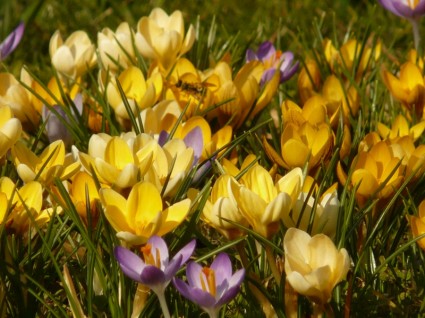
While researching Minoan Crete I learned that each autumn young girls once gathered blue violet saffron crocus to leave as an offering for the Wild Crocus Goddess as they prepared for adolescent female initiation rites. I was intrigued by the reference to autumn because I associate flowers more with spring than any other season. From other sources I discovered that in Minoan Crete young girls also gathered bright yellow crocus to celebrate the Great Goddess and the return of the growing season and that yellow was the color associated with the Great Goddess because of the golden color of the dye made from the precious saffron crocus. Later in Greece during the Lesser Mysteries, flowers, especially yellow crocus were also picked to celebrate Persephone’s return from the Underworld. I was particularly delighted by the reference to Persephone picking bright yellow crocus because my relationship with this goddess has been a somber one; I have always associated her with death. And yellow is a joyous color that I associate with early spring.

I felt a wild sense of hope as a volcanic fire erupted inside me when I first imagined Persephone picking spring flowers because of my uncomfortable relationship with this mythical figure and also because I love flowers.

Continue reading “Persephone Rises, Part 1 by Sara Wright”

Carol P. Christ’s Legacy: THE LABRYS: A RIVER OF BIRDS IN MIGRATION

Moderator’s Note: Carol Christ died from cancer in July, 2021. Her work continues through her non-profit foundation, the Ariadne Institute for the Study of Myth and Ritual and the Goddess Pilgrimage to CreteThis blog was originally posted July 29, 2013. You can its original comments here.

labrys seal ring

“There’s a river of birds in migration, a nation of women with wings.” Goddess chant, Libana

On the Goddess Pilgrimage to Crete, I explain that many of the names given to “Minoan” (c. 3000-1450 BCE) Cretan artifacts and architecture are products of patriarchal and Eurocentric imaginations, and as such, are misleading.  For example the name “Minoan” was given to the culture of Bronze Age Crete in honor of “King Minos,” who was said to have ruled in Crete a few generations before the Trojan War–several hundred years after the end of the culture to which his name was attached.  In fact, despite his eagerness to find evidence that King Minos ruled at Knossos, the excavator Sir Arthur Evans finally had to concede that the best he could do was to produce a fresco of a “Prince of the Lilies” which he identifed as the image of the male ruler of the culture he called “Minoan.”  Evans’ Prince had white skin, a fact that Evans conveniently overlooked–because according to his own interpretation of “Minoan” iconography, white skin would mark the figure as female.  Mark Cameron, who reviewed Evans’ reconstruction of the fresco, suggested that the Prince is more likely to be a young woman who is perhaps leading a bull to take part in the bull-leaping games.  He also stated that the “crown” belonged to another fresco altogether.

Continue reading “Carol P. Christ’s Legacy: THE LABRYS: A RIVER OF BIRDS IN MIGRATION”

From the Archives: Creating Spaces for Grieving and Receiving by Anjeanette LeBoeuf

This blog was originally posted on April 26, 2020.

By now, all aspects of life have been altered or halted. The world as we know it has become radically different as we attempt to get a handle on this disease and stop the rising number of deaths each day. We are enduring trauma on a global and individual level. Trauma carries a myriad of emotions; anger and grief sometimes being the prominent two.  And with the rising uncertainty paired with the increasing amount of trauma and grief we are all experiencing, we need to find ways to talk about our feelings, share, and move forward.

As a global community, as a family, and as individuals we are impacted on all fronts. And the only way through this is that we must grieve. All people, even those that can work from home, those that continue to work ‘in’ the world, and everyone in-between. Everyone’s life has been altered in many ways and degrees. Expectations, plans, and standards of achievements have had to be put aside. We have had to adapt to a different way of life. Prom, tests, graduations, weddings, birthdays, holidays, and even funerals have had to fluctuate between being postponed, cancelled, or reworked to fulfill the lack of physical meetings. Currently over 22 million Americans had applied for unemployment benefits, countless others have seen their hours reduced, been placed on furlough, or sought employment at a company that is considered ‘essential business.’

Continue reading “From the Archives: Creating Spaces for Grieving and Receiving by Anjeanette LeBoeuf”

A COMPLICATED CHOICE by Katey Zeh – Book Review by Esther Nelson

Katey Zeh, an ordained Baptist minister, CEO of the Religious Coalition for Reproductive Choice, and a contributor to this Feminism and Religion (FAR) blog recently published her newest book, A Complicated Choice  Making Space for Grief and Healing in the Pro-Choice Movement (Broadleaf Books, 2022). Not only does Zeh push back against those individuals who are dead-set against giving space to pregnant people to make their own decision about whether or not to carry a pregnancy to term, she dares to imagine a world where people are not just free to easily access an abortion procedure, but are also given the support to grieve (if need be) and heal without being bogged down with shame heaped on them by the larger society. 

One of the strengths (given the current religious-political climate in the U.S.) of this slim volume is that Zeh uses Christian Scripture to illuminate the way for pregnant people to embrace their inner knowing, something that helps slough off the stories that our society (collectively) has given them that silences and shames them “from speaking up and speaking out” about their abortions. “There is a culture of silence around abortion, and that silence is shaming and isolating on both a personal and a collective level.” When we break the silence of isolation and give voice to our difficult and painful experiences, we are then free to find healing and wholeness.

Continue reading “A COMPLICATED CHOICE by Katey Zeh – Book Review by Esther Nelson”

My Favorite President: Hillary by Marie Cartier

Can I finally write about that night? Not sure. Here goes. Hillary Clinton. My heart beat. I voted for her every chance I got. Loved her passionately—the way I’ve heard folks talk about working for a candidate with their whole soul. I was so happy: she was winning. We were going to have a woman president.

            What do you want to be when you grow up?

PRESIDENT!

Girls can’t be president, stupid! That’s never gonna happen.

No more. My wife and I wore our white pantsuits to the primaries. What a night! She won! The most exciting political event of my life –and that’s saying a lot for someone who first put her body down in front of a nuclear facility at fifteen. I know politics, And protests.

Continue reading “My Favorite President: Hillary by Marie Cartier”

The Darkness by Annelinde Metzner

Collage by Deb Pollard

As a composer and poet, I’m interested in cultural perceptions and assumptions that influence beliefs.  In monotheistic religions as well in some types of more recent spiritual thought, the assumption has been to equate Darkness with evil and Light with good. “Love and light!” we hear often, or maybe “I’m surrounding you in light.”  But this assumption feeds a form of prejudice that infuses all of society. The mind hears “darkness” and associates it negatively with Earth, female, skin color, dirt.

Continue reading “The Darkness by Annelinde Metzner”

On Ukraine, War and Goddess’s Protection by Judith Shaw

We have all been horrified by the Russian invasion of Ukraine as we witness the brutal bombardment of not only military sites but also of civilians, neighborhoods, hospitals, churches, historical sites and nuclear power plants. It has been called the first TicToc war as these images fill up our computers and cellphones, leaving peace lovers challenged to maintain their belief in peaceful resolutions to conflict

Continue reading “On Ukraine, War and Goddess’s Protection by Judith Shaw”

The Lady of Saint Serin by Sara Wright

I just learned about Jen Taylor who is a singer and songwriter and a woman who embraces the goddess. Her philosophical work focuses on re-wilding the body/mind – returning us to our source.

Jen Taylor writes:

“Statue-Menhirs are sandstone standing stones that were carved about 5000 years ago. They are also known as slabs or anthropomorphic steles (my italics). They are the earliest life-size representation of human beings known to date, appearing across Africa and Eurasia, engraved or carved in low-relief on both sides. Over 100 menhirs were found in the area of Southern Aveyron, France alone. 

Continue reading “The Lady of Saint Serin by Sara Wright”