When will justice come to us, my unborn babe… the Earth cries out, the very olive trees are weeping from the violence, the injustice, the apathy. The fig trees are too brokenhearted to bear fruit, from the oppression, the division, the hatred. The vines droop and wither from the greed, the want and hunger, the grief and despair.
My child, my child, my firstborn beloved… I hate to say this, but part of me cannot but hope you will be a boy. Oh, if you are a daughter, I will love you just as much, of course, and teach you everything I know, but my little one, I tried so hard to help our people – to tell them the good news, the Word of Emmanuel, how Divine Love is within us, is born in us, is calling us to birth a new reign of justice and peace, in which the mighty are cast down from their thrones, and the lowly are lifted up… the hungry are filled, and the rich are sent empty away. Continue reading “Mary’s Pondering Heart by Trelawney Grenfell-Muir”
I have something hard to say. It is about some of ourselves, some of the time.
Let me start by offering you my perspective on negativity on the internet: people are not always conscious or mindful. We let our bitter wounds affect our ability to listen to each other and respond in compassionate ways. Being compassionate does not mean we have to agree with each other. But it means that we shelf our ego and do not immediately jump to disregarding another’s experience or perspective; we can disagree without being harsh. We can be honest, while being kind.
There is some negativity in the comments from regular FAR readers and contributors that I want to speak to in hopes we can become a more supportive community and a better model of peaceful difference. Support simply means that we will create a more safe space for people to share their experiences, give their opinions, and be able to disagree. Diplomacy is the key. If diplomacy does not feel authentic to you. If it feels repressive and you equate it with being polite, then let’s look at the definition of the term:
During the first week of November 2018, 12 graduates and current students of the Kohenet Hebrew Priestess Institute attended the Parliament of the World’s Religions in Toronto, Canada. The Parliament is a conference with a 125-year-old history that has grown to an estimated 10,000 participants representing more than 200 spiritual traditions. To share a Jewish feminist perspective with the Parliament’s attendees, we sought to create moving experiences and intimate spaces through a variety of invited and informal initiatives.
Priestessing Panels
Many of us were slated to speak at the Parliament, and rather than just show up and give an academic presentation on a panel, we brought the feminist spirit of Kohenet into our sessions, moving rows of chairs to create a circle, guiding participants through embodied practices rather than giving speeches, and crafting ritual. Continue reading “Priestesses at the Parliament by Rae Abileah, Bekah Starr & Chaplain Elizabeth Berger”
Warning contains images of rape in the history of art portrayed through the pornographic male gaze
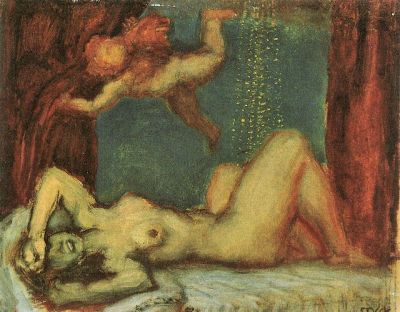
According to the myth, Danae was the only child of the King of Argos who longed for a male heir. After an oracle declared that Danae would indeed bear a son, but that he would kill his grandfather, the King locked his daughter in a tower. Hearing the story, Zeus decided to breach the tower. Transforming himself into a shower of gold, he entered the tower through its roof and raped Danae. When Danae gave birth to Perseus, the King locked them both in a chest and dumped it into the sea. Zeus rescued them, and Perseus went on to behead Medusa, but that is another story.
The myth of the rape of Danae has been a popular subject for male artists from classical times up to the present. It is unclear whether, when they dreamed of “golden showers,” the artists had in mind degrading activities involving pee or whether they thought of sperm as inherently golden, perhaps as the mirror image of golden treasures stolen as the spoils of war. In any case, they were fascinated with the image of golden sperm. In their works, Danae is portrayed as beautiful and rape is normalized. The brutality of the facts–that Danae was locked in a tower by her father, that she was raped while imprisoned, and that her father tried to murder her and her infant son–are overlooked.
Classical Greece
Correggio
Titian
Rembrandt
Franz von Stuck
Gustav Klimt
I was little more than a child myself when I began to study images like this in the history of art. I spent countless hours gazing at them in the museums of Europe before I was twenty. I am not sure I even knew what sperm was at the time. Nor had anyone explained to me that rape is always a violent act. Like Danae, I accepted rape: the rape of my innocence, the rape of my mind, the rape of my psyche.
#JustSayNo
Do not accept what you are taught. Do not accept that rape is beautiful. Do not accept that paintings of rape are beautiful. Do not accept rape culture. Do not let anyone tell you that Greek myths are beautiful. Do not let anyone tell you Greek myths are archetypes of the psyche. Question. Question everything.
Mary Daly still causes me awe. I think about the way she was so keenly able to diagnose the Catholic Church’s collusion in creating, sustaining, the oppressive structures that directly impact women (and men, as she always affirmed). Mary Daly knew that the situation of women’s second-class status, outlined at the time most powerfully by Simone de Beauvoir in her book The Second Sex,[1] was in great part made possible by the Catholic Church. The church used Christianity to justify the creation of gender hierarchies (for it can be used otherwise), and regarded a category of humans as having greater value and worth than others by default. So much so that it comes to be understood as “god ordained” or “natural” – the right order of things.
At the time of her early writing, Mary Daly still identified as part of the Catholic Church – but she did not hesitate to call out her church. Building on the work of existentialist philosopher Simone de Beauvoir, Daly made a powerful case against the church. She described the antagonism between the Catholic Church and women as based on the fact that the Church’s teachings perpetuated a “traditional view of woman” that both “pretends to put woman on a pedestal but which in reality prevents her from genuine self-fulfillment and from active, adult-size participation in society.”[2] She drew on insights from de Beauvoir to make her case and wrote her book The Church and the Second Sex with the conviction that there were “harmful distortions of doctrine and practice” in the Catholic Church. Continue reading “Mary Daly and Simone de Beauvoir: Sister Diagnosticians by Xochitl Alvizo”
Warning: contains images of rape portrayed through the lens of the objectifying pornographic male gaze
When I reflected on the discovery of a rape fresco from ancient Pompeii that depicted Leda and the swan, I did not mention that the image of the rape of Leda by Zeus along with related images of Zeus raping Europa as a bull and raping Danae as a shower of gold are favorite themes in the history of western art up to the present day. Myths of rape not only give artists permission to paint or sculpt naked women but also to normalize rape as an aspect of culture. In the imagination of western artists, noble or immortal women are portrayed as passively accepting and even enjoying being raped. The fact that these women are understood to be icons of female beauty delivers the message that female beauty invites rape.
I am beginning to understand my university education as brain-washing. I was 17 years old and in my first semester of college when I was shown images of Zeus raping women on a large screen in a darkened auditorium while being told that I should pay attention to perspective, brush-work, and detail. I understood that in learning to appreciate great works of art I would be considered intelligent and sensitive by other intelligent and sensitive people whose ranks I hoped to join. I learned what I was being taught. I was not told was that my “education” was grooming me to accept rape as part of high culture and as beautiful. Continue reading “This Is What Rape Culture Looks Like in “Great” Art by Carol P. Christ”
Parshah Vayigash covers Genesis 44:18 to 47:27. It involves the reunification of Joseph with his brothers and his father, the immigration of Jacob’s entire family to Egypt and Joseph successfully leading Egypt through famine. In other words, the parshah provides the backdrop for how the Israelites become slaves in Egypt.
Any mention of women is confined to verses 46: 14-26. They are not active participants, but are remembered as mothers and (a few) daughters and help explain the size and development of Jacob’s family. It is most striking that they are mentioned at all as the text is heavily preoccupied with sons. Nonetheless, according to the account, Jacob’s family has 70 members and a seemingly very small number are women and daughters.
Clearly it comes as no surprise that this text is highly influenced by its patriarchal roots and we could dismiss it for that reason. Nonetheless, it has become a project of mine in this blog over the past few months to find redeeming qualities and food for thought within these texts. In other words, despite its sexist pitfalls, there are still holy insights and life lessons as my previous blogs attest. Continue reading “Vayigash: Lessons from Joseph’s Behavior by Ivy Helman”
When Emmy handed me the pot I held it gently in my palm, marveling over its rounded shape, the warm earth tones, the sparkling mica speckled through the smooth clay.
“It’s broken,” she said simply as I turned the small pot in my hands, laying my cheek again her soft skin. How did she manage to stretch the clay that thin?
“I think it’s beautiful just as it is,” I responded gazing at the lines where the clay had cracked in the fire – almost as if it was meant to be this way.” I peered inside the neck of the bowl to see two pieces of broken lip nestled in the bottom, two sisters asleep in the arms of their mother.Continue reading “Broken Pot by Sara Wright”
The Virgin Mary says #Time’s Up for Bullies: illumination from a 13th century manuscript
Bullying is rife in our society and it’s not just school kids who have to deal with it. Bullies flourish in the work place, in academia, in spiritual and religious communities, and, of course, on social media. Although female bullies exist, women, from my experience, are more likely to experience the most severe forms of bullying at the hands of entitled males. I would even argue that female-on-female bullying is a direct symptom of patriarchy’s attempts to divide and conquer us.
Just as #Me Too and #Time’s Up blew the whistle on sexual assault and workplace harassment, I believe we are in desperate need of a #Time’s Up for Bullies movement. One thing is certain–our current methods of dealing with bullies seem agonizingly ineffectual, to say the least. Continue reading “Time’s Up for Bullies by Mary Sharratt”
“I am sorry!” “I am guilty of sex abuse” “I have hurt many young children!” “I have ruined lives!” “We are sorry for hiding sex abuse in the Church!” “We are criminals!” “We want to make amends!” We, in the pews, have yet to hear true contrition, instead we hear how the Church needs healing. True, but where is remorse from those who perpetrated and covered-up the crimes? To heal, we must hear from them.
Remorse, a contrite heart, admitting grave sin, deceitfulness, criminal behavior, the global Catholic Church has not yet confessed this loud enough. Why? Why is male clerical privilege so deeply ingrained in the construct of In Persona Christi that none of these guilty perpetrators of crime are able to directly tell Catholics worldwide that they truly, in their hearts grieve for our church and grieve for what they have done to our children? Where is their sensitivity for children? Continue reading “Clerical Male Mess! by Janice L. Poss”


 When will justice come to us, my unborn babe… the Earth cries out, the very olive trees are weeping from the violence, the injustice, the apathy. The fig trees are too brokenhearted to bear fruit, from the oppression, the division, the hatred. The vines droop and wither from the greed, the want and hunger, the grief and despair.
 I have something hard to say. It is about some of ourselves, some of the time.
 According to the myth, Danae was the only child of the King of Argos who longed for a male heir. After an oracle declared that Danae would indeed bear a son, but that he would kill his grandfather, the King locked his daughter in a tower. Hearing the story, Zeus decided to breach the tower. Transforming himself into a shower of gold, he entered the tower through its roof and raped Danae. When Danae gave birth to Perseus, the King locked them both in a chest and dumped it into the sea. Zeus rescued them, and Perseus went on to behead Medusa, but that is another story.




 When I reflected on the discovery of a
  Parshah Vayigash covers Genesis 44:18 to 47:27. It involves the reunification of Joseph with his brothers and his father, the immigration of Jacob’s entire family to Egypt and Joseph successfully leading Egypt through famine. In other words, the parshah provides the backdrop for how the Israelites become slaves in Egypt.
 When Emmy handed me the pot I held it gently in my palm, marveling over its rounded shape, the warm earth tones, the sparkling mica speckled through the smooth clay.
 “I am sorry!” “I am guilty of sex abuse” “I have hurt many young children!” “I have ruined lives!” “We are sorry for hiding sex abuse in the Church!” “We are criminals!” “We want to make amends!” We, in the pews, have yet to hear true contrition, instead we hear how the Church needs healing. True, but where is remorse from those who perpetrated and covered-up the crimes? To heal, we must hear from them.
 Feminism and Religion