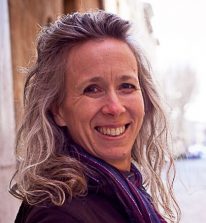
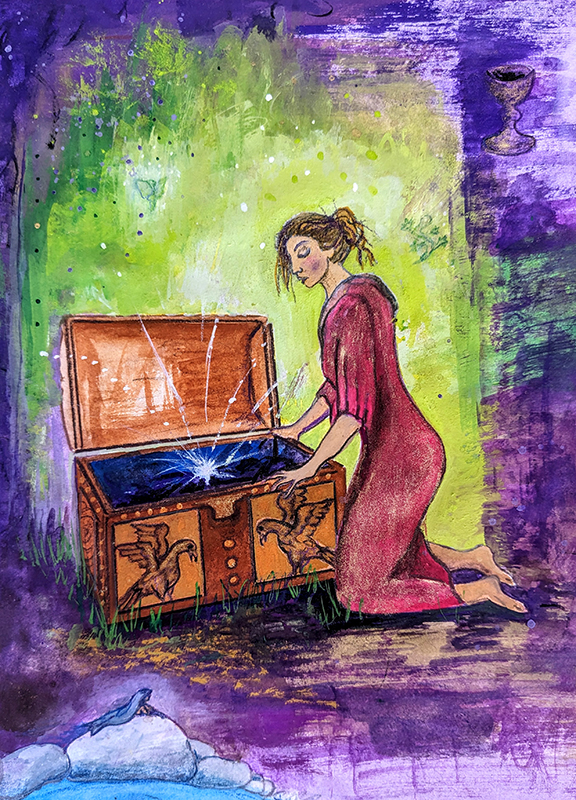
The Gifts of the Magi Were Meant for the Mother by Laura Shannon

For over forty years I have been researching women’s dance and folk arts. This quest has been inspired by Merlin Stone, Max Dashu, Vicki Noble, Mary Kelly, Marija Gimbutas and others, including my close friend Carol P. Christ, who encouraged scholars to examine ‘nontextual artifacts’ and ‘expand our notion of history to include records that are not written’. 1

Through extensive travels in southeastern Europe, North Africa and the Near East, I’ve learned to recognise the symbols and significance encoded in dance patterns, textile motifs, jewellery designs, healing practices, and other forms of women’s ritual arts.2 This experience has trained me to discern patterns and meaning beyond superficial interpretations – to look ‘with eyes to see’.

In this article I would like to offer a closer look at the ‘nontextual artifacts’ in the Christian Nativity story: the gold, frankincense and myrrh brought by the Magi. My lifelong interest in North African bridal jewellery leads me to suggest that the gifts of the Magi were meant for the mother, not the child. Not only that, this closer look reveals that  the Magi were probably not three, almost certainly not kings, and very likely included both men and women.

Continue reading “The Gifts of the Magi Were Meant for the Mother by Laura Shannon”
Three poems by Rebecca Rogerson

Don’t Take Me to Church

He never let me eat communion because I wasn’t a catholic, but it was okay for me to eat his dick. My tiny palms forced to stroke him, the same dextrous hands that coloured in the lines. 

I knew his God wasn’t my God. I knew she saw everything there was to see and that he wouldn’t reach salvation; no matter how many Hail Marys he said at mass in Ireland.

The Virgin Mary knew what he stole from me, what they steal from all of us.

I couldn’t fall apart on Sundays at noon when he took me to church—before he took me home after he did what he did—to the little Jewish girl who didn’t know she was Jewish.

I couldn’t remember it because I buried it in Survive, until, it was resurrected by nightmares and demons who professed caring and brought me to altars of despair to vomit up all the darkness, and when there was no more left to cleanse or tear out; light ripped in.


No one talks about the embarrassment that goes along with the telling, sharing and surfacing of sexual violence. How it comes up, how it comes back. How we’re always haunted by the deadbeat dead and grabby grandfathers who try to reach from there into here, pretending they are made of heaven.

I fled a friend’s choir concert because perpetrators keep stealing time, moments, sleep, joy, and friendship, in churches and baths. On my flight, I hunted for nature, soil and anything else that felt most alive in the hilly town of Nelson. Pretending I was like everyone else, I hid the panic that strikes broken hearts.

Continue reading “Three poems by Rebecca Rogerson”

Two Poems by Rebecca Rogerson

ROSE WATER

I am the holy place somewhere in the stars of eternity,
 someone’s daughter who seeks reprieve somewhere.

Yetta changed her name to Mary. She tried to erase her past, not as a Jew, well maybe some of that, but more as a Jew molested by her father—a frum[1], “Monster”, his daughters called him.

On my altar sits my tallit alongside a Menorah with seven brass holders. No stars of David—before or after the decimation of Gaza. Can rose water sweeten our hearts? We pour it graciously in our hands, hoping the lost petals heal our guts and brighten our thoughts. She searches hungrily for hope in glass bottles adorned with Farsi, that cost $4.29 each.

Continue reading “Two Poems by Rebecca Rogerson”

Veiled by Michelle Wahila

Photos by Paige Gribb Photography
 https://paigegribbphotography.com/

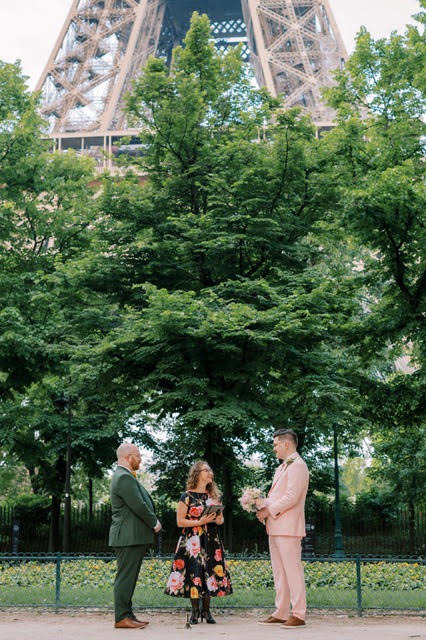
Springtime in Paris brings the magnificence of cherry blossoms, the scent of sweet crêpes, and an influx of tourists eager to capture their own moment of passion on the cobblestone streets of the world’s most romantic city. I may be biased because Paris is my home, but there’s no denying its magic. With its art, history, cuisine, fashion, and architecture, the city offers extraordinary experiences. It’s no wonder so many couples choose to marry in the City of Light.

Years ago, when I entered the wedding industry, I did so reluctantly, only after leaving the one profession I had ever known – ministry. What I didn’t expect was that I would become a bridge for couples navigating the ever-widening gap between love and institutional religion. The so-called “rules” of tradition are often mislabeled as matters of faith but are more accurately named as remnants of the heteropatriarchy. They place enormous pressure on engaged couples. It’s no surprise that many of the eloping couples I meet in Paris have chosen their path simply because it is less stressful than trying to appease tradition, religion, family, or friends (or all of the above).

Continue reading “Veiled by Michelle Wahila”

‘Willowing’ at the Turning by Sara Wright

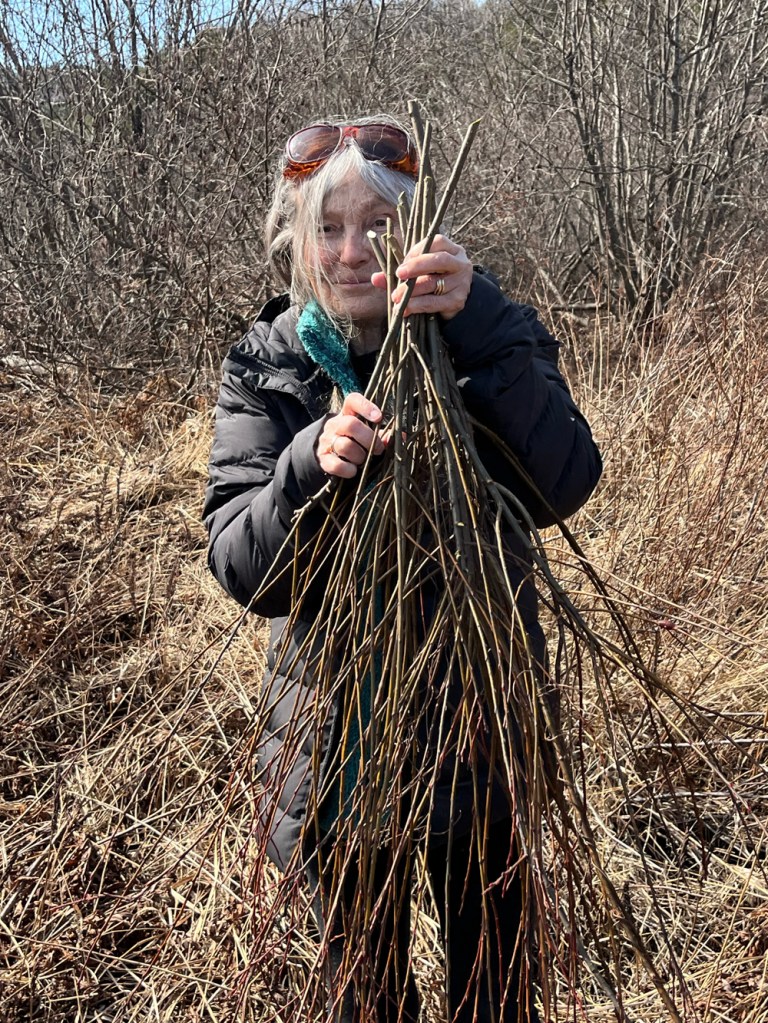
My relationship with and time spent with Indigenous peoples reinforced my intuitive sense that seasonal turnings like the Spring Equinox need to be honored and experienced when the ‘time’ is right. Time, in the Indigenous sense is fluid. Because of this learning I have come to understand that although it is important to write a little ceremony that includes guardians, elements, prayer, gratitude, framing intentions/release that I also need to allow the powers of nature to determine when the actual passage occurs. Indigenous people dance their ceremonies which helped me understand that any experience that transpires around these turnings may become the body of the ceremony if it feels right though the words were written earlier. This year around the equinox darkness reigned in every sense of the word. Having set my intentions, I waited, wondering when the door would open… yesterday it did, and this is the story of what happened. Only afterwards did I realize that in every sense we had honored and experienced the beginning of spring and the rising of clear waters.

My Vet and dearest friend made one of his unscheduled visits. The moment after I got the text my little dogs began to bark. This is normal behavior for both animals who adore their Uncle Gary and are tuned into him on levels that defy explanation (he lives more than a half an hour away). They bark until he arrives, regardless of whether this is a regular visit, or one that’s a surprise. We keep track of the exact timing of his leave – taking, their behavior and his arrival for fun.

Continue reading “‘Willowing’ at the Turning by Sara Wright”

Legacy of Carol P. Christ: “Mermaid, Goddess Of The Sea”

carol-christ

This post was originally posted on Nov. 4th, 2013

On the recent Goddess Pilgrimage to Crete, I visited the Historical Museum in Heraklion where I saw a beautiful embroidered silk panel of a mermaid identified only as having come from Koustogerako, a village in western Crete. As it is unlikely that a man in a Cretan village would have been talented in embroidery, in this case “Anonymous” most definitely “was a woman.”

In this thread painting a mermaid surrounded by fish is holding the anchor of a ship in one hand and a fish in the other. In Greece the mermaid is the protectress of sailors. In a well-known legend, a mermaid said to be the sister of Alexander the Great, emerges from the sea in front of a ship during a storm and asks: “Is Alexander the Great still living?” If the sailors answer, “Yes, he lives and reigns,” the ship is saved.

mermaid greek0001

In this image the mermaid–who does not much resemble “the little mermaid” of recent lore—is identified by the woman who embroidered her as: “GORGONA, H THEA TIS THALASSIS,” MERMAID GODDESS OF THE SEA.” Assuming that the woman who created this embroidery was probably a Christian, I was surprised to see that she nonetheless referred to the mermaid as a Goddess. Was this phrase passed on to her down to her from pre-Christian times? Did she see any contradiction between her Christian beliefs and the “Goddess of the Sea?” Continue reading “Legacy of Carol P. Christ: “Mermaid, Goddess Of The Sea””

Presenting Feminine Courage by Cheryl Petersen

Madam C.J. Walker was born Sarah Breedlove in 1867, to sharecroppers who had been slaves before the American Civil War. Sarah married at age fourteen. Six years later Sarah was a widow with a daughter. For income, Sarah did laundry and cooked. In 1905, she remarried and became Madam C.J. Walker. With little more than a dollar, she began her own line of hair products for African American women and prospered humanity beyond imagination or expectation.

Nearly two decades back, I read “On Her Own Ground: The Life and Times of Madam C.J. Walker,” by A’Lelia Bundles. The author describes Walker’s journey from desperation to inspiration. The narrative impressed me with an exacting respect for the womanhood that embraces other women.

Continue reading “Presenting Feminine Courage by Cheryl Petersen”

Pandora/Gaia—Bringer of Gifts by Judith Shaw

As we move deeper and deeper into full autocratic rule, the timeless themes found in mythology help me find my way. 

My first thought for these days was of Pandora, whose story in the myth of Pandora’s Box serves as a powerful metaphor for the complexities of human choice—relevant today by the choice of many to elect Trump, resulting in multiple destructive consequences. 

Hope Endures, by Judith Shaw, gouache on paper, 7.5″x10″
Continue reading “Pandora/Gaia—Bringer of Gifts by Judith Shaw”

Women and Trees: Little Red Pine by Sara Wright

Women and trees belong together; our relationships with them stretches back to antiquity. They have been our protectors, guiding us through grief and difficult times. They offer us gifts of beauty, fruits, and nuts, are receivers of prayers, sometimes speaking through prophecy. Sometimes healing springs appear at their feet. And always they are wisdom keepers, these Trees of Life. It is not surprising that women’s ceremonies were and are often enacted in the forest under a canopy of trees.

Weeping white tears

Emergence magazine recently posed three questions that I want to share because I think they might help raise awareness for women who love trees and the relatively small minority of other people who are attempting to deal with what is happening to the rest of nature during this political crisis and time of earth destruction.

Some folks who are not Indigenous still love and care for the land as a beloved friend, relative and teacher and it is to these people, both women and men, that I offer up these questions because I think they may help to keep us grounded in a painful but potentially creative way. Queries like these attach us to a larger long-term perspective that allows for a ‘both and’ approach to the future. The last question invites the reader to take personal action. Feeling that reciprocal connection between an individual and some aspect of the land s/he is attached to is a key that opens a door to deeper engagement with the rest of nature.

Continue reading “Women and Trees: Little Red Pine by Sara Wright”

Legacy of Carol P. Christ: Staying In or Leaving the Religious Community of Your Birth- The Dialogue Continues

carol p. christ 2002 color

This post was originally published on June 24th, 2013

This blog is part of an on-going discussion between me and my friend Jewish feminist theologian Judith Plaskow about the differences in our choices to stay in and leave traditional religious communities, which is part of our forthcoming book Goddess and God since Feminism: Body, Nature, and Power.

When you (Judith) discuss the reasons I left Christianity while you stayed Jewish, I think you hit upon a crucial difference between us when you say that I am more “idealistic” than you are.  I agree that this does not mean that I am more ethical than you are.  When you say that I require more “purity of thought” or perhaps more accurately more “purity of ritual symbolism” than you, I think you have hit the nail on the head.  I simply cannot participate in a religious symbol system that I feel has done and continues to do great harm in the world.

I reiterate that for me this “problem” is not limited to the ways in which the maleness of God justifies male domination—including violence against and rape of women.  Equally important to me are the ways that religious symbolisms justify the violence of warfare and conquest.    I simply will not and cannot participate in religious rituals that justify domination and violence in the name of “God.”  If that makes me a “purist” or an “idealist,” I am willing to accept those terms.  Continue reading “Legacy of Carol P. Christ: Staying In or Leaving the Religious Community of Your Birth- The Dialogue Continues”