In his speech announcing that he signed the Religious Freedom Restoration Act, Governor Mike Pence of Indiana did not mention the issue of the so-called “right” to refuse service to gays, lesbians, and transgendered individuals as one of the reasons this bill came to his desk. However, the idea that bakers could be “coerced” into baking cakes for gay weddings, photographers “required” to photograph them, and venue owners “forced” to provide space for them was frequently mentioned in discussions of this and similar bills. Governor Pence’s evident defensiveness during his press conference, and his repeated assertion that “this is not about discrimination” made it clear that an elephant was very much in the room.
Instead of defending the alleged “right” of religious individuals to discriminate against gay, lesbians, and transgendered individuals, Governor Pence invoked the right of employers to refuse to provide contraception to women as part of employee insurance plans, mentioning the Hobby Lobby and University of Notre Dame cases. If anyone has forgotten, in the Hobby Lobby case the Supreme Court decided that employers with a deeply held conviction that birth control is wrong do not have to offer it to their employees as required by federal law if “less restrictive” ways of providing it can be found.
What is the shifting conception of religious liberty as religious groups carve out exemptions in complying with laws on LGBTQI rights, particularly as they relate to marriage? As gay marriage becomes “normative” how does it change the structure and study of religion? How did the anti-gay rights movement in California, regarding Proposition 8, funded largely through religious organizations such as the Church of Latter Day Saints and the Catholic Knights of Columbus, have a direct impact on state decisions, and animate new conversations about the juncture of religion and politics?
Let’s start with this information:
Sociologist Brian Powell posed the question of why people were opposed to gay marriage. Do what people say match the legal arguments that justify the opposition to gay marriage? Since legal arguments are based on public policy, what public policy was shaping the legal arguments? The findings, published recently in Social Currents, show that the most common reason for gay marriage opposition was given as: “Because I don’t believe God intended them to be that way.” Running a close second was: “Well, they’re sinners.”
If public opinion drives public policy, then the motivation for banning same-sex marriage is moral disapproval. Or as stated in Powell’s findings—religious disapproval—and the belief that God is not “on the side” of the homosexuals; casting homosexuals as sinners in the faith choice of the person formulating the public policy critique. With these formulations, Powell suggested that public discourse —based on religious formulations such as “sinner” and what “God intended” are the primary agents erecting state laws that ban access to civil rights- such as marriage- for the LGBTQI population. Continue reading “Spouse for Life & the Fight for Gay Marriage by Marie Cartier”
Last week, Supreme Court Justice Ruth Bader Ginsburg was in the news again, but not for reasons you would expect. She, along with Rabbi Lauren Holtzblatt, penned a feminist essay about the Exodus title “The Heroic and Visionary Women of Passover.” Finding this story was exciting, especially because I am so drawn to the Exodus story (the intrigue and curiosity of which caused me to return to school and study, as one of my main areas of focus, Hebrew Scriptures – along with Archaeology and Ancient Near Eastern History). Now women’s roles in this story are being elevated thanks to Justice Ruth Bader Ginsburg and Rabbi Holtzblatt.
Before I discuss the message and the importance this message brings, I think it is important to know an important fact about Justice Ginsburg. Ginsburg is not observant, but does embrace her Jewish identity. When her mother died, she was excluded from the mourner’s minyan because she was a woman; an event in Judaism that is meant to comfort the mourner, brings a sense of community, and is considered obligatory – a means of honoring our mother/father. This important event left an impression and sent a loud message that inspired and influenced her career path – she did not count – she had no voice – she had no authority to speak. No wonder her life and career focuses so much on women’s rights and equality.
As many of us know, the story of Exodus is focused on two things 1) Moses and 2) liberation from the bonds of servitude and enslavement; women are rarely discussed. In the essay co-authored by Ginsberg, women are described as playing a crucial role in defying the orders of Pharaoh and helping to bring light to a world in darkness. In the Exodus event, God had partners – five brave women are the first among them, according to Ginsburg and Holtzblatt. These women are: Continue reading “Passover and the Exodus: A Feminist Reflection on Action, Hope, and Legacy by Michele Stopera Freyhauf”
Dawn Mandala, ink and watercolor on paper, by Judith Shaw
Can geometry open our hearts and minds to spirit? Throughout time people around the world have thought so. Mandalas and Sacred Geometry symbols are found in many cultures both ancient and modern.
Mandala is a Sanskrit word which means “sacred circle.” In Buddhism, Hinduism and other ancient wisdom traditions of the East, the mandala has been used as a tool to facilitate contemplation and meditation. Through the process of studying and/or creating a mandala one can reach one’s center, one’s connection to Source. The circle, the first closed shape of Sacred Geometry, thus becomes a doorway to Oneness.
Traditional Hindu mandalas follow a strict form. Every mandala is created following the precise design of that form. One sees a further development of other Sacred Geometries within these traditional forms. First there is the squaring of the circle also known as “The Marriage of Heaven and Earth”, with the circle representing Heaven and the square representing Earth.
In the Hindu tradition, each design within this “Marriage of Heaven and Earth” is called a yantra mandala and functions as a symbol which reveals cosmic truths. Thus yantra mandalas become sacred geometric symbols of a particular Hindu deity.
One of the most famous yantra mandalas is the Shri Yantra, a symbol of Tripurasundari, a supreme Hindu Tantric Goddess. It depicts a series of precisely interlocking triangles, half pointing downward and half pointing upward. It forms a state of perfect balance and harmony and represents the union of the female and male principles. Also known as the Yantra of Creation or the Cosmic Yantra it is the most honored of all the Hindu yantras. The Shri Yantra becomes a door which can lead to the experience of Oneness.
Another goddess whose divine truths are revealed through the mandala is Lakshmi, Hindu Goddess of fortune, light, luck, and beauty. Meditating on the Lakshmi Yantra encourages spiritual progress and helps to overcome internal blocks.
Christianity has also used the mandala to represent Divine Oneness and to teach the wisdom of its tradition. The magnificent rose windows of the Gothic cathedrals are luminous examples of western mandalas. Complex sacred geometries were used in the architectural designs of the buildings themselves and of the rose windows.
The rose windows are a western representation of our human aspiration towards wholeness and balance. The rose windows operate on various levels; spiritual, emotional and intellectual. The instructional aspect of the rose windows is clearly seen by the subject matter – biblical stories, lives of the saints, astrological calendars, and morality stories to name a few.
In much the same way that the Hindu yantras symbolize the aspects of a particular deity, the rose windows typically show Christ or the Virgin or some other combination in the central rosette of the window. The gates at the cardinal points of the yantras depict the many paths available to reach the divine. In a similar fashion, the saints shown in the petals of a rose window can be seen as paths to Christ.
More than likely, mandalas were reintroduced into western thought through the Carl Jung’s pioneering work on the unconscious. Jung wrote: “I sketched every morning in a notebook a small circular drawing,…which seemed to correspond to my inner situation at the time….Only gradually did I discover what the mandala really is:…the Self, the wholeness of the personality, which if all goes well is harmonious.”
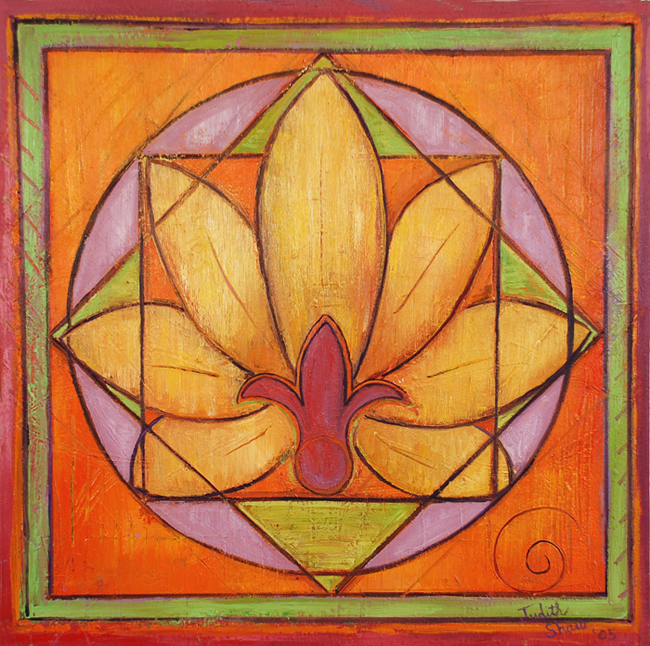
Lotus Mandala 1, oil on canvas, by Judith Shaw
Continuing in this tradition, artists and spiritual practitioners today have been exploring a more free-form style of the mandala. Within the basic foundation of the “squaring of the circle”, the artist then creates a personal, spontaneous design based on the concepts of balance, wholeness and oneness.
A quick google search reveals a multitude of mandala workshops being offered all around the world. Exploration of the mandala through these workshops offers a connection to your true self, an experience of sacred love, an opportunity to improve your life with intention, a deepening of your connection to nature, healing of emotional, mental, or physical pain, and a chance to be truly in the moment.
The mandala is a form that I have used in my own art since before I discovered the existence of Sacred Geometry. Even when not directly exploring the mandala, I find that often I want to draw a circle around the main image in my painting – seeking that experience of wholeness in the process of painting.
In future posts I will explore other elements of Sacred Geometry, all of which grow out of the mandala, the sacred circle.
Judith’s deck of Celtic Goddess Oracle Cards is available now. You can order your deck on Judith’s website. Experience the wisdom of the Celtic Goddesses!
Judith Shaw, a graduate of the San Francisco Art Institute, has been interested in myth, culture and mystical studies all her life. Not long after graduating from SFAI, while living in Greece, Judith began exploring the Goddess in her artwork. She continues to be inspired by the Divine Feminine in all of Her manifestations. Originally from New Orleans, Judith now makes her home in New Mexico where she paints and teaches part-time. She is currently hard at work on a deck of Goddess cards. Her work, which expresses her belief in the interconnectedness of all life, can be seen on her website.
We find our versions of home in these communities and it is within these spaces where our home not only begins to define who we are but we, as a reflection of that space, begin to outwardly redefine the spaces we exist in. If we slowly begin, through our experiences to shape our homes based on privilege and power without self-reflection and acknowledgment of others, then we are no better than those oppressive forces we say we’re against.
This post is a response to a recent blog entry titled “Who is Gender Queer?” on this site from Carol Christ. The post can be read by clicking here.I want to thank my friend, advocate, and upcoming scholar Martha Ovadia for reasons only she knows! Stay brave, speak up, be heard! _________________________________________
It is terrifying to know that something is wrong but not be able to speak truth to power.
It is even more terrifying to know something is wrong, be able to speak to it, and then silence those voices that do not have that same privilege, power, or position.
The struggle that many of us in positions of privilege and power face is not just that of being ostracizing and essentializing forces—it is that we, as allies, members of communities, or even those dedicated to a cause, can ourselves participate in the oppression we are fighting against and can do harm.
It’s taken me a long time to not only be comfortable with who I identify as, but also how I go about fighting and defining my life based on said identity and experience. However, the one thing that I have the ability to do is choose that identity more freely than others. Unlike Leelah Alcorn, Ash Haffner, Aniya Knee Parker, or Yaz’min Shancez pictured above, I did not have to face the types of oppressions they did, to which they sadly lost their lives, as a result of the fact that we exist in a society that can’t deal with the inability to leave things undefined or to allow people to define who they are on their own terms.
It is vital that although my lived experiences could never meet nor match the same types of oppression that these brave individuals had to face, I, as a white, cisgendered gay male, do not become part of their oppression through my own position and privilege.
As a man who exists in the world of feminism and within various women’s communities, I walk a daily tightrope of privilege and power to insure that I do not silence those that I consider allies, friends, mentors, or colleagues. As a man who exists in the world of the LGBTQ community, I walk an additional tightrope to additionally not take away from or diminish the experiences of those members of our community that do not have the same type of lived experiences as myself. Even within minority communities, there are positions of hierarchy and within these hierarchies of knowledge, identity, or power, comes a responsibility to insure that the oppressed do not become the oppressors.
We find our versions of home in these communities and it is within these spaces where our home not only begins to define who we are but we, as a reflection of that space, begin to outwardly redefine the spaces we exist in. If we slowly begin to shape our homes based on privilege and power without self-reflection and acknowledgment of others, then we are no better than those oppressive forces we say we’re against.
I can’t speak for what identity feels like –I can only speak for what essentializing does, and what it does is reflected in the deaths of Lelah, Ash, and the many others who die nameless. It is our responsibility, as allies, members of communities, and those fighting to end sexist, patriarchal, and, even now, homonormative oppression, to make sure that no more deaths occur on our watch or that truth is spoken to power even when power is masquerading around as truth.
John Erickson is a Ph.D. Candidate in American Religious History at Claremont Graduate University. He holds a MA in Women’s Studies in Religion; an MA in Applied Women’s Studies; and a BA in Women’s Literature and Women’s Studies. He is a Non-Fiction Reviewer for Lambda Literary, the leader in LGBT reviews, author interviews, opinions and news since 1989 and the Co-Chair of the Queer Studies in Religion section of the American Academy of Religion’s Western Region, the only regional section of the American Academy of Religion that is dedicated to the exploration of queer studies in religion and other relevant fields in the nation and the President of the University of Wisconsin Oshkosh’s LGBTQA+ Alumni Association. When he is not working on his dissertation, he can be found at West Hollywood City Hall where he is the Community Events Technician and works on policies and special events relating to women, gender, sexuality, and human rights issues that are sponsored or co-sponsored by the City of West Hollywood. He is the author of the blog From Wisconsin, with Love and can be followed on Twitter @JErickson85
News of Karen Brown’s recent death came via email from a mutual friend of ours, Christine Downing.
There are many things that can be said about Karen’s life and career, including that she won prizes for her life’s work Mama Lola in scholarly associations in the fields of religion and anthropology, that her work has been influential in bringing the study of Vodou into the scholarly mainstream, and that it has been inspiring to women of color.
Here I will focus on the years when our friendship provided crucial support for our audacious scholarly work. I first met Karen through the New York Feminist Scholars in Religion, a group Anne Barstow and I organized in 1974 that nurtured work on women and religion for many of us, including besides me and Karen, Judith Plaskow, Naomi Goldenberg, Ellen Umansky, Lynn Gottlieb, Beverly Harrison, Nelle Morton, Elisabeth Schussler Fiorenza.
My friendship with Karen was sparked by the explosion that occurred in the New York feminist scholars group when Anne Barstow and I spoke in the fall of 1976 about our attractions to the Goddess. Our presentations evoked a great conflagration, which I remember as coalescing around Beverly Harrison’s authoritative and authoritarian statement that there can be no ethics in Goddess religion because ethics comes from a transcendent source—not from nature. Karen was among those who responded tentatively that she was not so sure Beverly was right.
In the discussions that continued over the academic year, Karen and I exchanged meaningful glances, supported each others’ comments, and finally met for a few longer conversations shortly before I left New York to take up a new teaching position in California. Karen was then in the process of leaving her husband and moving into the magnificently quirky loft apartment that she would decorate with Haitian art in Tribeca on the lower west side of New York City.
I offered to do a house blessing for Karen’s new apartment, and she agreed. We blessed the thresholds and the corners of each room with salt and water and incense, and Karen spoke of the new life she hoped to begin in her new home. Later Karen told me that Alourdres (Mama Lola) insisted on blessing the house again and that the rituals were nearly the same.
During the years Karen lived in the Lower West Side from 1977 to 2001 or 2002, I stayed with her several times a year when conferences and lectures brought me to and through New York and on my way back and forth from teaching in Greece in the summers. During that time we had many long and intimate conversations in which the details of our lives were interwoven with the details of our work.
Carol Christ & Karen Brown 1985
Our friendship was important to both of us, not only because we were pioneers in the study of women and religion, but also because within it we were becoming a minority within a minority as our work took us outside an increasingly Christian-dominated field. Our conversations ranged fluidly around many subjects including: leaving Christianity; the importance of female symbolism for divinity; whether we need male Gods of war or not; religions that focus on the divine and human connection to nature; similarities and differences between Goddess and Vodou rituals and altars; healing; female leadership styles; the experience of living between cultures; and our common struggles to find a voice in which to write about what we were discovering.
Karen and I were in the process of rejecting the dispassionate voice of scholarly objectivity and searching for a way to write that combined scholarly research with the passion to know the world more deeply and to think about it clearly that inspired our work. Our conversations with each other were a lifeline, as we had no role models for the personal paths we were exploring or for the new ways of writing our scholarship with which we were experimenting. We quite literally “heard each other into speech” to quote the phrase Nelle Morton used to name the importance of our female conversations.
I happened to visit Karen shortly after she underwent her initiation into Vodou, which was at about the same time that I experienced what felt to me like revelation at the temple of Aphrodite in Lesbos. We both felt that we must incorporate these moments into our writings, but we also were afraid to do so because we feared that others would call us heretics and dismiss our writing as unscholarly. Karen and I spoke publicly of these experiences on a panel organized by Rita Gross at the American Academy of Religion in 1985 that was published in Journal of Feminist Studies in Religion 3/1 (1987).
Karen received more scholarly recognition for her transgressions than I have. This is in part due to a greater interest in difference among anthropologists than among theologians. However, Karen often told me that scholarly recognition is not the only way to judge the importance of feminist contributions and reminded me that my work has had a major impact within and outside the academy.
One day Karen and I were discussing whether she could fully embrace Haitian culture and whether I would become Greek. Invoking the Vodou concept of living “between the worlds” of the spirit and ordinary reality, she said that this was how she understood herself: she could never be nor would she want to be Haitian, but neither would she ever be fully American or Christian again. She added that one of the reasons she felt comfortable living between worlds was that she had never felt comfortable in her own culture.
In the intervening years, I have thought about this conversation many times. While there was once a time when I wanted to become Greek and leave my American culture behind, I have come to realize that this is not possible. Like Karen, I live between worlds and find my greatest comfort in belonging to two worlds and to neither. This insight is only one of the many gifts I gained though my friendship with Karen McCarthy Brown.
Remembering Karen, let us bless the Source of Life, and the cycles of birth, death, and regeneration.
We’re no longer shocked, albeit still horrified and sickened, by the images of violence that come at us daily from all around the globe. I’ve come to expect it. Beheadings. Burning people in cages. Shootings–“execution-style.” Bombings of all kinds–including drones and suicide. Perpetrators of such violent acts often claim God to be the motivator for their violent deeds.
Responses to that claim vary. Some people assure themselves that they were right all along–the God that motivates one to kill and destroy is indeed a God that demands such from “his” followers. “I knew all along their God to be a God of hate and violence–that’s why they do the things they do.” Other people insist that “God would never require a person to engage in destructive acts–not the ‘true’ God anyways.” Sometimes a proselytizing effort gets under way to inform people about this “true” God.
Deborah is one of the few women in scripture depicted as a strong leader who does not need the help of a man. The start to Deborah’s story appears bland, a mere introduction to a narrative that will later become juicy, surprising, and even a bit gory. Judges chapter four merely introduces us to a woman named Deborah, a judge over Israel. Judges is a book that records a time when Israel was without a king, so judges had to arbitrate justice, command, lead, and settle disputes. The book of Judges involves a constant downward spiral in which the people of Israel experience God’s grace; they forget God and do evil; they get into trouble and cry out for help; a judge arrives to help; the people get better; the judge dies and the people repeat the cycle.
When Deborah appears on the scene, the people have gotten themselves into trouble. We, as readers, know that because she is a judge, she will deliver them. But it’s easy to pass over Deborah’s uniqueness in reading her seemingly boring introduction. As in most texts, when we take time, we realize there is much more than meets the eye. Continue reading “Painting Deborah by Angela Yarber”
“I stood in the authenticity of my being: Black, preacher, Baptist, woman. For the same God who made me a preacher made me a woman, and I am convinced that God was not confused on either account.”
– Reverend Dr. Prathia Hall
These words came across my Facebook feed on Sunday in celebration of International Women’s Day. Reconciling Ministries Network put the statement on its Facebook page, along with a picture of Prathia Hall preaching from the pulpit, in remembrance and honor of women leaders who contributed to the US Civil Rights Movement. This past Sunday, March 8, when the quote was displayed, marked the 50th anniversary of Selma’s Bloody Sunday. Prathia Hall was a leader in the Student Non-Violent Coordinating Committee (SNCC) and one of the activists on the Edmund Pettus Bridge who were attacked as they began to march from Selma to Montgomery, Alabama. Later in her life, she became an ordained minister, professor, and womanist theologian.
For me, this past weekend was about remembrance through many forms. While there were many events commemorating Selma and the important events that unfolded there 50 years ago, my family and I were focused on a more intimate form of remembrance. On Saturday, we held a dinner and informal memorial service for my godfather who passed away last month. I got the news of his death on a day when I’d been doing some deep soul-searching and reflecting about the image I present to the world and its correspondence with who I am and desire to be. Just a few days prior, I’d spoken to my godfather about his health and subsequently, I had been questioning how I might be more connected to him. We lived several states apart, and I wondered how I could be a good goddaughter to him despite the distance. Those questions are left unanswered in the wake of his death. Continue reading “Role Play: In Search of the Authenticity of My Being by Elise Edwards”
We live in a youth-obsessed culture. The cosmetic industry pushes wrinkle creams and hair dye on us while celebrities resort to Botox and surgery to preserve an illusion of eternal girlhood. We live longer than ever before, yet advancing age, once a mark of honour, has become a source of shame.
But what happens when women embrace midlife as an inner awakening and call to power?
One such woman was Saint Hildegard von Bingen (1098-1179), powerfrau and late bloomer par excellence.
Her youth was dire. Offered to the Church at the age of eight, she was entombed in an anchorage. Though she had been haunted by luminous visions since earliest childhood, she didn’t dare speak of them. Her entire existence was bent on silent submission to her superior, Jutta von Sponheim, an ascetic whose regime of fasting and mortification of the flesh eventually killed her.
Only after Jutta’s demise could Hildegard step out of the shadows and carve out a spiritual life based not on suffering but on celebrating life in all its burgeoning green beauty. Even so she might have remained obscure, lost to history.
But when she was forty-two, everything changed.
“When I was forty-two years and seven months old,” she wrote, “Heaven was opened and a fiery light of exceeding brilliance came and permeated my whole brain, and inflamed my whole heart and my whole breast, not like a burning but like a warming flame, as the sun warms anything its rays touch.”
Dazzling visionary experiences descended upon Hildegard, along with the divine summons to write and speak of her revelations. Reluctantly at first she embarked on her first book of theology, Scivias, or Know the Ways. After putting quill to parchment, she could never go back.
Hildegard went on to found two monasteries, go on four preaching tours, compose an entire corpus of sacred music, and write nine books on subjects as diverse as cosmology, botany, medicine, and human sexuality, thus leaving her indelible mark on history.
Most of us believe we live in a more enlightened age than Hildegard’s—after all, children are no longer offered as tithes to monasteries. Yet many young women find themselves in modern and secular forms of servitude—dead end relationships, soul-crippling jobs, credit card debt, a life of junk food and junk television—all the sadness and waste of an unexamined life.
We don’t need to be visionaries to break free. We just need to remember who we are, that we all serve some higher purpose. Each of us has our own unique gift to give the world.
In youth, it’s easy to be beguiled by the glamour of the surface of things—if we get the right job, the right partner, the right clothes we’ll be happy forever.
But in midlife we are gifted with the maturity to see through the false scripts consumer society hands to us. After a certain age we can see just how absurd it is to kill ourselves to emulate airbrushed supermodels. We realize that the greatest lover in the world can’t fulfill us until we are at peace with ourselves. And so we can let ourselves go. Paint the pictures we’ve always longed to paint. Learn French and travel the world. Dance under the stars. Play the saxophone. Offer our own song to the vast symphony of life.
Remember, it’s never too early or too late to embrace your inner powerfrau.
Mary Sharratt’s book Illuminations: A Novel of Hildegard von Bingenwon the 2013 Nautilus Gold Award: Better Books for a Better World and was a 2012 Kirkus Book of the Year. Her forthcoming novel, The Dark Lady’s Mask, will be published by Houghton MIfflin Harcourt in Spring 2016. Visit her website.


 In his speech announcing that he signed the Religious Freedom Restoration Act, Governor Mike Pence of Indiana did not mention the issue of the so-called “right” to refuse service to gays, lesbians, and transgendered individuals as one of the reasons this bill came to his desk. However, the idea that bakers could be “coerced” into baking cakes for gay weddings, photographers “required” to photograph them, and venue owners “forced” to provide space for them was frequently mentioned in discussions of this and similar bills. Governor Pence’s evident defensiveness during his press conference, and his repeated assertion that “this is not about discrimination” made it clear that an elephant was very much in the room.
 Last week, Supreme Court
 ![Ruth_Bader_Ginsburg_official_portrait[1]](https://feminismandreligion.com/wp-content/uploads/2015/03/ruth_bader_ginsburg_official_portrait1.jpg?w=181&h=235) from the
from the 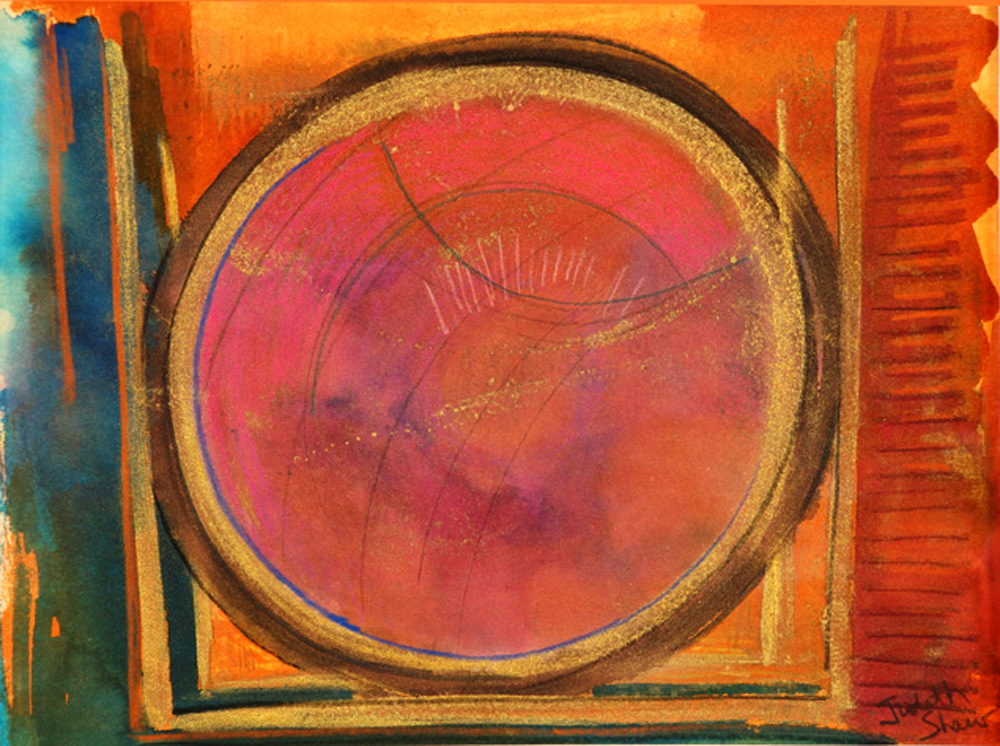









 Deborah is one of the few women in scripture depicted as a strong leader who does not need the help of a man. The start to Deborah’s story appears bland, a mere introduction to a narrative that will later become juicy, surprising, and even a bit gory. Judges chapter four merely introduces us to a woman named Deborah, a judge over Israel. Judges is a book that records a time when Israel was without a king, so judges had to arbitrate justice, command, lead, and settle disputes. The book of Judges involves a constant downward spiral in which the people of Israel experience God’s grace; they forget God and do evil; they get into trouble and cry out for help; a judge arrives to help; the people get better; the judge dies and the people repeat the cycle.

 Feminism and Religion