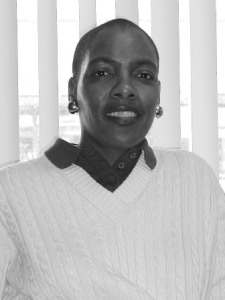
The Descent of Inanna to the Underworld by Deanne Quarrie

Deanne QuarrieInanna provides a many-faceted image of the feminine. She is a goddess of order, fertility, grains, love, war, heaven and earth, healing, and emotion. She is called the “Lady of Myriad Offices”. Most of the powers once held by her, “the embodied, playful, passionately erotic feminine; the powerful, independent, self-willed feminine; the ambitious, regal, many-sided feminine” were eroded by the patriarchy throughout time.

Her descent to the Underworld is a valuable story at any time of the year but even more so here as the wheel turns fully into the dark of the year. During the dark of the year, we are to turn inward, our most introspective work is to be accomplished at this time. It is vital that we enter the darkness as did Inanna, bare and bowed low. Continue reading “The Descent of Inanna to the Underworld by Deanne Quarrie”

Honoring Our Dead, Holding their Stories by Marie Cartier

MarieCartierforKCETa-thumb-300x448-72405Next Saturday, November 1,  is the holiday Día de Muertos, or Day of the Dead. This is a Mexican holiday that has currency now throughout the world—but especially in California. After all, in 2014 Latinos will surpass whites in California demographics. It is prevalent at this time in Southern California to see sugar skulls decorated—to even have children make decorated sugar skulls and honor the dead. The holiday provides a focal point for a centered observance and prayer dedicated to those who have died in the past year. It is connected to the other holidays at this time, particularly Halloween where as we Wiccans often say “the walls between the worlds are thin.”

Another tradition celebrated at this time is creating an altar for loved ones—or several altars or ofrendas. The altars can hold sugar skulls, photos and artifacts of the deceased, and marigolds. Marigolds are a symbol of death and are referred to as “the flower of death.” Marigold petals might mark a path from a home to a grave in a village so that the dead can find their way back for this holiday. Marigolds make arches and decorations in and around the altars/ofrendas for the scent of the marigold is purported to draw the dead back for the Day of the Dead reunion. The holiday has its roots in indigenous Mexican holidays and continues back possibly 4,000 years to Aztec rituals honoring the goddess Mictecacihuatl, the Queen of the Underworld. Continue reading “Honoring Our Dead, Holding their Stories by Marie Cartier”

Devotional Poetry: You’re Invited to a Community Bardic Exercise

Kate BrunnerLet the creative word romp begin!  Our exercise will be simple, yet challenging. I invite you to write one devotional poem per day for the next seven days about whatever moves you spiritually that day in whatever poetic format the words emerge.

Your goal for the next seven days is to let loose a little- step into the creative flow and allow your Bardic Soul to speak. What we will not be going for is perfect, publication-ready material. I know whenever I undertake something like this, I have to remind myself of that. And I have to muzzle that horribly devious little fellow known as my Inner Critic in order for my Courageous Bard to spring free.

Poetry is the creative form which attempts to capture in words and sound the mystery which lies beyond language. We are all capable of writing poetry.

~from Priestess of Avalon, Priestess of the Goddess by Kathy Jones~

Look for divine poetic inspiration in any and everything around you during next week. Step with intention through your days. Let the whole world sing to you. Dance with language- FEEL it move you! Do not bludgeon yourself with repeated editing. Write, share, and be brave enough to let it be. Continue reading “Devotional Poetry: You’re Invited to a Community Bardic Exercise”

In Memory of Margot Adler (1946-2014) Priestess, Journalist, Skeptic, Mystic by Elizabeth Cunningham

Elizabeth Cunningham headshot jpeg“Ritual has the power to end our alienation from the earth and from each other. It allows us to enter a world where we are at home with the trees and the stars and other beings, and even with the carefully hidden and protected parts of ourselves that we sometime contact in dreams or in art.” –Margot Adler

Margot Adler died of cancer on July 28, 2014. A Pagan priestess, she asked for memorial events to be held in the season of Samhain, also known as Halloween.  At this time of year, the rituals of many religious traditions remind us that we are all connected, the living, the dead, and those to come, one continuous communion.  In this spirit, I offer a tribute to the late Margot Adler.

Though I must have heard her distinctive voice on National Public Radio where she served as an innovative and eclectic journalist for thirty years, I encountered Margot Adler’s work more intimately by accident—or synchronicity—as countless others have.  I had recently found myself face to face with the goddess.  As if in answer to my question: “Who are you and what do you want from my life?” a hefty book literally fell off a shelf in a small-town bookstore: Margot Adler’s ovarian work Drawing Down the Moon: Witches, Druids, Goddess-Worshippers, and other Pagans. Writing as both observer and participant, Margot brought into fruitful union the spiritual seeker and the fact-finding reporter, the social activist and the ecstatic celebrant.  I had found a trustworthy guide for my own explorations. Continue reading “In Memory of Margot Adler (1946-2014) Priestess, Journalist, Skeptic, Mystic by Elizabeth Cunningham”

Thinking Out Loud About Protecting Our Borders and the Ebola Crisis by Kelly Brown Douglas

Rev.-Dr.-Kelly-Brown-DouglasJust as crises can reveal the strengths of our infrastructure, so too can they reveal the weaknesses.  At the same time, a crisis can disclose the enormity as well as the limitations of our humanity.  Even as the current Ebola crisis may have shown forth the strong points of the U.S. healthcare infrastructure, it clearly exposed some of its vulnerabilities.

The same can be said in relation to our humanity. From the time that Mr. Thomas Eric Duncan was diagnosed with the Ebola virus, cries to close “the borders” to those traveling from West Africa began. As two of Mr. Duncan’s caretakers contracted the virus, the cries to close “the borders” between the “United States” and West Africa became shrill.

The futility and impracticality of such a measure seems to make little difference to those who call for closed borders.  At stake, they say, is the health and wellbeing of our U.S. citizenry.  Even when marked by sincere concern, I find the call to close U.S. borders a troubling indication of the limitations of our humanity.   A story in the life of Jesus makes this plain.

In the social-religious context of Jesus’ day, there was a long history of conflict between Jews and Samaritans. Jews had constructed images of Samaritans as an indecent and ritually impure people. Samaritan women were considered the most impure of them all. Multiple narratives of power intersected on the bodies of Samaritan women—ethnic, gender, and cultural. Put simply, they represented at once an inferior “race,” gender and religion.  Thus, the social spaces of Jewish men and Samaritan women were to remain separate.  Jewish men in particular had to protect themselves from the contamination of Samaritan women.  Generally speaking, Samaritans were a feared and thus demonized people.

By most accounts, Jesus did not have to pass through Samaria on his journey from Judea to Galilee. This was considered a circuitous route.  It was also considered a dangerous route given the antagonism between Jews and Samaritans.  Again, Samaritans were considered dangerous enemies to the Jews, and most certainly ritually impure. However, Jesus crossed the borders into Samaritan space anyway. By going into Samaria, Jesus placed himself in the midst of those most feared, if not demonized, in the Jewish world.  He ignored all the prevailing animus directed toward the Samaritans and dismissed notions of them as an unclean and dangerous people. He flagrantly rejected the social-religious hysteria about Samaritans by going out of his way to enter their space.  He refused to let the “madness” of his times to blind him to the divine humanity of the Samaritans, or to overwhelm his own divine humanity.  He, therefore, crossed the constructed human borders to bring healing and salvation to the Samaritan woman. This story is of course only representative of a ministry that consistently crossed borders of fear and stereotypes to affirm the humanity of those who were lepers in Jesus’ day.  Simply put, Jesus’ compassion was no respecter of borders. Continue reading “Thinking Out Loud About Protecting Our Borders and the Ebola Crisis by Kelly Brown Douglas”

Anne Hutchinson, America’s First Feminist Theologian: 1591-1643 by Carol P. Christ

Carol Christ in Lesbos“She had rather been a husband than a wife; and a preacher than a hearer; and a magistrate than a subject.” Reverend Hugh Peter of Salem

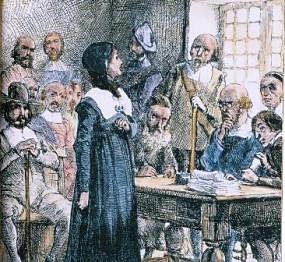
Anne Hutchinson was banished from the Massachusetts Bay Colony for heresy in 1637 and excommunicated from the Puritan Church of Boston in 1638. Her banishment came just three years after she, her husband, and eleven living children arrived in America seeking the freedom to practice their religion as they saw fit. Governor Michael Dukakis pardoned her in 1987. Historian Howard Zinn called her a true American hero.

anne hutchinson trialI managed to get through graduate school in Religious Studies without ever having studied the theology of Anne Hutchinson,* though I vaguely remember references (probably with smirks of disapproval) to the “Antinomian Controversy” which is associated with her name. I recall Anne Hutchinson’s name because of an article published in Feminist Studies in the 1970s, when I had just begun to study women and religion. However it was not until recently that I learned of her place in history through reading American Jezebel by Eve LaPlante.

Hutchinson was accused of theological errors in her trials. The Calvinist doctrine of predestination figured heavily in the accusations. But the real issue at stake was that Anne dared to follow her own inner knowing, to articulate it theologically, and to teach her views against the grain of the Puritan authorities in Boston. Continue reading “Anne Hutchinson, America’s First Feminist Theologian: 1591-1643 by Carol P. Christ”

You Can’t Save Everyone by Oxana Poberejnaia

oxanaIn my previous post here on Feminism and Religion, “Emerging Energy Wisdom” I suggested we should develop new feminist wisdom for young women of the world, which will hopefully allow them to avoid some of the mistakes we have made (some irreparable). The gist of that wisdom would be “conserve your energy!”

Some of these mistakes originated in our being unaware of the limitations in a patriarchal society. I for instance thought that since I knew I was intelligent powerful and energetic I could affect any positive change I wanted. I also believed I could help anyone. I disregarded my own needs, including energy needs, as well as being blind to the objective conditions of patriarchy.

Today I would like to give an example, from fiction, of how this energy wisdom might work. In its application, I believe, this wisdom is related both to the Buddhist teaching of self-reliance and to the idea that each person must find their own connection to Goddess and God from modern paganism.

Continue reading “You Can’t Save Everyone by Oxana Poberejnaia”

How Shall We Then Live? by Esther Nelson

esther-nelsonPresident Obama, responding to the beheading of American journalist, James Foley, by ISIL (Islamic State of Iraq and the Levant), said, “ISIL speaks for no religion…and no faith teaches people to massacre innocents….ISIL is not Islamic” (August 20, 2014). I don’t believe President Obama realizes the tangled thicket he’s entered with those words.
We don’t like to think of our faith traditions as places that harbor theologies or ideologies that promote death and destruction. We’d rather think along the lines of what Huston Smith (b. 1919), a philosopher and religious scholar, asserts: “If we take the world’s enduring religions at their best, we discover the distilled wisdom of the human race.” So words that reflect “religions at their best”–love, justice, mercy, compassion, peace, fairness, kindness, truthfulness, and charity are what come to the minds of most people when thinking about how faith traditions should manifest themselves in the world.

This proclivity to think of religion as weighted on the side of “best” is most noticeable when faith traditions express themselves dualistically–good/bad, right/wrong, sacred/profane, pure/impure, etc. Those things labeled “bad” most often get ascribed to an anti-god or Satan. Monotheistic religions (Judaism, Christianity, and Islam) have a more dualistic bent than do Goddess traditions, Hinduism, and Buddhism.

In addition, when we understand our sacred writings to be “revealed,” meaning information has been given to humanity by a divine source–information that could not be known other than through revelation–we become more prone to dualistic thinking. The “Revealer of Truth” (God) brings light to a wayward humanity. God (a symbol that often gets reified) easily fills the role of being and defining all that is “good” although “good” is a relative term. Kill a journalist? Bomb an abortion clinic? Start a war? Feed the hungry? Educate children? Eradicate Ebola? Humans have engaged in all these activities in the name of God. Each activity has been defined as “good.” Continue reading “How Shall We Then Live? by Esther Nelson”

You Are What You Read by Martha Cecilia Ovadia

10298689_10104523891581853_7256973903379376739_nWhen it comes to my family, I’ve always felt different. One of my earliest memories from when I was really young was being told that I felt things too passionately—that I felt too much. What was never said but was implied was that I felt dissent too much, too often, too vocally. It made people uncomfortable. It made my family uncomfortable. When it came to understanding my faith/religious path, my family and I started diverging early on, never really meeting again—at least not for now.

When I was about five, I remember asking why women could not be priests. My mother brushed it aside and said we could be nuns. She was blind to the inherent misogyny behind the same Church that so many of her female family members had built (we come from a long line of nuns and Jesuits). I thought maybe someday I could be a woman priest. I would change it all. I would be Pope Joan. 

When I was thirteen, I started noticing the wealth involved in the Roman Catholic Church, the opulence of the lived Catholic life. When I asked my parents why the Church did not lead in example and live in poverty using its wealth to actively live the gospel, I was told, “ This wealth is a gift to humanity. It is there for all of us, a patrimony to those who open their hearts.” I wasn’t talking about art, I was talking about the RCC’s gold assets—valued in the billions —but it didn’t matter. I’ve seen my family donate to Church building funds my entire life—buildings that were then sold off to pay for the Church’s offenses later on. Still, I thought if I became more involved, with the “right kind of Catholics”, I would be able to change the Church from within.  Continue reading “You Are What You Read by Martha Cecilia Ovadia”

Casa Coatlicue by Erica Granados De La Rosa

Erica GDLR 2On a corner adjacent to a cantina, across the street from a home full of barefoot children running through open doorways, and a few houses down from a paleteria y fruteria in San Antonio, Texas, sits a bright white house dressed up in orange trimmings – Casa Coatlicue[1]. Before you walk through the gate you notice a raised bed of herbs, a garden, a large collection of potted succulents, and a metate[2] on the ground. Walking inside you can’t help but smell the sage, copal, and other herbs and incense that have left their smoky traces on the walls of the living room, the kitchen, and then the bedroom. As the house begins to introduce itself, you notice altars in corners and crevices of each room. Your curiosity begins to churn as you notice pictures and canvasses on the walls of ancient and present day cultural symbols, including one poster that reads “This land was Mexican once, and indigenous always,” and a large picture of Selena Quintanilla that captures her warm smile and beautiful black hair. As soon as you begin to take in the colors and ancient smells, the house is introduced to you by name, Casa Coatlicue, the home of four queer young healers, dreamers, lovers, artists, scholars, and spiritual activists who are reclaiming the life-giving traditions of their ancestors.
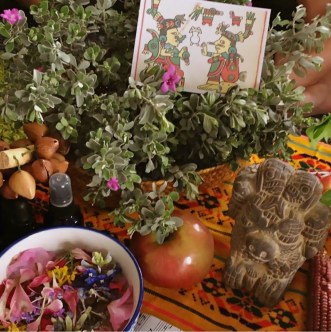
Community altar from  workshop
Community altar from workshop

Earlier this year, I was invited to a curanderismo workshop hosted at Casa Coatlicue. The word curanderismo had an air of secrecy, power, and nostalgia of home for me. I understood curanderismo as the medicine and magic of our grandmothers, and increasingly the forgotten inheritance of our communities. As I spoke with the residents of Casa Coatlicue, we began to identify the chronic erasure and appropriation of brown folks’ spiritual traditions, food, art, and customs by predominantly white, new age culture. Saddened by the loss and the historical disconnect of our people, we collectively affirmed the urgency and importance of relearning and reclaiming our own spiritual traditions not only to tap back into our cultural identity as native and mestizo people but also to tap into a powerful tool for the transformation of our current realities. In the midst of historic and present day manifestations of systemic violence against us – young brown bodies being gunned down in our streets, whole communities being persecuted, incarcerated, and displaced, as well as forced sterilization and assimilation- there is a critical need to tap into radical and sustainable ways to not only resist but to heal. Continue reading “Casa Coatlicue by Erica Granados De La Rosa”