A Poem About Sister Love by Marcia Mount Shoop

A Poem:  Sister Love

This post will
never be complete
it can only house the fragments,
the remains
of days at my sister’s hospital bed

the vortex of medical labels
“critically ill”
“brain aneurism”
the singular attention to
fragile body chemistry
sodium, potassium, blood sugar, magnesium

Continue reading “A Poem About Sister Love by Marcia Mount Shoop”

IS THE SPIRIT OF GREAT GENEROSITY IN CRETE A SURVIVAL OF ANCIENT MATRIARCHAL VALUES? by Carol P. Christ

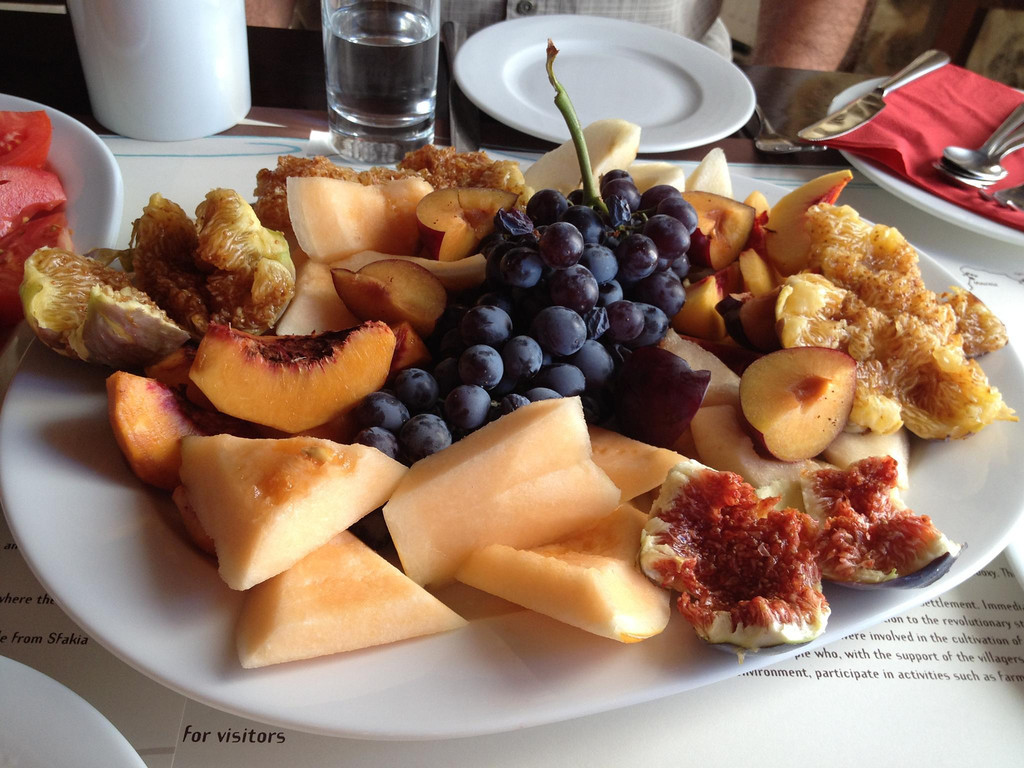
carol-christAt a coffee shop in Agios Thomas, Crete last month a perfect stranger offered to pay for the coffees and sodas of the 16 women on the Goddess Pilgrimage to Crete. This spirit of great generosity is rarely experienced in the United States or other parts of Europe, but it is still common in rural Crete and some parts of Greece.

 In fact our group was in Agios Thomas because our bus driver Babis, also in a spirit of great generosity, insisted on stopping to show us his village when we were passing nearby. He guided us to see Roman rock cut tombs and arranged for the early Byzantine church to be opened. At the end of the our pilgrimage, Babis stopped the bus at a wooded glen beside a small church where he offered us his own homemake raki, wine, and olives, accompanied by local sheep cheese he had purchased while we were climbing a mountain. After every meal that we ate in local tavernas, we were offered bottles of cold raki, fruit, and sweets.

crete fruitsThis spirit of great generosity has long been commented on by travelers in Greece, who often speak of it as unexpected (for them) hospitality to the stranger or traveler. That it is, of course. Through the work of Heidi Goettner-Abendroth, I now understand that the famous Greek hospitality to the stranger has deep roots in matriarchal cultures. According to Goettner-Abendroth, equality of wealth is assured through the widely-practiced custom of gift-giving in matriarchal cultures. Continue reading “IS THE SPIRIT OF GREAT GENEROSITY IN CRETE A SURVIVAL OF ANCIENT MATRIARCHAL VALUES? by Carol P. Christ”

She Loves It All by Alla Renée Bozarth

Alla Renée Bozarth, Philadelphia 11, Philadelphia ordinations

when god was a girl she loved
to play dress up with hydrogen
and nitrogen, she wiggled her hips
and blew kisses from her voluptuous
lips and wiggled her fingers to toss the stars~
she juggled them and tied ribbons on them
when she wanted to create new dimensions,
to open all the directions she hurled them like a salad
that no one told her not to play with, so she giggled
and played until all the ingredients stuck on the ceiling of sky,
but then she’d coax them back into action and let them decide
where to go and how far and when or if to land, and

she would go far out, way, way out to play
with her dolls, the gaseous, luminous balls of delight,
hold them in her cool hands for a millennial minute
to turn them into planets and things of that sort,
with what we call substance, solid stuff  Continue reading “She Loves It All by Alla Renée Bozarth”

Feeding the Dead by Deanne Quarrie

Deanne QuarrieMost people really love this time of year and I share much of that.  Living in South Central Texas we actually only have two seasons, with a perhaps two to three weeks in between what we laughingly call spring and fall.  Because the winters are not harsh here, the step into spring feels different from those whose winters are frozen for months on end.  We do experience some relief when our temperatures finally drop a bit in October. Even then those drops are only teasers.  When we do finally get a briskness in the air in the wee, early morning hours of dawn but when the sun rises overhead, any memory of that coolness is forgotten.  This morning at 5:30 am, when I woke, it was 54 degrees. I stepped outside to smell and feel the air, so clean and cool.  And yet, now it is 85 degrees and rising, it once more feels like summer. We don’t have the sudden frosts that turn our trees to vibrant reds, yellows and browns.  Yes, the leaves eventually turn and fall to the ground, but we have no heavy freeze and so our colors are pale compared to those in the North and colder climates.

Many Texans think the emotional feel for our two seasons is backwards, believing that summer, with its blazing sun, is the time to withdraw.  Then in winter, when the weather is mostly mild, that’s the time to come out to play.  This is a reversal of pagan thinking about the seasons in North America. Continue reading “Feeding the Dead by Deanne Quarrie”

Three Poems by Janine Canan

Janine Canan

The Visit

I came here
in order to lie in the sand
on a sunny day

and feel the warmth
the way it lifted me
weightlessly

we were one
the Earth and I
seamless

she pressed her face
to mine, I ran
my hands through her

and we streamed
with timeless
happiness

I came to lie in the sand
and feel
her living warmth.
Continue reading “Three Poems by Janine Canan”

“Enlightened Sexism” and The Media: The Cultural Attack on Feminism by Michele Stopera Freyhauf

Freyhauf, Feminism, Religion, Durham, Old Testament, Blogger, Bible, Gender, Violence, Ursuline, John CarrollWhat is a feminist mother of four daughters to do these days?  Look at our media and how girls and women are portrayed to our daughters, teens, and young adults. Then take a look at how media portrays the face of feminism, promoting every negative stereotype out there.  As I scroll through the magazines, listen to songs on the radio, and watch the programming targeted at girls in junior high and up, I cannot help but ask the question – Is the media trying to destroy feminism?

While this introduction might sound drastic, much truth lies behind the questions.  One merely needs to look around and watch former Disney Star, Miley Cyrus, twerk and make lewd gestures with a foam finger while grinding against a man, almost twice her age, as he sings about the blurred lines of sexual consent. When I saw the news stories and yes, watched the video, I was utterly mortified and stunned.  Gloria Steinem, in a statement that seems to condone this behavior stated that Cyrus’ performance (actions) is not a new phenomenon, but a product of American culture.  Instead of looking at it through the lens of degradation and influence, she defended the young star by saying:

 “I wish we didn’t have to be nude to get noticed. But given the game as it exists, women make decisions.  For instance, the Miss America contest… the single greatest source of scholarship money for women in the United States.  If a contest based only on appearance was the single greatest source of scholarship money for men, then we would be saying ‘this is why China wins.’ You know?  But that’s the way culture is.  I think that we need to change culture, not blame the people that are playing the game that exists.”

When Cyrus’ actions are boiled down to being “nude to get noticed,”  and we accept this behavior by merely chalking her performance up to  culture – isn’t it time to change culture?  Continue reading ““Enlightened Sexism” and The Media: The Cultural Attack on Feminism by Michele Stopera Freyhauf”

Our Sisters’ Feminisms by Xochitl Alvizo

 We live in a very small and connected world that at the same time is a very large and disparate one. Sometimes I am overwhelmed by all the news available of the things that occur all over the world, to which I have such quick and easy access online. It makes everything feel so close and connected. At the same time, I also experience a huge disconnect between my very particular and local context and that of others around the globe; women whose reality and life experience I know little about. Even as news about them flash before my eyes, it’s not possible to reduce them to those brief flashes of information or claim to know something substantive about them. In reality, how much am I even able to say about the woman who lives across the street from me, much less women who I only know about online? And yet, my feminism compels me to call them my sisters.

Continue reading “Our Sisters’ Feminisms by Xochitl Alvizo”

Longing for Hermitage by Elizabeth Cunningham

Elizabeth Cunningham headshot jpegAt least since the days of the Desert Mothers in the 4th and 5th centuries CE, there have been women in the Christian tradition (and doubtless other traditions) who have lived lives in religious solitude, whether by choice or circumstance.  In Medieval Europe many churches had anchorholds, small enclosures inhabited by men or women dedicated to a life of solitude and prayer. The word anchorhold implies that the presence of the anchoress or anchorite grounded the church community, but the word derives from the ancient Greek verb (pronounced anachōreō) for to retire or withdraw.  Anchoress Julian of Norwich is still revered as the author Revelations of Divine Love, possibly the earliest surviving book written by a woman in the English language.  Six centuries after her death, her vision of Jesus our Mother continues to challenge, comfort, and inspire.

I grew up in an Episcopal rectory, daughter of a secretly agnostic mother who loathed being a minister’s wife (living in a fishbowl, she said) and a father who preached and practiced the social gospel as had his father before him. If you weren’t directly feeding, clothing, visiting “the least of these my brethren,” your pieties (as my father dismissed them) were worthless. At every meal we prayed, “make us always mindful of the needs of others.”  Selfishness and individualism were synonymous. The pronoun “I” was frowned upon.  The only route to salvation was social and/or political activism. My father walked his talk, literally, taking part in the 1965 march from Selma to Montgomery.

Continue reading “Longing for Hermitage by Elizabeth Cunningham”

Hajar: of the desert by amina wadud

Amina Wadud 2 I am Muslim, by choice, practice and vocation

This week the Islamic pilgrimage or Hajj was completed.  For those not gathering on the dusty plains of the desert in Arabia, we have the celebration of the Feast of the Sacrifice, commemorating the exchange of a lamb for the blood of the son of Abraham.  This story is coated with patriarchy, and so it is with some fascination that Hajar (biblical Hagar) configures so significantly in the Islamic telling of it.

According to the same patriarchal twist, it is Abraham’s first son that is pivotal to the story’s continuation and the salvation of a people, yet to be born.  That his first son, Ishmael, was born of a slave woman—some say of African origins—is not without extreme symbolism for African-American women, mostly Christian.  That she is the mother of the tribes of Arabs is also not without some extreme genealogy along with that symbolism. But that she a single female head of household, whose sojourn in the desert still, has a central ritual re-enactment in the Hajj, that I turn to here. Continue reading “Hajar: of the desert by amina wadud”

The Little Words by Kelly Brown Douglas

As I contemplate the state of our world from the rhetoric of shut-downs to stand your ground, from the self-righteousness of political discourse to the dogma of ecclesiastic pronouncements, and from the justifications for political inequality to the explanations for ecological disregard, I wonder what has happen to all of our little words?

What has happen to our little words of gratitude? These are words like “thank you,” or “I appreciate that,” or “that is kind of you.” Have you ever noticed how in our world today people rush through it without stopping to say thank you? We have become a taken-for-granted people in a taken-for-granted world. We act as if we are entitled to certain things because of who we are or simply because we are. But here is the thing, that which we take for granted we tend to squander, to abuse, and to easily discard—like our natural and human resources. We take for granted our relationships to the earth as well as to one another. We take for granted our life on this planet and our life in community. It is time that we recover our little words. We must learn once again to speak little words of gratitude, for such little words go a long way in changing our world and to transforming a people from being wasteful, excessive and warring to being conserving, non-indulging, and peaceable. Continue reading “The Little Words by Kelly Brown Douglas”