Oh, so many people cannot figure out why/how in the hell I can be a feminist AND a practicing Catholic. And, I must admit there are days when I, too, am perplexed.
For example, one recent Sunday after Mass I waited outside the Cathedral while my children ran and climbed and smelled flowers around a statue of St. Therese. After a few minutes, two modestly dressed women with clipboards walked up to me and asked: “Would you like to sign a pro-life petition?” I snappishly said no. (Still wishing I would have asked more questions. How do you define pro-life? What good will a petition do?)
I sensed a little surprise from them. I’m sure I was the picture of Catholic motherhood, if you didn’t notice the electric blue toe nails. Only about 30 minutes earlier, I was on the altar reading Scripture to the congregation — something I’ve done since I was 17, when I realized that was likely the closest I would get to priesthood. Also during Mass, my two older children were altar servers (the gender-neutral of “altar boys). And, we were waiting outside because my husband was washing chalices as part of his duties as Eucharistic minister. So, I certainly appeared to be someone who would gladly sign their petitions. Continue reading “Feminism + Catholicism = ? By Dawn DiPrince”
I remember the election season of 1984. At the 1984 Democratic National Convention on July 18 in San Francisco, California, Jesse Jackson delivered the Keynote address, entitled “The Rainbow Coalition.” The speech called for Arab Americans, Native Americans, Asian Americans, youth, disabledveterans, small farmers, lesbians and gays to join with African Americans and Jewish Americans for a political purpose. My lover at the time woke me up very early in the morning to tell me that Jesse Jackson had said the words “lesbians and gays” as part of his speech at the Democratic Convention. I started to cry and called my mother and she cried, too. We both cried. It was a moment I will never forget…because in that moment I as a lesbian existed on national television and in the imagination and spoken word of the country’s political system where I live and pay taxes—in a way I never had before—I was spoken out loud. Continue reading “Out of the Bars and Into the Streets and ….by Marie Cartier”
When we were growing up, my dad would often exclaim to my sisters, brother and me, “You got the world in a jug with the stopper in your hand.” He most often said this when he noticed us indulging in some pleasurable event: be it watching our favorite television show or savoring every bite of our favorite food. We would laugh every time my dad said this. We did not know he was quoting a blues lyric, we thought this line was another example of our dad’s creative wit—there was no one that could make us laugh more than dad. But, as creative and witty as dad was, this jug line was not original to him. This was a line from the song, “Downhearted Blues” a song originally recorded by blues woman Alberta Hunter and later covered by Queen of Blues Bessie Smith in 1923. Indeed, as suggested by my father’s use of the line, this line would come to have signfiyn’ meaning within black culture and for black people. It would be this jug line that indeed made Downhearted Blues a mega hit within the black community.
It is very disappointing to share that Fr. Roy Bourgeois was excommunicated, dismissed, and laicized by the Vatican as a result of his support for women’s ordination and the eradication of sexism in the Catholic Church. The following was sent out for immediate release by Maryknoll on November 19, 2012. Additional information will be shared once released.
FOR IMMEDIATE RELEASE
The Congregation For The Doctrine Of The Faith
Canonically Dismisses Roy Bourgeois
Maryknoll, New York – November 19, 2012 – The Vatican’s Congregation for the Doctrine of the Faith, on October 4, 2012, canonically dismissed Roy Bourgeois from the Catholic Foreign Mission Society of America, also known as the Maryknoll Fathers and Brothers. Continue reading “BREAKING NEWS: Fr. Roy Bourgeois Excommunicated”
Are violence and domination innate in human nature? We have been told that we are the “naked ape” descended from “apes” who, like the chimpanzees with whom we share 98% of our DNA, were male dominant and violent. Do we, then, have any hope not to be violent and dominant?
Dusk was falling and mist rising as I drove sadly across the Somerset Levels – a liminal place which once formed the huge marshy lake out of which the Isle of Avalon majestically rose. When I rounded a bend to see a large swan walking straight up the centre of the road in the same direction I was going, my first thought was for its safety. I expected it to take flight or veer off at any moment, but the swan continued on its path, seemingly determined to walk just where it was. The road was narrow and all I could do was respectfully follow until it widened a little, eventually managing to squeeze carefully past before starting to flash my headlamps at oncoming traffic to warn them of the swan’s unlikely presence.
Only later that evening did I remember the last time I saw such a stately walk in front of a moving vehicle – when a formally-dressed funeral director led off the hearse which carried my father from his home and on his last journey in this world. I was thunderstruck. Could the swan be marking this new loss, making me mindful and slowing me down? Continue reading “Death of a Priestess by Geraldine Charles”
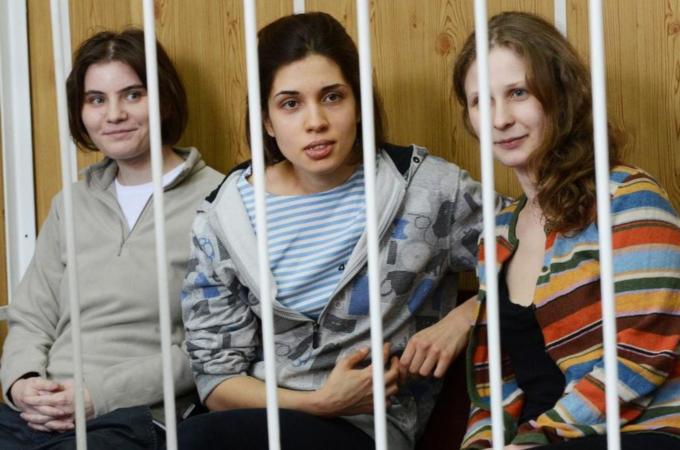
In a country that was willing to [sic] its secular court on a “religious” cause, Pussy Riot are true revolutionaries. Nonetheless, it was not until they delivered these closing statements that their supporters—and opponents—heard what these three brave women stand for. Although they are being crushed in the jaws of the system—and know it!—their courage and steadfast sincerity are sufficient cause for (impossible) hope. If not for the Russian state, then at least for the Russian people. —Bela Shayevich
“When religion puts people in jail it’s unjust” – David Gross
The intermix of religion and politics are familiar, especially after this year’s presidential election. Many supported Mitt Romney out of concern for religious freedom; a stance that had the potential to marry religion and politics in a dysfunctional union. We also witnessed a veiled attempt by the Catholic Church to emphasize and sway the faithful to vote for the one true moral candidate; a stance contradicted by Obama’s ability to carry the Catholic vote. I believe what we see in Russia is a shining example that shows what happens when regulations and laws do not segregate between secular law and church law. Freedoms do not exist, rather, rules and restrictions are imposed creating an institutional prison.
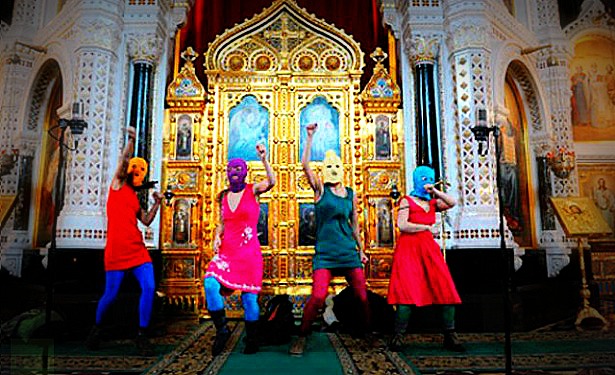
The prosecution of an all girl punk band named Pussy Riot [i] demonstrates a “complete fusion of the institutions of the state and church,” which devalues “women’s rights and freedom of speech.”Members of Pussy Riot are serving a two year sentence of hard labor for “hooliganism motivated by religious hatred.” What was their crime? They went into a Cathedral in Moscow and started singing a punk prayer – “Mother of God, Chase Putin Out!”
They danced, kneeled, and crossed themselves in front of the Church’s high altar. This occurred the day before the re-election of Vladimir Putin. While I do not support going into a sacred space with relics to make a protest, what I find problematic is their harsh sentence. However, it should be noted that with the coverage of the trial and the outpouring of support received from many organizations, and musicians, they did manage to bring to the forefront issues surrounding the government and the Church.
Male feminists must be aware that we not only engage in an ongoing struggle against sexual and gender inequality, but more importantly an ongoing fight with ourselves.
I have often struggled with that little voice, call it my conscience if you will, that speaks to me during times of distress. Although I consider myself a proud feminist, I still struggle with aspects of what I call, internalized misogyny, or more aptly defined as a male born characteristic trait that imparts the idea that men are not only dominant but also more powerful than the other 50% of the species.
On Tuesday, President Obama’s acceptance speech included the following statement about coming together as a country across differences of opinion. He said, “We will disagree, sometimes fiercely about how to get [toward the future we hope for]…by itself, the recognition that we have common hopes and dreams won’t end all the gridlock or solve all our problems or substitute for the painstaking work of building consensus and making the difficult compromises needed to move this country forward…”
How do we really do this work? How do we come together across difference to make change? How do we foster productive dialogue that produces genuine and real results? In this dialogue, what principles do we use? What values do we honor? What criteria do we use to judge opinions of others? When is an opinion wrong or when is an opinion just different from our own? Continue reading “Building a Bridge toward the Future: Will You Meet Me in the Middle? By Ivy Helman”
Before I feared too much disclosure, but now I seek to channel revelations of personal experiences into exercises that inform the moral and intellectual agency of everyone in the classroom, including me.
I have always been a bit nervous when people share personal experiences in non-intimate settings. For the past several years, I’ve been in an academic environment where people routinely discuss and reflect upon significant life events. There were times that I was very uncomfortable listening to classmates discuss abortions, first sexual experiences, and encounters with racism. Even though they did not use graphic or disturbing language, I questioned the appropriateness of sharing intimate details of one’s life in a classroom.
So when I was preparing to teach my own course on Christian Ethics, I was careful to define a course policy that related to sharing and participation. In part, it reads: “While students are encouraged to use the course material to reflect on their own experiences and develop their own theological-ethical perspectives, sharing intensely personal reflections is not required – in fact, it is discouraged to maintain the professional atmosphere of the classroom.“ In class, we discuss conceptions of God and religious faith as they are applied to complex issues like sexuality, racial reconciliation, war, and medicine. The potential for conflict and personal attack is always present in the classroom because we often have deep commitments and personal beliefs on these issues, so I wanted to curb the amount of personal reflection that occurs in the corporate setting.
Over the course of the semester, though, my perceptions have changed due to well-written memoirs and personal statements I have read recently, the profound statements my students have shared, and the teaching philosophy I am developing. Whereas before, I feared too much disclosure, now I seek to channel revelations of personal experiences into exercises that inform the moral and intellectual agency of everyone in the classroom, including me. Continue reading “Exposure by Elise M. Edwards”








 Feminism and Religion