

 This week, I read an excellent, gripping, poignant blog post by Feminist Philosopher Leanne Dedrick entitled “Things That Make Me Cry: The Practice of Unbelief.” The purpose of the piece was Leanne’s desire to address a misperception by some non-atheists that atheists are devoid of emotion, violently hostile to anything associated with faith, and unable to deal honestly with the Divine. She also corrects the erroneous assumption that atheists seek to “hide from, or purposefully turn […] away from, the ‘saving grace’ of religion.” In the post, she wrote specifically about her own journey from ultra-conservative Christianity to atheism. Continue reading “The Solace of Another Woman’s Story by Yvonne Augustine”
Category: General
Soror Mystica: New Myth for a Changing Earth by Gael Belden
 Once, when my life collapsed around me, as life is wont to do at times, I began creating clay images, placing them near the headwaters of watersheds around the United States. I called this project 100 Clay Buddha’s and it seemed at the time an incantation and a prayer for water, for the planet. Later, I came to understand that I was also re-figuring my life, image by image, waterway by waterway.
I was also working at the time with particular koans, myths, and fairy tales because they speak not only to the personal, but to the collective –to the ways things have been over time. The hero’s journey monomyth, although genderless in its most distilled terms, seemed, though its imagery, to speak mostly to the theme of the outer quest (slaying dragons, returning from battle, and whatnot). I felt as a woman, however, my journey had to do with a descent into the Great Below and with that a dying into something new. Continue reading “Soror Mystica: New Myth for a Changing Earth by Gael Belden”
WHEN THE OLYMPICS CELEBRATED THE STRENGTH OF GIRLS AND THE RENEWAL OF LIFE by Carol P. Christ
 The first “Olympics” were races of girls of various age-groups around a 500 foot stadium in ancient Olympia. The races of girls were held every four years on the new moon of the month of Parthenios (September/October). They were dedicated to Hera Parthenos who renewed her virginity in the river Parthenias. The winners of the races wore olive crowns and feasted on the flesh of Hera’s sacred cow.
These “Olympics” for Hera and for girls came before the more celebrated Olympics for men that were dedicated to Olympian Zeus. The temple of Hera at Olympia is older than the temple for Zeus and the girls’ Olympics were tied to the more ancient lunar calendar.
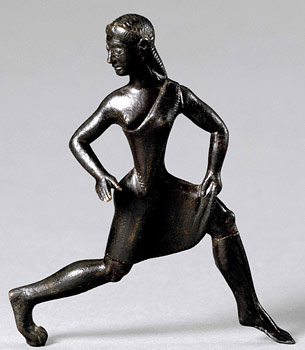
What did the girls’ Olympics celebrate? Continue reading “WHEN THE OLYMPICS CELEBRATED THE STRENGTH OF GIRLS AND THE RENEWAL OF LIFE by Carol P. Christ”
A Shaman’s Journey by Kelley Harrell
 When I was five years old, I asked my Sunday School teacher–a woman, “What if Jesus had been a girl?”
“But he wasn’t,” she replied.
Unsatisfied, I asked again, only to receive the exasperated, recursive answer. My mother gave the same empty response later, in private.
It’s no huge surprise that when I was about 14, my many dissatisfactions with the Church overwhelmed my fondness for it, and I began to explore other spiritual paths. Coinciding with this transition was also the realization that intuitive gifts I’d manifest since childhood demanded open expression, and that the energetic truth of my femininity deserved acknowledgement on my spiritual path. By the time I was 17 I had separated from the Church and begun crafting my own relationship to shamanism.
That may not seem like a terribly logical leap on the surface, but for me it was sound. Continue reading “A Shaman’s Journey by Kelley Harrell”
If You’re Lucky You Get Old—Part One by Marie Cartier
 This year two significant shifts happened inside of me: I realized I was getting older. And I wanted to protect my body/mind. These may seem to be perhaps the same realization– but both of these realizations came from very different incidences.
Realization #1
Let me explain the first realization—realizing I was getting older. I am 56. Perhaps since I am a professor and while I have been getting older, my students stay the same age as each new crop of undergrads greets me in the fall. Perhaps because I have chosen to not have children of my own. Perhaps because I do work out—jogging (albeit slowly). Whatever the reason in my mind I was still not “older,” whatever that is — yet.
And then I went for a long over due eye exam. When my new glasses arrived I admired them in the large mirror across the room. But when I sat at the desk and looked in the mirror directly in front of me, I gasped. “Oh my God!” I exclaimed. “What are those?” I was staring through my new lenses at the wrinkles above my lip. I stared at the eye glass specialist — a fabulous gay man (and partner to my ophthalmologist) who helped me pick out the frames. “Do you see those wrinkles?” I asked. It was only after he said, “Oh, honey, $900 you can fix that– I know someone,” that I realized I was assuming he would say, “What? I don’t see anything.” But you can rest assured a gay male friend will not lie to you about your looks. If that dress make you look fat, he’ll tell you (and help you fix it). In any case, in that moment of corrected vision I saw my wrinkles for the first time. And I hated them. Continue reading “If You’re Lucky You Get Old—Part One by Marie Cartier”
To “Ride By On a Wheel” by Kathryn House
 If you have been socialized that fading into the background should be your first concern, cycling can seem like one long experiment in declaring your valuable, irreplaceable, amazing existence in this world.
I love riding my bicycle for many reasons. It clears my head, is convenient, affordable, good for the environment and good for my calf muscles. It no doubt also has its dangers, but most of the time, I love maneuvering through Boston’s busy streets.
I have not always been a bicycle enthusiast. Last week as she was preparing for a sermon, a friend asked if any of us had good stories about “saying yes.” I explained that my “yes” to biking has always seemed to me a story of “saying yes” to one thing and getting something else altogether. Riding my bike has also become a surprising source of insight in this first year of doctoral work in theology, and about how one who identifies as a feminist begins to engage theologically.
Silencing Miriam: Prophetess, Liberator, and Leader By Michele Stopera Freyhauf
 The prophetess Miriam, Aaron’s sister, took a tambourine in her hand, while all the women went out after her with tambourines, dancing; and she led them in the refrain: Sing to the LORD, for he is gloriously triumphant; horse and chariot he has cast into the sea.”(NAB, Exodus 15:20-21)
The Song of Miriam is not a story of death and destruction, but rather liberation. It is a poetic celebration of God’s liberation of the Israelites from the oppressive Egyptians, which, according to Bernhard W. Anderson in “The Song of Miriam Poetically and Theologically Considered,” marks the beginning of the Israelite tradition (292). Phyllis Trible in “Bringing Miriam out of the Shadows” states that this act marks the end of the Exodus, which was started by Miriam, not Moses (169, 172). The act of liberation reveals God’s action in humanity. Gerald Janzen in Exodus believes this act also moved the Israelites “to fear the LORD and believe in the LORD and in his servant Moses” (109). The uniqueness of this passage is that the most unlikely person leads – this person is not a man but rather a woman.
This brief passage in the Hebrew Scriptures is revelatory – Miriam is revealed for the first time. She is a prophetess, Aaron’s sister, and the role of leader of the victory dance to honor the Divine Warrior.
Continue reading “Silencing Miriam: Prophetess, Liberator, and Leader By Michele Stopera Freyhauf”
Things That Make Me Cry: The Practice of Unbelief by Leanne Dedrick
 I have been doing a lot of unpacking lately, both literally and figuratively. I have recently moved to a different city, and returned to a place I once knew well, many years ago. It hasn’t been a case of ‘going home again’ as much as it has been an expression of self awareness of my preferences, but as with other significant life events, there are surprises waiting around each corner — surprises that carry with them hidden issues that require figurative unpacking. For the purposes of this post, however, I will only address one. It is the one that left my FB friends scratching their heads and sending me comments like, “WTF?” and “Wow. You surprise me!” and “Have you lost your mind?” It also led to the most annoying statement anyone can ever hear, “Obviously, you have issues you aren’t dealing with…” I don’t know about you, and maybe it is just my age, or the fact that I am a philosopher, but it is damn near the biggest insult you can pay me. The way I see it, and live it, my obsessively organized and compulsively compartmentalized mind is constantly on hyper-drive when it comes to analyzing and ‘dealing’ with my ‘issues.’ So after a few days of sitting with (read: doing anything but calmly sitting with) my annoyance and reviewing my own out of character posts, I have gotten to a place where I can begin to unpack the responses of others, rather than perseverate on my own insecurities. Continue reading “Things That Make Me Cry: The Practice of Unbelief by Leanne Dedrick”
CAN WOMEN HAVE IT ALL WITHOUT CHANGING THE WORLD FIRST? by Carol P. Christ
In the early days of the second wave of the feminist movement, we really did believe that we could change the world. Our dreams were for a world without racism, poverty, and war, and for a world where women and men would be equal in every respect. Men would take an equal role in child care and women would take an equal role in all aspects of public life. We were inspired by the dream that women (and men) could have it all, but I don’t think many of us believed that anyone could have it all without radically transforming the world.
We eagerly spoke about the need to lower working hours for both women and men to say a 36 hour week, about flexible working hours, and about the Swedish model that encouraged both women and men to take parental leave. Changing the conditions of work was a central platform of second wave feminism.
The feminists of my generation understood that it would be very difficult to “have it all” before we changed the world. Continue reading “CAN WOMEN HAVE IT ALL WITHOUT CHANGING THE WORLD FIRST? by Carol P. Christ”
Mary Magdalen’s Feast Day: Celebrating Goddess Incarnate by Elizabeth Cunningham

I believe the current resurgence of interest in Mary Magdalen does reflect a collective desire for the divine incarnate in a woman’s body.
July 22nd. In the Village of St Maximin in the South of France, a (real) blackened skull with topped with gold hair (that looks a bit like a battle helmet) is being lovingly paraded through the streets in celebration of Mary Magdalen’s feast day. Except for this annual airing, the skull resides atop a gold bust of the saint in a glass case in the crypt of the basilica. Just under where her heart would be is a small glass cylinder reputed to contain a shred of tissue from Mary Magdalen’s breast bone, the place where Jesus touched her on Resurrection morning warning her: Noli me tangere. Don’t touch me. Not yet.
Incarnation is all about touch. Though most of us no longer venerate—or battle over—the relics of saints, there is something touching about our longing for the divine made tangible, vulnerable, human. Continue reading “Mary Magdalen’s Feast Day: Celebrating Goddess Incarnate by Elizabeth Cunningham”
 Feminism and Religion