Get Some Grip! by Stephanie Arel

In my practice working in rehabilitative exercise, addressing minor injuries as well as traumatic ones – from brain injuries to falls, I see a lot of women over 60 who have a history of not training or challenging their upper body. The lack of upper body strength in women is, in some part, a result of culture. The historic role for women molds them to avoid muscles – to look thin, small, or frail in the upper body. A message emerges: “Let the man do it.” These roles are not benign, a fact reflected by changes in cultural views of sex and gender roles/expectations. While hewing to the feminine idea of the past might be easier, there is a price to pay later in life.

Anecdotally, men concern themselves with larger pecs, big biceps, and successful arm wrestling. Incidentally, when they can no longer do what they did as young men, some men give up doing much of anything. In my experience, women usually don’t surrender to age, but they traditionally resist both the look of a strong upper body and the labor necessary to achieve such strength. I have one client who feels afraid every time she has a weight over 10 pounds in her hands. Furthermore, women often defer to men: observe the next time you travel who lifts luggage in an airplane or brings baggage to the car. Life gets easier when someone else can grab the bags…but this ultimately makes later life harder – strength in the upper body is critical to the ability to break a fall, recover from injuries, and longevity.  

Continue reading “Get Some Grip! by Stephanie Arel”

Your Body Knows Before You Do by Andrea Penner

Our interstate move of 325 miles due east on U.S. Highway 40, formerly Route 66, that iconic highway through the American Southwest, took us from one rental home to another. A month later, I sat in a closed graduate seminar, having received a coveted “yellow card.” By some stroke of magic, the professor had read my master’s thesis.

“I know your work,” he said, signing the over-enrollment waiver.

For the next several years, I studied, wrote, taught, ate, slept, and moved through marriage and motherhood (and one more rental)—all toward the goal of completing the PhD in English while my then-husband cycled through professional jobs and both of us recovered from eight years of cross-cultural Christian ministry.

Continue reading “Your Body Knows Before You Do by Andrea Penner”

Black Bird Ballet by Sara Wright

Wikimedia Commons

In September I was patient. My beloved birds were having a good year seeking food in natural places like my field I reminded myself over and over as they remained absent from my feeders until I fell and was hospitalized for weeks.

After November’s first snow storm the grouse arrived and I had high hopes that she would stay. I occasionally flushed her in thickets but did not see grouse’s plump brown body feasting on the remainder of the berries from the crabapple or see her hieroglyphs in the snow.

The turkeys remained absent. When I walked through my young pine forest where chickadees chirp even on windy days, the musical whirring wings of mourning doves tore into the grief I felt and didn’t want to own. Sometimes I called out “I love you” to those birds who chose to converse with me because I know they know.

 In late November when the snow piled up bowing trees to the ground it also brought in the first winter cold; this time the brook almost froze solid. A few birds did visit the feeder for a day or so: titmice, chickadees, one female cardinal, a few juncos, goldfinches, but the absence of abundance was overwhelming. Two days later nothing.

Continue reading “Black Bird Ballet by Sara Wright”

Legacy of Carol P. Christ: The Feast Day of St. Brigid

This was originally posted on Jan 30, 2012

May we remember Brigid on her day in the fullness of her connection to bountiful and life-giving earth by setting a bowl of milk on an altar or special place in the garden on her holy day.  Who knows, a snake just might come to drink from it.

The Christian Feast Day of St. Brigid of Kildare, one of the two patron saints of Ireland, is held on February 1, the pre-Christian holiday known as Imbolc.  It is well known that St. Brigid has the same name as a pre-Christian Goddess of Ireland, variously known as Brighid (pronounced “Breed”), Brigid, Brigit, Bride, or Bridie.  The name Brigid is from the Celtic “Brig” meaning “High One” or “Exalted One.”  Brigid like other Irish Goddesses was originally associated with a Mountain Mother, protectress of the people who lived within sight of her and of the flocks nurtured on her slopes.

Imbolc marked the day that cows and ewes give birth and begin to produce milk.  It was also said to be the day when hibernating snakes (like groundhogs) first come out of their holes.  In northern countries, Imbloc signals the beginning of the ending of winter.  The days have begun to lengthen perceptibly after the winter solstice when the sun stands still and it seems that winter will never end.  At Imbloc spring is not yet in full blossom.  But if hibernating snakes come out of their holes, it is a sure sign that the processes of transformation will continue and warmer days will not be far off.  As Marija Gimbutas says, “The awakening of the snakes meant the awakening of all of nature, the beginning of the life of the new year.”  

Continue reading “Legacy of Carol P. Christ: The Feast Day of St. Brigid”

Time for Change by Carolyn Lee Boyd

The Cosmic Egg, Orphic egg, James Basire, 1730–1802 (engraver), Public domain

The Greek Eurynome, one of the most ancient Goddesses who emerged before patriarchal times, rose from chaos and began to dance, separating “light from darkness and sea from sky”1 whirling to create a great wind. She faced it, grabbed it and “rolled it into clay like a serpent”2 . She made love with the serpent, “transformed herself into a dove” and “laid the universal egg from which creation hatched”3 Eurynome was a goddess who embraced and created change, bringing the universe into being in the process. 

She would have been at home in a 21st century physics lab where scientists are learning that the nature of reality is constant change. According to physicist Carlo Rovelli, “The entire evolution of science would suggest that the best grammar for thinking about the world is that of change, not of permanence. Not of being, but of becoming”4.  He further explains, atoms “move freely in space, colliding with one another; they hook onto and push and pull one another. Similar atoms attract one another and join. This is the weave of the world. This is reality. Everything else is nothing but a by-product—random and accidental—of this movement”5. Even our human bodies, which we tend to think of as a single object changing very slowly over the years, are really a maelstrom of molecules, ever-transforming and renewing.

Continue reading “Time for Change by Carolyn Lee Boyd”

Iceland: The Dream Made Real by Marie Cartier

I just came back from a bucket list trip- Iceland. I have wanted to go ever since I learned they had a Women’s Party- which were sometimes in power. The Women’s Party of Iceland ‘Power of the masses’: the day Iceland’s women went on strike and changed history | Iceland | The Guardian where women went on strike and changed the history of the country forever. Today Iceland is the most gender equity country in the world for women, the safest country in the world for women- and extremely beautiful. You can read more about it here: What Are the Icelandic Women Like? Feminism, Tradition and CrossFit (iamreykjavik.com) and here: 7 Laws That Show Why Iceland Ranks First for Gender Equality (globalcitizen.org)

Continue reading “Iceland: The Dream Made Real by Marie Cartier”

Three Women Sit on a Stone: Images of Fate in a Jewish Incantation by Jill Hammer

Tapestry, three fates, 16th century Netherlands

There is an old Yiddish incantation, documented from the 18th century forward, that features three mysterious women.  It is a folk spell warding off the evil eye–the negative influence that may come either from demons or from the jealousy and spite of others (or both). Fear of the evil eye is the reason it was traditional not to compliment cute babies or talented people—because the evil eye might be attracted to such beauty or talent and cause harm.  The evil eye, to give a personal example, is the reason my father, who was normally not a religious person, refused to allow my mother to shop for a crib until I was born, lest the evil eye notice they were going to have a baby and prepare some terrible fate for me.

Continue reading “Three Women Sit on a Stone: Images of Fate in a Jewish Incantation by Jill Hammer”

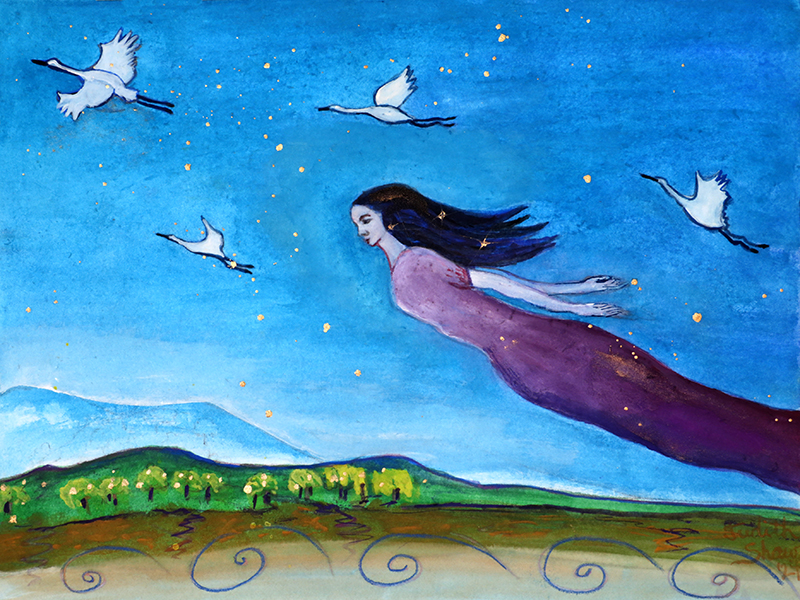
Elena and the Reindeer Goddess: The Mission Begins by Judith Shaw

As much as I wanted to finish my fairytale project in time for the winter holidays, the muse had a different idea. Perhaps the energy of winter was what I needed in order to finish the grand finale painting for the tale. It depicts a night sky filled with magic and wonder.

Continue reading “Elena and the Reindeer Goddess: The Mission Begins by Judith Shaw”

The Natural History of Starlings by Sara Wright

Last week Sara wrote about her and her family’s personal connection to starling. You can read it here. 

Wikimedia Commons

Amazingly, all the European starlings in this country descended from 100 birds that were deliberately set loose in New York’s Central Park in the 1890’s by colonists who wanted to see the birds they missed after immigrating to the US. Soon there were more than two million birds that ranged from Alaska to Mexico. All are closely related.  Sometimes if a female misses the first nesting she will try to lay an egg in other bird’s nests. They are wonderful mimics learning the calls of up to 20 species of birds like the pewee, killdeer, wood thrush, red tailed hawk and robin to mention a few.

Starlings turn from spotted and white to glossy and dark each year without shedding their feathers. The new feathers that grow in have white tips. These are the spots that disappear by spring as the feathers turn dark and glossy. These birds are incredibly strong fliers as is evidenced by the extraordinary starling murmurations that still occur throughout the fall and winter all over Europe.

Continue reading “The Natural History of Starlings by Sara Wright”

Legacy of Carol P. Christ: THE “G” WORD

This was originally posted on December 10, 2011

Recently, I saw the following line in a promotion for a book to which I contributed: “This volume includes voices from Christianity, Judaism, goddess religion, the Black church, and indigenous religions.” The editors of this book are to be strongly commended for expanding the dialogue in feminism and religion beyond the confines of the Christian hegemony in which it is still all too often framed.  Nonetheless, I felt hurt and offended.  I immediately wrote to the editors asking how they would feel if a book were promoted using the words:  “This volume includes voices from Goddess religion and god traditions such as judaism and christianity.”

Continue reading “Legacy of Carol P. Christ: THE “G” WORD”