Spiritual Ideas, Existential and Eastern, in Jonathan Livingston Seagull by Elisabeth Schilling

Peaceful Solitude

After my year of teaching high school students, I found a kinship with them in their frustrations, longing, apathy, hopelessness, and hope. Fortunately, we studied together Jean Paul Sartre, whom I want to get to know more intimately, but we, the teens and myself, could take the spiritual answer to our questions about the meaning of life (is there one? What is it?): The meaning of life is to give it meaning.

I am not sure about their generation, but adolescence for me, in mine, was about discovering, not necessarily creating. Of course, now I think it is a little of both.

Sometimes I wonder if there is also a lesson. Being an academic, perhaps I love learning and teaching. I demonstrate my love as Jonathan Livingston Seagull does, by offering to others, perhaps a specific community of others, those who have chosen or must be in a state of learning (easily found in institutions of high school and college), the truths I have gathered (59). Of course ‘truth’ is a word that tastes a bit tannic, for it needs to be rolled around by the tongue a bit to be cleansed; perhaps to mitigate its toxic potential, we can never consume it undigested, but must gestate it and transform it within our warm bodies, just at the cliff, before we allow it to permeate our organs in a chemical structure that serves us.

Continue reading “Spiritual Ideas, Existential and Eastern, in Jonathan Livingston Seagull by Elisabeth Schilling”

Kintsugi for the Soul – Part II – by Vanessa Rivera de la Fuente

IMG_20170723_113240

Continued from Part 1.

How do you start to put the pieces together? For me, it was imperative to keep a space to express emotions without self-censorship or self-prejudice, to identify exactly what was hurting me. It was not the What, but the How. A split is always sad, but part of life. I could have been the “ungrateful” partner.

What aches …

Well, just to mention some, it was not the obstacles of a relationship between two people used to singleness, with different cultural backgrounds and family styles, but the neglecting, insults, and public belittling, leading to my progressive invisibility and objectification in the daily life. It was not his one night stand a few years ago with an Islamic feminist I know. Every adult has a sexual past, that is not a problem, but discovering that past was quite current (thanks Whatssap) is the problem. Someone decided I was not smart enough to understand it, so triangulation and lies were employed, with the consequent mind games, an emotional roller coaster that included gaslighting and violation of trust.

Continue reading “Kintsugi for the Soul – Part II – by Vanessa Rivera de la Fuente”

The Gift of Life by Judith Shaw

judith Shaw photoLife – a precious gift I so often take for granted.  Events of recent weeks have turned that blatant disregard into profound gratitude.

I began keeping bees about three years ago.  My first two years were unsuccessful.  But last year, bees I obtained from my bee mentor, Mike, were strong and vibrant.  They provided me with my first honey harvest, wintered well, and come spring were out and about pollinating the neighborhood.

Continue reading “The Gift of Life by Judith Shaw”

A Message from the Ancestors by Carol P. Christ

carol at green party 2014 croppedIn recent weeks and even months I have not been my usual cheerful self. After returning from sharing companionship and spiritual vision with a group of wonderful women on the Goddess Pilgrimage to Crete, I have been feeling lonely. This feeling came to a head on December 7 when it was cold and grey here in Lesbos, as had it been for weeks.

Feeling particularly sad that morning, I realized that December 7 was my mother’s Yahrzeit, the twenty-third anniversary of her death. The fact that I must use a Yiddish word to speak of this important day reflects the fact that we do not have a word (let alone a ritual) in the English language, in our versions of the Christian tradition, or in Goddess feminism to recognize the day a loved one died. As we Americans all know, we are supposed to get on with it and not dwell on death and dying.

A friend called that day to let me know that she was planning to visit me for few days during the holiday season, adding that she was looking forward to enjoying my tree and holiday decorations. “Oh,” I said, “my (live) Christmas tree is so heavy and hard to get into the house, I was thinking of not even bringing it in this year.”

That afternoon, I girded my loins and knocked on a neighbor’s door to ask for help. Of course one of the reasons that I was feeling sad is that as I live alone, I have no one to help me move a heavy tree. The neighbor’s shy son was more than willing to help, and we were lucky that we got the tree in a day before the pounding rains that would have doubled the weight of the soil in its pot.

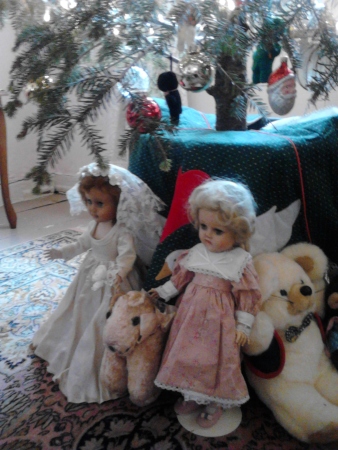
001dec 2014 232As I decorated my tree over the next two days, memories of my mother flooded into my mind. How I miss my mommy. “Do you still think of your mother?” I asked an older friend shortly after my mother died. “Yes,” she replied, “Every day.” Me too, I thought, as I unwrapped the Christmas tree skirt, one of the last gifts Mom had given to me, and the dolls and pink doggie she had saved for me.

The ritual of decorating my tree for Christmas is my memorial to my mother’s love. How much fun we had choosing what was usually a scrawny tree—the largest we could afford, but not the smaller prettier one my mother would have preferred. How I remember baking and decorating cookie cutter cookies—eating the raw dough, licking the sugar icing from our fingers, and always putting what Mom said were too many red hots and silver dots onto the cookies.

My mother’s memories of Christmas were not all happy. But my Mom tried her best not to dwell on sadness. Shortly before she died, I found my mother baking cookies for a man who also had cancer. “I was feeling sorry for myself,” she said, “so I decided to do something for someone else.” I could hear my mother’s mother speaking through her in that moment.

My grandmother’s attitude, which was Midwestern, Christian, and deeply female, was nearly lost to me, for I come from the generation that discovered therapy. In the process of dealing with our feelings, we criticized our ancestors for not doing the same. As Christmas approaches this year, I wonder: were my Mom and my Grammy right? Is there a profound truth in their knowledge, transmitted through the generations, that the best way to deal with one’s own sorrows is to do something for others?

***

011If so, then I guess it is time to plan my winter solstice birthday party (which I was also thinking of cancelling this year)–pick up the phone and start inviting friends over to enjoy my home, my tree, and my food, the gift of life shared with others.

Happy Winter Solstice to all and to all a good night!

***

Carol leads the life-transforming Goddess Pilgrimage to Crete (facebook and twitter) spring and fall–early bird discount available now on the 2015 tours.  Carol can be heard in interviews on Voices of the Sacred Feminine, Goddess Alive Radio, and Voices of Women.  Her books include She Who Changes and Rebirth of the Goddess and with Judith Plaskow, the widely-used anthologies Womanspirit Rising and Weaving the Visions and the forthcoming Turning to the World: Goddess and God in Our Time. Photo of Carol by Michael Bakas.

The Ancestors Live in Us by Carol P. Christ

Carol Christ in LesbosOn the recent Goddess Pilgrimage to Crete women had the option of riding up a winding road on a mountainside in the back of a farm truck singing “She’ll Be Comin’ ‘Round the Mountain” or could choose to go with the guard in his closed automobile.

That evening one of the older women who had chosen to ride in the car said, “I saw how much fun you were all having, but I have done that before. This time I was happy to let the rest of you do it.”

“That’s exactly how I feel about death,” I responded. “Some people want to live on after death, but I don’t. I am happy to let others do it. The only thing that would upset me would be if life did not go on after me.” Continue reading “The Ancestors Live in Us by Carol P. Christ”

In the Face of Despair, Choose Life by Carol P. Christ

carol mitzi sarahYesterday I had a delightful swim with a friend in the cool Aegean Sea. In in the evening I met two dear friends at an open air restaurant for a delicious meal and good conversation. Last night a beautiful moon rose over the sea and a soft breeze caressed my skin. All of this made me very happy. However, the state of the world does not.

Michael Brown. Trayvon Martin. The Ferguson police. Hold your ground laws. Bombing in Gaza. War in Ukraine. War in Iraq. War in Afghanistan. War in Syria. Wars that are not on my radar. Rape as a part of war. Joe Biden threatening to chase ISIL “to the gates of hell.” Citizens United. A rash of laws restricting voting rights. A rash of laws restricting abortion rights. Police brutality. Police brutality that is racially motivated. Young men being sentenced to prision for minor drug offenses. The brutality of the prison system. A woman with children being paid $8.50 an hour working at McDonalds and not even knowing when she will be called in to work. Open carry laws allowing Americans to walk the streets with loaded weapons. And that’s just off the top of my head this morning.

When I was young and protesting poverty, racism, and the War in Vietnam, I thought that it would be a relatively simple matter to change the world. It turned out that I was not only wrong: I was very wrong. The world has changed all right, but not for the most part for the better. In fact, despite the diligent efforts of social justice activists, in many respects the world has changed for the worse. Continue reading “In the Face of Despair, Choose Life by Carol P. Christ”

Honoring the Sacred Yoni by Deanne Quarrie

Deanne QuarrieThe word Yoni is a Sanskrit word. Translated, it means womb, origin, source, and vulva. It is also known as the divine passage or sacred temple. The Yoni consists of the entire female genital system. Many of us have chosen to use the word Yoni in preference to vagina as it offers us the opportunity to reclaim the sacredness and power of our sexuality as women, as goddesses. The Yoni is where we find Shakti, the universal creative energy.

A woman’s yoni has been worshipped all over the world. In India the yoni is worshipped as the sacred symbol of the Divine Feminine, referred to as the Devi, the Great Goddess, the source of life, the Universal Womb. Continue reading “Honoring the Sacred Yoni by Deanne Quarrie”

MATRIARCHY: DARING TO USE THE “M” WORD by Carol P. Christ

carol-christFor me the word “matriarchy” expresses the certainty that “another world” can exist—a world not based in domination and hierarchy or violence and war. 

The word “matriarchy” makes people’s hair stand on end as they imagine the mirror-image of patriarchy: societies in which women dominate men, beat men, rape men, hold men as slaves, and demand obedience from men.  Some who do not protest very loudly or at all against patriarchy are horrified by the very idea of matriarchy. To be fair, most feminists have also been schooled not to use the “m” word.

Early in my academic career, I read “The Myth of Matriarchy” by Joan Bamberger and learned that the idea of matriarchy gone wrong has been used by men to justify patriarchy. From other academics I learned that in matrilineal societies, uncles have a great deal of power—so therefore there never was a matriarchy.  I was also aware that Jungian and other proponents of a “matriarchal stage” in the development of culture have argued that matriarchy had to be succeeded by patriarchy in order for societies to evolve to a “higher” stage. Unlike many of my colleagues I stubbornly held onto the belief that there must have been “a better way” prior to patriarchy. Continue reading “MATRIARCHY: DARING TO USE THE “M” WORD by Carol P. Christ”

The Great Commandment for Women: Love and Care for Yourself as You Love and Care for Others by Carol P. Christ

carol-christA rabbi known as Jesus of Nazareth taught that you should  “love God with all your heart and your neighbor as yourself.”  Charles Hartshorne, philosopher of relationship and a twentieth century advocate of the “two great commandments,” added that it should be understood that this means that God wants you to love yourself too.

I quote Hartshorne’s midrash on the great teaching often because, sadly, too many women—and some men too–have been taught to love their neighbors at the expense of themselves, to care for others, but not to care as much for themselves.  Continue reading “The Great Commandment for Women: Love and Care for Yourself as You Love and Care for Others by Carol P. Christ”