Week 2 – Goddess Birthing Liberation: A Feminist Advent Daily Devotional by Trelawney Grenfell-Muir

If you have not yet realized that the Christmas story is a story of liberation from oppression, it is time to realize that. I like to dust off the patriarchy and mysogyny of scriptural writers to find the beautiful wisdom within the stories. Here is my daily devotional for the second week of Advent, the week of Peace. May our ever-birthing Goddess guide you to recognize and birth Peace, with all Creation. As the sky turns dark, may our candles shine ever brighter, together.


Feminist Advent Daily Devotional, Day 8:


The Peaceful Kin-dom

New shoots shall grow out from the stumps of old trees,

and branches shall grow out of their roots.

The spirit of Eternal Becoming rests on young prophets of Goddess,

the spirit of wisdom and understanding,

the spirit of counsel and might,

the spirit of knowledge and the reverence of Gaia.

Their delight shall be in the reverence of Gaia.

They shall not judge by the diseased eyes of their culture,

or decide by the distorted ears of falseness or deceit;

but with righteousness they shall proclaim justice for the poor,

and bring abundance to the meek of the earth;

they shall heal the earth with the birth canals of their mouths,

and with the breath of their lips they shall redeem the wicked.

Righteousness shall be the belt around their waists,

and faithfulness the belt around their wombs.

The wolf shall live with the lamb,

the leopard shall lie down with the kid,

the calf and the lion and the fatling together,

and a little girl shall lead them.

The cow and the bear shall graze,

their young shall lie down together;

and the lion shall eat straw like the ox.

The nursing child shall play over the hole of the asp,

and the weaned child shall put her hand on the adder’s den.

They will not hurt or destroy

on all my holy mountain;

for the earth will be full of the knowledge of the Eternal Womb

as her waters cover the sea.

Continue reading “Week 2 – Goddess Birthing Liberation: A Feminist Advent Daily Devotional by Trelawney Grenfell-Muir”

Week 1 Goddess Birthing Liberation: A Feminist Advent Daily Devotional by Trelawney Grenfell-Muir

If you have not yet realized that the Christmas story is a story of liberation from oppression, it is time to realize that. I like to dust off the patriarchy and mysogyny of scriptural writers to find the beautiful wisdom within the stories. Here is my daily devotional for the first week of Advent, the week of Hope. May our ever-birthing Goddess guide you to recognize and birth Hope, with all Creation. As the sky turns dark, may our candles shine ever brighter, together.

Feminist Advent Devotional, Day 1:

Isaiah 2:1-5, revised

The word that Isaiah, daughter of Amoz, saw concerning the kindred of faithful seekers.

In days to come the mountain of Peace shall be established as the highest of the mountains, and shall be raised above the hills; all Creation shall stream to it.

Many peoples shall come and say, “Come, let us go up to the mountain of Peace, to the house of Love and Justice; that we may learn her Wisdom and that we may walk in her paths.” For out of Gaia shall go forth instruction, and the Wisdom of the Eternal Womb from the Earth Mother.

She shall guide all Creation, and shall reconcile all the Earth; they shall beat their swords into plowshares, and their spears into pruning hooks; nation shall not lift up sword against nation, neither shall they learn war any more.

O kindred of faithful seekers, come, let us walk in the light of Hope!

Continue reading “Week 1 Goddess Birthing Liberation: A Feminist Advent Daily Devotional by Trelawney Grenfell-Muir”

Adoring God in Labor by K Kriesel

The day before the 2019 Nevertheless She Preached conference at First Baptist Church of Austin, TX my own Catholic church’s young adult ministry hosted Eucharistic Adoration. Although I’ve enjoyed Adoration dozens of times, several factors made this evening different. I was preparing for cervical surgery for one. My Hebrew Bible class at Austin Presbyterian Theological Seminary was grappling with Rebekah, Rachel, Leah, and the voiceless Dinah. The call to write the history of 20th century Catholic women theologians had been at my ear all day. The catalyst was when two men at the Adoration began leading a song about God the Father.

Maybe it was just the incense but I swear I saw something. An image of the baby crowning from the womb, God gasping in labor, as the Eucharist wore the gold of the monstrance as a crown before the tabernacle. God was pushing the Body of Christ into creation while I prayed for my own sick body. God was crying out with the voices of these thousands of unheard women. We were all there. I snuck out my phone and took a picture, determined to put the scene to paper.

Continue reading “Adoring God in Labor by K Kriesel”

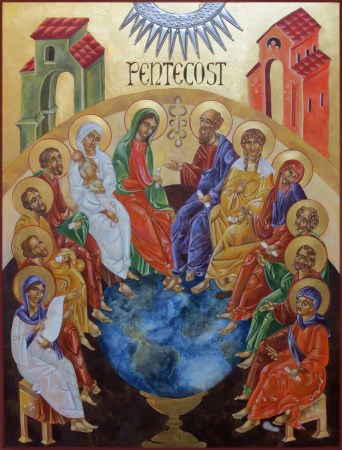
PENTECOST a time to FILL THE WORLD WITH SPIRIT by Mary Jane Miller

Pentecost is followed by Ordinary time, the longest season of the church year. It gives us plenty of time to think about what happened when the Holy Spirit descended on the Apostles. I have always loved the idea that this one moment changed us, it was and is the fulfillment of God’s promise to pour out the Holy Spirit on all flesh, empowering diverse people to exercise divine power. It is commonly understood that the first to receive the power from on high are the male disciples, “locked in a closed room for fear of persecution.” Apparently these Jewish disciples were not too worried about their wives and children.

After painting several Pentecost Feast Day icons as an artist, iconographer and child of God I cannot remain silent with what I think the icon has taught me. It feels obvious that the great gift of the Holy Spirit was for all of humanity. I want to commemorate an ongoing Pentecost, a time to fill the world with spirit, where women and children are invited into the closed room and given a rightful place at the table. Images have a great deal of influence in opening the heart and the mind. Imagine a new contemporary understanding of divine light touching all human beings as well as the planet.

The Spirit Descending

A half circle of twelve descending rays is commonly found at the top of any Pentecost icon. This representation is critically important for the beginning of our narrative. “Then there appeared to them divided tongues, as of fire, and one sat upon each of them.  And they were all filled with the Holy Spirit and began to speak with other tongues, as the Spirit gave them utterance. (Acts 2:2-4)

Imagine that these rays represent the uncreated energies filling the universe, the same rays any of us might feel when touched by grace. These divine rays envelope us as they come from beyond time and space.

Continue reading “PENTECOST a time to FILL THE WORLD WITH SPIRIT by Mary Jane Miller”

Gentle Moments in a Violent World by Marcia Mount Shoop

mms headshot 2015“Be gentle with yourself.”

It may be some of the most redemptive guidance I have ever received.  And I share that invitation daily with people in painful situations.

“Be gentle with yourself.”

In a world seemingly hell bent on self-destruction, being gentle even for a moment is a radical act of resistance. A moment of tenderness. A moment of trust. A moment of attentiveness to need.

But really, what good does gentleness do in a world as brutal as ours can be?  How does being gentle provide any kind of answer to the assault of being commodified or objectified or betrayed or assaulted or oppressed or erased or abused or discarded or exploited? Continue reading “Gentle Moments in a Violent World by Marcia Mount Shoop”

Finding God in Music by Gina Messina

We cannot force a connection with God through a faulty conduit. What is important is that we affirm ourselves when we find it — when we feel it. Embrace those experiences, name them for what they are and recognize that you are sacred and the divine – whatever that means to you – is present.

When I’m in a funk, I generally feed into it and make it worse. Once we are in a rut it is easy to continue the spiral downward. I’m good at admonishing myself for lacking gratitude when I feel this way. It might be a Catholic guilt thing.

A few days ago, I was in a dark place; but this time I tried to own my sadness, acknowledge it, and let it go. The only thing I could think to do in hopes of shifting my emotions was to put on music – something up beat that would allow me to transcend the moment.  

I listened to a live version of “Stay” by The Dave Matthews Band, a song about embracing the beauty of our lives and the idea that those moments where it feels like we are just wasting time are often our most precious; the ones that allow us to connect with each other and ourselves. It was the sermon I needed — and an important lesson my uncle taught me — but more on that shortly.

I often say that I think music is the sound of my spirit — our spirits. As I started writing this, I struggled with finding the words to articulate the feeling music provokes within me. There is little else that creates such an indescribable experience and that is why I think that music is where I find my connection to the divine. 

Traditional religious services have always felt challenging to me.  I don’t connect to much of anything and generally find myself feeling angry and rejected by the Church and the community where I am supposed to find God. My grappling with Catholicism aside, we are told that our spiritual lives must take place within particular dimensions, and for many of us God is not there. Continue reading “Finding God in Music by Gina Messina”

Moments by Katie M. Deaver

The phone rings loud on the bedside table near my head, and I wake with that tiny heart attack that only truly jarring things, like middle of the night phone calls, seem to trigger. It takes me a moment to gather myself, to remember who I am, where I am, and what that sound is… and then I grab the phone, hop out of bed and cross the hall into the office where I can finally answer.

It’s a familiar voice, Eli, my colleague and friend from the domestic violence and sexual assault shelter where I volunteer. They’ve just received a call from the emergency room about a sexual assault survivor asking for an advocate and I’m the volunteer on-call this week.

Eli handles himself so very well, knowing that while he is awake working the night shift I am still trying to grasp his words, trying to shake the sleep from my body and my mind. As his words sink in I write down the survivor’s name and start pulling on clothes to head to the hospital.

Though I’ve taken a fair amount of these calls during daylight hours, this middle of the night call is a new experience for me. I live in the upper peninsula of Michigan and while I love it here, this particular night also happens to be yet another night with significant snowfall, and it takes me quite a while to dig my car out enough to get it out of the tiny alley next to our house and up the hill toward the emergency room.

Continue reading “Moments by Katie M. Deaver”

Behaalotecha: Lessons and Questions for Feminists by Ivy Helman.

29662350_10155723099993089_8391051315166448776_oThis week’s Torah parshah is Behaalotecha: Numbers 8:1 to 12:16.  By now, much of what comes to pass should sound familiar. The parshah starts with another discussion of leadership and the priesthood.  It then prescribes a second Pesach for those who happened to be ritually unclean for the first one and describes the consequences of not participating in the first Pesach if you had been ritually clean.  Next, the Israelites’ wanderings through the desert are detailed which includes the divine appearing as natural phenomena and the very loud rumblings of the Israelites’ tummies. Finally, the parshah ends with a discussion of Moses’ wife and Miriam’s punishment.

While this Torah parshah contains one of my favorite images of the divine: as a pillar of fire by night and clouds by day, I’ve discussed it many times.  See these posts.  What I want to discuss is the Israelites’ hungry tummies.   Continue reading “Behaalotecha: Lessons and Questions for Feminists by Ivy Helman.”

Resurrections by Elizabeth Cunningham

Photo by: Douglas C. Smyth

As a minister’s daughter, I grew up almost literally in the church, its red door and ivied walls across the driveway from the rectory. On Easter the church was packed; every family received a pink or red geranium. There were Easter egg hunts, baskets stocked with chocolate rabbits and the jelly beans these magical creatures laid. The church rang with triumphant hymns: Jesus Christ is risen today. Although like all children I reveled in holidays involving excessive sweets, it was not the candy or the or the requisite rejoicing that moved me most.

It was the women, or in the Gospel according to John, the woman, bereft and brave, who went to the tomb to tend Jesus’s body. The male disciples had scattered and gone into hiding. In the Protestant Episcopal Church, Christmas Eve and Easter were the only times women played a prominent role in the story. Those were not the loud, triumphant moments. They lived in my child’s imagination as the quiet, mysterious times, Mary giving birth in the night attended by cows, donkeys, and stars. Dawn in a garden, wet with dew, the only sound birds waking and singing, the only people, the women, or the one woman who captured my imagination and, in my story, has her own apotheosis on that morning.

I did not question the miracle of resurrection. Miracles and magic made sense to me as a child. Theology didn’t. My father liked to expound on Jesus’s utterance from the cross “My God, my God why hast though forsaken me.” He insisted that Jesus was not crying out in despair but quoting Psalm 22, which ends in triumph. The Gospel narratives emphasize Jesus’s rising again “in accordance with the scriptures,” implying that he knew he would come back to life on the third day.

Continue reading “Resurrections by Elizabeth Cunningham”

The Lady Be With You – A Closer Look at Liturgical Idolatry by Tallessyn Zawn Grenfell-Lee

Even though I realized at least 17 years ago that it makes no theological sense to limit our symbols of the Divine to male symbols – Lord, God, Father – it took several years for this idea to embed itself into my subconscious. Over time, male language moved from ‘unnoticed’ to ‘noticed’ to ‘distracting’ to, eventually, ‘oppressively violent when used exclusively, without female images to balance out millennia of the idolatry of maleness.’

One of my favorite ways to dislodge this subconscious, internalized patriarchy has involved rewriting favorite old hymns. I usually try to incorporate a combination of images, to represent the incarnate divinity of all genders and all Creation. But let’s be honest: female terms for the Divine remain startling in many religious and secular, cultural contexts. In my own Methodist tradition, even though progressive Methodists sign up on paper to the idea that “God” (there we go again with the male terms) is bigger than any symbol or gender, I’ve as yet only ever been to one Christian church that used balanced gender images of the Divine, and that was a queer welcoming Methodist ministry with intentionally inclusive theology and liturgy.

I think that church saved my life. Some days, I also think it ruined my life. It showed us all what Methodism can be; and then, its time ended, and we alums drifted into the diaspora to try to take the hope and healing we experienced there into our own journeys. Some of us remain within Methodism and continue to work for the vision of welcome, of the kin-dom, that we sought together there. Personally, I love being Methodist. Grace, the journey, grace, the quadrilateral, grace.

Continue reading “The Lady Be With You – A Closer Look at Liturgical Idolatry by Tallessyn Zawn Grenfell-Lee”