The path leading to the Klapados Waterfall begins at the edge of an open meadow in the pine and oak woodlands of a mountain in the island of Lesbos. After driving several miles on a very rutted dirt track, we parked under an oak tree, crossed the meadow and scrambled down a winding path. After about 20 minutes, it ended at a stream surrounded by plane trees. From there, we climbed over rocks to reach a pool created by the seasonal waterfall.
On the day we visited it, the waterfall was only a trickle of cascading drops that moistened its moss-covered path to the pool. The roots of a plane tree growing at the top of cliff followed the path of the water, weaving a web over the rockface all the way down to the pool.
Not too long ago I heard someone deride members of a seminar who were building labyrinths in the olive groves of Greece as “a bunch of tree-huggers.” I bristled! I probably first heard of the Chipko tree-hugging movement which is led by women in the 1970s and 1980s. Because I love nature, I naturally assumed hugging trees is a good thing. Originally, I had no idea that the tree-hugging movement was about much more than saving trees from being felled in the interests of short-term profit.
I did not know that the deeper purpose of the movement is to save a way of life based on forest-culture that is being threatened by the imposition of western ideas and practices promoted by colonialism and its successor, the green revolution. Nor did I know that the traditional forest-culture of India is the provenance of women: more than 4000 years of observing and experimenting created a “women’s knowledge” passed down from mother to daughter.
A Modern Pilgrimage to the Isle of Lewis & Harris, Part 2
In the previous post of October 14th, I introduced my recent pilgrimage to meet the Goddess, honour the physical and psychological changes that have happened inside me recently. I described the different mountain ranges that resembles the bodies of sleeping women, and an ancient well dedicated to the Celtic goddess Brighde.
If I was traveling over the body of the goddess, the Callanish Standing Stones would be her navel. It seems as if energy is flowing out from there to all edges of the island. The shape of the site resembles a Celtic cross. Unusual is that the site consists of one large, central standing stone, surrounded by 13 stones, and with stone avenues to the cardinal directions. With its solar alignment, paraphrasing Jill Smith, the configuration looks like a cosmic dancer who juggles the sun from east to west. The “arms” are aligned exactly with the sunrise and sunset at this time of year.
Model of the Standing Stones as seen from above, in Callanish Visitor Centre
Callanish 1, the main stone circle, is connected to 11 other sites across the island, some circles, some solitary standing stones. Together they are called the Callanish Complex. I visited Callanish 1 many times that week, and I was lucky to spend the Autumn Equinox there.
I’ve never come across stones that were so alive and expressive. Light would bounce off differently at different times of the day, accentuating irregularities, dulling, or sharpening edges, emphasising different aspects. I saw lion and wolf heads, young maidens, hooded wanders, gargoyle and dragon-like creatures, dolphins and even a Horned Dancer… Most importantly, it felt like in each of the stone circles in the area (Callanish 1, 2, 3, 4, and 8), there was at least one stone resembling a woman’s body, and I came to think of them as the Grandmother Guardians. They had a real living presence, that became even stronger as the day-visitors disappeared.
Usually there were 2-5 people there, sometimes I found myself alone. The sunset of the Equinox, however, drew many more people. There were about twenty tourists, who were taking snapshots of this magnificent light show, leaning, or pushing against the stones, talking, and giggling. Several professional photographers tried to capture a magical moment. And there were 5-7 fellow pilgrims, whom, like me, would stay long into the night. Everyone was so focused on the sunset, was I the only one who noted the rainbow in the east?
The below images were literally taken a minute apart – rainbow to the east, sunset and silhouettes to the west.
Rainbow during the Sunset at Callanish 1, on the Autumn Equinox, September 22, 2022Sunset at Callanish 1, on the Autumn Equinox, September 22, 2022
Eventually the tourists and photographers disappeared, and the rest of us gathered at the heart of the circle, in the remains of an ancient burial mound. With African and shamanic drums, a whistle, a singing bowl, an old man tapping his walking stick to the bottom of his tin mug, and some rattles, we improvised a rhythmic invocation to the spirits of the stones. With the rain becoming heavier, I soon found myself alone with the stones. Now I could finally sing, dance, weave between the stones without disrupting anyone, lean into the stones, close my eyes, and pray.
I felt very aware of the ‘balance’ in the year, the point of equally long days and nights. I asked for guidance on balance in my own life: between work and leisure, between doing and resting, between the first and second half of my life, between gathering wood for the fire and sharing it, between birth and death, and how I can better look after my body and energy living with an invisible auto-immune condition in these fast and demanding times.
After the rain departed, the clouds tore open, revealing the clearest and most brilliant night sky I’ve ever seen. The silhouettes of the stones reaching up into the night was truly magnificent. Moving, weaving, pausing, I made my way clockwise around all the 13 stones in the circle. I stood at either side of the stones, outer and inner, and took my place in between them, as if I was a moving stone myself. I reflected on centre and circumference, on axis, on direction, on the wheel of life, turning, turning, turning, turning… and felt connected to similar circles across Europe lighting up in the darkness, as a radiant hub of energy-places.
Photo Collage: Impression of Night Sky, by Eline Kieft October 1, 2022
After having completed my weaving of the circle, by which time I had enjoyed half of my ginger tea for a warm kick, I decided to return to our cottage – also an act of balance. Having a cold already, I did not quite have the proper gear to stay out in the windy and rainy night. My lovely bed was calling! On my way home I saw three deer next to the road. I stopped the car and could be with them for several moments before they wandered off.
I had been so attuned to the rhythms that I woke up well before the alarm. I laid in the comfortable darkness, until it was time to return to the stones to witness the sunrise. My mom came along this time. Again, there were several photographers ready for ‘the moment’ (no tourists at this hour!). I just HAD to dance, and chose my spot at the far western end, out of line of any cameras. A dance of ground, earth, mountain, honouring the mother and my mother, weaving the light, the turn of seasons, changing, praying, calling, giving thanks, celebrating, welcoming, and letting go. Strong, soft, vibrant, still…
Both Images of Sunrise at Callanish 1, on the Autumn Equinox, September 23, 2022
Standing against the central menhir, looking east, we finished the last of the ginger tea. So special to be able to share this together. Mother and daughter in a circle of ancient Grandmother Guardians, witnessing the sun rise on a new day. Sacred land, ongoing cycles of time, and a modern-ancient pilgrimage…
It will take many moons to fully digest and integrate the richness of this journey, but I already know this precious experience seeped deep into my bones.
May the magic of the land touch you too, wherever you are.
Mother and Daughter – this photo was in fact taken at another moment, against another stone, mid-afternoon on 22nd…
I’d love to invite you for my series of Embodied Spirituality Masterclasses that are going to start today, 21st October! Have a look if you’re interested in reconnecting body and spirit, re-anointing the body as sacred, nature as a temple, contemporary ceremony and much more… You can still join until Christmas, so don’t worry if you can’t make the first session live, it will be available in replay!
Jill Smith is a deep well of goddess lore on Lewis:
Mother of the Isles (2003)
The Callanish Dance (2000)
Bio
Eline Kieft danced from a young age, including rigorous classical and contemporary training to become a professional dancer. She then studied anthropology, deepening her fascination with worldwide similarities between indigenous traditions regarding intangible aspects of reality and other ways of knowing, including embodied epistemologies and shamanic techniques.
She completed her PhD in dance anthropology at Roehampton University, trained in depth with the Scandinavian Centre for Shamanic Studies and the School of Movement Medicine. Eline worked at the Centre for Dance Research (C-DaRE) at Coventry University for five years, where she created a Somatics Toolkit for Ethnographers, and pioneered soulful academic pedagogy. Her recent book Dancing in the Muddy Temple: A Moving Spirituality of Land and Body was well received as a unique blend of theory and practice and a medicine for our times.
She is now a full-time change-maker and facilitates deep transformation through coaching and courses both online and in person. Her approach The Way of the Wild Soul offers a set of embodied, creative, and spiritual tools to re-connect with inner strength and navigate life’s challenges with confidence.
A Modern Pilgrimage to the Isle of Lewis & Harris, Part 1
For a long time, I felt a soft but insistent tug to go to the Isle of Lewis & Harris, on the west coast of Scotland. Third time lucky, because the trip got cancelled twice due to Covid-19. Even this time was a challenge, with flights being pulled, and airport strikes causing last minute changes. It was as if the Goddess was asking me, “how serious are you about this, daughter?”
Eventually I managed to get to Edinburgh on time, all the way by train from our small sleepy village in France, to catch the connecting flight to the island.
In this post (Part 1), I write about meeting the Triple Goddess in the Land. Part 2: The Stones, focuses on my Equinox ceremony in the Callanish Stone Circle.
Prehistoric and indigenous religious traditions are often disparagingly mischaracterized as primitive fertility religions, concerned not with higher morality, but rather with the processes of reproduction of humans, animals, and plants. When these religions feature a Great Mother Goddess, it may be assumed that these religions are primarily focused on birthing human babies. Nothing could be farther from the truth.
Indeed, archaeologist Marija Gimbutas discovered that in the symbol systems of Old Europe, the Goddess is only rarely imaged as pregnant or giving birth. Nor is She portrayed solely in human form. Rather, She is portrayed with a bird head, wings, and a plethora of other animal and plant features. If She is a Great Mother Goddess, She is revered as the Source of Life, not simply as a mother of human babies. Gimbutas states that in Old Europe the Goddess was worshiped in as a symbol of the powers of birth, death, and regeneration in all of life. Gimbutas said these societies were matrilineal and probably matrilocal. Recent research into matrilineal and matrilocal egalitarian matriarchies provides insight into the values of prehistoric societies. The Minangkabau of West Sumatra, Indonesia are matrilineal and matrilocal, with family ties being traced through the mother line and land being held communally and in perpetuity by the maternal clan. Though the Minangkabau trace their ancestry through their mothers and grandmothers, it is important to note that, as Peggy Reeves Sanday discusses in Women at the Center, it is not birth or the ability to give birth that is celebrated as the highest value, but rather the nurturing of the weak and the vulnerable.
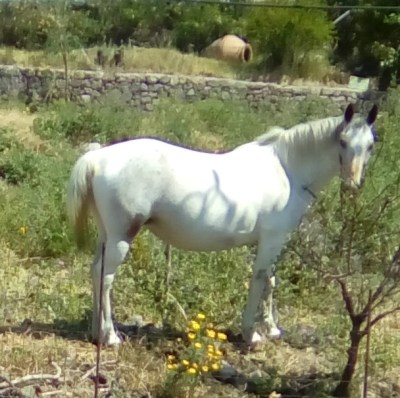
Imagine my surprise when, a few days ago, I looked out my window to see a dappled horse munching on flowers in the field across the street from my house. In the next days I got used to her being there. I would look for her in the mornings and at odd times during the day. Sometimes she was visible and sometimes she was not. When I could see her, I would open the window and call out, “Hello, white horse, you are very beautiful.” Once or twice she turned her head to look at me and seemed to respond, “Thank you for noticing.”
Many hundreds of years ago, Sappho must have had a similar vision in a field near a grove of trees where she and her students waited for the Goddess to appear, for she wrote: “In meadows where horses have grown sleek among spring flowers, dill scents the air.“ These lines are part of a longer poem addressed to Aphrodite that begins: “Leave Crete and come to us.” In this place, “incense smokes on the altar,” there is a stream, there are apple trees and rose bushes and horses in a field of flowers.
If theology is rooted in experience, how do we move from experience to theology? In my life there have been a number of key moments of “revelation” that have shaped my thealogy. One of these was the moment of my mother’s death.
In 1991 my mother was diagnosed with cancer. While she was being treated, I realized that I had never loved anyone as much as I loved her. When I wrote that to her, she responded that “this was the nicest letter” she “had ever received” in her life and she invited me to come home to be with her and my Dad.
My mother died only a few weeks after I arrived, in her own bed as she wished. She was on an oxygen machine, and I heard her call out in the dark of early morning. When my Dad got to the room, he tried to turn up the oxygen, but it didn’t help. Then he called the doctor who reminded him that my mother did not want to go to the hospital under any circumstances.
we need a god who bleeds now a god whose wounds are not some small male vengeance some pitiful concession to humility a desert swept with dryin marrow in honor of the lord
we need a god who bleeds spreads her lunar vulva & showers us in shades of scarlet thick & warm like the breath of her our mothers tearing to let us in this place breaks open like our mothers bleeding the planet is heaving mourning our ignorance the moon tugs the seas to hold her/to hold her embrace swelling hills/i am not wounded i am bleeding to life
we need a god who bleeds now whose wounds are not the end of anything
On the recent Goddess Pilgrimage to Crete, I visited the Historical Museum in Heraklion where I saw a beautiful embroidered silk panel of a mermaid identified only as having come from Koustogerako, a village in western Crete. As it is unlikely that a man in a Cretan village would have been talented in embroidery, in this case “Anonymous” most definitely “was a woman.”
In this thread painting a mermaid surrounded by fish is holding the anchor of a ship in one hand and a fish in the other. In Greece the mermaid is the protectress of sailors. In a well-known legend, a mermaid said to be the sister of Alexander the Great, emerges from the sea in front of a ship during a storm and asks: “Is Alexander the Great still living?” If the sailors answer, “Yes, he lives and reigns,” the ship is saved.
This blog was originally posted on December 1, 2014
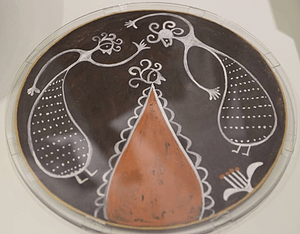
The image from an ancient Cretan bowl (c.1700 BCE) from the Sacred Center of Phaistos pictured here has often been interpreted as an early depiction of Persephone’s descent or rising. But are clues from later Greek mythology pointing in the right direction in this case?
Recently, my colleague Mika Scott posted the Phaistos bowl image on our Goddess Pilgrimage Facebook site in conjunction with the bee pendant from Mallia. This juxtaposition led me to think again about the importance of bees and pollination in agricultural societies and to offer an alternative reading of the symbolism on the bowl.






 Feminism and Religion