Brigid, the Celtic Goddess of Healing, Poetry, and Smithcraft, begins her reign on Imbolic, February 2, the midpoint between winter solstice and spring equinox. On this day the ancient Celts held their Fire Festival in honor of Brigid and the growing light. In Scotland, as recently as the mid-twentieth century, houses were cleaned and the hearth fires rekindled on February 2, to welcome in Brigid. Remnants of this festival are found in America today on Groundhog Day.
Like the Cailleach, She existed in many places and was known by many names. The Irish called her Brighde; she was Bride in Scotland, Brigantia in Northern Britain, and Brigandu in France. Some called her Brid, Brig or Brighid. Later she was transformed by Christianity into Saint Bridget. Her older name was BREO SAIGHEAD. Her name has various interpretations, many relating to fire – “Power,” “Renown” “Fiery Arrow of Power ” “Bright Arrow”, “The Bright One”, “The Powerful One”, “The High One” and “The Exalted One”.
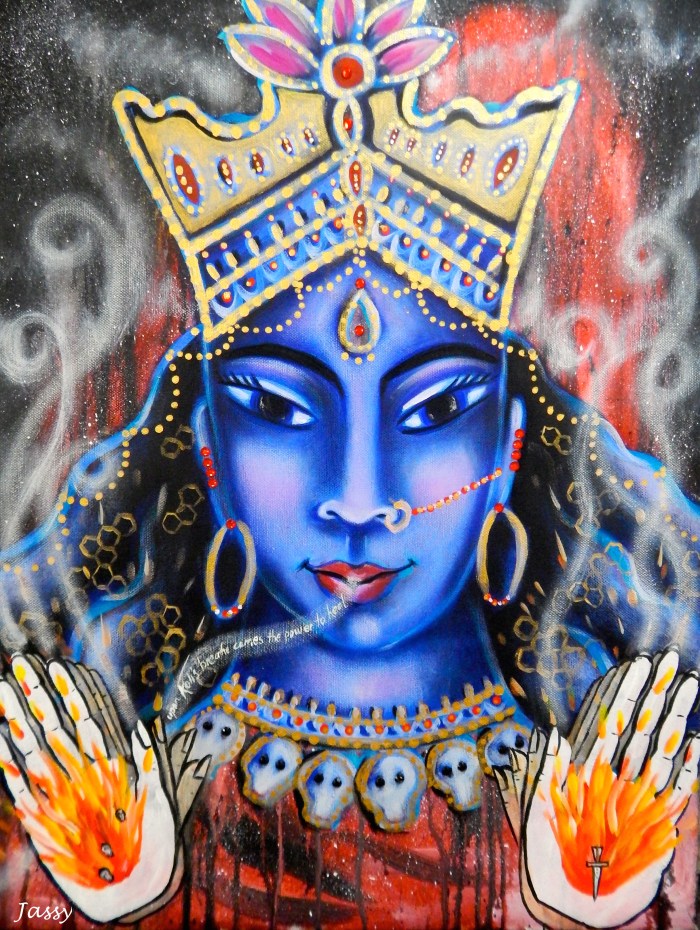
Kali Ma – She who carries transformation upon Her breath.
The recent backlash against women and feminism, highlighted by the Supreme Court decision overturning Roe v. Wade, has left many people asking: Is feminism dead? Or if it isn’t dead, is it lost? The decision dealt a blow to one of the most basic freedoms of women—control over their own bodies. In the rush to protect the life of embryos and fetuses, the lives of millions of women will be compromised if not lost altogether, especially poor and BIPOC women.
The Court is inflicting its right-wing views on a country that does not share its values; a majority of Americans support a woman’s right to abortion. “The “triumphal right,” says Susan Faludi in an interview with Michelle Goldberg, “has taken the gloves off and is pursuing a scorched-earth campaign against women’s most fundamental rights.” [i] And although the feminist movement cannot be reduced to the fight for reproductive justice (with issues such as maternity leave, equal pay, childcare, healthcare, etc., still on the table), banning abortion has become the tip of the patriarchal iceberg.
Before he told the story of how his people received the sacred pipe, Black Elk said:
So I know that it is a good thing I am going to do; and because no good thing can be done by any man alone, I will first make an offering and send a voice to the Spirit of the World, that it may help me to be true. See, I fill this sacred pipe with the bark of the red willow; but before we smoke it, you must see how it is made and what it means. These four ribbons hanging here on the stem are the four quarters of the universe. The black one is for the west where the thunder beings live to send us rain; the white one for the north, whence comes the great white cleansing wind; the red one for the east, whence springs the light and where the morning star lives to give men wisdom; the yellow for the south, whence come the summer and the power to grow.
But these four spirits are only one Spirit after all, and this eagle feather here is for that One, which is like a father, and also it is for the thoughts of men that should rise high as eagles do. Is not the sky a father and the earth a mother, and are not all living things with feet or wings or roots their children? And this hide upon the mouthpiece here, which should be bison hide, is for the earth, from whence we came and at whose breast we suck as babies all our lives, along with all the animals and birds and trees and grasses. And because it means all this, and more than any man can understand, the pipe is holy. [italics added]
In this passage Black Elk illustrates the multivalency of symbols: the sacred pipe does not have a single meaning, but many meanings, in fact, more meanings than anyone can understand.
The mad pre-Christmas rush of activity has passed and we find ourselves again in the quiet, dark and cold of winter. Winter Solstice, the longest night and shortest day of the year in the Northern Hemisphere, occurred last week. With a gain of only a few seconds of daylight each day in the ten days after Winter Solstice, we can take advantage of the stillness offered to seek within ourselves for the seeds laying dormant, waiting to be recognized and nurtured into fruition and manifestation.
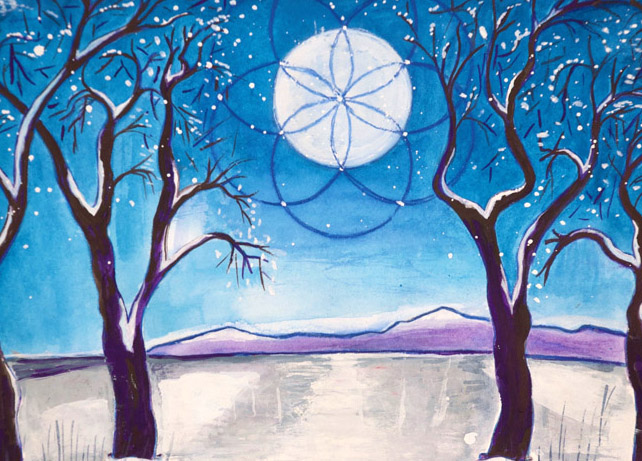
Bright Solstice Night by Judith Shaw
Having just finished all the pre-press and pre-order fulfillment of the first of the Animal Wisdom Oracle decks, now is the perfect time for me to work on seeds of my own – another project that has long been in the works. This project has gotten back burnered every spring for the past couple of years as I seem to need the dark of winter to complete the art. It’s a folk tale inspired by the ancient stories of the Reindeer Goddess. It’s a tale that honors the Sacred Feminine. The story is written and now I have the illustrations to complete. Here’s a little taste of what’s to come:
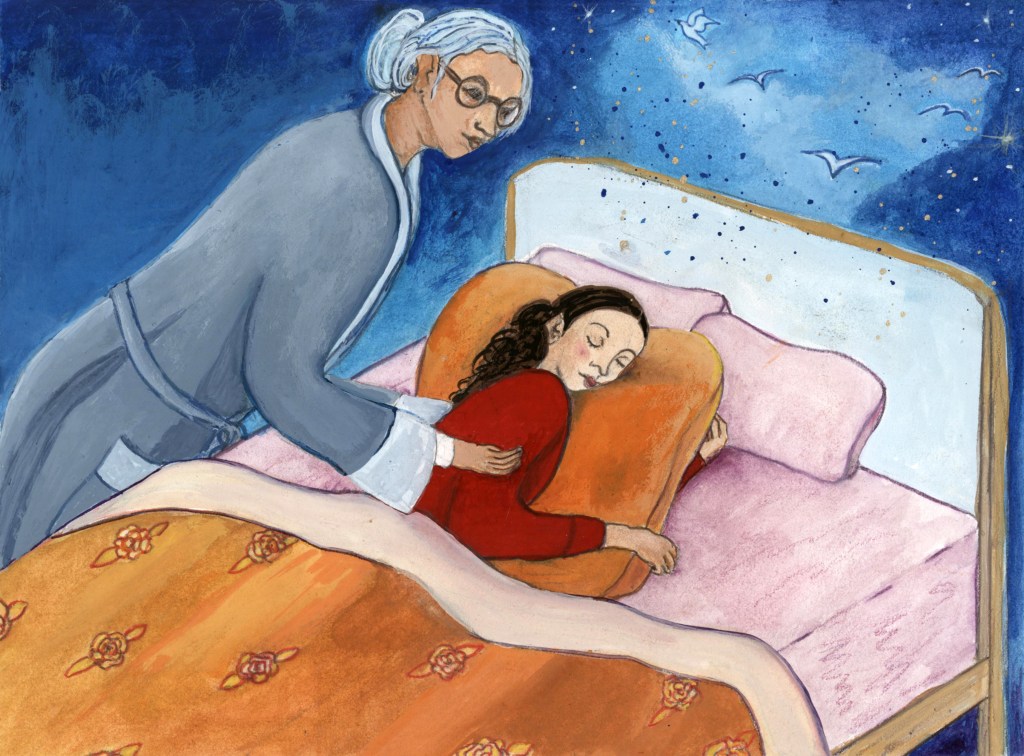
Elena and the Reindeer Goddess
Just before dawn on a cold winter morning, Grandmother woke up with a smile on her wrinkled face and a feeling of hope in her heart. She had had a dream, one that had come from her ancestors, and from her own deep knowledge. It was a dream of prophecy.
“The Reindeer Goddess returns,” Grandmother whispered to herself.
She threw back her quilts and rose, shoving her cold feet into soft wool slippers, and hurried to wake her granddaughter, Elena.
She rushed into Elena’s cozy little room, then leaned over her and shook her gently, saying, “Elena, Elena, wake up. Quickly Elena, there’s no time to lose!”
Elena opened her eyes and yawned. “What’s wrong Grandmother? What’s happened?”
“It’s more about what will happen,” Grandmother said. “Come, let’s put on our coats and boots and while we walk I’ll explain everything. I need your pure heart, your quick wit, and your strength.”
Elena and Grandmother bundled up against the cold and stepped outside. They began to trudge through the snow lying thickly on the ground, past little puddles here and there, glinting hard as stone in the light from a million stars.
Grandmother gathered her coat more tightly around her as she began telling Elena the story, her breath puffing out like mist in front of her.
“Long, long ago in the northern lands of snow and ice – the Old World of our ancestors – the Reindeer Goddess was alive in the hearts of the people. It was she who took flight on the Winter Solstice bringing understanding of the power that lies in darkness and of the hope that spring would return.
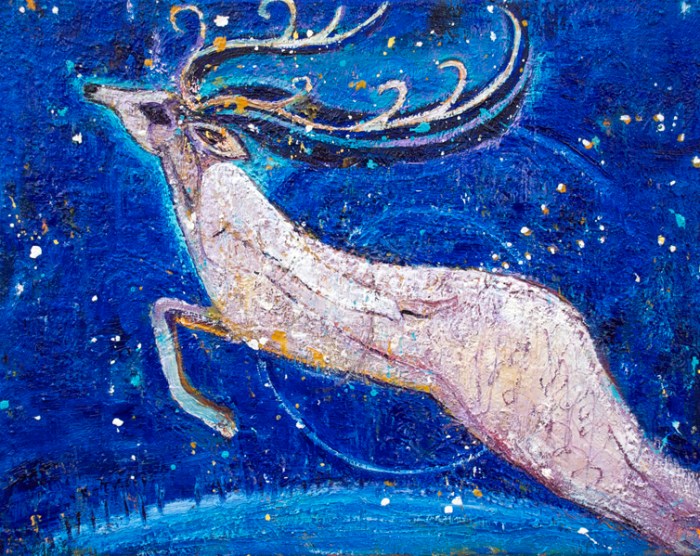
“Our people knew her as Reinna. Sometimes she was seen as a woman who flew through the skies in a chariot pulled by reindeer. At other times she was seen as a flying reindeer herself.
Flight of the Reindeer Goddess by Judith Shaw
Look for more excerpts over the winter months and discover how Elena helps the Reindeer Goddess accomplish her very important mission of love. The book should be ready for the printers by the end of summer – early fall 2024.
Reindeer are the only deer species in which the females grow antlers. And the females’ antlers are larger and stronger than those of male reindeer. So who was Santa Claus really and who were his flying reindeer?
As our ancestors were well aware of the need for balance, Stag – the male red deer indigenous to the UK – is also celebrated at this time. Stag, who grows a massive rack, is symbolic of the masculine power of regeneration, a messenger from the spirit world and one who leads humans to spiritual enlightenment. Males are called bucks in other deer species.
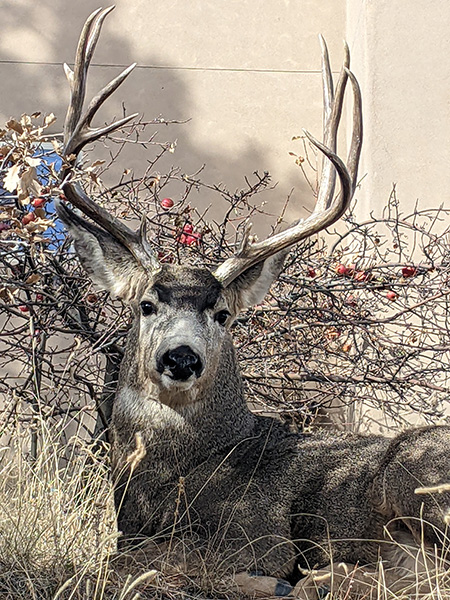
The racks found on bucks from other deer species during the fall rut are also impressive. I was lucky to see many mule deer during my Thanksgiving stay in the Jemez Mountains of New Mexico. Deer who wander into town are protected and thus not afraid of humans. This allowed me to get very close to this magnificent buck and capture his photo. He was not at all interested in looking at me so it took awhile to get this shot from just a few feet away.
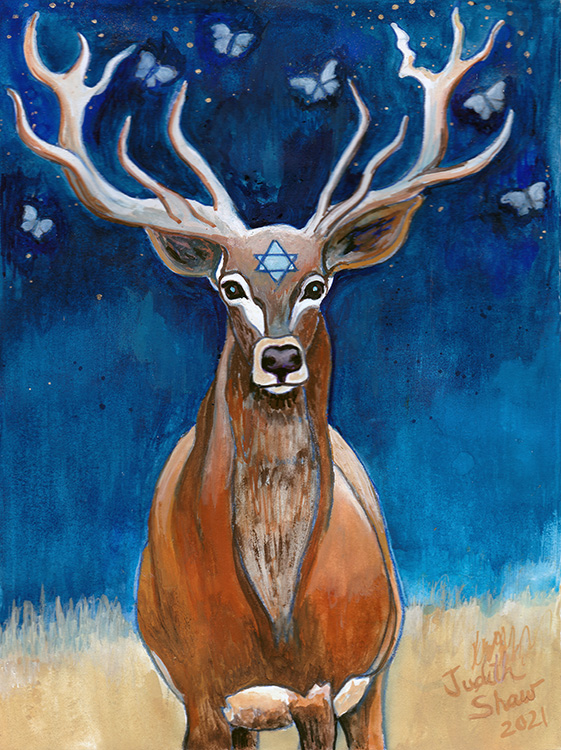
And finally I’ll share my painting of Stag with you all again.
May the Reindeer Goddess continue to nurture you with her love and gifts of abundance while Stag guides you to spiritual enlightenment.
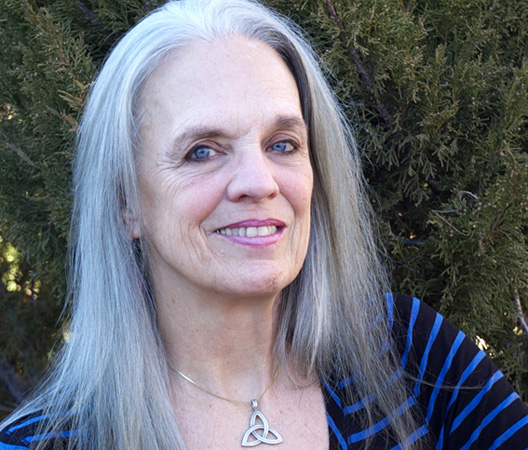
Judith Shaw, a graduate of the San Francisco Art Institute, has been interested in myth, culture and mystical studies all her life. Not long after graduating from SFAI, while living in Greece, Judith began exploring the Goddess in her art. She continues to be inspired by the Goddess in all of her manifestations, which of course includes the flora and fauna of our beautiful Earth. Originally from New Orleans, Judith makes her home in New Mexico, The Land of Enchantment.
When I became a feminist, I realized that somebody had to write all about this women’s art that was out there being totally ignored, and it was going to be me. And of course the ideas and the discoveries about what women’s art was……. I look at it for the information it gives me about women’s imagery, women’s psyches, women’s lives, and women’s experience.”
I have been making art, masks, and theatre about “surfacing” for a very long time. As a child I was always digging at the roots of trees, fascinated by their interwoven strength, wondering how far down they went. That fascination never really left me. Sometimes it occurs to me that I and most of my colleagues are “spiritual archeologists”, sorting through artifacts and the mythic overlay of the past to re-discover and re-vitalize the present. I joined many of those colleagues for over 20 years: un-earthing, re-inventing, and animating stories of the Great Goddess throughout world culture with the Masks of the Goddess Project (1999-2019), among other collaborations. I am not religious, so much as I am a mythologist, following archetypal trails of myth back and back, seeking the sacred source they often reveal.
Thirty years ago, Carol P. Christ founded her Goddess Pilgrimage to Crete, which she wrote about in her book A Serpentine Path: Mysteries of the Goddess (original 1995 title Odyssey with the Goddess) and in numerous posts on this site over the years. She led over 40 groups of women Pilgrims to encounter the history and sacred sites of the peaceful, egalitarian civilisation of Bronze Age Crete.
Here, the Goddess-honouring culture of Old Europe survived the longest, when patriarchal Indo-Europeans were taking over in the ‘Kurgan waves’ Marija Gimbutas has described. The sophisticated artworks of ‘Minoan’ Crete show women in positions of honour and authority, and do not depict violence, slavery, or war. People celebrated at ceremonial centres, made offerings at cave and mountain shrines, and worshipped the Goddess in sacred trees and stones.
As many readers know, before Carol passed away, she asked me to take on the leadership of her Goddess Pilgrimage, and to serve as her literary executor and the director of her Ariadne Institute for the Study of Myth and Ritual. Deeply moved by her trust in me, and guided by very clear dreams I received around the time of her death, I accepted Carol’s request. In October 2022, after a three-year delay due to the pandemic, the Goddess Pilgrimage to Crete was reborn.
Image from an Egyptian tomb ca. 1314-1200 BCE. Isis is giving nourishment in the form of fruit and drink,
In many cultures of the world, including our own, trees are considered the ancestors of humanity – own our ancestors.
Trees are connected with great goddesses throughout antiquity. We see this in the bible where, as I’ve noted before, the Tree of Life is Eve’s tree for the word Eve means life. It is, in essence, the Tree of Eve. Goddesses in trees feeding humans were common themes in ancient Middle Eastern art. The tree was Hers to give freely of as she wished.
Anthropologist and religious scholar, Mircea Eliade writes extensively about the associations of trees ancestral connection to humans. He calls them both mystical and mythical.[1] His examples include the Miao groups of Southern China and Southeast Asia who “worship the bamboo as their ancestor.” He also notes Australian tribes who view the mimosa as their progenitor. And there is a tribe from Madagascar, called Antaivandrika which means “people of the tree,” who considered themselves descended from the banana tree.
The path leading to the Klapados Waterfall begins at the edge of an open meadow in the pine and oak woodlands of a mountain in the island of Lesbos. After driving several miles on a very rutted dirt track, we parked under an oak tree, crossed the meadow and scrambled down a winding path. After about 20 minutes, it ended at a stream surrounded by plane trees. From there, we climbed over rocks to reach a pool created by the seasonal waterfall.
On the day we visited it, the waterfall was only a trickle of cascading drops that moistened its moss-covered path to the pool. The roots of a plane tree growing at the top of cliff followed the path of the water, weaving a web over the rockface all the way down to the pool.
Not too long ago I heard someone deride members of a seminar who were building labyrinths in the olive groves of Greece as “a bunch of tree-huggers.” I bristled! I probably first heard of the Chipko tree-hugging movement which is led by women in the 1970s and 1980s. Because I love nature, I naturally assumed hugging trees is a good thing. Originally, I had no idea that the tree-hugging movement was about much more than saving trees from being felled in the interests of short-term profit.
I did not know that the deeper purpose of the movement is to save a way of life based on forest-culture that is being threatened by the imposition of western ideas and practices promoted by colonialism and its successor, the green revolution. Nor did I know that the traditional forest-culture of India is the provenance of women: more than 4000 years of observing and experimenting created a “women’s knowledge” passed down from mother to daughter.
A Modern Pilgrimage to the Isle of Lewis & Harris, Part 2
In the previous post of October 14th, I introduced my recent pilgrimage to meet the Goddess, honour the physical and psychological changes that have happened inside me recently. I described the different mountain ranges that resembles the bodies of sleeping women, and an ancient well dedicated to the Celtic goddess Brighde.
If I was traveling over the body of the goddess, the Callanish Standing Stones would be her navel. It seems as if energy is flowing out from there to all edges of the island. The shape of the site resembles a Celtic cross. Unusual is that the site consists of one large, central standing stone, surrounded by 13 stones, and with stone avenues to the cardinal directions. With its solar alignment, paraphrasing Jill Smith, the configuration looks like a cosmic dancer who juggles the sun from east to west. The “arms” are aligned exactly with the sunrise and sunset at this time of year.
Model of the Standing Stones as seen from above, in Callanish Visitor Centre
Callanish 1, the main stone circle, is connected to 11 other sites across the island, some circles, some solitary standing stones. Together they are called the Callanish Complex. I visited Callanish 1 many times that week, and I was lucky to spend the Autumn Equinox there.
I’ve never come across stones that were so alive and expressive. Light would bounce off differently at different times of the day, accentuating irregularities, dulling, or sharpening edges, emphasising different aspects. I saw lion and wolf heads, young maidens, hooded wanders, gargoyle and dragon-like creatures, dolphins and even a Horned Dancer… Most importantly, it felt like in each of the stone circles in the area (Callanish 1, 2, 3, 4, and 8), there was at least one stone resembling a woman’s body, and I came to think of them as the Grandmother Guardians. They had a real living presence, that became even stronger as the day-visitors disappeared.
Usually there were 2-5 people there, sometimes I found myself alone. The sunset of the Equinox, however, drew many more people. There were about twenty tourists, who were taking snapshots of this magnificent light show, leaning, or pushing against the stones, talking, and giggling. Several professional photographers tried to capture a magical moment. And there were 5-7 fellow pilgrims, whom, like me, would stay long into the night. Everyone was so focused on the sunset, was I the only one who noted the rainbow in the east?
The below images were literally taken a minute apart – rainbow to the east, sunset and silhouettes to the west.
Rainbow during the Sunset at Callanish 1, on the Autumn Equinox, September 22, 2022Sunset at Callanish 1, on the Autumn Equinox, September 22, 2022
Eventually the tourists and photographers disappeared, and the rest of us gathered at the heart of the circle, in the remains of an ancient burial mound. With African and shamanic drums, a whistle, a singing bowl, an old man tapping his walking stick to the bottom of his tin mug, and some rattles, we improvised a rhythmic invocation to the spirits of the stones. With the rain becoming heavier, I soon found myself alone with the stones. Now I could finally sing, dance, weave between the stones without disrupting anyone, lean into the stones, close my eyes, and pray.
I felt very aware of the ‘balance’ in the year, the point of equally long days and nights. I asked for guidance on balance in my own life: between work and leisure, between doing and resting, between the first and second half of my life, between gathering wood for the fire and sharing it, between birth and death, and how I can better look after my body and energy living with an invisible auto-immune condition in these fast and demanding times.
After the rain departed, the clouds tore open, revealing the clearest and most brilliant night sky I’ve ever seen. The silhouettes of the stones reaching up into the night was truly magnificent. Moving, weaving, pausing, I made my way clockwise around all the 13 stones in the circle. I stood at either side of the stones, outer and inner, and took my place in between them, as if I was a moving stone myself. I reflected on centre and circumference, on axis, on direction, on the wheel of life, turning, turning, turning, turning… and felt connected to similar circles across Europe lighting up in the darkness, as a radiant hub of energy-places.
Photo Collage: Impression of Night Sky, by Eline Kieft October 1, 2022
After having completed my weaving of the circle, by which time I had enjoyed half of my ginger tea for a warm kick, I decided to return to our cottage – also an act of balance. Having a cold already, I did not quite have the proper gear to stay out in the windy and rainy night. My lovely bed was calling! On my way home I saw three deer next to the road. I stopped the car and could be with them for several moments before they wandered off.
I had been so attuned to the rhythms that I woke up well before the alarm. I laid in the comfortable darkness, until it was time to return to the stones to witness the sunrise. My mom came along this time. Again, there were several photographers ready for ‘the moment’ (no tourists at this hour!). I just HAD to dance, and chose my spot at the far western end, out of line of any cameras. A dance of ground, earth, mountain, honouring the mother and my mother, weaving the light, the turn of seasons, changing, praying, calling, giving thanks, celebrating, welcoming, and letting go. Strong, soft, vibrant, still…
Both Images of Sunrise at Callanish 1, on the Autumn Equinox, September 23, 2022
Standing against the central menhir, looking east, we finished the last of the ginger tea. So special to be able to share this together. Mother and daughter in a circle of ancient Grandmother Guardians, witnessing the sun rise on a new day. Sacred land, ongoing cycles of time, and a modern-ancient pilgrimage…
It will take many moons to fully digest and integrate the richness of this journey, but I already know this precious experience seeped deep into my bones.
May the magic of the land touch you too, wherever you are.
Mother and Daughter – this photo was in fact taken at another moment, against another stone, mid-afternoon on 22nd…
I’d love to invite you for my series of Embodied Spirituality Masterclasses that are going to start today, 21st October! Have a look if you’re interested in reconnecting body and spirit, re-anointing the body as sacred, nature as a temple, contemporary ceremony and much more… You can still join until Christmas, so don’t worry if you can’t make the first session live, it will be available in replay!
Jill Smith is a deep well of goddess lore on Lewis:
Mother of the Isles (2003)
The Callanish Dance (2000)
Bio
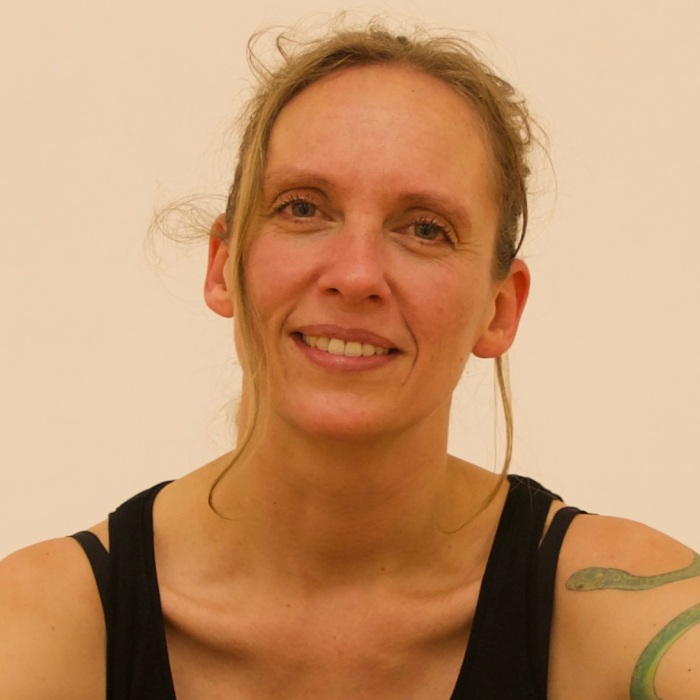
Eline Kieft danced from a young age, including rigorous classical and contemporary training to become a professional dancer. She then studied anthropology, deepening her fascination with worldwide similarities between indigenous traditions regarding intangible aspects of reality and other ways of knowing, including embodied epistemologies and shamanic techniques.
She completed her PhD in dance anthropology at Roehampton University, trained in depth with the Scandinavian Centre for Shamanic Studies and the School of Movement Medicine. Eline worked at the Centre for Dance Research (C-DaRE) at Coventry University for five years, where she created a Somatics Toolkit for Ethnographers, and pioneered soulful academic pedagogy. Her recent book Dancing in the Muddy Temple: A Moving Spirituality of Land and Body was well received as a unique blend of theory and practice and a medicine for our times.
She is now a full-time change-maker and facilitates deep transformation through coaching and courses both online and in person. Her approach The Way of the Wild Soul offers a set of embodied, creative, and spiritual tools to re-connect with inner strength and navigate life’s challenges with confidence.