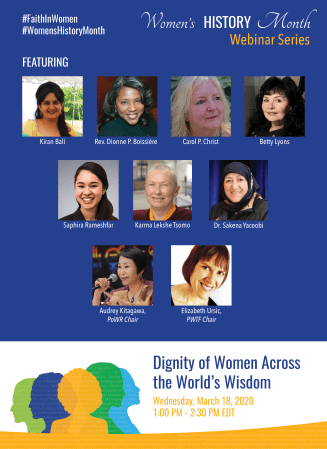
Dignity of Women Across the World’s Wisdom: Parliament of World Religions Webinar by Carol P. Christ

I have been asked to post my contribution to the Parliament of World Religions Webinar: Dignity of Women Across World’s Wisdom. 
I am participating in this discussion as a representative of women who are on a Goddess path. I do not represent any established or newly formed religious or spiritual tradition. Rather I speak for an increasingly large number of women who are seeking alternatives to established traditions that celebrate and legitimate male power as power over or domination. We do not follow leaders or gurus and we place no trust in any sacred texts.

Most of us have grown up in cultures where the most prominent religious traditions feature male Gods, male teachers, and male religious leaders. We agree with Mary Daly who said that when God is male the male is God. In traditions where God is male, male teachers and religious leaders are viewed as reflecting or being in the image of the male divinity. We do not assume that images of God as male are never valid, but we do assert the need for images of God as female.

As I said in my often re-published essay, “Why Women Need the Goddess,” the most important meaning conveyed by the symbol of Goddess as the ultimate creative power in the universe is that female power is legitimate and good. This does not mean that female power is always good, but it clearly undermines the widely held view that female power exercised apart from male control is always evil or bad. This view is reinforced by images of women as evil in religious traditions, for example, Eve seduced by the snake. Continue reading “Dignity of Women Across the World’s Wisdom: Parliament of World Religions Webinar by Carol P. Christ”

Insights on Sisterhood: An Offering to the Great Goddess by Eirini Delaki

I have been facilitating women’s circles in Europe since 2006. This has involved years of deep, challenging, thankful, and fun teaching and learning. During that time, I have collaborated with different facilitators in the fields of art and spirituality and connected with different cultures, experiences that have reinforced a vision of SISTERHOOD.

Let me clarify that in no manner am I excluding men from these reflections. On the contrary, I believe that many dysfunctional and suffering men have been shaped by women who haven’t managed to stand up for themselves. They harm their children through manipulation while not directly challenging an oppressive system out of fear or a need to feel accepted and to belong.

My students and I are going through an important transition. Most of us come from parents who have spent their lives seeking material possessions, safety, comfort, and success in terms of competition enforced through harsh discipline. Then we moved to the other extreme: we have a reactive attitude towards the previous patterns that is manifested as procrastination, avoidance of tasks that involve responsibility towards ourselves and others, being too permissive, confusing freedom with doing whatever feels right at the moment, and so on. Continue reading “Insights on Sisterhood: An Offering to the Great Goddess by Eirini Delaki”

Matriarchies Are Not Just a Reversal of Patriarchies: A Structural Analysis by Heide Goettner-Abendroth

Matriarchies are not just a reversal of patriarchies, with women ruling over men – as the usual misinterpretation would have it. Matriarchies are mother-centered societies. They are based on maternal values: care-taking, nurturing, mothering. This holds for everybody: for mothers and those who are not mothers, for women and men alike.

Matriarchal societies are consciously built upon maternal values and motherly work, and this is why they are much more realistic than patriarchies. They are, on principle, need-oriented. They aim to meet everyone’s needs with the greatest benefit. So, in matriarchies, mothering – which originates as a biological fact – is transformed into a cultural model. This model is much more appropriate to the human condition than the patriarchal conception of motherhood which is used to make women, and especially mothers, into slaves.

Within matriarchal cultures, equality means more than just a levelling of differences. Natural differences between the genders and the generations are respected and honoured, but they never serve to create hierarchies, as is common in patriarchy. The different genders and generations each have their own dignity, and through complementary areas of activity, they function in concert one other. More precisely, matriarchies are societies with complementary equality, where great care is taken to provide a balance. This applies to the balance between genders, among generations, and between humans and nature. Maternal values as ethical principles pervade all areas of a matriarchal society. This creates an attitude of care-taking, nurturing, and peacemaking. Continue reading “Matriarchies Are Not Just a Reversal of Patriarchies: A Structural Analysis by Heide Goettner-Abendroth”

Spiritual without a Tradition and Feminist to the Core! by Carol P. Christ

In “Who Owns the Sacred?” Eline Kieft, who was raised Protestant and considers nature and the ancestors her teachers, noted that those of us who have left the Christian tradition but who have not signed on to another tradition are often demeaned; she writes:

any form of spirituality outside the five major religions is considered as empty, eclectic, post-modern consumerist product that lacks meaning and substance because of its diluted, selective ‘picking’ of traditions from other times and contemporary contexts.

I have heard this criticism from feminists and non-feminists alike.

Since 9/11, Christian feminists have questioned the widespread assumption that Christianity is the only true or important religion. However, recognition of religious diversity among Christian feminists is frequently limited to the 3 so-called Abrahamic traditions. More rarely Buddhists and Hindus are included. In either case, religious diversity is defined in terms of the 5 so-called “great”—and patriarchal–religious traditions: Christianity, Judaism, Islam, Hinduism, and Buddhism. Ironically (or not!) the recognition of religious diversity among feminists serves to underscore the notion that the only legitimate feminists in religion are those who are working to transform patriarchal religions. Continue reading “Spiritual without a Tradition and Feminist to the Core! by Carol P. Christ”

Let’s Try Creativity This Year by Barbara Ardinger

As usual, I’m writing my post a couple weeks before you’ll be able to read it. I bet we’re all wondering in mid-December if 2020 is really gonna happen. Will we still be living in a civilization? Will there still be wild animals (outside of zoos)? Will trees and other plants still be growing? Well, my friends, if we all woke up last Wednesday and opened our eyes and it’s all still here……hooray!

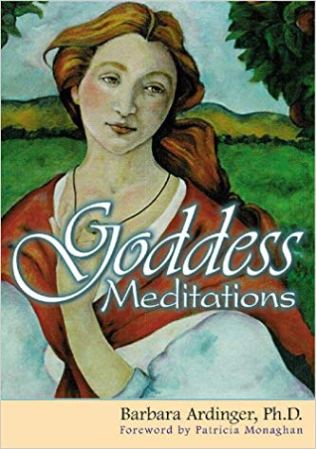
Way back in 1998 I wrote a book called Goddess Meditations. It was the first-ever book devoted to guided meditations centered only on goddesses. No gods. No empty minds or asanas. Goddesses, some well known, others obscure, from many pantheons. One chapter in the book is “Chakra Goddesses,” in which I assigned a goddess to each of the seven major chakras. The goddess of the throat chakra—which rules clear communication, self-expression, and creativity—is Sarasvati. Here (with comments that pop out of my mind and into my fingers as I type) is part of what I wrote about communication.

Continue reading “Let’s Try Creativity This Year by Barbara Ardinger”

My Feline Familiars by Joyce Zonana

When I made my breakfast, Ginger watched and waited for his own; when I worked at my desk, he slept beside me or walked across my keyboard; when I relaxed in front of the TV in the evening, he immediately jumped onto the couch and curled up in my lap. I prided myself on living alone, on my solitude—but in fact I was never alone. The cat was a constant presence in my life, a silent witness to all my actions, my deeply intimate, silent companion.

jz-headshotSixteen years ago, I was living alone in New Orleans in a lovely Craftsman’s Cottage I’d purchased the year before. In late December—just around now—a friend called to tell me about a kitten she’d seen at her Uptown veterinary office: “It’s time you got a familiar,” she declared. “I think this one’s perfect for you.” Grudgingly, I agreed to visit the vet’s office and take a look at the little black-and-white female tabby she’d seen. I wasn’t at all sure I was ready, but Mary was my priestess, the leader of our small coven, and I trusted her implicitly.

I’d lost two beloved cats—Charlie and Lisa—a few years earlier, cats who’d made the journey with me from Philadelphia—where I earned my Ph.D.— to Oklahoma—where I had my first teaching job— to New Orleans—where I’d been teaching since 1990. Charlie and Lisa had been a sort of ballast, accompanying me through huge changes of circumstance and locale, loving me and letting me love them no matter what. I’d nursed Charlie through several years of diabetes, giving him daily insulin injections, and my partner had regularly administered subcutaneous fluids to Lisa after she’d been diagnosed with kidney disease. Charlie died in our arms, and we buried him in the backyard behind my little cottage near Bayou St. John; Lisa died less gently, but she too was buried with great ceremony behind the house we later shared. Continue reading “My Feline Familiars by Joyce Zonana”

Tlachtga, Forgotten Celtic Goddess – by Judith Shaw

judith shaw photoI am the Sun – bringer of the warming light of day. I am Lightning –  bringer of fire to Earth. I am Tlachtga who flew through the sky together with my father Mog Ruith in our glowing wheel. I am destruction and creation. I illuminate the darkness and point to the pathway of light that resides in each of you. Over time I made my final resting place at the Hill of Tlachtga, where the great fire ritual of Samhain is practiced, reminding the folk of the promise of Sun’s return at the end of the time of darkness and dreaming.  

  Continue reading “Tlachtga, Forgotten Celtic Goddess – by Judith Shaw”

Let Us Now Practice Her Presence by Barbara Ardinger

I’m giving you a twofer this month: a poem and a ritual. I’m writing this a few days after the latest mass shooting in Texas by a crazy white man and a few days before the next debate by Democratic candidates. But you know what? I’m getting real tired of politics and…well, what’s going on around us. Tweets. Bullets. Fires. I’m a liberal, but I’m deciding that there must be a better definition of “conservative,” one that has nothing to do with politics. The OED defines “conservation” as “the action of conserving; preservation from destructive influences, decay, or waste.” Further down: “conservative: a preserving agent or principle.”

Back in the late 80s and into the 90s, I taught a class I called Practicing the Presence of the Goddess, which evolved into a ritual circle. As far as I know, most of the women in the class are still spiritual feminists (though the term hadn’t been invented then), a couple have died (cancer is an awful thing), and one is fading into dementia (but she still remembers our class). Among other assignments, I asked them to read Carol Christ’s splendid book Laughter of Aphrodite (1987), and once we went as a group to hear Marija Gimbutas speak on her newest book The Civilization of the Goddess (1991).

Continue reading “Let Us Now Practice Her Presence by Barbara Ardinger”

Harriet Boyd Hawes, Marija Gimbutas, and the Religion of Ancient Crete by Carol P. Christ

One of the projects I am working on these days is an essay on the religion of ancient Crete for a series of books on various aspects of the Minoan site of Gournia.

Harriet Boyd excavated the Minoan town of Gournia in 1901-1904. She was one of the first woman archaeologists and the first woman to run her own excavation in Crete, to be followed by Edith H. Hall whom she trained. She was also the first to excavate a Minoan town as opposed to a “palace,” providing the first evidence of daily life in Minoan Crete. Harriet Boyd might have continued to excavate in Crete, but her marriage in 1906, followed by the birth of her son soon thereafter, caused her to lose interest in a career as an excavator. Nonetheless, she published the results of her excavations in her book Gournia in 1908 and taught at Wellesley College until she reached retirement age.* Continue reading “Harriet Boyd Hawes, Marija Gimbutas, and the Religion of Ancient Crete by Carol P. Christ”

We Are Not Alone: Embodying and Re-enacting Ancient Wisdom by Carol P. Christ

A few nights ago, on the way to dinner, two friends and I passed by a small church near the old fortress in Ierapetra, Crete. The liturgy was broadcast via microphone and a crowd of people gathered outside the church. “Must be some kind of name day,” one of my friends commented, but I could not think of a saint celebrated on August 1.

We decided to light candles and make our prayers. I asked one of the Greek women the reason for the ceremony. “This is the first night of our celebrations for the Panagia,” she responded, referring to the Assumption of Mary that would occur on August 15. I looked around and saw that indeed many of the women were wearing black. “Of course,” I thought to myself. Continue reading “We Are Not Alone: Embodying and Re-enacting Ancient Wisdom by Carol P. Christ”