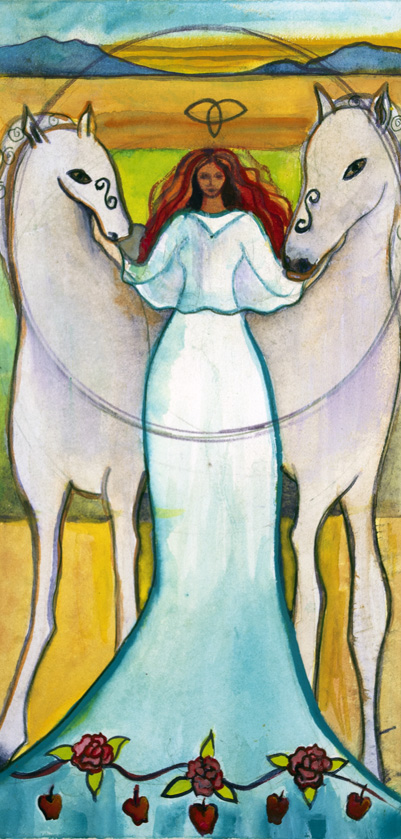
Thank You, Goddess By Barbara Ardinger

Actually, it’s very hard to say what the Goddess is. She’s ineffable. She’s both abstract and concrete at the same time. She created the universe, but she also brings destruction to beings and things whose time has ended. Even as she is (perhaps) the earth embodied and is (perhaps) a sort of universal spirit of loving-kindness and is (perhaps) the powers of life, death, and rebirth, she is as global as the oxygen we must breathe to live.

I do my end-of-the-month spending tables and balance my checkbook and find that there’s enough for me to send donations to politicians and nonprofits I want to support, like the Brady Campaign to Prevent Gun Violence. I write a couple checks, put stamps on the envelopes, and as I drop them in the mailbox, I say, “Thank you, Goddess.” Everybody who lives in Long Beach knows there is no place to park in the whole city. I rent a parking space in a driveway across the street. Thank you, Goddess. I have nice little chats with strangers in adjacent seats during the intermissions of Les Miserables and Spamalot. Thank you, Goddess. I’m breathing every day, I live with two friendly cats, I earn my living doing something I enjoy doing and that’s useful to the people I do it with. Thank you, Goddess.

Does the Goddess run my life? Not the way you may be thinking. Please don’t think I think the Goddess is a big fat woman wearing a crown and sitting on a big fat throne up in the sky and sending little goddessettes and superheros and superheras down to earth to chase editing clients to me, puff my lungs full of oxygen, and carefully arrange that I sit next to nice folks at the theater or find places to park when I need them. (I have a Magic Parking Place Word for that last item.) That’s not the Goddess. She’s not the Boss of the Universe, she doesn’t live “up there,” she doesn’t dictate how I should live my life. Continue reading “Thank You, Goddess By Barbara Ardinger”

Death of a Priestess by Geraldine Charles

Dusk was falling and mist rising as I drove sadly across the Somerset Levels – a liminal place which once formed the huge marshy lake out of which the Isle of Avalon majestically rose.  When I rounded a bend to see a large swan walking straight up the centre of the road in the same direction I was going, my first thought was for its safety.  I expected it to take flight or veer off at any moment, but the swan continued on its path, seemingly determined to walk just where it was. The road was narrow and all I could do was respectfully follow until it widened a little, eventually managing to squeeze carefully past before starting to flash my headlamps at oncoming traffic to warn them of the swan’s unlikely presence.

Only later that evening did I remember the last time I saw such a stately walk in front of a moving vehicle – when a formally-dressed funeral director led off the hearse which carried my father from his home and on his last journey in this world.  I was thunderstruck. Could the swan be marking this new loss, making me mindful and slowing me down? Continue reading “Death of a Priestess by Geraldine Charles”

Does Terpsichore Tapdance? By Barbara Ardinger

Goddesses of art and inspiration, the Muses gave their name to our museums, where they are (or should be) worshipped. I feel a special devotion to them. … The ones I really like, though, are the theatrical Muses—Euterpe, Thalia, Melpomene, and Terpsichore, plus maybe Calliope and Errato. I was a drama major (and possibly a drama queen) in college…. Today, I go to the theater as often as I can.

Although my greatest devotion is to the Great Goddess, who is said to have ten thousand names, I find myself more and more adoring the Muses: 

  • Clio, “Fame-giver,” ruler of history and shown with an open scroll
  • Euterpe, “Joy-giver,” the lyric Muse who plays the flute
  • Thalia, famous for her comic mask and wreaths of ivy
  • Melpomene, wearer of the tragic mask and vine leaves
  • Terpsichore, “Lover of dancing,” who carried a lyre and ruled choral music as well as dance
  • Errato, “Awakener of desire,” ruler of erotic poetry
  • Polyhymnia, “Many hymns,” shown as the meditating inspirer of hymns
  • Urania, “Heavenly,” ruler of astronomy who carries a globe
  • Calliope, “Beautiful-voiced,” ruler of epic poetry who carries a tablet and a pen[1] Continue reading “Does Terpsichore Tapdance? By Barbara Ardinger”

The Mago Hedge School: Why Remember Mary Daly? By Helen Hye Sook Hwang

Prologue

By writing this, I do not intend to defend Mary Daly’s position in any dispute. A controversial figure, Mary Daly never let go of her fight with those whom she thought on the other side of her feminist war. Like anyone else in history, Mary Daly belonged to her time and culture, and I leave her unresolved issues up to her. What I write here is my fond memory of her, whose feminist thought left an indelible mark on my being as well as humanity as a whole. Daly’s contribution remains to be reassessed from the fresh eye of new generations. In the meantime, I begin to speak for my part. Without Mary Daly’s thought, I would not have been in this place where I stand right now. It has empowered me to actualize my dreams to the fullest as a wo/man who was born and raised in Korea but had come from the One Home in origin.

I first hear of the hedge school
“Have you heard of the hedge school, Hye Sook?” asked Mary. “No, I haven’t heard of it,” I answered. This conversation took place during the conference called the Feminist Hullaballoo held in Santa Fe, New Mexico in 2007. We met there and spent three days as chums. Mary was with another friend, Yvonne Johnson, so the three of us hung out together. It was a very special time for me – I felt as if I were wrapped up in the eye of the storm. (In fact, my life feels so.) At the conference, someone asked me how I came to be invited as a featured speaker. I was among such renowned feminist speakers as Sonia Johnson, Paula Gunn Allen, and Mary Daly herself. They felt like giants to me. I told her that Mary Daly invited me. Mary had asked me if I would like to go and speak at that conference. I did not have an inflated ego. I would not have been hurt if I were not chosen. But I said “Yes” without hesitation. At the time, it felt like another one of the many “outlandish” adventures that I had undertaken throughout my life. In retrospect, however, this was a very special “Yes” to the beginning of my life’s new phase.   Continue reading “The Mago Hedge School: Why Remember Mary Daly? By Helen Hye Sook Hwang”

Why are We Drawn to the Black Madonna? by Judith Shaw

judith Shaw photoOnce the opportunity came my way to spend two weeks with my sister in Paris, I knew I had to visit the Black Madonnas at Chartres.  I had been to Chartres many years ago,  before I knew about the Black Madonnas scattered throughout Europe.  I felt the power of the site at that time, but had little understanding of where that power came from.

History of the Black Madonna 

Isis

The indigenous goddess worship of Europe, was influenced by Phoenician traders who introduced statues of dark skinned African and Middle Eastern goddesses such as Isis, Inanna, and others to the European continent from 1550BC to about 300BCE.  The worship of these goddesses continued  with The Roman invasion of Gaul (France) and other parts of Europe.

Once Christianity took hold in Europe, churches were built on top of sacred pagan sites. But old ways die hard; many of these dark skinned goddesses were incorporated into the newly built Christian churches.  Today there are more than 500 known Black Madonna statues and paintings throughout the world, the majority in France. Continue reading “Why are We Drawn to the Black Madonna? by Judith Shaw”

Reading Plato’s Allegory of the Cave as Matricide and Theacide by Carol P. Christ

When I read Plato’s allegory of the cave as an undergraduate, I was told it had something to do with the idea that the “form” of a table is more “real” than the table itself. I must confess that I had no idea what this could possibly mean.

As a graduate student, I struggled with philosophical and theological ideas rooted in Platonism.  Rosemary Radford Ruether named the flawed worldview created by a “classical dualism” that separates mind from body, spirit from the world, rationality from emotion, and male from female.  Her ground-breaking essay “Mother Earth and the Megamachine” clarified the difficulties I was having.

Western philosophy, described by Alfred North Whitehead as a series of footnotes to Plato, had gotten off on the wrong foot. At its very beginnings, western philosophy had attempted to sever mind from the body and nature, alleging that “man’s true home” was not life in the body on planet earth. Continue reading “Reading Plato’s Allegory of the Cave as Matricide and Theacide by Carol P. Christ”

Visions of My Grandmother by John Erickson

“I never told my grandmother I was gay. I’ve often wanted to visit her grave, clench my hands together, and pray that she forgive me for betraying the trust she instilled upon me long ago. However, even today, I cannot bring myself to make that trek, up the hill into the countryside where her ashes lay below the ground.”

I haven’t dreamt of my grandmother since her passing one hot summer July evening.

The night, and the days that followed, continue to be a blur.  However, as my family members continue to see her in their nightly visions, I, go on unabatedly longing to see and hear the voice of a woman who made me feel the presence of the divine with each passing story.

My sister saw her in a dream when she was buying shoes, my mother has seen her multiple times when she would be undergoing a particularly stressful situation, and I, left alone and oftentimes wondering through an abyss of loneliness and disarray, wake up each morning wondering why, I am left all alone. Continue reading “Visions of My Grandmother by John Erickson”

Why a Goddess Pilgrimage? by Carol P. Christ

What is a Goddess Pilgrimage and why are so many US, Canadian, and Australian women making pilgrimages to ancient holy places in Europe and Asia?  The simple answer is that women are seeking to connect themselves to sources of female spiritual power that they do not find at home.

Traditionally pilgrims leave home in order to journey to a place associated with spiritual power.  “Leaving home” means leaving familiar physical spaces, interrupting the routines of work and daily life, and leaving friends and family behind.  For the pilgrim, “home” is a place that has provided both comfort and a degree of discomfort that provokes the desire to embark on a journey.  The space of pilgrimage is a “liminal” or threshold space in which the supports systems of ordinary life are suspended, as Victor Turner said.  A pilgrim chooses to leave the familiar behind in order to open herself to the unfamiliar—in hopes that she will return with new insight into the meaning of her life.  Continue reading “Why a Goddess Pilgrimage? by Carol P. Christ”

Who is She? The Existence of an Ontological Goddess By Molly

I do feel Her presence directly in my life—call it an energy, call it the sacred feminine, call it the divine, call it source, call it soul, call it spirit, call it the great mystery…I perceive a web of relatedness and love within the world and I choose to put a feminine form to that energy—to name it and know it as Goddess.

To me, Goddess is found in the act of specifically naming that ineffable sense of the sacred that we all, universally, experience or perceive at some point during our lives. Whether it be in gazing at the ocean or in climbing a mountain, in the births of our children or the hatching of a baby chick, almost all humans experience transcendent moments of mystery, meaning, wonder, and awe. We can call these experiences by different names and I feel that the Goddess arises when we have the courage and capacity to name Her as such, rather than stay hazy, generic, or afraid.  In my own life, I call these numinous experiences Goddess and through this I know She exists in, of, around, and through the world that I live in. It is in these experiences that I touch Her directly. Continue reading “Who is She? The Existence of an Ontological Goddess By Molly”

Goddess as Love: From Experience To Thealogy by Carol P. Christ

If theology is rooted in experience, how do we move from experience to theology? In my life there have been a number of key moments of “revelation” that have shaped my thealogy. One of these was the moment of my mother’s death.

In 1991 my mother was diagnosed with cancer. While she was being treated, I realized that I had never loved anyone as much as I loved her. When I wrote that to her, she responded that “this was the nicest letter” she “had ever received” in her life and she invited me to come home to be with her and my Dad.

My mother died only a few weeks after I arrived, in her own bed as she wished. She was on an oxygen machine, and I heard her call out in the dark of early morning. When my Dad got to the room, he tried to turn up the oxygen, but it didn’t help. Then he called the doctor who reminded him that my mother did not want to go to the hospital under any circumstances.

My Dad then sat by my mother’s bed and held her hand.  As my mother died, I felt that the room was” filled with love.” I sensed that my mother was “going to love.” Continue reading “Goddess as Love: From Experience To Thealogy by Carol P. Christ”