Priestess as Shamanic Path – Part 1 by Molly Remer

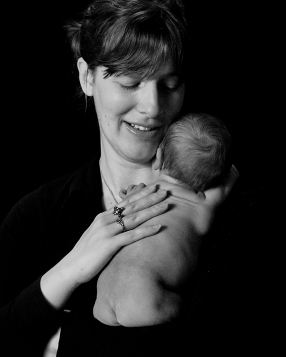
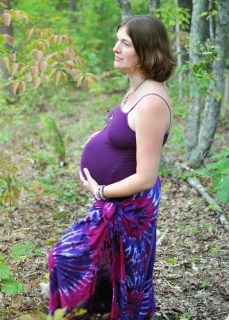
It is late autumn, 2009. I am 30 years old and pregnant with my third baby. He dies during the early Mollyblessingway 045part of my second trimester and I give birth to him in my bathroom, on my own with only my husband as witness. The blood comes, welling up over my fingers and spilling from my body in clots the size of grapefruits. I feel myself losing consciousness and am unable to distinguish whether I am fainting or dying. As my mom drives me to the emergency room, I lie on the back seat, humming: “Woman am I. spirit am I. I am the infinite within my soul. I have no beginning and I have no end. All this I am,” so that my husband and mother will know I am still alive.
I do not die.

This crisis in my life and the complicated and dark walk through grief is a spiritual catalyst for me. A turning point in my understanding of myself, my purpose, my identity, and my spirituality.

It is my 31st birthday. May 3rd. My baby’s due date. I go to the labyrinth in my front yard alone and walk through my labor with him, remembering, releasing, letting go of the stored up body memory of his pregnancy. I am not pregnant with him anymore. I have given birth. This pregnancy is over. I walk the labyrinth singing and when I emerge, I make a formal pledge, a dedication of service and commitment to the Goddess. I do not yet identify myself verbally as a priestess, but this is where the vow of my heart begins.

I do not know at the time, but less than two weeks later, I discover I am in fact pregnant with my daughter, my precious treasure of a rainbow baby girl who is born into my own hands on my living room floor the next winter. As I greet her, I cry, “you’re alive! You’re alive! There’s nothing wrong with me!” and feel a wild, sweet relief and painful joy like I have never experienced before.

Continue reading “Priestess as Shamanic Path – Part 1 by Molly Remer”

Gratitude by Esther Nelson

esther-nelsonI’ve been in the midst of moving for almost a year, yet am still not finished with that onerous task.  My youngest son and family recently moved into the place I’ve called home since 1980.  I bought a small house in the vicinity and have just settled in after spending four months painting, cleaning, and hauling box after box to my new dwelling.  At the same time, I’ve been traveling back and forth to New Mexico busy with painting, cleaning, and remodeling my “retirement house.”
I’m tired.  Am also experiencing emotions that I thought I was impervious to.  I never perceived myself as somebody having an attachment to place, but a month or so before moving out of my old home, I began to feel nostalgic.  There was so much I didn’t want to leave behind–the woods, birds nesting in bushes around the property as well as on top of the front porch light, the wildlife (deer, opossum, rabbits), and neighbors far enough away so I didn’t have to hang curtains at the windows.

Just days before the agreed-upon date to turn the old home over to my son and family, I became emotionally distraught.  A friend suggested I read Oliver Sacks’ book, Gratitude.  Oliver Sacks (1933-2015) was a British neurologist who spent his professional life in the United States caring for people with brain “disorders” such as aphasia, Tourette Syndrome, amnesia, autism, and a host of other neurological diagnoses.

Gratitude is a slim volume featuring four essays written during the last few months of Dr. Sacks’ life.  In the second essay, “My Own Life,” he writes: “I cannot pretend I am without fear.  But my predominant feeling is one of gratitude.  I have loved and been loved; I have been given much and I have given something in return; I have read and traveled and thought and written.  I have had an intercourse with the world, the special intercourse of writers and readers.”

I wanted to know more about Dr. Sacks’ life and promptly procured his memoir, On The Move  A Life, published just before he died in 2015.  I was struck by the apparent comfort he felt in his own skin as he went about living in the world.  He came from a fairly Orthodox Jewish family and realized during his teen years that he was gay.  When his mother discovered his homosexuality, she said, “You are an abomination. I wish you had never been born.”  He writes that she undoubtedly was referring to a text in Leviticus (Hebrew Bible) and although she never mentioned the incident again,” …her harsh words made me hate religion’s capacity for bigotry and cruelty.”

His mother’s view regarding his homosexuality didn’t seem to affect Dr. Sacks’ ability to get on with his adventures living on, what he calls, “this beautiful planet.”  He focused on his passions–medicine, literature, traveling, observing the natural world, swimming, lifting weights, and riding his motorcycle.  Along the way he met a wide variety of people (patients, colleagues, authors, and characters in books).  He squeezed gallons of nectar from those meaningful encounters.  Yet, I think his mother’s disgust regarding his sexual orientation must have cut him to the quick.  He included the incident in his last book, Gratitude.   Continue reading “Gratitude by Esther Nelson”

Finding Bavarian Ancestors by Carol P. Christ

Bavarian first communion
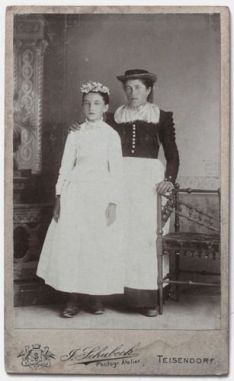
First communion, Bavaria 1800s

In the past month I have been on a spiritual journey seeking my German ancestors. Six of my 2x great-grandparents were born in Germany, which means I am 37 ½ percent German. Growing up, I was subjected to a form of patriarchal family disciple I came to identify as German, but I was told very little, positive or negative, about my German heritage.

Though I had been researching my family tree for five years when I began my trip to Germany, I had no clue about where in Bavaria the Thomas Christ-Anna Maria Hemmerlein branch of my family originated. While making final preparations before the trip, I learned that German church records are no longer kept in individual churches, but are grouped together in church archives. Some areas also have family records in state archives. Contrary to popular belief, the majority of German records were not destroyed  in the two World Wars. However, many of the German records are not online. Continue reading “Finding Bavarian Ancestors by Carol P. Christ”

#HillYes by John Erickson

I’m going to do something I’d never thought I’d do: fill your newsfeed with yet another article pertaining to the 2016 United States Presidential election and yes, I’m going to talk about former Secretary of State Hillary Clinton (hint: I’m emphatically supporting her and I’m unapologetic about it.)

John Erickson, sports, coming out.I’m going to do something I’d never thought I’d do: fill your newsfeed with yet another article pertaining to the 2016 United States Presidential election and yes, I’m going to talk about former Secretary of State Hillary Clinton (hint: I’m emphatically supporting her and I’m unapologetic about it.)

Let me start off with my central point: a vote for Hillary is a vote to change history and the world. No, not because she’ll hail in some type of new economic stimulus (although I’m sure she’ll do just fine with our economy #ThanksObama) or because she’ll save us all from the evils of the GOP (looking at you Trump/Cruz/and the “moderate” Kasich) but because she’ll do one thing that’s never been done before: become the first female President of the United States, ever.

While I have tried not to get into “it” (read: online trysts with my friends on social networks who are #FeelingtheBern) the question I beg to ask is: what’s so wrong with wanting the right woman to be the President? This is one, but not my only reason, I will cast my vote for her both in the Democratic Primary in California in June as well as in November (and, if you haven’t guessed, I do not believe or promulgate the reasoning or rhetoric that Bernie Sanders will come from behind and win the Democratic Party’s nomination because I passed 5th grade level Math.)

Hillary Clinton

Continue reading “#HillYes by John Erickson”

What Happens when Wonder Woman “Leans In” and Winds up in Traction? by Michele Stopera Freyhauf

FreyhaufThey always say in writing – use a title and the first few sentences to grab attention and the reader will want to see what you have to say. By my title, you have probably ascertained that I have made reference to a couple things:  Wonder Woman, Sheryl Sandberg’s “Lean In,” and traction.  While lately, I have suffered from writer’s block and lack of time to work on my writing, I have also found myself in another place of suffering that has me in traction at least thrice weekly.
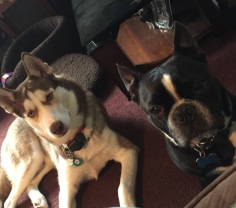
It is in that spirit that I reflect on my former status as the infallible wonder woman – the mom of 4, who works full time, teaches, writes, supports her family, is in the middle of writing a dissertation and who started this new year as my year to “Lean In” and really excel in my career  – to the current status of fallible woman, mom of 4 trying to stay afloat in all of her obligations, dealing with difficult sibling and teenage bantering as well as (thanks to a begging daughter spouting promises of responsibility) a Siberian Husky puppy and a resident 10 year-old Boston Terrier who now demonstrates the IMG_3984epitome of love-hate relationships, to prioritizing projects in order to keep everyone happy while I try to heal, attend physical therapy, and manage newfound pain and limitations.
In this post,  I offer my [brief] thoughts about aging and struggles when a body, probably abused through pushing too hard, but also enduring the normal wear and tear of aging, begins to betray you while trying to come to terms with to a new normal of limitation within your own being  –  “adapting” if you will – a skill that I believe women have come to master well.

Throughout life, we all face our shares of limitations and encounters with mortality.  Lately, it seems like I have encountered one thing after another.  However, as these events arise, life must inevitably move on – but, moving on does not mean ignoring what just occurred.  Rather, time needs to be taken to understand and appreciate each of these things – even if things do not go our way. Continue reading “What Happens when Wonder Woman “Leans In” and Winds up in Traction? by Michele Stopera Freyhauf”

Creating Families and Traditions of Choice—and Saving Your Life by Marie Cartier

thanksgiving 3Last week I went out to eat with a group of insightful scholars at the American Academy Religion 2015 Conference held in Atlanta, Georgia. We had just participated on a remarkable panel which was an “Author Meets Critic” session with Bernadette Barton, author of the book Pray the Gay Away: The Extraordinary Lives of Bible Belt Gays. One of our panelists was in Georgia after years of estrangement, not only from his biological family, but also from the geography of his birth because of the biological familial estrangement. He was experiencing the geography of his hometown for the first time in many years. He spoke eloquently in the panel about how much being in the geography itself again was triggering, but also how somatically it was necessary for his own healing. He needed to revisit and be embodied on the actual land—which was very different than re-remembering the hurt from a geographical distance. Also, in order to fully participate in the life of a scholar, which he was now choosing, he had to reconcile being able to revisit this geography in order to attend this particular conference. And frankly, to be able to participate on the panel which was so close to his heart—being a person who was from the Bible Belt and had literally been “prayed” over so that his “gay would go away.”
I have moderated many panels, but this is the first one where I wrote “Congratulations!” on a piece of paper to one of the panelists and passed it to him after his reading. Overall it was a great session of papers and as mentioned we all adjourned for drinks and conviviality. And to celebrate that our gay had not been prayed away.

We began to discuss holiday plans. I said to the young man who had presented his paper so courageously that I was very proud of him not only for his work, but for his ability to return to the geography in which he had experienced so much harm. I said that I was from a very abusive biological home in New England and I had not been north of New York since leaving at age 30 (I am now 59); that for me, putting my embodied self into the actual geography where I had experienced so much harm had not been possible, except for attending my mother’s funeral- its own extreme event.

Some folks at the table expressed surprise and much sadness—how could those of us without biological ties to family handle the holidays? I realized that for me it has been almost thirty years since I began creating “alternatives” to the family I was born in—my biological family- and that I have successfully created chosen family and chosen traditions instead. One of the ways I first learned to deal with holidays which had expected traditions and attendance at biological family functions was to create alternate plans well before the expected day (Thanksgiving, Christmas, etc.) and stick to that plan. I learned that once that day was “here,” I would be triggered and would not be able to create spur of the moment alternatives in the midst of those feelings.

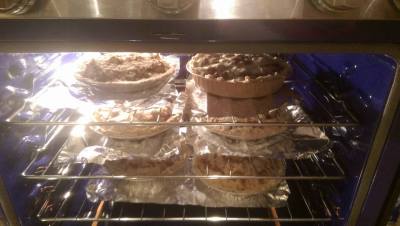
thanksgiving 2One tradition I created 20 years ago was the tradition of “Pie Day” with a good friend of mine. We realized this year that we have been doing that for 20 years! Now that is my “tradition” and that is my “family.” We bake an inordinate amount of pies on Pie Day—a very specific recipe—green apple with golden raisin reduction— and people and friends come over. We celebrate. We eat pie with cheese (a New England tradition) and salad- I call it “a French meal” after my Canadian heritage. Whoever bakes or drops by, eats. Some folks walk away with a pie. We freeze a bunch and have “pie nights” throughout the year. Various girlfriends, friends and friends of friends have helped throughout the year make our estimated 15-20 pies per year, complete with hand rolled, all butter crusts every year.

Continue reading “Creating Families and Traditions of Choice—and Saving Your Life by Marie Cartier”