Reconstructions of the Past 8: Hafsa bint Sirin (My Story of Her Life 3) by Laury Silvers

silvers-bio-pic-frblog - Version 2As discussed in earlier blogs, the sources tend to paint pious women as recluses for any number of reasons. No matter the intention, the message transmitted over time–in so many ways–is that pious women should restrict their social lives, especially their public social lives, even if that means restricting spiritual or scholarly engagement. But what I have been arguing over this series of blogs is that pious and Sufi women lives were not restricted in the way they are portrayed. Thus I argue that despite the messaging that silence is the mark of our purity, there is little historical ground for it. If we are to take the Prophet’s wives and pious and Sufi women such as Hafsa bint Sirin seriously as models for women’s piety, then there is no “sunna” of silence or social disengagement to be a good woman.

The portrayal of the tender relationship between Hafsa and her son is out of character in the literature concerning early pious and Sufi women. When children are mentioned in these sources, it is almost always in bare sketches depicting their service to their mothers, transmitting their mother’s wisdom, or, less often, distracting their mothers from their worship. For all the idealization of mothers in Islam from the early period onward, it is surprising to find this aspect of women’s experience missing from biographies devoted to articulating their piety. Even in those very few accounts in which a loving relationship is depicted between mother and child, like Hafsa and al-Hudhayl, the stories seem to be used mainly to portray the mother as an idealized solitary worshipper, not an idealized mother.

After al-Hudhayl died, Hafsa became close with her student Hisham who seems to have become something of an adopted son to her. She shared stories about al-Hudhayl with him which he transmits and are recorded in the sources. But these stories are not transmitted in order to demonstrate the tenderness of their relationship. Consider that Hafsa’s intent may have been to share stories with Hisham about her close relationship with her son, but the transmitter’s intent was first and foremost to show that she stayed awake all night in solitary prayer and that she fasted everyday.

Playing down the presence of children in these women’s lives seems to have less to do with de-emphasizing the women’s identity as mothers or grandmothers as it does with de-emphasizing women as embodied social beings of which motherhood is a part. Women raised their children as part of a community of other women, members of their extended families, and neighbors in which the shared experience of the cycles of life create ineluctable social bonds. Just because these relationships are not documented in the texts, does not mean we cannot logically infer the possibility of them given all the other evidence to hand.

Given the structure of homes at the time in Basra and the common practice of extended families living in related quarters, Hafsa, her son, and his family probably lived in a grouping of rooms with a shared courtyard and an area set aside for his camel. Her son visited with her regularly. Given the social roles of family members during that time, it is likely that her daughter-in-law helped out with cleaning and cooking. After al-Hudhayl died, his wife probably returned to her own family. Hafsa is reported to have purchased an enslaved girl to do the household chores after he died. This girl, about whom we have no other information, was asked about her and transmits a story about her habit in prayer. She was Hafsa’s unwilling companion. Her sister is said to have visited her often, and although we only have the story of the lamp from her, I find it hard to believe that they never spent time with one another as sisters do. Likewise, there are no stories of her and her sister Karima visiting each other or worshipping together, even though Karima was also known for being a devoted worshipper.

Her brother Muhammad’s wife is said to have been almost continuously pregnant and to have lost nearly all her children. These were hard times in Basra and Muhammad had little interest in business. His work as an itinerant cloth salesman seems to have been more of an opportunity for him to sit with other scholars and pious folk. His wife and children seem to have lived in dire poverty. Given Hafsa’s close relationship with her brother and love of her own child for whom she would grieve so deeply, it is hard for me to imagine that she never came to the aid of her sister-in-law. No doubt her sister-in-law’s own family would be there for her, but in this cultural context it would be expected that all the members of extended families would care for one another.

Perhaps more telling for the silence in the texts, we never hear of any grandchildren or her siblings’ children visiting her. She had twenty-two full or half brothers and sisters. A number of her siblings were also scholars and pious worshippers. It seems impossible that any of their children, not to mention Ibn Sirin’s surviving son who would become a scholar himself, never sat with her to learn Qur’an and Hadith as a child. Ibn Sirin sent his own companions to study with his sister, but not his son who would himself become a pietist and transmitter of hadith?  Just because these relationships are not documented in the texts, does not mean we cannot logically infer the possibility of them given all the other evidence to hand.

So despite almost no mention of these social relations in the reports concerning her, I feel comfortable assuming that Hafsa would have spent a good amount of time with her sisters, sister-in-law, daughter-in-law, their children, not to mention her enslaved servant.

If my understanding of her life as filled with family, friends, and her students is correct, then it is impossible, as the sources report, that she only left her place of prayer long enough to relieve herself and get some sun. This claim becomes even more implausible when we consider that the very reports attesting to her extraordinary solitude are transmitted by people who so often spent time in her company: the young men who studied Qur’an with her on a regular basis. In particular, Hisham visited with her socially in her old age, learning from her, taking advice from this wise old woman, and listening to her as she shared stories about her relationship with her son.

Most likely, then, Hafsa stayed awake in worship from the evening prayer to the morning prayer, slept until the midday prayer, then received visitors, students, or visited others during the afternoon hours, performing the afternoon and sunset prayers at their appointed times. This schedule would leave her ample time to take part in the social life of her home as well as teach her classes on the Qur’an and Hadith. We know too that she traveled for Hajj several times in the company of others and visited the homes of elites in Basra. Finally, consider that at least on cold nights, her son, and then her slave, kept her company through the night feeding the fire while she prayed.

All of which begs the question, when was this recluse ever alone?

This entry marks the completion of the Hafsa blogs.

(Accounts are taken from Ibn Saʿd’s Tabaqat al-kubra, her transmissions of hadith, and Ibn al-Jawzi’s Sifat al-safwa).

The featured photo is of the Senegalese Sufi leader Sayyida Zeynabou Mbathie and disciples at a Friday ḥaḍra (gathering) and sikkar (zikr, dhikr). For more on the many female Sufi leaders of Senegal see Hill’s linked article or his forthcoming book Wrapping Authority.

 Laury Silvers is a North American Muslim novelist, retired academic and activist. She is a visiting research fellow at the University of Toronto for the Department for the Study of Religion. Her historical mystery, The Lover: A Sufi Mystery, is available on Amazon (and Ingram for bookstores). Her non-fiction work centres on Sufism in Early Islam, as well as women’s religious authority and theological concerns in North American Islam. See her website for more on her fiction and non-fiction work. 

Have You Seen These Muslim Women? by Vanessa Rivera de la Fuente

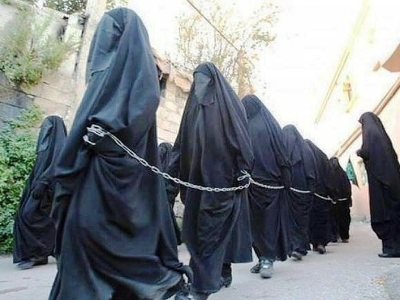
Shia Women AshuraThe photo that accompanies this article, or others similar, have been posted, shared and commented through social networks as expression of the inherent misogyny of Islam, with descriptions such as “DAESH taking women to sell in the concubine’s market” or “Muslim women being carried to forced marriages”. I’ve also seen this picture being used by some feminists in academic conferences to illustrate their presentations on the “Status of Women in Islam.”

This photo has been misused. This image is taken from a religious event which is celebrated for Shiite Muslims to describe the terrible events that took place in Karbala 1,200 years ago. This act recalls the occasion when the family of the Prophet Muhammad, formed mostly by women, was taken prisoner, including children and forced to walk chained. History records and praises the courage of women who bear this painful pilgrimage instead of submit themselves to their captors.

 “Muslim Women” is a Hoax Continue reading “Have You Seen These Muslim Women? by Vanessa Rivera de la Fuente”

Khutba “A Call to Radical and Angry Women of Faith” by Vanessa Rivera de la Fuente

Sacred+Circle+home+page+image+oneI am grateful to the Interfaith Group of Feminist Theologians and Women of Faith for remembering my spiritual affiliation and giving me the opportunity to lead this service in this fully of blessings month of Ramadan and share with you a reflection in the form of a sermon or khutba. Perhaps you know that in orthodox Islam, tradition, without any theological basis, still forbids women to speak or lead rituals. So, this is a joyful occasion for me and I want to start with my usual invocation:

I thank God for this day. I praise Allah for the paths I had to walk that led me to its light and the present day. I ask the protection of the Divine that lives in the essence of everything. and I invite my female ancestors to walk with me in this journey.

A Call to Radical and Angry Women of Faith

My dear sisters, I want to invite you this evening to reflect on what it means to be a radical woman of faith, in a context of extreme upsurge of violence against women and minoritized groups we live in. What does mean being a radical woman? As we know, radical women are feared even by their activist and feminists peers. For the mainstream of society, a radical woman is a little crazy, a little witch, a little ugly, and especially, a very angry woman.

Well, they are right about anger. To be radical is to be as outraged enough to, fearlessly and tirelessly, claim and work for the total end of all kinds of oppression. You heard it right, the total end of all kinds of oppression. For women of faith, like us, who believe in social justice as the prior duty and principle of living in the creation, the current status of abuse, violence and exploitation to which a part of humankind is subjected must provoke us to rage, anger and outrage.

Aren`t you upset? Because I am. Religious patriarchy has historically exercised and endorsed, until today, violence against women and those group defined as “minority.” This religious patriarchy, composed for priests, imams, lamas and rabbis legitimize multiple forms of exclusion of women, sexism, control of our bodies, misogyny and rape culture.

This week we mourn the death of about 50 of our Latino siblings in Orlando. We have to add to this list the hate crimes against queer people in Veracruz, México, as well the slaughtering of women in thousands of gendercides that have become the standard cover of newspapers every day, and the violence against lesbians and trans women, crimes that fail to capture the visibility and solidarity of a homophobic and androcentric society.

Without denying the misogyny and homophobia existing in my community, I want to say that the specific religion of those criminals doesn´t matter, you know why? The pernicious influence of religious patriarchy extends beyond the limits of our assemblies. People blame misogyny and LGTBQphobia on religions as if this is something external to their lives. But each day, at the school, workplace and media our society reproduces all that hetero-sexist, colonial, racist, elitist violence. Heterosexuality as a political regime, validated by hegemonic religious narratives, present in all belief systems, is a source of violence and a form of terrorism itself. Continue reading “Khutba “A Call to Radical and Angry Women of Faith” by Vanessa Rivera de la Fuente”

Mawada, Rahma and Sakina by Vanessa Rivera de la Fuente

Feminism and Religion Vanessa RiveraLast year I thought, seriously, of getting married. I know, it may be hard to believe, given my image of cranky feminist. But I still have an engagement ring in art-deco style with a bright ruby to show this was true.

He and I came across each other in 2011 and we talked about many things. Then, we got caught up in life and lost touch with each other. Exactly a year ago, he found me again and the universe granted us to meet and agree in time, place, intentions, and feelings.

From the beginning, I had faith that what I was living was a gift from God. I received it with thankfulness and opened my heart. I often prayed in gratitude and asked for guidance: “Allah, let me see his heart,” “Allah, grant us understanding.” God always answered me. We had beautiful moments of bliss and deep connection in which we disclosed our wounds and scars as well as learned to appreciate each other. One Sunday, after I showed him how to cook Tacos with Guacamole, he asked me for the third time. I accepted. Continue reading “Mawada, Rahma and Sakina by Vanessa Rivera de la Fuente”

Reconstructions of the Past 6: Hafsa bint Sirin (My Story of Her Life 1) by Laury Silvers

silvers-bio-pic-frblog - Version 2In this sixth reflection on the life of Hafsa bint Sirin and in blogs to follow, I will be emphasizing that her much praised great piety was not incompatible with social engagement, or even sometimes a good dose of family drama.

Hafsa bint Sirin was the oldest child of freed slaves. Her parents had been taken as captives and most likely distributed as war spoils to the Prophet’s companions, Abu Bakr al-Siddiq and Anas b. Malik. Because her parents had been enslaved by such significant companions, and after their release became clients and treated like foster family, certain social advantages were open to her that might not have been for a free woman of no connection.

Let me pause here to say that there is no point in pretending, as some do, that slavery in Islam meant that the people they enslaved or clients were “like family,” in any way that makes sense to us now. The wealth of legal injunctions discussing the rights an owner had over those they enslaved makes the point. Likewise, innumerable calls to be good to enslaved people in piety literature demonstrates just how often the free had to be reminded to treat those they enslaved well. Furthermore, conversion to Islam did not mean that enslaved people were set free. I make this point because I do not want the successful story of Hafsa’s family to give the impression that Muslims who enslaved others were somehow less ethically culpable than slave owners in the Americas, nor do I want to minimize the Hafsa’s own purchase of a woman for household labour (who goes unnamed yet is also a transmitter of her story). I look at Hafsa’s story to demonstrate how women’s histories were transformed and worked for elite male purposes, this includes the histories of those who were enslaved. I address this aspect of pious women’s history in my piece on pious and mystic women in The Cambridge Companion to Sufism.

It is often said that with the coming of Islam Arab tribal social hierarchies were upended. While this is true to some degree, in practice, the social levelling that came with Islam was more of a redistribution of status than the elimination of it. Social status came in many modes and often hand in hand with great piety and great poverty. Those who sacrificed everything to join Muhammad early on and fought alongside him had the greatest rank. Those physically nearest to him or his companions had the greatest opportunity to learn about him and transmit his teachings. So even a slave of a household of one of the Prophet’s Companions would have been able to establish higher social connections based on mere proximity to these elites than a wealthy free man who lived in outside Medina.

First as enslaved servants and then clients of close companions of the Prophet, Hafsa’s parents, Sirin and Safiyya, were able to claim such connections and Sirin was eager to make use of them. Sirin had run a coppersmith business before his enslavement. He seems to have been eager to reclaim his lost status. Safiyya was the perfect wife in this regard. She was an appropriate match as a former slave, but she would also have raised him in status through her clientage relationship to the Prophet’s best friend and father-in-law, the first caliph of the Muslim community, Abu Bakr al-Siddiq. Throughout her life, Hafsa’s mother enjoyed relationships with the extended family of Abu Bakr as well as the Prophet’s wives. She was so well-esteemed, it is said that when she died three of Muhammad’s wives laid her out along with other notable companions.

The depiction of Sirin’s wedding to Safiyya bears the mark of a lavish and somewhat awkward event. He is said to have held a celebration (walima) for seven days, most likely paid for by Anas b. Malik, which would have been ostentatious by prophetic standards. Anas was a highly regarded companion, a transmitter of many hadith, but seems to have a sense of wealth that was out of keeping with some other companions of the Prophet. It is reported that Anas demanded 40,000 dirhams or more from Sirin for his freedom. Sirin could hardly afford this. He was forced to go to ʿUmar ibn al-Khattab, Muhammad’s close friend and the third caliph, for help facilitating his release. At the wedding party, the esteemed companion Ubayy b. Kaʿb stopped by, bringing other companions with him and praying for the couple. Ubayy b. Kaʿb was an early companion of the Prophet, one of his scribes and the possessor of a personal copy of the Qur’an. But notably Ubayy refused to eat at the celebration, saying he was fasting, which would have been considered a slight directed at Anas. 

Despite this implied criticism, Anas held great status and was able to give Sirin and his spiritually and intellectually precocious children the best opportunities for success. Through her father and mother’s connections, Hafsa, her two sisters Umm Sulaym and Karima, and her brothers Muhammad and Yahya–not to mention her half-siblings, some of whom also transmitted hadith–would have grown up in the deeply intertwined social, scholarly, and devotional circles of the Companions and Followers in Medina and Basra. Because her family had access to these elite social circles, Hafsa had the opportunity to memorize the Qur’an by the age of twelve as well as sit with companions such as Umm ʿAtiyya, Abu al-ʿAliya, and Salman b. ʿAmir from whom she transmits hadith. Ultimately, she became known as a reliable scholar and a woman of great piety and was taken seriously in influential circles (as we saw when she argued the legal status of women’s right to pray the ʿeid prayer at the mosque).

Later Anas contracted a second marriage for Sirin to one of his former slaves, then, again decades later, to one of his nieces as a third or fourth wife, thus elevating Sirin from client to family. Given Sirin’s multiple marriages, Hafsa grew up around many siblings in what was likely to have been a bustling compound of rooms. Her father tried to make space for his children’s devotional needs. It is said that he built separate prayer spaces of wooden planks for her, Muhammad, and Yahya. But such quiet spaces devoted to piety did not keep Hafsa from family drama arising from Sirin’s marriages.

When Anas offered Sirin his niece in marriage, Hafsa was supportive of the match despite her mother’s clear objection. Hafsa may very well have accepted the multiple marriages. She may have felt some advantage to them given her close relationships with her siblings and the social ties it further afforded them. Marriage was primarily a social arrangement for families, not solely a matter of legitimating desire or love. Or she may simply be portrayed this way to promote what male transmitters would consider a proper pious response highlighted against that of her mother. Whichever the case, it is reported that when given the news, she congratulated her father for a tie that would raise them from a clientage relationship to family with Anas. But when Hafsa delivered the news to her mother, Safiyyah insulted Hafsa for supporting her father and retorted, “Tell your father, ‘May you be distant from God!”’

To be continued…

(Accounts are taken from Ibn Saʿd’s Tabaqat al-kubra, her transmissions of hadith, and Ibn al-Jawzi’s Sifat al-safwa). Thanks goes to Yasmin Amin for clearing up a few matters, including the nature of Safiyya’s message to Hafsa’s father [literally, may God keep you young, but meaning, may you be delayed in meeting God and so distant from God]).

 Laury Silvers is a North American Muslim novelist, retired academic and activist. She is a visiting research fellow at the University of Toronto for the Department for the Study of Religion. Her historical mystery series, The Lover: A Sufi Mystery, is available on Amazon (and Ingram for bookstores). Her non-fiction work centres on Sufism in Early Islam, as well as women’s religious authority and theological concerns in North American Islam. See her website for more on her fiction and non-fiction work. 


Islamophobia is Gender Violence and a Feminist Issue

The case of Larycia Hawkins, an African-American Christian, Associate Professor of political science at Wheaton College in the United States, who published a photo on Christmas day on Facebook wearing a headscarf in solidarity with Muslim women victims of Islamophobia, has raised a significant controversy about whether non-muslim women wearing the hiyab is useful for Muslim women and our feminists struggle in Islam or not. Beyond the debate about veils, the heated discussion that followed reminds us that Islamophobic violence against Muslim women is a gender matter that must be addressed not only by Islamic feminists, but also by all decolonial feminists.

According to Itzea Goicolea Amiano, a Spanish researcher, in her work “Feminismo y Piedad” (“Feminism and Piety”):

Gender Islamophobia is a term that refers to the xenophobic and Islamophobic attitudes mixed with sexist and misogynist discourses that oppress, discriminate and targets with a negative preference for Muslim women more than muslim men …

Continue reading “Islamophobia is Gender Violence and a Feminist Issue”

Declaring a Theological State of Emergency: Trump’s Ignorance Must Not Be Ours by Mary E. Hunt

Mary HuntOn CNN’s State of the Union, Donald Trump reiterated his call to bar Muslim immigration to the U.S. and predicted that his fellow presidential candidates would soon come around to his position.

This prompts me to  declare a theological state of emergency. And I urge religious first responders to step forward.

His anti-Muslim rhetoric has caused Muslims to fear for their lives and well being—and it runs counter to the American Constitution on matters religious, although that does not seem to deter its adherents.

Because the content of these statements is focused on a specific world religion, I believe that scholars and activists of many religions need to step forward in concrete, educational ways.

Theologians must be among the first responders on this one. And we need to start at the beginning since Mr. Trump’s ignorance of the Muslim faith mirrors that of many Americans. “Islam” has become a code word for terrorism. In fact, it is the name of a monotheistic faith tradition based on the Qur’an which is practiced by more than 1.6 billion people, nearly a quarter of the world. Its practitioners are referred to as Muslims.

So our popular pedagogy must begin in order to right the wrongs of misinformation and demagoguery. Just as Christianity and Judaism have many expressions, so too with Islam. It is for Muslims to sort out their internal matters—but it is incumbent on global citizens to inform ourselves so as not to be cowed by the likes of Trump.

For example, a group of Muslims, including feminist journalist Asra Nomani, is calling for a new movement:

“We are Muslims who live in the 21st century. We stand for a respectful, merciful and inclusive interpretation of Islam. We are in a battle for the soul of Islam, and an Islamic renewal must defeat the ideology of Islamism, or politicized Islam, which seeks to create Islamic states, as well as an Islamic caliphate. We seek to reclaim the progressive spirit with which Islam was born in the 7th century to fast forward it into the 21st century. We support the Universal Declaration of Human Rights, which was adopted by United Nations member states in 1948.

We reject interpretations of Islam that call for any violence, social injustice and politicized Islam. Facing the threat of terrorism, intolerance, and social injustice in the name of Islam, we have reflected on how we can transform our communities based on three principles: peace, human rights and secular governance. We are announcing today the formation of an international initiative: the Muslim Reform Movement.”

Do Mr. Trump and the sector of the American public that agrees with him have any such information? I doubt it. Nor do they apparently have much experience with Muslim neighbors who live and work peacefully in virtually every part of the country.

Ignorance of religion is an acute problem in the United States. We have a lack of basic education about religion. Few school districts venture into the topic with their students. So it is not until tertiary education that most American young people have any formal instruction, if then, about religions other than their own. There must be a better way.

I propose that religious professionals, whether educators, pastoral people, or activists, become part of the solution by engaging in a massive, differentiated educational campaign to counter the negative narratives about Islam. This does not mean that anyone need convert to Islam. It is simply that in a democracy we owe one another a fair rendering of our faith traditions. That Mr. Trump’s remarks about Islam have caused such damage already, and could give license for more violence, add urgency to this task.

It is time for community forums where the basics of Islam can be explained in every part of the country. Radio shows, teleconferences, videos, social media posts, religious education classes, community group meetings might usefully focus on the basics of Islam. Simply to demystify the terms and show how ordinary Muslims go about their ordinary law-abiding lives would go a long way toward stemming the current tide.

I do not expect Muslims to educate the rest of us. But those who want to collaborate with other religious first responders are more than welcome. Among feminist colleagues, plans are afoot to launch some modest efforts, but we recognize and respect the need for safety and security for those who have been put in harm’s way by ignorant rhetoric and unconstitutional proposals.

It is non-Muslims who must bear the burden of this education about religion.

Not since the Nazi period has the specter of religiously-based oppression taken on such a heightened profile, with the potential for such devastating results. I believe it is a true emergency for which strong and constructive countermeasures are necessary.

The following is reprinted with permission from Religion Dispatches. Follow RD on Facebook or Twitter for daily updates.”

Mary E. Hunt, Ph.D., is a feminist theologian who is co-founder and co-director of the Women’s Alliance for Theology, Ethics and Ritual (WATER) in Silver Spring, Maryland, USA. A Roman Catholic active in the women-church movement, she lectures and writes on theology and ethics with particular attention to liberation issues.


Reconstructions of the Past 5: Hafsa bint Sirin (“Women’s Withdrawal in the Literature”) by Laury Silvers

silvers-bio-pic-frblog - Version 2As I mentioned in the last entry, the textual idealization of women’s pious withdrawal extends to secluding women from public exposure in the texts themselves. Sufi and pious women were mentioned in very early sources, then dropped almost in their entirety. They do not (re)appear until the fifth century, and then only in two biographical sources in significant numbers: Sulami’s Early Sufi Women and Ibn al-Jawzi’s Characteristics of the Pure. As is the case with all biographical literature, their accounts reveal the editorial impulses of their compilers, both of whom emphasize pious withdrawal from social engagement in many of the narratives.

It would be wonderful if someone would do a full study on these gendered editorial agendas. To date, I have only seen Rkia Cornell’s account in her introduction to Early Sufi Women and heard Aisha Geissinger’s analysis of Ibn al-Jawzi’s biographies in a paper she gave at the American Academy of Religion in 2014. Meghan Reid’s excellent work is not discussed here because she does not take up a gender analysis of the sources.

Cornell argued that Sulami chose to emphasize the spiritual vocations of these women to strengthen their spiritual authority, whereas Ibn al-Jawzi tended to portray the women as emotional thus undermining them. Geissinger argued that Ibn al-Jawzi tends to present women’s interactions with the Qur’an in ways that reinforce stereotypes of women as less knowledgeable and their piety as more experiential, domestically focused, and individual. I have suggested that some transmitters and editors were protecting some women’s reputations by distancing them from their social contexts and their female bodies.

Looking at the historical context, although many Sufis believed themselves to be in the mainstream of the developing Islamic sciences, non-Sufis (and some Sufis) did not always agree. At times they faced serious threats. Many Sufi works, including that of Sulami (d. 1021), reflect an effort to explain or justify their rituals and beliefs and emphasize their sobriety (and marginalize male or female ecstatics). Sufis may have dropped women or portrayed them in a cautious manner to protect their communities from accusations of impropriety and to control a “proper” expression of Sufi experience.

Ibn al-Jawzi (d. 1201) was virulently critical of Sufis. Nevertheless, he admired those aspects of Sufism that he saw as universal to Muslim piety and included stories of those Sufis who exemplified them in his biographies. He wrote from a position of scholarly power which might explain why he included so many biographies of women in greater detail than Sulami and in a more ecstatic light. Nevertheless, since sobriety was highly valued among scholars, his portrayal did not risk giving those women any institutional authority.

The only thing I can be sure of is that no matter the respect Sulami and Ibn al-Jawzi had for the women they depicted, they were not challenging the primacy of male authority. The primary mode of transmission and guarantee of Sufi knowledge or religious piety was through men. So while they chose to acknowledge women’s piety and their spiritual authority, they did so from within well-established androcentric parameters.

In their distinct ways, both Sulami and Ibn al-Jawzi emphasized modesty and seclusion in their stories of women. Hafsa’s biographies are a case in point. Because other accounts of Hafsa’s life and work are available in a number of sources, we can see how their accounts of Hafsa end up either erasing or backgrounding her engaged scholarly life by so strongly emphasizing her seclusion and immaculate modesty.

Sulami and Ibn al-Jawzi’s Portrayal of Hafsa

Sulami’s entry on Hafsa is one of the most austere treatments in his entire book (see Cornell, 122). He mentions that Hafsa was a renunciant, scrupulous, and known for “signs” and “miracles.” Then, he relates only one story about her:

Hafsa bint Sirin used to light her lamp at night, and then would rise to worship in her prayer area. At times, the lamp would go out, but it would continue to illuminate her house until daylight.

He does not mention her highly respected knowledge of Qur’an and Hadith, her ability to reason legally from these sources, nor that male students came to study with her. I agree with Cornell that Sulami is primarily interested in calling attention to women’s spiritual vocation in these reports, portraying them as “career women of the spirit.” It is telling, though, that honoring women’s spiritual vocation seems to require removing them from their social contexts such that, for example in Hafsa’s case, there is no trace of a woman left, just a pure soul that kindles lamps.

Ibn al-Jawzi has a fuller treatment that allows Hafsa some bodily humanity and cites her intellectual and pious achievements (see Cornell, 270-74; IJ #585). But the narrative flow of the accounts ultimately portrays Hafsa as a learned woman whose interpretive choices and piety kept her at a remove from others. Ibn al-Jawzi opens his entry on Hafsa with several accounts that act as the lens through which one reads the others. One pays tribute to her as a scholar of the Qur’an and its legal interpretation; but more importantly, it assures the audience of the reliability of her opinions by pointing out her scrupulous modesty even in her old age.

ʿAsim al-Sahawal said, “We used to visit Hafsa bt. Sirin [to study with her]. She would pull her outer wrap in such and such a way and would veil her face with it. So we admonished her, ‘May God have mercy on you. God has said, ’Such elderly women as are past the prospect of marriage, there is no blame on them if they lay aside their outer garments, provided it is not a wanton display of their beauty (24:60). [ʿAsim explains], This refers to the outer wrap known as the jilbab.

She queried us then, “And.. what comes after that in the verse?”

We answered “But it is best for them to be modest (24:60)”

Then she replied “That part of the verse is what confirms the use of the outer wrap.”

The two other accounts establish her as a woman of extraordinary piety and a committed recluse.

Hisham b. Hassan said, “Hafsa used to enter her prayer area and would pray the midday, afternoon, sunset, evening, and morning prayers. She would remain there until the full light of day; then she would make a single prostration and leave. At that time, she would perform her ablution and sleep until the time for the midday prayer. Then she would return to her prayer area and perform the same routine as before.”

Mahdi b. Maymun said, “Hafsa remained in her place of worship for thirty years, not leaving it except to answer the call of nature or to get some sun.”

All of the other accounts depict her likewise. She is scholarly, standing at length in prayer, fasting, patiently bearing up under the grief she felt over the death of her beloved son, and most of all secluding herself from others.

Then Comes My Portrayal

In the following blog entries, I will share my “feminist reconstruction” of her life from the available sources. Suffice to say, I’ll be portraying her life as more socially engaged than the way she has been portrayed by Sulami and Ibn al-Jawzi.

(to be continued…)

 Laury Silvers is a North American Muslim novelist, retired academic and activist. She is a visiting research fellow at the University of Toronto for the Department for the Study of Religion. Her historical mystery, The Lover: A Sufi Mystery, is available on Amazon (and Ingram for bookstores). Her non-fiction work centres on Sufism in Early Islam, as well as women’s religious authority and theological concerns in North American Islam. See her website for more on her fiction and non-fiction work. 

The Pilgrimage We Need Is Not To Mecca by Vanessa Rivera de la Fuente

PilgrimageMany people have been writing about the Hajj from a critical perspective, telling Muslims it is a time to reflect seriously and deeply about what is happening there in Saudi Arabia with our sacred places and rituals. I am here to add my two cents to that fountain but also, to say that the Hajj we need is not in Mecca.

Even when the season of Hajj is over, it is never too late to ponder the idea that Islam is a spiritual path that encourages a way of life based on reflection, responsibility and ethical decisions. The Qur’an encourages believers through many verses to reflect on the reality surrounding the way of life and on our role in it like in 29:43, 30:21, & 30:22. Among the things Muslims should reflect on and take action concerning are firm opposition to oppression and raising their voices against injustice. That is the call of Allah  in 57:25, 4:76, 4:135, 5:8, for example.

We all know what happens in Saudi Arabia. So, I wonder, if we believe the word of Allah is true: why do some of us, declaring ourselves believers, continue to fuel the arrogance, injustice and oppression of the usurpers of our Faith? Why are we still funding the oppression occurring in Saudi Arabia with performing the Hajj? Are you naive or sheep-minded or unwilling to take responsibility for the role you play in the maintenance of oppression in the name of Islam?

You pay thousands of dollars to the Saudis for the Hajj, and with that you finance a million dollar business that has nothing spiritual or halal .. yes, hear me well: HAS NOTHING HALAL ABOUT IT! Then at the Mosque, Mussala or Derga you are shocked that the Saudis invaded Yemen to kill Muslims, make deals with Zionism, leave thousands of people to die at sea without giving them shelter, torture dissidents and activists and treat women like animals.  After all of that, why do you complain if you don´t have the courage to act as prescribed by the Quran and oppose injustice? Instead you fund oppression and become part of the problem. You are an oppressor by omission and payment via PayPal or Visa! Continue reading “The Pilgrimage We Need Is Not To Mecca by Vanessa Rivera de la Fuente”

Invisible Giants: On Women, Mosques, and Radical Activism by Juliane Hammer

hammerAt times, being ignored, erased, and made invisible, is more hurtful than open debate and disagreement. Such silencing and marginalization render the energy, activism, and work of so many people mute and, ultimately, they do not serve the communities and society we are attempting to change. In what follows I insist on uplifting and naming some of the radical Muslim activists and advocates for gender justice I saw ignored in a recent Muslim community event.

On Labor Day weekend, the Islamic Society of North America (ISNA) met for its annual convention in Chicago. On Friday evening, in a well-attended panel, ISNA unveiled (pun intended) its latest statement and campaign on “the inclusion of women in masjids” (places of worship) and issued a call and invitation to sign the statement and implement its central demands in mosques and community centers across the United States and Canada. Panelists at the launch included Hind Makki, the creator of Side Entrance, a tumblr collecting pictures of the various (good, bad and in between) accommodations for women in mosques, and member of the ISNA task force on the issue; Dr. Ingrid Mattson, professor of Islamic studies and former president of ISNA; Imam Mohamed Magid, also a former president of ISNA; Dr. Sarah Syeed, chair of the ISNA task force and Dr. Ihsan Bagy, another member of the task force. Continue reading “Invisible Giants: On Women, Mosques, and Radical Activism by Juliane Hammer”