From the Archives: Preserving the Complete History: Remembering Japanese Internment Camps

This was originally posted on May 28, 2017

A couple of months ago I did a day trip to visit the historical site of one of the 10 internment camps which were formed due to Executive Order 9066 issued on February 19, 1942. Manzanar Relocation Camp is located between the Sierra Nevadas and the Owens Valley. Manzanar held over 11,070 Japanese Americans from 1942–1945. EO 9066 forced 120,000 American citizens to leave everything and become in all accounts prisoners; two-thirds of those were native-born American citizens. This executive order largely focused on people living on the West Coast of the United States to eliminate the possible threat of a secondary attack. They were relocated far inland and the majority of the camps were outside of the West Coast. While this was done in the 1940s, our current climate is looming to make it seem like there are forces in this world that are attempting to perform different forms of subjugation and confinement.

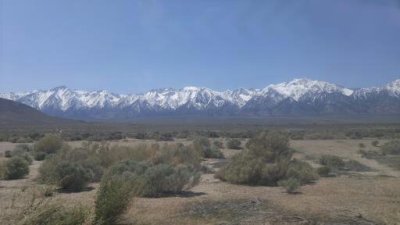
Manzanar, in the middle of nowhere California (and I mean nowhere—it takes over three hours to drive the more than 230 miles from Los Angeles and it is not directly accessible from Central California), is divided by the great Sierra Nevadas. This is one of the things that struck me when I arrived at Manzanar—the stark beauty and ruggedness of the mountains, the immense flat lines of the valley, and the complete isolation. Due to being so close to the Nevadas and the desert valley conditions, the weather can be extreme. Many of the detainees documented the harshness of the weather conditions, from the high winds to the stark cold at night, and the barely adequate buildings to shelter them from it.

Continue reading “From the Archives: Preserving the Complete History: Remembering Japanese Internment Camps”

From the Archives: What Would Durga Do? by Barbara Ardinger

Moderator’s note: This marvelous FAR site has been running for 10 years and has had more than 3,600 posts in that time. There are so many treasures that have been posted in this decade that they tend to get lost in the archives. We have created this column so that we can all revisit some of these gems. Today’s blogpost was originally posted August 2, 2015. You can visit it here to see the original comments.

It’s one of my favorite T-shirts. Every time I wear it, people who know who Durga is comment. So do some people who don’t know who the Hindu goddess is.

“What would Durga do?” is of course an echo of the question What would Jesus Do?

I’ve just done a bit of research and learned that this phrase may come from the Middle Ages, that it was famously used in a sermon in about 1891, and that it became very popular among evangelical Christians during the 1990s. What would Jesus do? I think he’d remind us to pay closer attention to the Sermon on the Mount (Matthew 5, 6, 7), especially the Beatitudes and the Golden Rule: “So whatever you wish that others would do to you, do also to them” (Matt.: 7:12). The Golden Rule is of course given in the other major religions, too. WWJD has also been turned into WWBD—“What would Buddha do?” I think the Buddha would tell us to live more mindfully.

Continue reading “From the Archives: What Would Durga Do? by Barbara Ardinger”

Women’s Bodies and Texas

I have been so angry about the Texas law that functionally bans abortion, I have not even been able to find the words to write about it. But alas . . . being angry without taking action is too often what we women do. So, I am forcing myself to focus and write this blogpost. I think the worst part of this law (although there are so many it is truly hard to choose), is how it isolates a vulnerable, pregnant woman. Can you imagine having an unwanted pregnancy and not being able to talk to anyone about it? This law puts a whole women’s support system into legal and financial jeopardy; a mother, sister, friend, doctor, staff at the doctor’s office, therapist, random neighbor and on and on. A woman’s only “legal” option is to talk to a crisis pregnancy center which comes with a hefty dose of political agenda. This is manipulation at this most virulent, cruel, and controlling.  

Continue reading “Women’s Bodies and Texas”

We Are Not Oppressed Because We Remember pt. 3: Sowing Seeds and Braiding Hair by Chasity Jones

Today, once again, I got to touch the earth!

While planting and constructing my indoor container garden, I thought about how my ancestors put seeds into their children’s hair so that in case they were taken away to live and die in chains, they would at least be able to sustain themselves with a piece of the motherland. Rice, okra, yams, watermelon, and so MANY more crops that would go on to make white slaveholding Americans so rich (passing their wealth to their descendants and zero reparations for the descendants of enslaved Africans), that they were willing to fight a war to sustain their evil practices of owning human beings as chattel (Check out High on the Hog Netflix documentary which was adapted from a book by Dr. Jessica B. Harris). Enslaved Africans brought these foods to the new world, a direct result of slavery.

As I wash my daughter’s hair (which for Black women and girls is a PROCESS!!), as I moisturize her hair, and as I braid my hair, I am thankful that no one has a right to my child and that I do not need to fear her enslavement. Instead, I manifest her revolutionary future to carry the torch of our ancestors. A Torch and a commitment to elevate our community and move the community forward. I leave it up to her to choose how she will carry that torch forward!

Continue reading “We Are Not Oppressed Because We Remember pt. 3: Sowing Seeds and Braiding Hair by Chasity Jones”

Lucky by John M. Erickson

This past weekend, I was asked by an individual why I decided to get my Ph.D. in American Religious History focusing on LGBTQ spirituality and sexuality.  Now, I’ve been asked this before, and if you know anything about me, you know I like to shock people at times, so my usual response is: “I have always been fascinated with people tell me I was going to hell.” 

It’s almost the end of Pride Month and I wanted to take a moment to reflect on where we’ve come and where we must go.

This past weekend, I was asked by an individual why I decided to get my Ph.D. in American Religious History focusing on LGBTQ spirituality and sexuality.  Now, I’ve been asked this before, and if you know anything about me, you know I like to shock people at times, so my usual response is: “I have always been fascinated with people telling me I was going to hell.” 

Continue reading “Lucky by John M. Erickson”

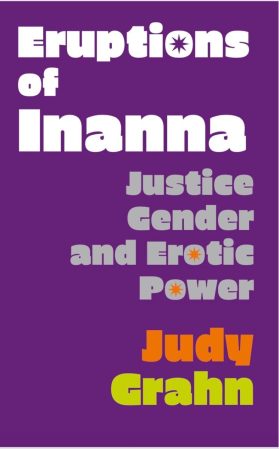
Eruptions of Inanna: Justice, Gender, and Erotic Power by Judy Grahn BOOK REVIEW by Carolyn Lee Boyd

Judy Grahn Eruptions of Inanna

Any new book by Judy Grahn is cause for celebration. For decades, Grahn has been a lyrical and passionate poet, author, mythographer, and cultural theorist whose work  features both goddess wisdom and contemporary culture centering on women and queer people. Nightboat Books has just published her newest book, Eruptions of Inanna: Justice, Gender, and Erotic Power, which offers ancient yet fresh world views with which to approach such issues as injustice, sexuality and gender, climate change, and more just when we need it most. 

In Eruptions of Inanna, she brings what she calls her “poet’s eye” to eight stories featuring the Sumerian goddess Inanna as well as religious practices of those devoted to her. She explores how these have directly influenced our world and, in her words, can continue to “feed our needs and help us take better care of each other and our world.” According to Grahn, Inanna “is a combination of human, creature, erotic and other energetic forces, and civilization. She also inherited very old powers that grew out of women’s rituals” (55).  Her essence engenders sovereignty and self-worth, especially in women and queer people.  She is a goddess of love, espousing passion and the joy of eroticism as integral to both life and society. She practices an expansive justice that creates positive outcomes in response to horrific acts. She creates a civilization of the arts, beautiful and useful crafts, abundance, and a jubilant communal life. She demands respect for nature and ecological sustainability.  

Continue reading “Eruptions of Inanna: Justice, Gender, and Erotic Power by Judy Grahn BOOK REVIEW by Carolyn Lee Boyd”

¡La Vida es la Lucha! – Women in the Colombian Protests by Laura Montoya

*Trigger Warning – Reference and description of distressing violence against women at the hands of police*

Alison Melendez was 17 when she was sexually abused last week by a group of Colombian policemen. She was captured for allegedly being part of the protest groups in Popayán, a city in the south of my country Colombia, South America. The next day Alison was found dead. The official version states that she committed suicide. In the social networks, there is a video of four policemen carrying Alison to the detention center, each holding one of her extremities. One can hear Alison screaming, “Four were necessary to carry me? Four against one woman? Cowards!” The next day – before she was found dead – she posted on Instagram that she was not part of the protests that night. She was walking to a friend’s house when the police showed up. She started recording their actions, they saw her and went mad, so they captured her. When she resisted, four of them took her to the police station. In the post, Alison mentions how they groped her to the soul.” In the video, one can see how her pants came off while they were carrying her, and the policemen did not care. They just kept walking. The last time we see Alison in the video is inside the station. Then cameras were turned off.

*End Trigger Warning*

Alison is one of the 18 cases of sexual violence reported during the protests that started last April 28 in different cities of Colombia. In addition, there are 87 reports of violence and abusive behavior against women protesting. Alison’s case has been more visible, but it is easy to find several videos of police officers beating, harassing, and capturing women in the protests on social media. We have been witnessing this terrible violence full of indignation and impotence, despite protesting is our legitimate right as citizens. 

Continue reading “¡La Vida es la Lucha! – Women in the Colombian Protests by Laura Montoya”

A Wish-Fulfillment Dream by Barbara Ardinger


Rest awhile, Dear Reader, and dream along with me. We’re standing on a corner, call it Main Street, Any City, USA. We’re chatting, passing the time of day, being happy we can stand among other people without the fear of a giant virus jumping out of someone’s breath and attacking us. It’s a nice day here on the street. Not much traffic.

Oh, look—there’s a huge box in the middle of the intersection. It’s shabby, looks to be made of old, thin wood loosely clamped together. The box starts shaking, rocking back and forth. What’s in there? Something is obviously trying to get out. As we watch, an orange mist starts seeping out through the cracks in the box. More shaking. Now the box seems to be jumping. More orange mist. And the box shatters. An orange form—is it human? It’s fat. It’s shaking an iPhone. Or is that a golf club? The orange one speaks. “Do you miss me yet?” “Stand back and stand by.” “I’ll be baa-ack.”

Continue reading “A Wish-Fulfillment Dream by Barbara Ardinger”

On Tazria-Metzora and Covid: Saving Lives, Saving Worlds, and Saving the World by Ivy Helman

It is often said that every year when you read the same Torah passages, you are in a different place, spiritually and otherwise.  Therefore, one will always be learning new meanings and discovering new insights from them.  No more is that true than in this week’s Torah parshah Tazria-Metzora.  

Tazria-Metzora (Leviticus 12:1- 15:33) is a double parshah containing a list of rules concerning ritual purity and impurity, mostly having to do with leprosy.  The parshah begins with the requirement for women a certain number of days after childbirth to immerse in a mikvah as well as offer animals for sacrifice at the temple.  Then, it commands the circumcision of a boy child at 8 days of age.  The next three chapters discuss an extensive list of what has to be all possible encounters with leprosy, including the infection of a home itself. The parshah prescribes various interactions between lepers, homes with leprosy, and the kohenim.  Mostly, the kohenim decide if the skin lesions people or houses have are leprosy, another skin disease or harmless.  If diseased or if the lesions are inconclusive, the people and houses enter quarantine. The kohenim also consult on whether a leper or house is healed and how to go about atonement.  For atonement, former lepers immerse in the mikvah and pay for the kohenim to offer specific sacrifices at the temple. Homes also undergo a type of ritual purification by the kohenim when they have been healed of leprosy. This double parshah ends with immersion requirements for emissions of semen and menstrual blood. 

Historically, there are two considerations, which I have discussed in other posts, to address first. To begin with, there is the ancient world’s understanding of disease as punishment for sin.  This sin can either be the sin of the diseased person or punishment from generations past.  For more about how this cycle of sin, punishment, repentance and atonement work as well as my thoughts on it, see here.    

Continue reading “On Tazria-Metzora and Covid: Saving Lives, Saving Worlds, and Saving the World by Ivy Helman”

The largest protest in the world: India’s Farmers Protest by Anjeanette LeBoeuf


So much has happened since my last post. From the inauguration of President Joe Biden and Vice President Kamala Harris, the GameStop Investment, the military coup of Myanmar, the 2nd Impeachment Trial and Republican Acquittal of Donald Trump, a catastrophic Artic Freeze of Texas, and other states, and the upcoming “no holding back, tell all” from the Duke and Duchess of Sussex. But what I really want to focus on this month is on something that is struggling to maintain publicity and support despite its importance; The Farmer’s Protest/Strike in India.

Continue reading “The largest protest in the world: India’s Farmers Protest by Anjeanette LeBoeuf”