And Thus God made a Covenant with Hagar in the Wilderness by Michele Stopera Freyhauf

Freyhauf, Feminism, Religion, Durham, Old Testament, Blogger, BibleWe are familiar with the covenant God made with Abraham and Moses, but are you aware that God also made a covenant with Hagar?

In the wilderness Hagar encounters a deity at the well named Beer-lahai-roi (Genesis 16). Water and wells are important because they symbolize fertility and life. Wells for women are common places where they met their future spouses. Because wanderers in the desert need water to survive, water itself becomes a symbolic of life-giving or life.

In the seemingly barren dessert, the fertile Hagar finds out that she is pregnant and going to be the mother of many children. Hagar is promised progeny in a motherless state.  According to Pamela Tamarkin Reis, this is called the “after-me” descendants, which guarantees Hagar that her children will live for “immeasurable generations;” a pattern that fits within the scope of this promise. This same promise of progeny is also given to Eve in Genesis 3:20, providing and interesting parallelism between Eve and Hagar.

It is worth pointing out the irony exists in this promise.  Sarai uses Hagar to “build her up.” According to Nahum Sarna, to be built up in terms of the number of children that you have, implies that you are mother to a dynasty.  In this pericope, however, it is Hagar, not Sarai that is built up through this divine promise.

This patterns of promise exists within the birth narrative through the annunciation of Ishmael and the promise of progeny.  It is through this narrative that Hagar enters into a covenantal relationship with the deity.  According to J. H. Jarrell, birth narratives have six common elements that establish this relationship:  mother’s status, protest, offer, son’s future forecast, Yahweh naming, and acceptance of the contract. Hagar’s story contain these elements:

  1. Mother’s Status:  Hagar is without child because she is a virgin (16:1).
  2. Protest:  Hagar flees from her mistress (16:8).
  3. Offer:  Return to your mistress and submit to her authority (16:9).
  4. Son’s Future Forecast:  He will live at the east of all his brothers (16:12).
  5. Yahweh Naming:  You will bear a son Ishmael because the Lord has given heed to your affliction (16:11).
  6. Acceptance of the Contract:  She called the name of the Lord (16:13).

Continue reading “And Thus God made a Covenant with Hagar in the Wilderness by Michele Stopera Freyhauf”

WOMEN FOR PEACE–TAKE TO THE STREETS by Carol P. Christ

Sometimes we are told that domination and violence and war are innate in human nature; therefore, it is futile to protest war.  But this is not true.

I oppose war because I oppose all forms of power-over, domination, and violence.  As a radical feminist and ecofeminist I believe that power can and should always be power-with, the power that nurtures the growth and development of self and others.  The power of Goddess/God is always and everywhere power-with and not ever power-over. 

Are violence and domination innate in human nature?  We have been told that we are the “naked ape” descended from “apes” who, like the chimpanzees with whom we share 98% of our DNA, were male dominant and violent. Do we, then, have any hope not to be violent and dominant?

Franz de Waal’s studies of the other “ape” species that shares 98% of our DNA, the bonobo, debunks this popular myth.  The bonobo live in peaceful matriarchal clans, and their response to conflict is to rub each others’ genitals until the desire to fight goes away.  They are living proof that species very much like us can choose to “make love not war.” De Waal says that the most we can conclude from studies of our ape relatives is that ancestors of human beings, chimpanzees, and bonobos had the capacity to evolve toward dominance enforced by violence, or toward more peaceful ways of resolving conflict.

Continue reading “WOMEN FOR PEACE–TAKE TO THE STREETS by Carol P. Christ”

Silencing Miriam: Prophetess, Liberator, and Leader By Michele Stopera Freyhauf

The prophetess Miriam, Aaron’s sister, took a tambourine in her hand, while all the women went out after her with tambourines, dancing; and she led them in the refrain: Sing to the LORD, for he is gloriously triumphant; horse and chariot he has cast into the sea.”(NAB, Exodus 15:20-21)

The Song of Miriam is not a story of death and destruction, but rather liberation.  It is a poetic celebration of God’s liberation of the Israelites from the oppressive Egyptians, which, according to Bernhard W. Anderson in “The Song of Miriam Poetically and Theologically Considered,” marks the beginning of the Israelite tradition (292).  Phyllis Trible in “Bringing Miriam out of the Shadows” states that this act marks the end of the Exodus, which was started by Miriam, not Moses (169, 172).  The act of liberation reveals God’s action in humanity.  Gerald Janzen in Exodus believes this act also moved the Israelites “to fear the LORD and believe in the LORD and in his servant Moses” (109).  The uniqueness of this passage is that the most unlikely person leads – this person is not a man but rather a woman.

This brief passage in the Hebrew Scriptures is revelatory – Miriam is revealed for the first time.  She is a prophetess, Aaron’s sister, and the role of leader of the victory dance to honor the Divine Warrior.

Continue reading “Silencing Miriam: Prophetess, Liberator, and Leader By Michele Stopera Freyhauf”

Hagar – Demoted Servant or Egyptian Princess? By Michele Stopera Freyhauf

A socio-political examination of Genesis 16 explores how ancient myth can influence the story of Hagar and Sarai. Socio-political events could have occurred between the Egyptians and King Solomon that influenced the writing of this text.  According to John Currid in Ancient Egypt and the Old Testament, the Egyptians and Hebrews borrowed many things from each other and because of that, an inter-relatedness exists between the languages as well as cultural and religious practices of both kingdoms (26).  It is this inter-relatedness that I wish to explore and ask the question -was Hagar an Egyptian Princess demoted to a lower position of servitude in order to make a political statement of superiority of the Israelites over the Egyptians?  Or is this a story of conflict between two of Solomon’s wives?  Finally, could this story tell us about events that occurred after Solomon’s death since the Biblical texts from the pre-exilic period began to take shape during the reign of David and Solomon?  This is a very brief exploration of these theories.

In Genesis 16, Hagar and Sarai connect Egypt and Israel in a familial relationship, one rooted in strife.  These two women, an Israelite and an Egyptian, are brought together because of Sarai’s barrenness and need to fulfill the covenantal promise. Because of this, Hagar becomes Abram’s secondary wife.  This is not the only time that marriage between an Israelite and Egyptian occurs in the Old Testament.  Joseph marries and an Egyptian, the daughter of a priest of On (Genesis 41:45).  Solomon also has an Egyptian wife who seems to have some importance because she is mentioned six times in the Old Testament (1 Kings 3:1; 7:8, 9:24; 11:1-2; 2 Chronicles 8:11).

Important is the fact that this passage could be rooted in the writings that emerged in that period that portray family strife.  Savina J. Teubal in Ancient Sisterhood: The Lost Traditions of Hagar and Sarah, states these “andocentric writing and editing” of the biblical narratives portray conflicts between women who “vie for the attention of their husbands or sons” (19).  In this case the story really could be a tale of family strife inspired by two of the wives of Solomon, one of which was Egyptian.

Continue reading “Hagar – Demoted Servant or Egyptian Princess? By Michele Stopera Freyhauf”

Is Baptism a Male Birthing Ritual? By Michele Stopera Freyhauf

Quite a number of years ago I had a conversation with one of my professors, a feminist theologian, who posed the question “Why do I need a man to purify my baby with the waters of baptism?  Is there something wrong or impure about the blood and water from a mother’s womb – my womb?”  Before you jump and shout the words Sacrament or removal of original sin, this question bears merit in exploring, especially in today’s world where women are taking a serious beating religiously, politically, and socially.  In today’s world, violations and rants are causing women to stand up and say STOP!  This is MY Body.  This outcry was provoked by chants of ethical slurs against women– Slut! Prostitute! Whore!  The cry got even louder when the issue of religion and government was raised in the fight of healthcare coverage of contraception. The cry got even louder with the enactment of the laws in Virginia and Texas (and many other states to follow suit) that forces women to undergo transvaginal ultrasounds in early stage abortions.  The mandatory insertion of a wand into a woman’s vagina (mandated by the government, mind you), is a violation and has women crying RAPE!

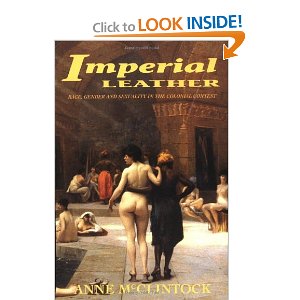
The memory of this conversation did not re-appear by chance, it was prompted by a book I read for my History of Sexuality Class – Imperial Leather: Race, Gender, and Sexuality in the Colonial Context by Anne McClintock who addresses the notion of baptism through origins, property, and power.  So many things are currently being taken away from women and reading McClintock’s assertion regarding male baptism is perplexing.  She believes that male baptism or baptism by a man takes women’s role in child bearing and diminishes it.  These are the same men who historically treated and regarded women as vessels.  She further asserts that this act is a proactive removal of creative agency with respect to a woman’s ability to have the power to name.  That is, the last name of the child belongs to the husband.  A point that supports the notion that patrimony marks the denial of women.  Anyone doing genealogy encounters a perplexing struggle to identify mothers because their names are essentially erased from memory and rarely attached to a child’s name. Continue reading “Is Baptism a Male Birthing Ritual? By Michele Stopera Freyhauf”

In the Beginning was . . . The Mother By Carol Flinders

The following is a guest post written by Carol Flinders, Ph.D.  Carol received her Ph.D. in Comparative Literature from the University of California at Berkeley and has authored multiple books including Enduring Grace: Living Portraits of Seven Women MysticsAt the Root of This Longing: Reconciling a Spiritual Hunger and a Feminist Thirst;  Rebalancing the World; and Enduring Lives. She has taught at UC, Berkeley, and at the Graduate Theological Union in Berkeley and gives workshops and lectures nationally and internationally. Carol is a Fellow of the Spirituality and Health Institute, Santa Clara University and is currently adjunct faculty at the Sophia Center in Culture and Spirituality, Holy Names University, Oakland, CA.

The word matrix  comes, of course, from the Latin root mater. Its literal meaning is “womb,” but it can also refer to the fine-grained portion of aggregate rock, the “glue” that holds the rest together.

It was probably this latter sense of the word that a resident of Littleton, Colorado, had in mind when she was interviewed after the Columbine shootings in 1999 and spoke about “the stunning erosion of our social matrix.”

When we get it right, she seemed to be saying, in the family, or community, or nation, an invisible container or force field comes into being that keeps everyone safe.  Something like this was implicit in the definition of matriarchy Peggy Sanday offered here a few weeks ago: “A balanced social system in which both sexes play key roles founded on maternal social principles.”  Continue reading “In the Beginning was . . . The Mother By Carol Flinders”

Exciting New Research on Matriarchal Societies By Carol P. Christ

The following is a guest post written by Carol Christ, Ph.D., a pioneer and founding mother of the Goddess, women’s spirituality, and feminist theology movements, and director of the Ariadne Institute.  She is also the author of multiple books including Rebirth of the Goddess.

Although there are some of us who disagree, the “party line” in the fields of Religious Studies and Archaeology—even among feminists– is that there never were any matriarchies and that claims about peaceful, matrifocal, sedentary, agricultural, Goddess-worshipping societies in Old Europe or elsewhere have been manufactured out of utopian longing.

I myself and most other English-speaking scholars defending Marija Gimbutas’s theories about Old Europe have studiously avoided the word “matriarchy” (speaking rather of “matrifocal, matrilineal, and matrilocal” societies) because the very word “matriarchy” conjures up the image of female-dominated societies where women ruled, waged wars, held men as slaves, and raped and abused men and boys. In fact, this fantasy tells us far more about patriarchy than about it does about matriarchy. Continue reading “Exciting New Research on Matriarchal Societies By Carol P. Christ”

Matriarchy By Peggy Reeves Sanday

The following is a guest post written by Peggy Reeves Sanday, Professor of Anthropology at the University of Pennsylvania. She is one of the founders of the anthropology of sex and gender and author of several foundational books including Women at the Center: Life in a Modern Matriarchy.

2008. Oxford Encyclopedia of Women in World History. See below for full citation at end of article.

Matriarchy

The role of matriarchy in women’s history has been obscured by the stereotypes used within male-centered Western social theory regarding the nature of power. In the late nineteenth century the concept of matriarchy played a role in discussions of presumed stages in the cultural evolution of society from “primitive” female rule to more advanced male rule. In the late twentieth century this definition of matriarchy was rejected in favor of a comparative and ethnographically based approach that yielded a more nuanced understanding of the logic of gendered responsibilities in particular societies. By the beginning of the twenty-first century, this new approach was the basis of the burgeoning field of matriarchal studies.

Matriarchy has changed from being thought of as merely a prepatriarchal evolutionary stage to being applied to women-centered societies founded on principles of gender balance and a gift-giving economy. This new definition reflects a maternal social philosophy for a global culture that seeks peace and stresses the importance of nurturing the young, the old, the sick, and the poor. Continue reading “Matriarchy By Peggy Reeves Sanday”