The Nature of Communal Pondering by Elise M. Edwards

elise-edwardsLast week, I listened to an episode of Krista Tippett’s series On Being that featured an interview with poet Marilyn Nelson.  I am not very knowledgeable about the world of modern poetry, but I am familiar with Nelson’s work.  A couple years ago, I wrote about Fortune’s Bones: The Manumission Requiem, Nelson’s poetic composition about Fortune, an enslaved man whose owner rendered his body into a skeleton for medical training.  Fortune’s identity and history had been erased across centuries as his remains were displayed.  Community concerns eventually led to a multi-disciplinary academic, artistic, and community effort to honor the man and, in 2013, put his bones to rest.  Isaye M. Barnwell, a musician formerly of Sweet Honey in the Rock, developed a cantata and choral work for Fortune’s Bones. These developed into a series of artistic performances and community events that demonstrate the power of art to speak through and for those who are marginalized—even in death.  Disparate communities joined together to ponder Fortune’s life, and it was powerful.

In the On Being interview, Nelson spoke about “communal pondering,” and I’ve been repeating this phrase to myself since then.  It identifies a form of creative activity and a spiritual way of being that I am deeply committed to, and have not been able to name.  Communal pondering occurs when a group of people are listening together and are opening up new paths for discourse and action by the engaged reflection that takes place within that listening.

Continue reading “The Nature of Communal Pondering by Elise M. Edwards”

Garden of Eden Retold by Trelawney Grenfell-Muir

Trelawney bio picture

Today, I came up with a less patriarchal Garden of Eden story:

Endelyn (age 7): “When I think of my soul, in my name “fire-soul,” I think of a powerful wind.”

Me: “That makes sense, since one of the names in the Bible for God/ess is Ruach, which means “breath” or “wind”, but we call it the Holy Spirit. God/ess is also symbolized by the other elements: fire, air, and earth – like when she shaped Eve and Adam out of clay.”

Endelyn, “What? I don’t remember that story.”

Me: “Oh, ok, I’ll tell you.” ……

Here’s the part where I froze momentarily, thinking “how can I tell my children that misogynist failed mentor story? how? how?” <deep breath>
Continue reading “Garden of Eden Retold by Trelawney Grenfell-Muir”

Novel Excerpt III: That Christmas Morning Feeling by Marie Cartier


MarieCartierforKCETa-thumb-300x448-72405I have posted selections from my novel in progress before here and here and here…I am again. My last post here at FAR was about women and silence. Silencing women—from the powerful (Hillary Clinton) to the obscure (this girl that in this novel excerpt is now a teenager) women are silenced.

In this novel, as you can read from the previous excerpts a journal is found by a brother who is twin to his sister. The journals he finds are addressed to him after his parents’ house sells. Upon reading them he begins to discover that they are written by his sister when she was younger and in all likelihood she does not now as an adult remember having written them. She does not remember what it looks like happened to her. Incest. What must he do? This grown up person that he now is finding this information out? She has been silenced and he is holding the key to the only voice she had at the time. I have been working on this novel for over ten years and am currently immersed in trying to pull together all of the pieces I have written over the years. What I have posted so far is excerpts from the journals he, Chris, finds. This excerpt continues that story line. Continue reading “Novel Excerpt III: That Christmas Morning Feeling by Marie Cartier”

A Renewed Vision of Being by Katey Zeh

Last Friday I spent the day at a re:New retreat led by author, speaker, and teacher Rosie Molinary. This year brought some big professional changes in my life and since I’ve never been one to make resolutions, I decided that I needed a different way to mark the transition into 2016. Instead of forming new habits, what new intentions would I be setting for this next chapter?

One of the biggest takeaways for me from the re:New retreat was something Molinary articulated at the very beginning of our time together. She said that as a culture we often use this formula:

doing–> having–> being

We start with the belief that if we do something, we’ll have something and then we’ll be something. An appropriate example for this time of year of resolutions: if I lose ten pounds, then I will have the self-acceptance I need to be more confident in my life.

Molinary said what we need to do is reverse the formula:

being–> having –> doing

If we focus on achieving the feeling that we want, then we have what we need to do the things we want to do. For a productivity junkie like me, this was a major shift in thinking.

Molinary led us through several journal and small-group exercises that helped us land on a single word that captured the feeling we wanted more of this year. One woman chose light. Another chose enjoy. I landed on resolve. The irony isn’t lost on me. I signed up for this retreat because I resisted the idea of resolutions, and yet I ended up selecting “resolve” as my 2016 world.

When I picture having more resolve in my life, I think of determination, focus, and decision. As a young leader I’m tempted to spend a significant amount of time fixated on how others perceive the job I am doing and when I sense dissatisfaction from anyone, I question myself. Not only is this detrimental to my own well-being, but it is also a distraction from the work.

Resolve also means that I will be careful in my decision making around opportunities that arise. Molinary shared with us a metric she uses when deciding when to say yes (and no). She calls it the whole-hearted continuum. From beginning to ending, will this opportunity bring her joy? If it will, she says yes, and if not, she lets it go with the faith that it will become an opportunity for someone else’s whole-hearted yes.

Surprisingly the most enjoyable part of the day for me was putting together my vision board for 2016. At first I felt a little like the way Brené Brown describes in this On Being interview with Krista Tippett:

I was one of those people who, if someone said, you know, “Hey, do you want to take this painting class with me, or do you want to scrapbook or do you want to …” you know, I was like, aw, that’s really cute. You know, “You do your A-R-T, I’ve got a J-O-B.”

As I sat on the floor and flipped through magazines, I pulled images and words that resonated with me, some of them for reasons I could not articulate until they came together on the board itself.  It now sits by my desk as a constant reminder of my goal to have more resolve in my life this year.

If you’re interested in learning more about Rosie’s retreats and coaching or if you’re looking for some ideas on renewal for this year (or anytime), please check out her website at rosiemolinary.com.

Katey Zeh, M.Div is a strategist, writer, and educator who inspires intentionalKatey Headshotcommunities to create a more just, compassionate world through building connection, sacred truth telling, and striving for the common good.  She has written for outlets including Huffington Post, Sojourners, Religion Dispatches, Response magazine, the Good Mother Project, the Journal for Feminist Studies in Religion, and the United Methodist News Service.  Find her on Twitter at @ktzeh or on her website www.kateyzeh.com.


 

Story Woman by Molly

mollyatpark“Human connections are deeply nurtured in the field of shared story.” –Jean Houston
 “The universe of made of stories, not of atoms.”  –Muriel Rukeyser

This month I went searching for a quote for one of my Red Tent Initiation students. She had shared some powerful reflections about the vulnerability required to reveal our personal stories—there can be a lot of risk, sometimes shame, and more, bound up in our ability to uncover ourselves and speak our truth. What I wanted to communicate with her was the idea that in sharing our stories, including the painful pieces, we free other women to do the same. Our courage to be vulnerable, to be naked, to be flawed, to experiment with ideas, concepts, or ways of being gives permission for other people to do the same.

In 2012, I went to a dancing workshop at Gaea Goddess Gathering. The facilitator mentioned that when facilitating ritual, you have to be willing to look a little ridiculous yourself, have to be willing to risk going a little “over the top” yourself, because in so doing you liberate the other participants—“if she can take that risk and look a little goofy doing so, maybe it is okay for me to do it too.”

After a lot of digging around, I found the quote! I should have known it was from one of my favorite authors and sister FAR blogger, Carol Christ, who said:

“When one woman puts her experiences into words, another woman who has kept silent, afraid of what others will think, can find validation. And when the second woman says aloud, ‘yes, that was my experience too,’ the first woman loses some of her fear.”

This is part of what makes Red Tent Circles so powerful. When women are willing to dig into the questions, activities, and processes, to turn them over, to explore how they work in their own lives…they lose some of the fear and they encourage others to lose their fear too. Continue reading “Story Woman by Molly”

Translating the Self by Vibha Shetiya

VibaOne of my favourite tasks is translating works from various Indian languages into English. I developed a love for this while enrolled in a graduate seminar on translation theory. The challenge of it all was mind-boggling – how do I reduce the jaggedness of despair running within the depths of someone’s soul into two-dimensional, Times New Roman, 12-point font? How do I convey an intangible phenomenon such as a believer’s union with god without losing the intensity of his or her experience? I loved the exercises, but it is only now I realize how much the concept of translation had also been intertwined with my own fiber of being.

When I lived in India and for many years afterwards, I went by Vib-ha, the usual pronunciation of my Indian name. I didn’t realize then that I didn’t identify with Vibha. A few years ago, I reverted to the Vee-bah of my childhood, the Anglicized pronunciation. It wasn’t so much as being picky, as it was about getting involved in the search for who I really was.

Growing up in an English environment since not quite the age of two, I automatically internalized the label of Vee-bah that my teachers and friends addressed me by, along with developing a “foreign” set of ideals and sense of self. “I’m Veebah,” would be a natural extension of myself; without thinking I had adjusted the complexities of being a little brown girl into one neat word: Veebah.

But by the sixth grade something wonderful was happening. I began to literally feel more comfortable in my skin – I no longer felt like I had to hide my Indian snacks from the rest of the class. I no longer felt I had to apologize for looking different or having a weird sounding, albeit Anglicized, name. And by the time I turned twelve, my changing mind and body soon began to embrace Veebah. It was like I had finally begun to own Veebah.

A year later, however, I moved to India, the land of my birth. My parents had come back “home,” but I had just acquired newly found status of “alien.” Could years of growing up abroad simply be undone by a one-way ticket and an unsigned contract between my father and Zamefa Pvt Ltd.? It got worse as time progressed. There were too many things to deal with. I sounded different; my ideas about music and movies were different; I was too outspoken; I looked much older than I was, and worst of all, I had a certain precociousness about me when it came to the birds and the bees. By the time I was fifteen, however, I managed to figure it all out. With a bit of help from others, I smoothened myself, rough edges, “over-smartness” and all into a two-dimensional being who, in turn, was soon transformed into an echo of everyone around her. An echo called Vib-ha. I was now in India, and had to go by Vib-ha, was what I told myself. With that label, I found myself pushing Veebah more and more into the background; I smothered her with my Indian sounding name and all the Indianness I thought ought to go with it. Continue reading “Translating the Self by Vibha Shetiya”

Normativity, Naming, and the Divine Image by Natalie Weaver

Natalie Weaver editedOver the past two days, I have been considering the challenges and competing perspectives on Carol Christ’s post, “Who is Gender Queer?”  I’d like to weigh in with some thoughts on normativity, naming, and the divine image.
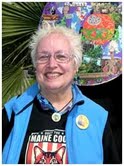
I do not identify as genderqueer.  But, like Carol describes in her post, I have often felt misfit or misnamed.  As we all do, I internalized categories of masculine and feminine in childhood and somehow felt myself to be “masculine” in my physicality, my dark eyebrows (which people – frequently strangers – felt regularly inclined to describe, critique, and even molest in bathrooms, checkout lines, and salons), my hairy legs (which seemed hairier than my girlfriends’ legs in grade school), my interests, even the way I thought.  My sense of my sexual self felt somehow masculine because I never experienced my body passively.  I climbed and jumped and ran more than my female classmates, and I had much smaller breasts than the women in my family.  The real proof for me, though, was that I never had a period on a 28-day cycle.  I grew up thinking I was defective and generally not a very good female.  All of this, of course, I now know merely reflects the onslaught of normative messages I unwittingly accepted in my formation about the experience, presentation, and performance of physical sex and gender.   Continue reading “Normativity, Naming, and the Divine Image by Natalie Weaver”

An Archaic Trinity of Goddesses? Not Necessarily. by Barbara Ardinger

Barbara ArdingerIn her comment following my last post which was about mythology, my friend, Carol Christ, expands on my paragraph about how the so-called “ancient triple goddess” was really invented in 1948 by Robert Graves in his book, The White Goddess. (Thanks, Carol.)

Back in the 1970s and 1980s, when the Goddess movement was just getting up on its feet and our ovular books were being published, the idea arose that if “they” have a holy trinity, “we” have one, too. And ours is older and holier. We see it in the three phases of the moon, new (Virgin), full (Mother), and dark (Crone). Here’s a tiny sample of these books that changed the lives of so many women and men:

  • Woman’s Mysteries Ancient and Modern by M. Esther Harding (1971, but first published in 1933)
  • The Goddesses and Gods of Old Europe (1974) by Marija Gimbutas
  • When God Was a Woman (1976) by Merlin Stone
  • Lost Goddesses of Early Greece: A Collection of Pre-Hellenic Myths (1978) by Charlene Spretnak
  • The first edition of The Spiral Dance (1979) by Starhawk
  • The Chalice and the Blade (1987) by Riane Eisler
  • Laughter of Aphrodite (1987) by Carol P. Christ
  • The Holy Book of Women’s Mysteries (1989) by Z. Budapest
  • The Reflowering of the Goddess (1990) by Gloria Feman Orenstein
  • Whence the Goddesses: A Source Book (1990) by Miriam Robbins Dexter

Triple goddess? ’Tain’t so. Our beloved triple goddess is one of our foundational myths. It’s nice and it’s perhaps inspiring, but it’s only a myth. Anyone who looks at a calendar or almanac—or up into the sky every night for a month—can easily see that the moon doesn’t have three phases. It has four: waxing, full, waning, and dark. And since the late 20th century, women have lived long enough to go through more than three stages of life. Continue reading “An Archaic Trinity of Goddesses? Not Necessarily. by Barbara Ardinger”

Are We Living in a Rape Culture? by Carol P. Christ


rape in the military rape in war rape in sports rape in the university rape in fraternities rape at parties rape on the way home rape in the car rape on the street rape in the park rape in the home rape on the couch rape on the bed rape on the floor rape in a closed room rape in the dark rape in the light rape in marriage rape on the job rape in the bible rape on tv rape in great works of art rape by a friend rape by a neighbor rape by a friend of the family rape by a member of the family rape by men with power rape by men without power rape by someone you know rape by someone you do not know rape as power rape as domination rape as humiliation rape as violation

.

.

.

silence Continue reading “Are We Living in a Rape Culture? by Carol P. Christ”

A letter to feminists…from a 70-year-old white guy by Peter Wilkes

Peter Wilkes - CopyHello everyone —

I’m new at this, so be gentle…  I’m also aware that some might believe this letter to be “mansplaining” (a term I just learned).  I trust it won’t be.

First, I’m not a theologian, and definitely not an academic.  I’m just a guy, like any guy you might see on the street.

But I believe that feminism – defined as true and honest equality – is the only thing that’s going to save this messed-up world.  I’m also convinced the biggest obstacle to this happening is organized religion.  However, most importantly, I’m distressed that other guys don’t get this.  So, before I leave this life, I’m determined to do something about that.

I didn’t always think this way but, in my fifties, as I was kicking and screaming and going down for the third time, I reached for Merlin Stone’s book, When God was a Woman.  Only then did things start to make sense.  I’ve always been told I’m a late bloomer.  I never realized how late “late” would be.

But really, it’s just logical that early man watching a child grow inside the body of a woman – then seeing it emerge from that same body – must have found something amazing, wondrous, and worthy of great praise and adoration.  And also worship, for something like that to happen was, and always will be, a true miracle.  Continue reading “A letter to feminists…from a 70-year-old white guy by Peter Wilkes”