After the First 100 Days—What Do We Do Now? by Marie Cartier

deb-and-i
Marie & Deb

I am sitting here again with my friend Deb—you can see our first conversation here,  where we were excited about the activism ensuing from the Women’s March. A photo essay of the Los Angeles Women’s March is here. However, like so many conversations we are all having still, we ask each other— “after the first 100 days…what do we do now?” We are speaking of the first 100 days of the 45th president. When we last got together, we gave a list of options for doing activism as a daily part of life. In this blog, we want to expand on that idea.

Let’s first take stock of where we have gone since the last blog that Deb and I collaborated on February 24th . . Among other things Trump accused President Obama of illegally wiretapping his phones. Here is a list of many other terrifying things he has done. As we write this, we have also recently bombed Syria, sent warships to Korea, and appointed an extremely conservative Supreme Court Justice, because the Republican Senate voted to remove the ability to filibuster, which allowed Gorsuch’s appointment to go through with only 54 votes (rather than the formally required 60). Continue reading “After the First 100 Days—What Do We Do Now? by Marie Cartier”

Trump’s Misogyny – A Case for the Contempt-Oriented Personality by Stephanie Arel

stephanie-arel

In the quotes below, you will briefly encounter the words of Donald Trump throughout the years as he has commented on women. You might have read or heard many of these, as I have. Reading them still brings a chill to the spine (please be warned of the misogynist language that follows).

“You know who’s one of the great beauties of the world, according to everybody? And I helped create her. Ivanka. My daughter, Ivanka. She’s 6 feet tall; she’s got the best body. She made a lot money as a model—a tremendous amount.” 2003 Howard Stern Interview

“My favorite part [of ‘Pulp Fiction’] is when Sam has his gun out in the diner, and he tells the guy to tell his girlfriend to shut up. Tell that bitch to be cool. Say: ‘Bitch be cool.’ I love those lines.” 2005 TrumpNation: The Art of Being the Donald

“If Ivanka weren’t my daughter, perhaps I’d be dating her.” March 6, 2006 The View

“While ‪@BetteMidler is an extremely unattractive woman, I refuse to say that because I always insist on being politically correct.” Oct 28, 2012 Twitter

Rosie O’Donnel is “crude, rude, obnoxious and dumb.” July 11, 2014 Twitter

“Why is it necessary to comment on [Ariana Huffington’s] looks? Because she is a dog who wrongfully comments on me.” April 6, 2015 Twitter

I hesitated to start this post with such deprecatory quotes related to women and women’s bodies. Yet, forgetting or camouflaging the misogyny that this administration represents is egregious. These quotes indicate a truth about Trump’s opinion of women: women are to be controlled, possessed, and disparaged. These snippets into Trump’s posture toward women exhibit his misogyny, his disgust of women, and ultimately, his own self-contempt.

Continue reading “Trump’s Misogyny – A Case for the Contempt-Oriented Personality by Stephanie Arel”

Modern Matricide by Sara Frykenberg

Many feminist theologians powerfully and convincingly ague that racist, capitalistic hetero-patriarchy is matricidal, as are its religions. Mother-murder takes a variety of forms, including:

  1. Suppression of mother goddesses/ the mother goddess through establishment of patriarchal religion,
  2. Erasure and appropriation of goddesses and female power figures in myth and historical accounts (i.e. the goddess Eostre),
  3. Recasts of goddesses into monster roles—the ‘monsterization’ of female power (i.e. Medusa, Kali, Dark Pheonix, etc.),
  4. Description of “original,” “world building” matricide, vivid with violent dismemberments, mythically and psychologically (i.e. Tiamat),
  5. Allegorizing of androcentric philosophical ideals through gendered symbols which demonize the mother, contrasting her “dark cave” with “the light of reason” (i.e. Plato’s Cave – thank you Carol for this insight),
  6. The demonization, discrediting, and, in some cases, extermination of midwives/ midwifery (i.e. through ‘witch’ burnings),
  7. Medicalization of pregnancy and childbirth—the disabling of childbirth, etc..

This is a too short list for a wealth of feminist knowledge on the subject of matricide: its pages and exemplars filling up books, databases and blogs with evidence for a misogyny, matricide and “theacide,” that the mainstream media is quick to trivialize and ignore.

In the wake of “Trumpcare’s” (or “Ryancare’s” if you prefer) recent false start,* I find it necessary to re-member this crime and re-contextualize matricide in the battle for health care rights.

In a recent CNN Politics article, Tami Luhby describes, “Essential health care benefits and why they matter.” The Affordable Care Act (aka Obamacare) required insurance plans to cover several “essential benefits,” including things like hospitalization, prescription drug coverage, pediatric services, and, maternal and new born care. Trumpcare, unsurprisingly, is working to dismantle these regulations.

Multiple liberal media sites circulated an image of the POTUS and VPOTUS’s meeting with the conservative Freedom Caucus regarding the health care bill, captions of which captured the gross irony: a room full of (mostly white) men in suits is debating women’s health care with nary a woman in sight. A patriarchal power decides (again) what to do about its mothers, and they propose: no more mandatory prenatal care or new born care. The reasons for which go straight to the heart of white supremacist, capitalist kyriarchy.

Republican Representative John Shimkus explains, responding to a question regarding what he “took issue with” in the ACA by asking in turn, “What about men having to purchase prenatal care… I’m just, is that correct… and should they?” Why should men have to pay? Made infamous for his remarks in many circles, Shimkus’ comments betray a common understanding of reality:

We shouldn’t have to pay for each other—capital is the priority.
We shouldn’t have to take care of each other (like mothers care)
We are not responsible for you (like mothers are)
We are independent, not dependent (upon a mother)
We are individual (not interrelational)
We should not have to care about the “other” (even if that “other” is more than half the population and literally “bears” the future of of our species.)
“We,” is not concerned with/ is not a woman, a child, a mother.

 If the United States lead the way in maternal health, if women had paid leave, if their partners/ spouses also had leave to help raise the next generation, I would still find the repeals of these protections reprehensible. But the fact of the matter is, the US is falling fall behind other industrialized nations—its maternal death rates rising despite the opposite global trend. The national average was 28 deaths per 100,000 live births in 2013, and 25 in 2015. Texas has a particularly high maternal death, growing alarmingly from 18.6 to 30 deaths per 100,000 live births from 2011-2014. USA Today provides important comparative data, reporting “That’s significantly higher than Italy (2.1 deaths per 100,000 live births), Japan (3.3) and France (5.5), and more in line with Mexico (38.9) or Turkey and Chile (15.2), according to World Health Organization statistics.” In light of this data (and other facts of the bill), I cannot respond to Trumpcare with anything but rage and disgust.

Reading different articles about this mortality trend, I was struck by one article in particular that reminded its readers that 25, 28 or 30 in 100,000 isn’t really that many people. ‘Not that many people’ are needlessly dying in a country that has the technology and resources to prevent such death. Not that many people’s lives are impacted—so why should I have to pay for them? Matricide and misogyny are alive and well in our health care system.

I am reading an important book this semester called, Love the Sin: Sexual Regulation and the Limits of Tolerance by Janet Jacobsen and Anne Pellegrini for one of my classes. In the text the authors remind us that people are selectively minoritized to serve particular political ends and uphold notions of a false dominant majority who is actually the minority.

I also read a powerful the chapter, “Looking Back But Moving Forward: The Radical Disability Model,” in Diability Politics & Theory, by AJ Withers—a work of Crip Theory. Here, Withers problematizes the category of “disability” as an arbitrary and socially constructed label (as opposed to impairment) which extends benefits to some in such ways as to deny benefits for many. Withers then warns readers that as long as the label exists, those who were once considered disabled (women, homosexuals and racialized people) are under constant threat of being reclassified and restigmatized in this way. I found the warning particularly chilling and eye opening, recalling how I (and other parents) accessed my own benefits when on maternity leave: by going on disability.

Trump(anti)care didn’t pass. But rather than read this as a victory, I want to reiterate a colleague’s post the day after the ‘defeat:’ the bill didn’t pass because it wasn’t ‘conservative’ enough for the Republican dominated Senate. This was a false start* in the modern renewal of ancient matricide.

Facing the realities of this death-dealing impulse, however, I want to declare that I re-member these mothers, women and goddesses. We re-member; and we will resist.

Finding Quantum Magic with the Wicked Witch by Barbara Ardinger

When El Presidente decided his war against his people was insufficient, his toadies began throwing very, very tremendous bombs at the university. When one of those very, very tremendous bombs blew up the university library, pages from exploded books floated far out into the country. Some of them spiraled down and landed on the wicked witch’s farm. Among the refugees driven away by this attack upon learning and knowledge were Professor Schroedinger, who had once owned a cat, and Professor Heisenberg, who had proposed that one could know either where a cat was going or how fast it was traveling, but not both. The two physicists and many other new refugees were welcomed by those who had escaped earlier, among whom were displaced performance artists, philosophers, musicians, and scientists.
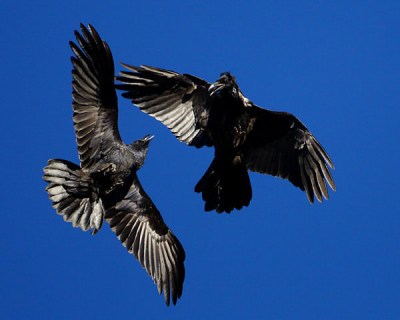
The wicked witch and the senior refugees called a meeting the next day. As people from other farms arrived, the two ravens, Kahlil and Hamilton, also flew in to attend. Everyone gathered in the field where they had magicked the scarecrow.

“My friends,” said the witch to the crowd of newcomers, “you’re welcome here,” she looked around, “though I have no idea where you can sleep. It’s already too crowded. All the farms, indeed, all the small towns past the woods and the river are also overcrowded. Is the capital city empty?”

“It’s nearly empty of people,” said Professor Schroedinger. “It’s just ruins and rubble.”

Kahlil the prophetic raven had been walking around the circle looking for handouts. “Yo, folks,” he said, “like I been sayin’, you’re all in a world a hurt. Yer El Presidente’s got most a th’ army, but since he decided to destroy learning, what else has he got? Nada.” He plucked up a tiny scrap of something that might be edible, then dropped it again. “He’s gonna come to a bad end. An’ that’s my prophecy fer today.” He bowed as everyone applauded, then dived on an eyeball. No. It was a cat’s eye marble. “Phooey.”

“A  bad end,” said one of the professors, “is devoutly to be hoped. Ignorance is a dangerous weapon.” He turned to the wicked witch. “Madame, what can we do to ensure that the bad end is ultimately his and not ours?”

By this time, of course, all the refugees both old and new were becoming enraged at El Presidente and his endless war. A muttering was arising among the gathered people, and pretty soon, someone shouted out, “Hey—you professors know how to build bombs, doncha?” “Isn’t that what physicists do?” someone else shouted. “So hows about we build a big ol’ bomb and give El Presidente a taste of his own medicine?” At which nearly everyone raised their fists and began cheering.

The witch raised her hand to try to stop the cheering. “Wait!” she cried out. “If we start hurling bombs, then we become as bad as he is. Do we want that?”

Some of the refugees cried yes, it’s the only way to get back at him, the only way we can go home, while others stopped cheering and considered her question. “No,” some called back, “no, we don’t want to be like him. But what else can we do?”

One of the older refugees tapped Professor Schroedinger on the shoulder. “You did that experiment with your cat,” he said. “How about you just build a bigger box and put El Presidente in it? Then release that fatal gas! Who cares what other universe he goes to as long as he’s not here anymore?”
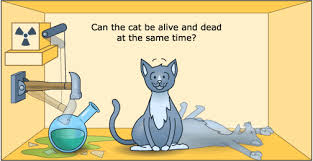
The professor shook his head. “That was a thought experiment,” he said. “And Sweetums, my cat, lived to a fine old age. I have no definitive proof that the thought experiment would work on the macro level in what we call ‘real’ life.” “And,” said Professor Heisenberg, “we have no more scientific equipment.”

While everyone was thinking about this, one of the louder refugees pushed his way through the crowd. When he reached the center, he approached the witch. “You keep saying you’re a wicked witch. Well, prove it! Be wicked! Invent quantum magic! Find a way to send El Presidente to some other universe. Or chop him up into quantums and send parts of him to multiple universes.”

This set everyone to whispering and muttering again. The idea of quantum magic even got the two professors thinking. After a brief conversation, they nodded at each other and turned to the witch. “We may be renowned theoreticians, but you’re the witch. How would this work? Can thoughts become things?”

And so the wicked witch let herself be persuaded. “Build another scarecrow and we’ll see what we can do. Professors, will you assist?”

A few days later, on the spring equinox when light and dark are equally present, refugees from far around returned to the field and took their places in a huge circle that was many layers of people deep. A new scarecrow (wearing a nice red tie) stood in the center, and the two ravens were dancing on its shoulders. As the wicked witch took her place at the north and cast the magical circle, the ravens flew around the circle nine times.

“Let us begin our magic,” said the witch. “Our honored professors worked on the subatomic level, with particles and waves. One thing they learned is that the particles and waves like to change form and become wavicles. I don’t know what a wavicle looks like…but we have our imaginations! What do you think a wavicle might look like?” She was silent for several minutes as the people built images of wavicles in their minds. “And now we attempt our quantum magic,” she said. “Throw your wavicles at the scarecrow and visualize them going to El Presidente to punish him for his crimes by being dissolved and his parts sent to multiple universes.” A few minutes later, the scarecrow disappeared.
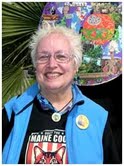
 

Barbara Ardinger, Ph.D. (www.barbaraardinger.com), is a published author and freelance editor. Her newest book is Secret Lives, a novel about grandmothers who do magic.  Her earlier nonfiction books include the daybook Pagan Every Day, Finding New Goddesses (a pun-filled parody of goddess encyclopedias), and Goddess Meditations.  When she can get away from the computer, she goes to the theater as often as possible—she loves musical theater and movies in which people sing and dance. She is also an active CERT (Community Emergency Rescue Team) volunteer and a member (and occasional secretary pro-tem) of a neighborhood organization that focuses on code enforcement and safety for citizens. She has been an AIDS emotional support volunteer and a literacy volunteer. She is an active member of the Neopagan community and is well known for the rituals she creates and leads.

Painting the Mother of Exiles by Angela Yarber

angelaLast month, my column focused on the importance of intersectionality within the feminist movement by highlighting the revolutionary work of Sojourner Truth, an escaped slave, abolitionist, and women’s rights activist. I’d like to continue to press the importance of intersectionality, particularly given our current political state. Of late, I’ve received a little criticism that some of my recent Holy Women Icons are too political, particularly with reference to Mothers of Black Lives Matter, Dolores Huerta, and the Midwives of Standing Rock. As a woman artist, and particularly a queer woman artist, the personal is always political. Feminists taught us this decades ago. Since the lives, loves, and bodies of LGBTQs, women, refugees, immigrants, people of color, Muslims, Jews, those who are differently abled, and the poor continue to be legislated, violated, excluded, and oppressed, I’d contend that writing about, painting about, and working for liberation for all of these intersectional identities is paramount, especially for those who profess faith in a homeless refugee liberator from the Middle East (that would be Jesus, of course). Needless to say, I believe these recent works in the Holy Women Icons Project fit in quite nicely with the over seventy revolutionaries—political and otherwise—that I’ve painted and written about in the past.
These critiques combined with the current climate of the United States, new legislation passed, proposed, and promised that attacks the lives of the aforementioned marginalized groups. So, I took to canvas and, for the first time, I did not pen the poetry scrawled across the holy woman’s heart. Instead, I relied on the words of Jewish American poet, Emma Lazarus (1849-1877). Most famous for the portion of her sonnet, “The New Colossus,” that graces the pedestal of the Statue of Liberty, I wanted Lady Liberty and Lazarus’ timely words to become my newest Holy Woman Icon. In its entirety, “The New Colossus” reads: Continue reading “Painting the Mother of Exiles by Angela Yarber”

Doctrine and Fidelity by Elise M. Edwards

elise-edwardsThis past week, I was listening to Krista Tippett’s podcast On Being as she spoke with Pádraig Ó Tuama.  He is a poet, theologian, and leader in the Corrymeela community of Northern Ireland. As he spoke about several things related to the challenges of belonging, reconciliation, and fractured communities, he said, ”The measure of Christian fidelity is more than the positions we take.”

I agree.  I interpreted his statement as a condemnation of the ways Christian doctrines and moral positions too often take priority over other matters of faith.

Continue reading “Doctrine and Fidelity by Elise M. Edwards”

She is Here by Mary Petiet

Mary Petiet photoOn the morning of January 20, 2017, the world watched Donald J. Trump stand on Capitol Hill for inauguration as the 45th president of the United States. He did not stand alone. Timothy Michael Dolan, Catholic cardinal and archbishop of New York, also stood, and he invoked the divine feminine as he opened the inaugural ceremony with a recitation of King Solomon’s prayer from the Book of Wisdom.

As Dolan stood before the capitol building, which houses the US congress, he called upon the divine feminine with the words:  “Now with you is wisdom, who knows your will and was there when you made the world, who understands what is pleasing in your eyes, what is conformable with your commands, send her forth from your holy heavens. From your glorious throne, dispatch her that she may be with us and work with us, that we may grasp what is pleasing to you. For she knows and understands all things and will guide us prudently in our affairs and safeguard us by her glory.”

She is here. Continue reading “She is Here by Mary Petiet”

Parenting and Politics: How I’m Showing Up by Katey Zeh

16143366_10101473904784794_642748390961867304_n

When I was ten weeks pregnant I gave an impassioned speech in front of the Supreme Court during the Hobby Lobby hearings about why universal access to contraception was part of my own religious understanding. I’d wanted to share about my own planned pregnancy, but at that point I wasn’t far enough along to feel comfortable telling that in a public way.

I didn’t know it at the time, but that would be my last protest for almost three years. After the birth of my daughter I cut my travel significantly. I spent most of my weekends in the cocoon–or what sometimes felt more like the prison–of our home rather than out in the public square.  As someone deeply ensconced in the activism world this turning inward felt like I was betraying the causes and the people for whom I cared deeply. How could I be an effective advocate if I couldn’t show up?

Over the last few months I’ve done a lot of reflecting on how parenting has shifted the way that I think about myself as an activist. Whether rooted in parental love, self-preservation, or some combination of these two, I’m less willing to put myself in harm’s way than I was before I became a mother. Continue reading “Parenting and Politics: How I’m Showing Up by Katey Zeh”

Welcome to the Resistance by John Erickson

john-womens-marchThere comes a time in all of our lives when we have to make important decisions. What do I believe in? Who do I want to be? What and who will I stand up for? There has been a lot going on in the world lately and a lot of it, sadly, is pretty awful. While people are learning pretty quickly that elections have very real and long-lasting consequences, what is critical to make clear in the next 4 years of this fascist regime isn’t just that we are taking to the streets to make our voices heard, but that we are willing to disrupt society at every turn to make sure that people on the other side of the proverbial political coin know we will not go gently into that good night.

I’ve been questioning G-d a lot lately; wondering what has happened to that shining “City on a hill” that John Winthrop called for in his 1630 sermon “A Model of Christian Charity.” The idea that the United States of America is “G-d’s country” is based in an American exceptionalism based not only the rich bounty of land and resources many would soon benefit from, but also on the potential for a different kind of society that America represented in a world full of monarchs. Continue reading “Welcome to the Resistance by John Erickson”

Trump: Shock, Awe, and Response by Stephanie Arel

stephanie-arelIn the frenzied wave of responses to Trump’s most recent, and horrifying, decisions – reinstating the Mexico City Policy and the newly instated Immigration Ban –  I have experienced surges of anger, frustration, despair, concern, and hopelessness. My adrenaline has rushed – both as a result of notifications from the New York Times buzzing on my Apple watch and as a consequence of stepping off a train to find myself in the heart of a protest I failed to know was happening, but for which I also felt pride.

But to be honest, and many of my women friends have echoed a similar sentiment, Trump’s outrageous choices likely mark the beginning of four long years, and my body cannot handle the seesaw of emotions. What compounds this reflection is the raw truth that we are only at the beginning. We are just over the threshold. What will come next?

This question has validity. Serious validity. Continue reading “Trump: Shock, Awe, and Response by Stephanie Arel”