My Feminist Perspective of Authority – Part 2 by Elise M. Edwards

My understanding of authority differs from that of the academy in that I have defined for myself a sense of ultimate purpose that those in power in the institution do not have authority to deny. It also differs because I believe my authority is conditioned in particular ways. Yet I think that ultimately my conception of authority fits the paradigm of mentorship that the academy establishes, even though I may be more guarded about my work and my choice of mentors. My “her-story” gives me the courage to proceed, even as I protect myself and my work.

In a previous post, I discussed insights on power and authority from a student’s perspective that I shared at a workshop on Living Texts: Celebrating Feminist Perspective and Theo/alogy, Authority, and the Sacred in the Academy. The workshop was a gathering where women scholars in religion discussed the challenges and promises of our voices in the academy. The dialogue was so inspiring to me that I decided tocontinue it here. Today, I reflect on these two questions:

  • Does my understanding of authority differ from that of the academy?
  • How do you situate my “her-story” in light of a largely patriarchal perception of authority in the academy?

Previously, I asserted that there is a critical distinction between power and authority. Authority is a personal characteristic based on a relationship of trust between me and a text, a person, or their work. Power, on the other hand, is operative with or without trust. Therefore, the people who have authority in my academic work are those whose supportive words provide direction and assistance, and whose criticism I take seriously.

My understanding of authority differs from that of the academy in that I have defined for myself a sense of ultimate purpose that those in power in the institution do not have authority to deny. Continue reading “My Feminist Perspective of Authority – Part 2 by Elise M. Edwards”

Presumed Guilty by the Sin of Silence: U.S. Nuns, Network, and The Congregation for the Doctrine of the Faith by Cynthia Garrity-Bond

In 1965, the Council document Perfectae Caritatis, Decree on the Adaptation and Renewal of Religious Life, encouraged women religious to situate themselves and their vocations in the social milieu to which they belonged.  Each religious community adjusted rules and customs to accommodate the needs and demands of particular ministerial vocations. For those communities that embraced Perfectae Caritatis entered into a complete paradigm shift in thinking that changed forever how they understood themselves and their chosen vocations. I recall vividly the morning, when, in 1968, Sister Mary DePatzie entered our classroom clad in a shorter habit and dress revealing the startling fact she 1) indeed had brilliant, beautiful red hair; and 2) rather shapely legs even in her sensible shoes.  Continue reading “Presumed Guilty by the Sin of Silence: U.S. Nuns, Network, and The Congregation for the Doctrine of the Faith by Cynthia Garrity-Bond”

Power and Wealth in The Hunger Games by Lisa Galek

Unless you have been living in grim, dystopian world for the past few months, you’ve no doubt seen or heard something about The Hunger Games. The movie, which is based on the first in a best-selling trilogy of novels by Suzanne Collins, debuted several weeks ago to mass acclaim. It has already had the biggest opening weekend ever for a non-sequel and its advanced ticket sales eclipsed that of the most recent installment in the Twilight Saga.

Feminists can rejoice a little in the fact that this movie, which tells the story of strong, female protagonist, Katniss Everdeen, has surpassed the Twilight movies in ticket sales. Unlike the Twilight movies, the plot of The Hunger Games does not revolve entirely around a romantic love triangle. Though two suitors do vie for Katniss’s attentions, the heroine has much more pressing concerns – like whether or not she will be able to survive until morning.

But, aside from the good news that tough, well-drawn female characters can perform well at the box office, the movie has also spawned some interesting discussions about government and politics. In fact, both liberal and conservative commentators have claimed The Hunger Games supports their personal viewpoints (See “Liberal, conservatives embrace ‘Hunger Games’ for very different reasons”). For me, the books and movie fall more squarely onto the liberal side of the fence for one reason – they call into question wealth and power and those who are unwilling to change existing structures of oppression. Continue reading “Power and Wealth in The Hunger Games by Lisa Galek”

My Feminist Perspective of Authority – Part 1 by Elise M. Edwards

I make a distinction between power and authority.  Authority is a personal characteristic based on a relationship of trust between me and a text, a person, or their work.  Power, on the other hand, is operative with or without trust.

This past weekend, I had the honor of participating in a workshop on Living Texts: Celebrating Feminist Perspective and Theo/alogy, Authority, and the Sacred in the Academy.  The workshop was organized for the Women’s Caucus of WECSOR, a regional association of national organizations who study religion.  I was delighted to connect with new friends, mentors and sisters interested in feminism and religion, including some of my co-contributors on this site –Theresa Yugar, Sara Frykenberg, and Corinna Guerrero .  There were two panels that shared our reflections about authority from either student perspectives or diverse professional perspectives.  I shared my experiences as a student.  This workshop was a gathering where women scholars in religion could discuss the challenges and promises of our voices in the academy.  Because our dialogue was so inspiring to me, I thought I’d continue the discussion here. Continue reading “My Feminist Perspective of Authority – Part 1 by Elise M. Edwards”

Is Baptism a Male Birthing Ritual? By Michele Stopera Freyhauf

Quite a number of years ago I had a conversation with one of my professors, a feminist theologian, who posed the question “Why do I need a man to purify my baby with the waters of baptism?  Is there something wrong or impure about the blood and water from a mother’s womb – my womb?”  Before you jump and shout the words Sacrament or removal of original sin, this question bears merit in exploring, especially in today’s world where women are taking a serious beating religiously, politically, and socially.  In today’s world, violations and rants are causing women to stand up and say STOP!  This is MY Body.  This outcry was provoked by chants of ethical slurs against women– Slut! Prostitute! Whore!  The cry got even louder when the issue of religion and government was raised in the fight of healthcare coverage of contraception. The cry got even louder with the enactment of the laws in Virginia and Texas (and many other states to follow suit) that forces women to undergo transvaginal ultrasounds in early stage abortions.  The mandatory insertion of a wand into a woman’s vagina (mandated by the government, mind you), is a violation and has women crying RAPE!

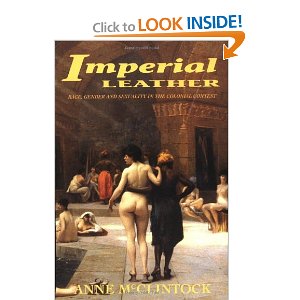
The memory of this conversation did not re-appear by chance, it was prompted by a book I read for my History of Sexuality Class – Imperial Leather: Race, Gender, and Sexuality in the Colonial Context by Anne McClintock who addresses the notion of baptism through origins, property, and power.  So many things are currently being taken away from women and reading McClintock’s assertion regarding male baptism is perplexing.  She believes that male baptism or baptism by a man takes women’s role in child bearing and diminishes it.  These are the same men who historically treated and regarded women as vessels.  She further asserts that this act is a proactive removal of creative agency with respect to a woman’s ability to have the power to name.  That is, the last name of the child belongs to the husband.  A point that supports the notion that patrimony marks the denial of women.  Anyone doing genealogy encounters a perplexing struggle to identify mothers because their names are essentially erased from memory and rarely attached to a child’s name. Continue reading “Is Baptism a Male Birthing Ritual? By Michele Stopera Freyhauf”

Waking up Muslim on 9/11 by Jameelah Medina

I have often stated that I went to sleep as an African American woman on September 10, 2011 and woke up Muslim on 9/11. It may seem odd to say this since I am a third-generation Muslim; however, my reason for doing so is that my life as an American Muslim now has two main eras: 1) pre-9/11 and 2) post-9/11.

In the pre-9/11 era of my life, I felt more black than Muslim because my color was a point of conflict and controversy throughout my life. I grew up in two areas as a child—an urban area with majority Latinos/as and then in a very rural area with majority whites. In both areas, being black was not so popular. I was called “mayate,”which is a bug but also the Mexican term for “nigger.” I was also called, “tar baby,” “nigger,” “African booty scratcher,” and a host of other hurtful names as a young black child.

In the post-9/11 era of my life, the main part of my identity that people focus on is my religion instead of my color. On 9/11, I went from being a nigger to being a “towel head,” from being a tar baby to being a “terrorist,” and from being the stereotype of an unruly and angry, loudmouthed black woman to being the stereotypically seen-but-not heard, oppressed Muslim woman in need of saving. As a Muslim, I suddenly was a potential threat and un-American, while as a Muslim woman I was also pitied and looked down on as misfortunate for being in a religion that oppresses me. In my life, white privilege and white monoculturalism have turned into Christian privilege and Christian monoculturalism. Continue reading “Waking up Muslim on 9/11 by Jameelah Medina”

Beyond “Liberal” Female Piety or “Women Read the Qur’an Too” by Amy Levin

I’m a teacher’s assistant for an undergraduate course at New York University called, “What is Islam?” The other day in class, my professor asked the students whether or not the Qur’an is considered a “book”. Fraught with anxiety over inheriting such a problematic scholarly tradition of defining and delineating what “religion” is, I kept quiet. While my professor was aiming more for something sounding like, “a book is read, while the Qur’an is recited,” I kept thinking about the physicality and sacrality of the Qur’an (among other authoritative religious texts) and the way it is handled, revered, preserved, loved, an constantly under interpretation. It was about a week later when news broke out that U.S. soldiers in Afghanistan were guilty of burning several copies of the Qur’an on their military base, followed by an unfortunate slew of casualties including at least 30 Afghan deaths and five US soldiers. Continue reading “Beyond “Liberal” Female Piety or “Women Read the Qur’an Too” by Amy Levin”

“If You Allow Gay Marriage…” by John Erickson

“We need to start examining the underlying questions of counter-cultural relationships that view one man marrying many women to be hip because we begin to see that although a polygamist idea of marriage may be sexy from a popular culture standpoint, the thought of legally recognized gay marriage always then gets likened to bestiality.”

… you have to allow polygamy, bestiality, and everything else!” The title for my post this week is a quote from an individual I used to associate with.  This individual, haling from a conservative evangelical background, tried to explain to several others and myself the reasons why gay marriage would eventually lead to the repeal of anti-polygamy and bestiality laws across the United States.

The problems that I have with this particular argument are conflating gay marriage with religious freedom.  Activists and scholars can draw comparisons to anti-polygamy cases such as the 1878 U.S. Supreme Court case Reynolds v United States and the 1882 Edmunds Act and 1887 Edmunds-Tucker Act that disfranchised and led to the imprisonment of Mormon polygamists. But in the end, gay marriage is not about religious freedom but rather human rights.

I often feel that there is this need both within and outside religious communities to promulgate the idea that LGBTQ individuals want to get married within the sanctified walls of “the church” just as much as heterosexual couples do.  Although I do not want to disqualify those who desire to see LGBTQ equality within their faith based communities, buying into a heternormative ideal of what traditional marriage should look like needs to result in LGBTQ individuals asking why marriage should be performed in sacred spaces in the first place The normative traditions that have often defined marriage have also served as shackles keeping LGBTQ couples in the mindset that to achieve fully marriage equality with their heterosexual counterparts is to fully immerse themselves within the same traditions and practices. Continue reading ““If You Allow Gay Marriage…” by John Erickson”

Preying on Victims: Radical Christianity and Exploitation of Tragedy in the Name of God By Michele Stopera Freyhauf

It is our moral responsibility, whether we identify as Christians or not, to pray for not prey on the victims of tragedies.

Over the last month, dare I say years, society has witnessed or been subjected to an all out war from radical Christians across America deploying the wrath of God and reveling in the tragedy of others to perpetuate their apocalyptic message of rhetoric and terror.   As I hear the news over the last few months, an old Billy Joel song starts to play in my head “We didn’t start the fire.”  Whether we started the fire or not, we should not feed the flames of hatred but figure out a way to extinguish it.

Here is a brief synopsis of current events that reflect this hatred and radicalism perpetuated in the name of God – examples of Christianity terrorizing or preying on victims through their actions.

The Westboro Southern Baptist Church: Preying on Victims at Funerals and Thanking God for their Tragic Deaths

Original Picture found at http://www.newsnet5.com

Their web address says it all: www.godhatesfags.com.  This group, which one cannot call Christian but rather “hate-mongers,” threatened to burn the Qur’an, was banned from Facebook for spreading hatred against homosexuals, and recently had the audacity to picket funerals of Americans killed in natural disasters, most recently, a teen-age shooting victim, Daniel Parmertor (age 16), from Chardon, Ohio.  Thankfully, volunteers across Ohio and a local group of bikers formed a human barricade to keep these people away from the funeral and grieving family and community.

This group preys on tragedy.  They “praise God for sending a shooter to a High School in Ohio.”  They “praise God for killing a coast guard member.’  They praise God for killing UK Singer Davy Jones.”  They also picketed the funerals of the Arizona shooting victims where Congresswomen Gabrielle Giffords was shot and six others, including federal Judge John M. Roll was killed stating, “God sent the shooter to shoot you!  And He’s sitting in Heaven laughing at you!”  The article goes on into quite graphic detail, which you can read for yourself  but concludes with the statement “Thank God for his Righteous Judgments!”  This group picketed over 47,500 funerals and events to date. One has to wonder what bible they are reading and what God they are praying to. Continue reading “Preying on Victims: Radical Christianity and Exploitation of Tragedy in the Name of God By Michele Stopera Freyhauf”

The Rhetoric of Freedom of Religion in the Debate about Contraception Coverage By Elise M. Edwards

Does freedom of religion include the right to impose your religious views on your employees?  Should freedom of religion exempt you from financially contributing to a medical benefit for your employees that you consider sinful?

According to an Associated Baptist Press article, Richard Land, president of the Southern Baptist Convention Ethics and Religious Liberty Commission, “called a new rule [by the Obama Administration] requiring insurance plans to cover birth control — including those paid for by religious employers that believe artificial birth control is a sin — a ‘horrible decision’ that poses a problem not just for faiths that object to birth control” in the January 28 broadcast of Richard Land Live.  Land believes that this policy infringes on religious freedom.  (Note that the health care policy  does exempt houses of worship and religious organizations that employ primarily those of the same faith, but not organizations like hospitals and colleges that employ and serve people of all faiths, or no faith. An article by Religion News Service, posted here, also on a Baptist media outlet, explains the policy in more depth.) Continue reading “The Rhetoric of Freedom of Religion in the Debate about Contraception Coverage By Elise M. Edwards”